จำนวน Repository ( 103 )
ตัวแบบเบย์สำหรับข้อมูลอนุกรมเวลาเชิงพื้นที่ ประยุกต์ใช้กับผลผลิตยางพารา ในจังหวัดภาคใต้ของประเทศไทย
The objectives of this research are to propose a Bayesian model for spatial time series analysis to apply the proposed model to forecast a monthly rubber yield in Southern provinces of Thailand and to compare the performance of the proposed model with the classical Holt-Winters Additive Exponential smoothing. The proposed model is a linear mixed model (LMM) with spatial effects which follow a conditional autoregressive model (CAR). Dummy variables are used for seasonal effects. A Bayesian method is used for parameter estimation. The estimated monthly yields are used for the monthly rubber yield forecasting. The dependent variables are the rubber yield in each month of each province. The data are secondary data at a provincial level. The factors considered are spatial effects heterogeneity effects and seasonal effects. The results show that the factors influencing on the amount of rubber yields are spatial heterogeneity and seasonal effects. The proposed model is proper and forecast accurately. Using the mean absolute error (MAE) the proposed model has a better performance compared to the classical Holt-Winters Additive Exponential smoothing in both model fitting and model validating. The proposed model should be the first consideration for spatial time series forecasting.
การเลือกฟังก์ชันการแจกแจงความน่าจะเป็นสะสมสำหรับแนวโน้มเพื่อสร้างตัวแบบสำหรับวิเคราะห์ข้อมูลอนุกรมเวลาหลายๆตัวพร้อมกันที่มีค่า อัตตสหสัมพันธ์แนวโน้ม และค่าผิดปกติ ด้วยวิธีของเบย์: กรณีศึกษาราคาหุ้นที่มีความผันผวนของตลาดหลักทรัพย์แห่งประเทศไทย
The objective of this research is to select a proper cumulative function for trend in an analysis of simultaneous multiple time series data with autocorrelation trend and outliers using a Bayesian method. The proposed model is applied to fluctuate stock price data in the stock exchange of Thailand. The data consist of the closing prices of 5 stocks. The algorithms are written in OpenBUGS and the performance of the model is evaluated via a simulation study in R. The cumulative distribution functions considered here are a Weibull cumulative distribution function and an exponential cumulative distribution. They are compared using RMSE MAPE and MAE as criteria. The research found that an exponential cumulative function for trends gives smaller values of the three criteria in both model fitting and model validation for the4 stocks EA NWR and KTB. However a Weibull cumulative distribution function gives smaller values of three criteria for the PTT in both model fitting and model validation.
การศึกษาวิเคราะห์อิทธิพลของธาตุเจือทองแดงและดีบุกที่มีผลต่อสมบัติทางกายภาพ (ความแตกต่างของค่าระดับสี) และพฤติกรรมความด้านทานการหมองของโลหะเงินเจือต่ำ 58.33 wt% AgCuSn
การวิจัยนี้เป็นการศึกษาสมบัติของโลหะเงินเจือต่ำ 58.33% ที่มีธาตุทองแดง (Cu) และดีบุก (Sn) เป็นธาตุผสม ซึ่งมีปริมาณการผสมอยู่ในช่วงระหว่าง 36.66-41.57%Cu และ 0.10-5.01%Sn ตามล่าดับ โดยท่าการเปรียบเทียบกับสมบัติของโลหะเงินสเตอร์ลิง 925 และโลหะเงินเจือต่ำ 58.33%เพื่อ ศึกษาวิเคราะห์อิทธิพลของธาตุเจือทองแดงและดีบุกที่มีผลต่อสมบัติเคมีและสมบัติทางกายภาพที่ เหมาะสมในการผลิตเครื่องประดับเงินเจือต่ำ 58.33% ผลจากการศึกษาโลหะเงินเจือต่ำ 58.33 % ที่ประกอบด้วยเงิน (Ag) และทองแดง (Cu) เมื่อน่ามา เปรียบเทียบกับโลหะเงินสเตอร์ลิง 925 จากการศึกษาเปรียบเทียบพบว่าโลหะเงินผสมเจือต่ำ ต่ำ 58.33Ag + 41.16Cu +0.51Sn มีค่า มีค่า L* = 92.18 a* = 4.64 b* = 10.71 และ ΔE = 28.32 เป็น ส่วนผสมที่เหมาะที่สุดจากการวิเคราะห์ค่าระดับสีและค่าความแตกต่างของสี และมีพฤติกรรมความ ต้านทานการหมองของโลหะเงินเจือต่ำมากที่สุด เนื่องจากอิทธิพลของธาตุดีบุก (Sn) ที่ผสมเข้าไปใน อัตราส่วนที่เหมาะสม ผลจากการวิเคราะห์ส่วนผสมทางเคมีของโลหะเงินเจือต่ำ 58.33% พบว่าส่วนผสมทางเคมีของ โลหะเงินเจือต่ำในแต่ละอัตราส่วนผสมมีสัดส่วนของธาตุใกล้เคียงกับอัตราส่วนผสมจริง จึงท่าให้โลหะเงิน เจือต่ำที่ได้ท่าการทดลองมีค่าระดับสีและพฤติกรรมความต้านทานการหมองที่สูงไม่แตกต่างกันมากนัก เป็นไปตามมาตรฐานของเครื่องประดับเงินตามมาตรฐานอุตสาหกรรมการผลิตเครื่องประดับทั้งของใน ประเทศและต่างประเทศ

Mathematical spatial analysis for multiple disease mapping application to hypertension and ischemic heart disease
The objectives of this research are to estimate the morbidity rates of Hypertension and Ischemic heart disease in each province of Thailand to investigate factors influencing on the morbidity rates and to construct the disease maps of those two diseases. The generalized linear mixed model (GLMM) in which the responses have a Poisson distribution and the spatial effects are a multivariate conditional autoregressive model (MCAR) are adopted. The provincial secondary data sets consisting of a number of Hypertension and Ischemic heart disease patients an average income per head and a student proportion were collected. The results show the average income per head (Relative Risk (RR) = 1.0002) and student proportion (RR = 1.0186) influence the morbidity rates of Hypertension and Ischemic heart disease. Hypertension and Ischemic maps are easy for readers to see which areas are at high risk. They are a useful tool for planning and controlling the Hypertension and Ischemic heart disease.
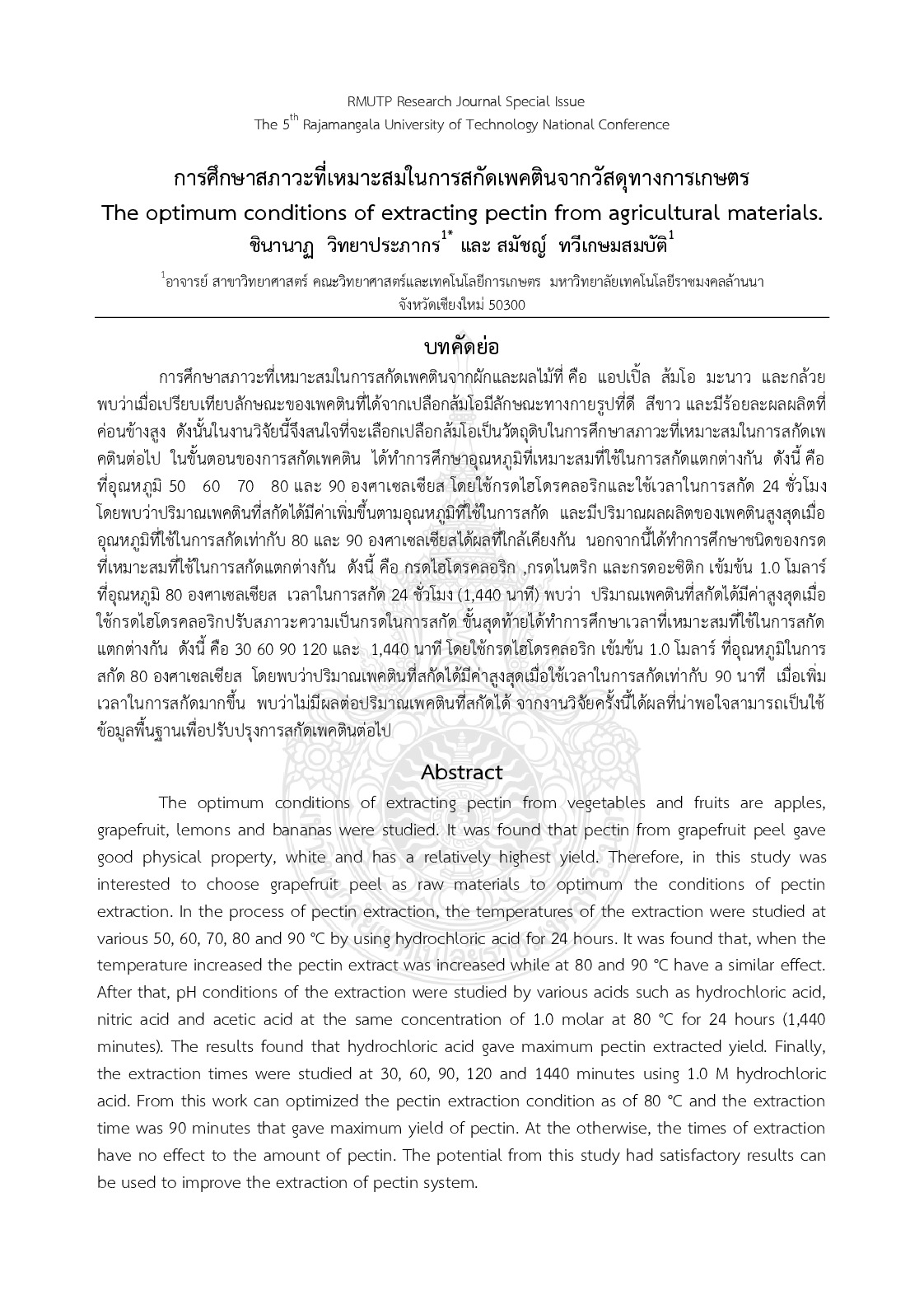
The optimum conditions of extracting pectin from agricultural materials.
The optimum conditions of extracting pectin from vegetables and fruits are apples grapefruit lemons and bananas were studied. It was found that pectin from grapefruit peel gave good physical property white and has a relatively highest yield. Therefore in this study was interested to choose grapefruit peel as raw materials to optimum the conditions of pectin extraction. In the process of pectin extraction the temperatures of the extraction were studied at various 50 60 70 80 and 90 ?C by using hydrochloric acid for 24 hours. It was found that when the temperature increased the pectin extract was increased while at 80 and 90 ?C have a similar effect. After that pH conditions of the extraction were studied by various acids such as hydrochloric acid nitric acid and acetic acid at the same concentration of 1.0 molar at 80 C for 24 hours (1440 minutes). The results found that hydrochloric acid gave maximum pectin extracted yield. Finally the extraction times were studied at 30 60 90 120 and 1440 minutes using 1.0 M hydrochloric acid. From this work can optimized the pectin extraction condition as of 80 C and the extraction time was 90 minutes that gave maximum yield of pectin. At the otherwise the times of extraction have no effect to the amount of pectin. The potential from this study had satisfactory results can be used to improve the extraction of pectin system.