จำนวน Repository ( 111 )
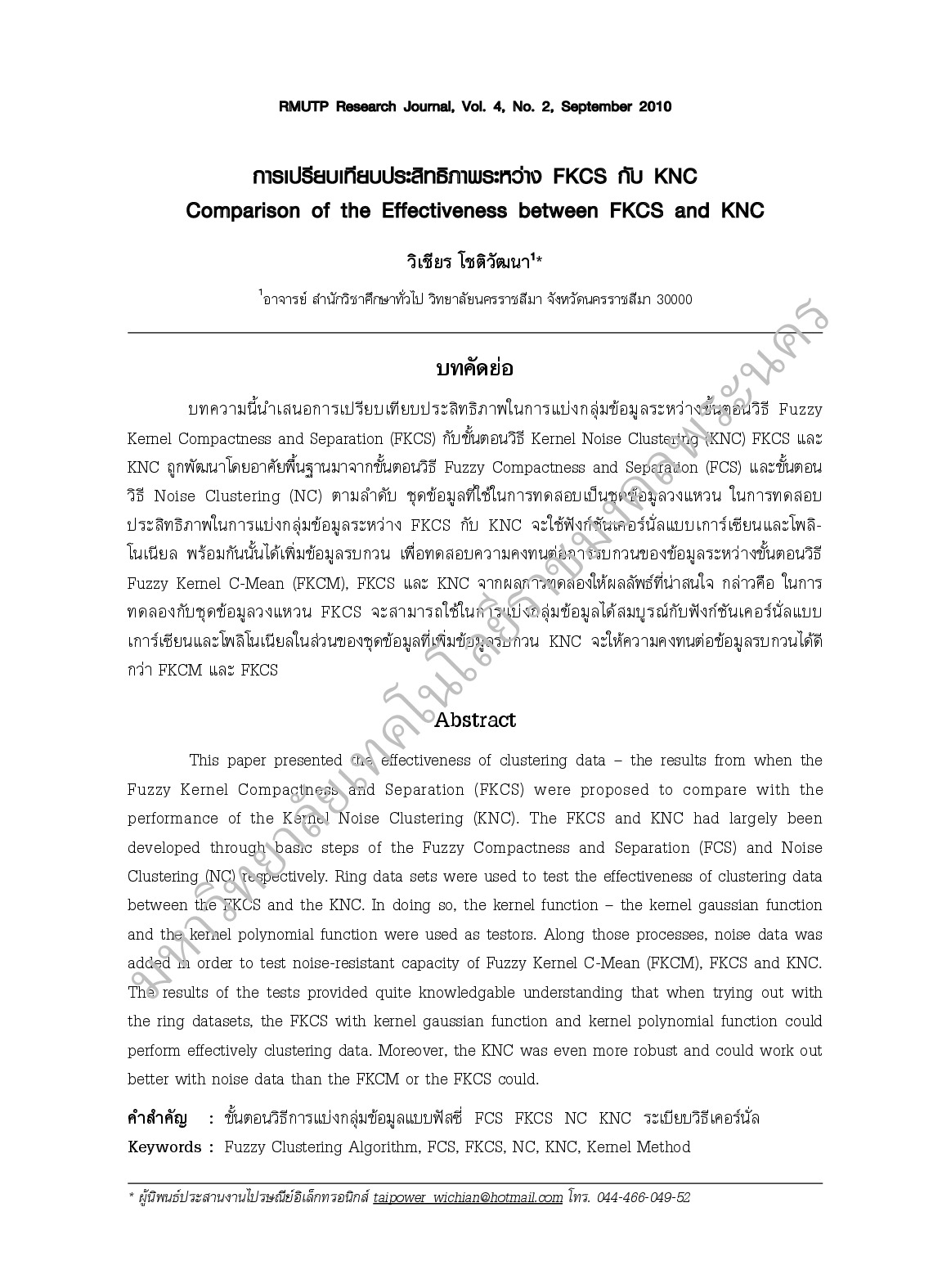
การเปรียบเทียบประสิทธิภาพระหว่าง FKCS กับ KNC
This paper presented the effectiveness of clustering data – the results from when the Fuzzy Kernel Compactness and Separation (FKCS) were proposed to compare with the performance of the Kernel Noise Clustering (KNC). The FKCS and KNC had largely been developed through basic steps of the Fuzzy Compactness and Separation (FCS) and Noise Clustering (NC) respectively. Ring data sets were used to test the effectiveness of clustering data between the FKCS and the KNC. In doing so the kernel function – the kernel gaussian function and the kernel polynomial function were used as testors. Along those processes noise data was added in order to test noise-resistant capacity of Fuzzy Kernel C-Mean (FKCM) FKCS and KNC. The results of the tests provided quite knowledgable understanding that when trying out with the ring datasets the FKCS with kernel gaussian function and kernel polynomial function could perform effectively clustering data. Moreover the KNC was even more robust and could work out better with noise data than the FKCM or the FKCS could.
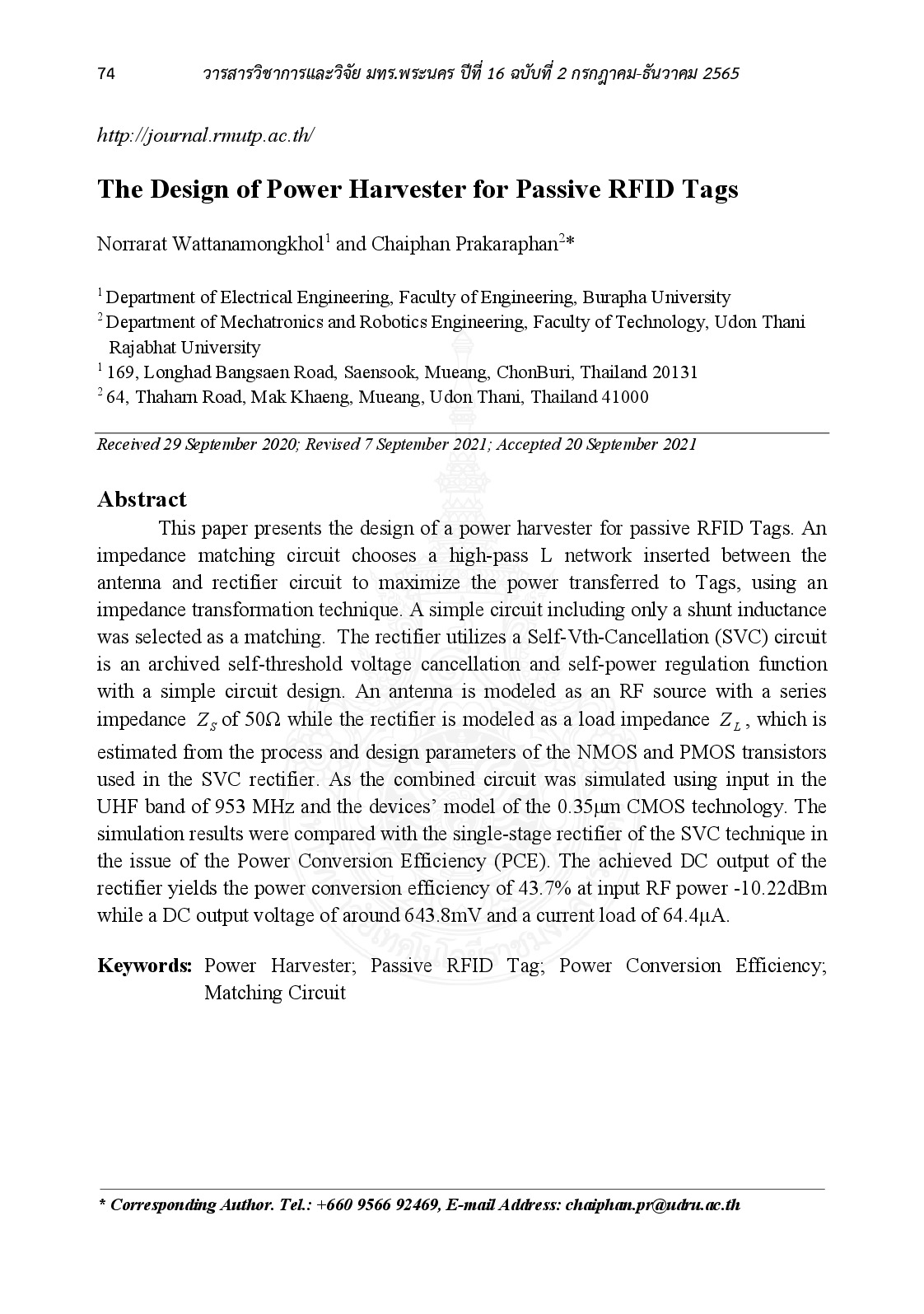
The Design of power harvester for passive RFID Tags
This paper presents the design of a power harvester for passive RFID Tags. An impedance matching circuit chooses a high-pass L network inserted between the antenna and rectifier circuit to maximize the power transferred to Tags using an impedance transformation technique. A simple circuit including only a shunt inductance was selected as a matching. The rectifier utilizes a Self-Vth-Cancellation (SVC) circuit is an archived self-threshold voltage cancellation and self-power regulation function with a simple circuit design. An antenna is modeled as an RF source with a series impedance Zs of 50Ω while the rectifier is modeled as a load impedance ZL which is estimated from the process and design parameters of the NMOS and PMOS transistors used in the SVC rectifier. As the combined circuit was simulated using input in the UHF band of 953 MHz and the devices’ model of the 0.35μm CMOS technology. The simulation results were compared with the single-stage rectifier of the SVC technique in the issue of the Power Conversion Efficiency (PCE). The achieved DC output of the rectifier yields the power conversion efficiency of 43.7% at input RF power -10.22dBm while a DC output voltage of around 643.8mV and a current load of 64.4μA.

Bananas drying performance with a developed hot Air dryer using waste heat from charcoal production process
The purpose of this research is to develop a hot air dryer using waste heat from a200 liter kiln for drying bananas and to investigate its drying performance. The main parts of the dryer consist of the drying chamber that has dimensions 0.71x0.83x.091 m3 the air circulation system and a heat exchanger which receives waste heat from the exhaust tube and kiln surface. The dryer was developed by designing a drying chamber on the top of a 200 liter kiln to reduce heat lost in the structure and an exhaust gas heat exchanger was developed using groups of copper tubes for increasing then heat transferred to the air. The drying performances were analyzed by measuring specific drying rates and specific energy consumption. Experiments were performed under different temperatures of 60 70 and 80℃ And at a constant velocity of 1.8 ms-1. Eucalyptus was selected as the heat source. Thirty kg of peeled bananas were prepared at an initial moisture content of 241.19±31.50% dry basis and were dried until to final moisture content of 48.47±10.46% dry basis. All experiments were carried out in duplicate. For temperatures of 60 70 and 80 ℃ the ave age specific drying rates were 0.085±0.0004 0.114±0.0009 and 0.1277±0.010 kg water h-1kesolid-1 and the average specific energy consumptions were 1.42±0.055 1.21±0.355 and 1.04±0.074 MJ/kg water respectively. Some dried bananas had burned at a temperature of 80℃ so at temperature of 70 ℃ was the optimal condition in this experiment. This produced good color a high specific drying rate and low specific energy consumption.
Effects of water injection on performance of 5-stroke si engine
The objective of this work is to investigate the effects of water injection on performance of 5-stroke SI engine converted from the conventional 4-stroke SI engine.The cylinder head of the 2ndand3rd cylinder was modified and connected to each other to be the ultra-expansion stroke or second expansion stroke (5thstroke). The engine was performed on a dynamometer at different engine speeds and loads of 1500 to 3000 rpm and 25% to 75% of full load respectively. The water was injected during the second expansion stroke (5th stroke). Fuel and air consumptions engine torque rotational speed air/fuel ratio and temperatures of intake air engine oil cooling water and exhaust gas were recorded to use for calculating brake specific water and exhaust gas were recorded to use for calculating brake specific fuel consumption (BSFC) and engine efficiency. The results showed that at low engine speed of 1500 rpm for all loads the water injection improves BSFC and the engine efficiency by 26% and 3.3% respectively. However a large amount of injected water shows insignificant improvement on BSFC and the engine efficiency due to short residence time especially at high engine speed. The deterioration of engine oil can be observed after test. These findings are relevant to engine design or modification especially at low engine speed.
ปัจจัยภายในองค์กรที่มีอิทธิพลต่อการรับรู้พันธกิจของมหาวิทยาลัยเทคโนโลยีราชมงคลพระนคร
The study was conducted to explore organizational factors influencing perceptions of Of Rajamangala University of Technology Phra Nakhon mission.This research is quantitative research which its 287samples used were Rajamangala University of Technology Phra Nakhon personnel selected through proportional stratified random sampling. The data collected were analyzed by frequency percentage mean standard deviation Pearson Product Moment Correlation Coefficient and multiple regression equations. The research results revealed that the organizational factors affecting perceived mission of Rajamangala University of Technology Phra Nakhon personnel included factors such as 1) strategic aspect 2) system aspect 3) Staff aspect 4) Style aspect and 5) skill aspect which influenced the perception of the mission of Rajamangala University of Technology Phra Nakhon staffs at 0.05 level of statistical significance. This could be explained jointly by the mission statement in the overall at 66.2 percent. However the organizational aspect and value aspect had no influence on the perceived mission of Rajamangala University of Technology Phra Nakhon staffs.