จำนวน Repository ( 99 )
การเพิ่มมูลค่าเศษวัสดุสิ่งทอเหลือทิ้งเป็นผลิตภัณฑ์เครื่องใช้ในบ้านและของที่ระลึก
The objectives of the research were : firstly to increase value of textile waste for household products : one set made from rags and the other from rag’s thread and to make the first model of the household products and souvenirs secondly to survey the satisfaction of the target group towards those products. To launch the research 5 styles of 11 products of each set were designed and made .The products were lamps cushions seats tablecloths mats wall-hangings bed sheets multi -purpose boxes shoes hats and handbags. Afterwards all of those products 110 pieces were brought to 5 experts for their 3 styles optimal selections of each set. Therefore 66 pieces of the selected products from the experts was brought to ask for the satisfaction from 100 persons of the target group that obtained by accidental sampling of statistically method. And the data was analyzed by frequency percentage mean and standard deviation. And the results of the study found that the target group satisfied all of the products in the utility of textile waste increasing value at the highest level. And their contentment were at high level to very high level in products from rags were handbags multi -purpose boxes bed sheets hats mats and seats and the other from rag’s thread were cushions handbags lamps bed sheets hats mats and seats.

Mini brown rice mill for house hold
This article presents the mini brown rice mill for household that is useful for farmers. After the harvest farmers keep their rice in the barn waiting for milling or paddy selling. In the rice market the cost of the paddy is very low but if the paddy is transformed to be the white rice or brown rice it could be more valuable. The mini brown rice mill is presented in this article. The rice mill was reshaped to be smaller and moveable. It consisted of four rubber crackers that turned around adversely in the different speed then the fan blew the chaff to be the brown rice and finally the brown rice will be scrubbed by the polishing machine to be the white rice. The result of this experiment revealed that the mini brown rice mill can produce more than 40 kilograms and around 10 kilograms per hour for the brown rice and the white rice respectively
Android application for control electrical and temperature system in silkworm house
Silk was one of economic goods that provided high revenue for agriculturists. Due to changing weather however there were some problems and limitations of silkworm breeding. For instance too hot and humid weather caused mold infection and made the silkworm easily get infected. On the other hand too less humidity might lead to dry mulberry leaves. In addition the agriculturists had no records of the silkworm breeding. This research realized these current obstacles and aimed to develop an embedded Android application system to control electrical system and temperature in a silkworm house. The operation was divided into 3 parts consisting of direct control via control board of the silkworm house control via wireless Bluetooth on the application SMS delivery system to warn distant users. The results of this study provided the electrical control system and temperature in the imitated silkworm house. It could automatically control the internal temperature and retrieve data of control equipments via the Android application system and Bluetooth for near distance about 20 meters and far distance by sending SMS. The system also measured the actual temperature and humidity from SHT11 Module. The temperature could be fixed between 24-30 Celsius while the humidity could be defined between 60-90% by applying ventilators lights and jet sprayer
Development of concrete boat by using lightweight concrete
The objective of this study aims to develop a concrete boat by using lightweight concrete. The use of granular foam replaced the aggregate in various quantities to reduce the weight of boat. The replacement ratios of aggregate by the granular foam were 0 25 50 75 and 100% by volume of aggregate. The test results of compressive strength tensile strength modulus of rupture and unit weight of concrete were used to find out the appropriate mixture for producing the concrete boat. The results indicated that the appropriate mixture for producing concrete boat was the replacement of aggregate by granular foam at 100% which had the compressive strength at 28 days of 50.59 kg/cm2 and the unit weight was 949.71 kg/m3. The weight of lightweight concrete was lighter than the normal concrete about 57%. The prototype of lightweight concrete boat which had 1.04 m wide 2.20 m long and 0.38 m height had about 50 kg of weight. The maximum weight capacity of the boat was 240 kg. The cost of a lightweight concrete boat was about 650 baht
The model of a sufficiency economy philosophy with socioeconomics of rural community’s households, Northeastern Thailand
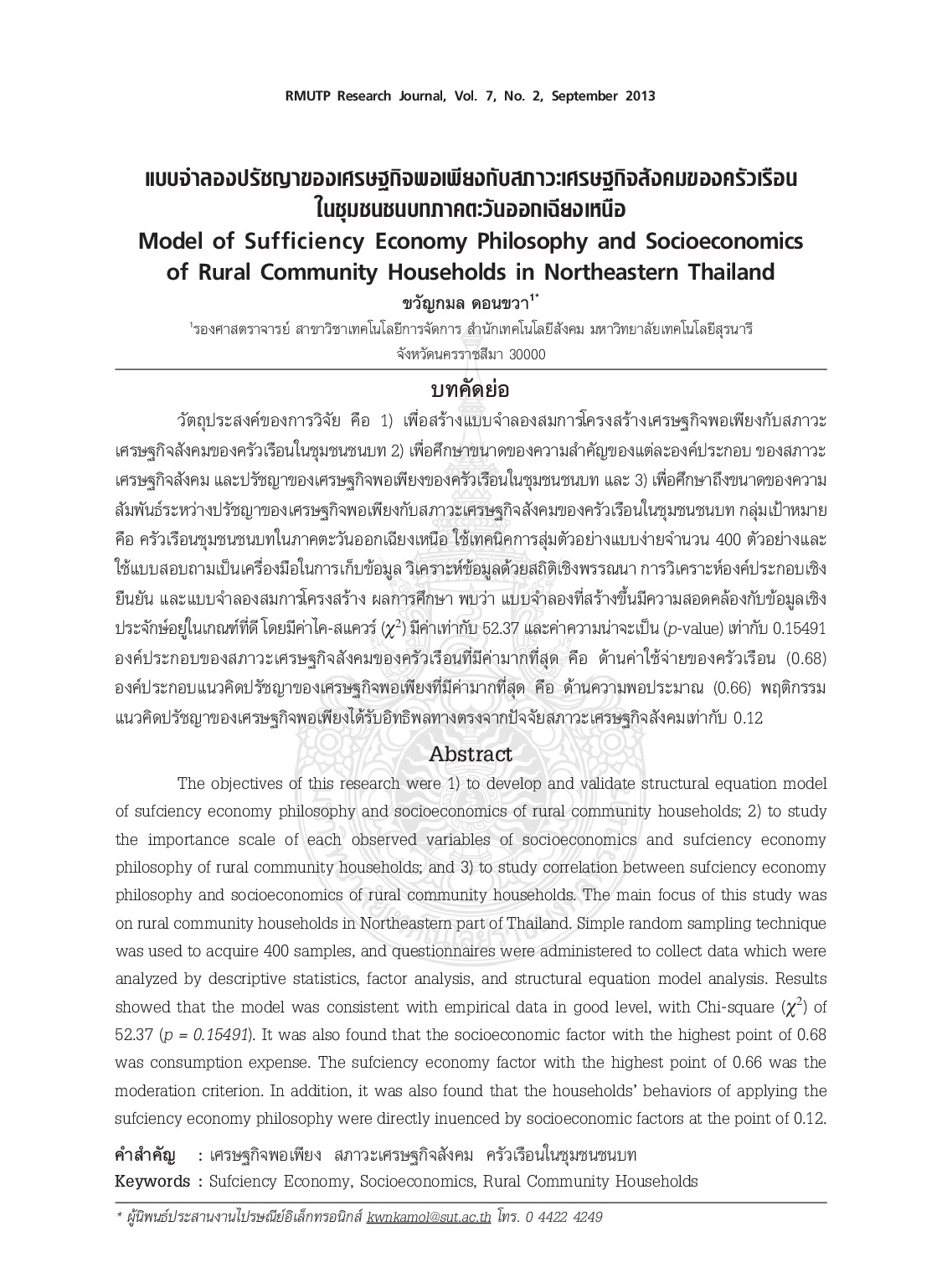
The objectives of this research were 1) to develop and validate the structural equation model of application of the sufficiency economy philosophy with socioeconomics of rural community households 2) to study the importance scale of each of the observed variables with socioeconomics and the sufficiency economy philosophy of rural community households and 3) to study the correlation level between the sufficiency economy philosophy and socioeconomics of rural community households. The main focus of this study was on rural community households. Simple random sampling technique was used to arrive at 400 samples and a questionnaire was administered to collect data and analyzed by descriptive statistics factor analysis and structural equation model analysis. The result showed that the model was consistent with the empirical data. Goodness of fit measures were found to be: Chi-square 52.37(p- value= 0.15491). It was also found that the factor loading of socioeconomics with the highest point was the consumption expenditure at 0.68 whereas the factor loading of the sufficiency economy philosophy with the highest point was the criterion of moderation at 0.66. Besides it was found that the rural community households’ behavior of applying the sufficiency economy philosophy received direct influence from the socioeconomic factors at the point of 0.12.