จำนวน Repository ( 115 )
Phosphonic Acid Functionalization of Hyperbranched Polyamidoamine Grafted Ultrafine Silica to Prepare the Flame Retardant for Cotton Fabric
Grafting of hyperbranched polyamidoamine (PAMAM) dendrimer onto ultrafine silica followed by the introduction of phosphonic acid groups onto branch ends was carried out. First an initiating site was incorporated into silica surface by reacting the silica silanol group with 3-aminopropyltriethoxysilane producing amino-functionalized silica. The free amine group content was controlled by varying ratios of methanol to water in the hydrolysis step of sol-gel reaction. Then grafting of PAMAM was performed by repetitive reactions between Michael addition of silica amino groups to methyl acrylate and amidation of the resulting terminal methyl ester groups with ethylenediamine. Amino group content in each generation was determined. This was found to be significantly lower than theoretical value due to unavoidable side reactions. After the G3.0 hyperbranched PAMAM grafted onto silica was synthesized phosphonic acids functionalization of the terminal amino groups by the Mannich type reaction was carried out. The phosphorylated hyperbranched PAMAM grafted silica was achieved and its application on cotton fabric to produce phosphonated cellulose was studied.
The Development of Indian Women Dresses of Punjabi Style Made by Weaving Cotton Fabric from the North-eastern Part of Thailand
The purpose of this research was to study the development of Indian women dresses of Punjabi style made by weaving cotton fabric from the north-eastern part of Thailand. The sampling group was 250 Indian women who live in Bangkok selected by Quota Sampling and analyzed by SPSS. The research result found that the sampling group of people was married and under 30 years old were undergraduate degree or equal level. They were house wives with average income of 15001- 20000 baht per month. Most of them were born and lived in Thailand. They liked to use north-eastern Thailand cotton handmade dresses which could be affordable in Pahurat the Central of Bangkok. The reason why Indian women bought this kind of fabric and turned it into Indian Women dresses of Punjabi style because it was suitable and could be worn in many social occasions. The analysis result found that the five different kinds of north-eastern Thailand handmade weaving cotton fabric including their colors and designs could affect to the satisfaction of the development of Indian Women dresses of Punjabi style. The satisfaction in types of fabrics differed at the statistical significance level of .05. The satisfaction in touching surfaces of fabrics did not differ at the statistical significance level of .05.
Development of Fabric Products and Technology Transfer to Lopburi Communities
The objectives of this project were to develop household items using cotton and silk fabrics weaved from local communities in Lopburi province and to transfer the developed technique to those communities in order to increase their incomes and also create the new career. There were 60 participants who were trained for two training courses. After training the participants’ satisfaction on the curriculums and training methods were evaluated by a mean of questionnaire. Then the average values were determined and used to represent the results. The results were concluded that the objectives of the curriculums as well as their structures were mostly suitable in every aspect. The satisfaction on activities during the training training equipment (materials and books) and place were rated in the “high level” while the satisfaction on the instructors was rated in the “highest level”.
Dyeing and Colour Fastness Properties of Silk and Cotton Fabrics Dyed with Eucalyptus Bark Extract
This research was concerned with dye extraction from the bark of eucalyptus and application for silk and cotton fabric dyeing. Silk and cotton fabrics were treated with premordanting process before dyeing experiments in order to facilitate dye absorbency of fabrics such as silk dyeing at 90ฐC for 40 minutes and pH 4 cotton dyeing at 60ฐC for 40 minutes and pH no adjustment. The best result was achieved when liquor ratio between fabric and dyed solution as 1:30 was employed. Silk dyed in the solution extracting from the bark of eucalyptus with mordant compound displayed yellow to brown colour except fabric using fesrrous (Fe) mordant exhibiting the shade of dark brown to grey. For cotton fabric the shade of yellow to orange was obtained except fabric using ferrous (Fe) mordant displaying the shade of pale grey to gray. Silk and cotton fabrics treated with pre-mordanted and dyeing process has presented the properties of colour fastness to washing water and perspiration from good to very good level whereas colour fastness to light and rubbing was from fair to good level.
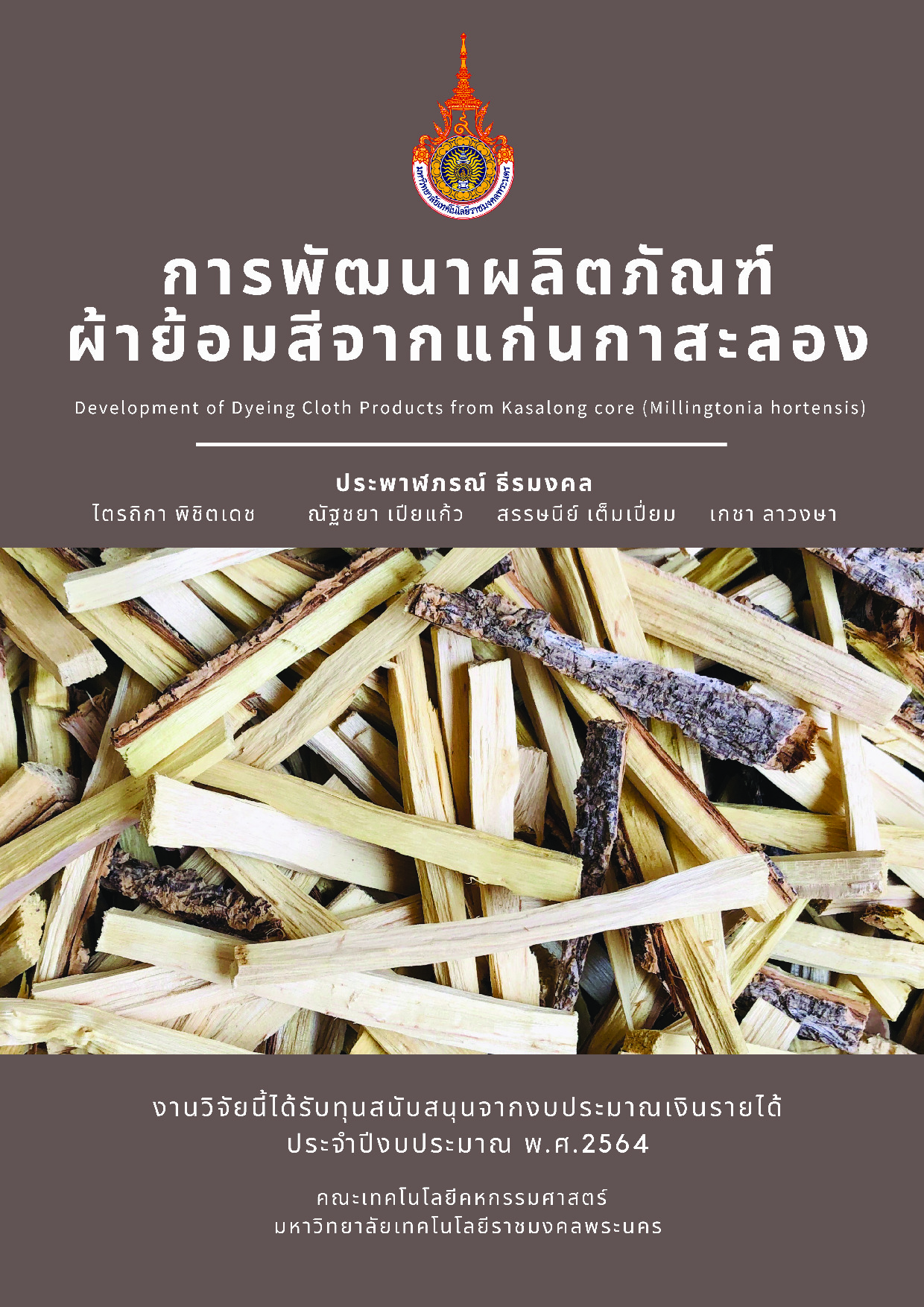
การพัฒนาผลิตภัณฑ์ผ้าย้อมสีจากแก่นกาสะลอง
Promotion of handicrafts in the field of natural dyes in the country. Increase the potential of the community and use the strengths of the cultural community. way of life and wisdom by finding ways to develop textile products by using creative textile innovations based on local wisdom in sustainable community areas To add added value to products in the ECO PRODUCT and ZERO WASTE product groups from the aforementioned concept To conserve plant genetics that exist throughout the country. The researcher therefore studied the process of dyeing fabrics by natural methods. By taking natural ingredients that are locally available and transforming them into environmentally friendly home products. This research is to study the natural dyeing of cotton fabric from Kasalong core. have a purpose Study on the effect of dyeing and the use of adjunctive agents in natural dyeing from Kasalong kernels. To develop dyed fabric products from Kasalong core and to pass on the knowledge and technology of developing dyed fabric products from Kasalong core for the general public. The result of dyeing cotton with natural dyes from Kasalong core. Four types of adhesives were used at a concentration of 20 percent as tamarind juice lime juice lime juice ash water and to test the washing fastness and sunlight resistance with the AATCC standard. The results can be summarized as follows. 1. The results of the study found that from the extraction of color from Kasalong kernels and then filtered with cloth. The color water extracted from Kasalong essence is brown. and when left for 24 hours the water color is dark brown and in this research using hot dyeing methods. 2. The result of dyeing cotton with natural dyes from Kasalong core without mordant using was found to yellow-brown but after washing the color intensity on the fabric fades slightly. 3. The result of dyeing cotton with natural color from Kasalong core. It was found that after washing the color intensity on the fabric was moderately fading. 4. The color measurement L* a* b* found that when the dye was measured in the CIELab system L* = 26.81 a* = 33.33 b* = 45.69 dL = 0.36 and dE*ab = 0.85 water. The resulting color from Kasalong will be reddish yellow. 5. Make the research prototypes as 10 of bag products. 6. Conducting technology transfer by organizing workshops dyeing course and sewing durating of the workshop for students and the general public was 1 day. Most of the participants had the highest level of satisfaction in all questions.