จำนวน Repository ( 171 )
การออกแบบและผลิตเสื้อสตรีโดยกระบวนการแปลงวัสดุเหลือใช้เป็นผลิตภัณฑ์ใหม่
Nowadays fashion industry affects the environment around the world and from that situation many fashion designers pay attention to the process of designing by upcycling. Researchers are interested to study the knowledge of fashion up cycling for creating my own up cycling project including 5 looks of women’s wear by using the upcycling method combining with quilting techniques. In addition then the 5 up cycling women- clothes are evaluated by 50 assessors about fashionable design and wearable design for forecasting the potential of making clothes by using up cycling methods for wearing in the real life. From the result of the knowledge’ s fashion up cycling and the evaluation there is possibility of making different designs from the old clothes into the new clothes and many people think the upcycling clothes can be wearable and fashionable.
การพัฒนา Application เพื่อกำหนดราคาสินค้าชุมชน
The purpose of this research was to develop an application for setting up price for goods in the community. The application helps the retailer calculate and determine the product price with the minimal risk. In order to assess the satisfaction of the application the samples used in this study were 30 community retailers and goods producers. The research found that the application was in good quality. The evaluation of satisfaction with the application was averagely 4.45 which was at a very high level. The application can be actually used in authentic circumstances.
รูปแบบกลยุทธ์ทางการตลาดบริการที่มีผลต่อผู้บริโภคในกลุ่มมิลเลนเนียลในการตัดสินใจสั่งอาหารจากร้านอาหารผ่านแอพพลิเคชั่นส่งอาหารเดลิเวอรี่
This research aims to study a model of marketing strategic towards generationmillennials customers’ buying decision using food delivery application and to present model of marketing strategic towards generationmillennials customers’ buying decision using food delivery application. The mixed methods approaches of quantitative and qualitative research methods were used. In qualitative research method using in-depth interviews with 11 respondents and quantitative research in which questionnaire was used as an instrument to collect data from 400 populations of generation millennials customer living in Bangkok who order foods through food delivery application. Statistics for data analysis included frequency percentage average standard deviation exploratory factor analysis (EFA) The results indicated that most of the respondents were women with a bachelorsdegree who had a career as private company employees and an average monthly income of 18000 – 25000 bahts use Grab application the most use less than once week there are a total of 2 orders per order choose order the most street food average 100 - 350 Baht cost per time order food in the evening (17.01-22.00 p.m.) order food to eat at accommodation most order food to eat with friends reason for ordering a delivery is that it is comfortable from out going by self choose to pay by cash and consumers think that all of the factors are important in deciding to order food from restaurants through the Delivery Application application at high level. Results analysis of factors affecting generation millennials customers’ decision making to order from food delivery application be classified into eight factor as 1) easy to user experience strategy 2) goods value and price strategy 3) physical evidence and presentation strategy 4) strategies for brand awareness 5) accuracy and complete strategy 6) restaurants management system strategy 7) sales promotion strategy 8) new product development strategy.
ประสิทธิภาพการกักเก็บคาร์บอนไดออกไซด์ด้วยสาหร่าย Spirulina sp.RMUTL
Increasing concentrations of CO2 in the atmosphere is causing severe environmental destruction to the earth. Bio-sequestration of CO2 is a promising way to completely sequester CO2 by converting it into biomass by way of photosynthesis. The current research focused on biomass productivity and CO2 sequestration efficiency using microalgae. The experiment choose Spirulina sp. RMUTL by cultivating in working volume 8 liters bioreactor with zarrouks medium for 24-hrs with light nature and aeration air. The CO2 (100%) was flushed into the medium with a flow rate were 0.01 0.02 and 0.03 vvm respectively. The period of all experiments were 30 days. The results showed that the maximum specific growth rate OD560 algae biomass productivity efficiency of CO2 reduction CO2 fixation rate and carbon loading rate were 0.35±0.01 d-1 0.85±0.00 600.00±10.00 mg.L-1 96.83±0.76% 1 128.00±18.80 mg.L-1.d-1 and 2 0 . 4 1 ±0 . 2 6 g. d-1 with 0.01 vvm CO2 flow rate. The average CO2 sequestration over 30 days were 3.15.±0.03 3.11.±0.02 and 3.07.±0.07% in 0.01 0.02 and 0.03 vvm CO2 flow rate respectively.
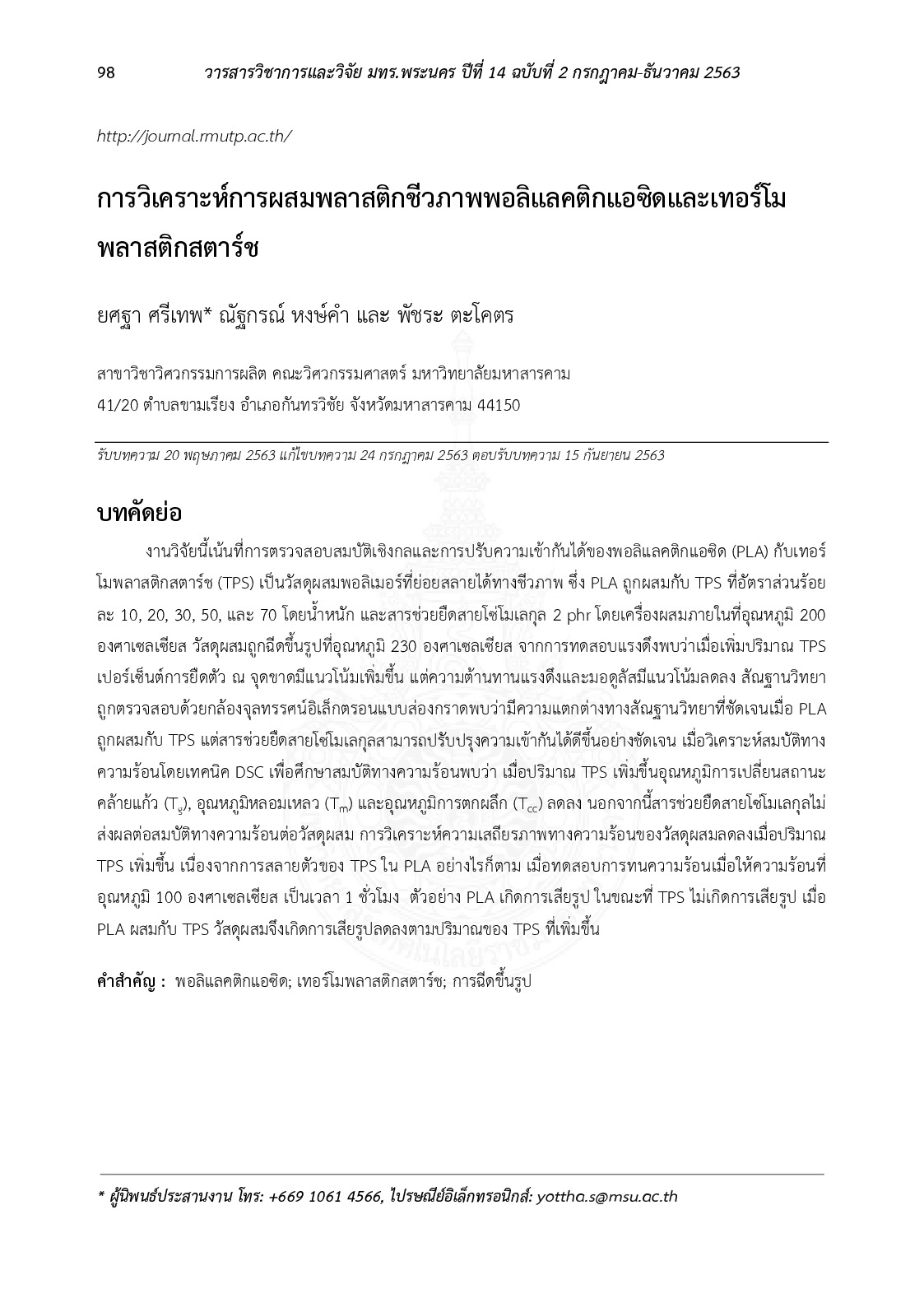
การวิเคราะห์การผสมพลาสติกชีวภาพพอลิแลคติกแอซิดและเทอร์โมพลาสติกสตาร์ช
This research was concentrated on characterized mechanical properties and adjusted compatibility of poly (lactic acid) (PLA) with thermoplastic starch (TPS) as biodegradable polymers composites. PLA was blended with TPS at the proportion of 10 20 30 50 and 70 wt% as well as 2 phr chain extender by an internal mixer at 200°C. The blended materials were then injection molded at 230°C. Tensile testing showed that as the amount of TPS increase the elongation at break tended to increase but the tensile strength and modulus tended to decrease. The morphology was investigated by scanning electron microscope. It was found that distinct phase between PLA and TPS was observed. Yet adding the chain extender clearly improved the compatibility between PLA and TPS. The blended materials were also analyzed by differential scanning calorimetry method to study thermal properties. It was found that as the amount of TPS increased the glass transition temperature (Tg) melting temperature (Tm) and cold crystallization temperature (Tcc) deceased. Additionally chain extenders did not affect thermal properties. The thermal stability of the composites decreased when increasing the amount of TPS because of the degradation of TPS in PLA. However when heated at 100ºC for 1 hr the PLA sample bent while TPS did not bend. When PLA was mixed with TPS the composite was bent according to adding TPS.