จำนวน Repository ( 15 )
การพัฒนารูปแบบเครื่องนุ่งห่ม จากผ้าทอพื้นเมือง จังหวัดพิษณุโลก
The research entitled “Development of Designed Clothing from Native Woven Fabrics of Phitsanulok” aims to 1) investigate the information of Phitsanulok’s native woven fabric patterns 2) develop designed clothing from native woven fabrics of Phitsanulok and 3) measure the consumer satisfaction for the clothing from native woven fabrics of Phitsanulok. The sample of this research comprised 398 working age women selected by using the accidental sampling technique form working age woman resided in Mueang district of Phitsanulok province. The questionnaire and clothing prototypes were used as a tool for the consumer satisfaction data collecting. The descriptive used for statistical analysis in the study were the frequency percentage arithmetic mean and standard deviation.
การศึกษาและพัฒนาโคมไฟตั้งพื้นจากผ้าย้อมครามสำหรับที่พักอาศัยคอนโดมิเนียม
The purpose of this project were to study floor lamp from indigo dyed fabric process of condominium. The researcher were interested in floor lamp from indigo dyed fabric product that could be used practically and beautiful. It were inspired by the mangrove tree root that grew out of the trunk to adhere. It made the mangrove tree root shape look like legs outstretched to suit for making it. The result of the floor lamp from indigo dyed fabric design were the shape obtained from the root of the mangrove to make the floor lamp from indigo dyed fabric design for use. It found that the floor lamp indigo dyed fabric could be used in residential condominium as well. There was a light that was not too dull or translucent when the light turned off. It would be beautiful when turned on to make the color and pattern more sharply.
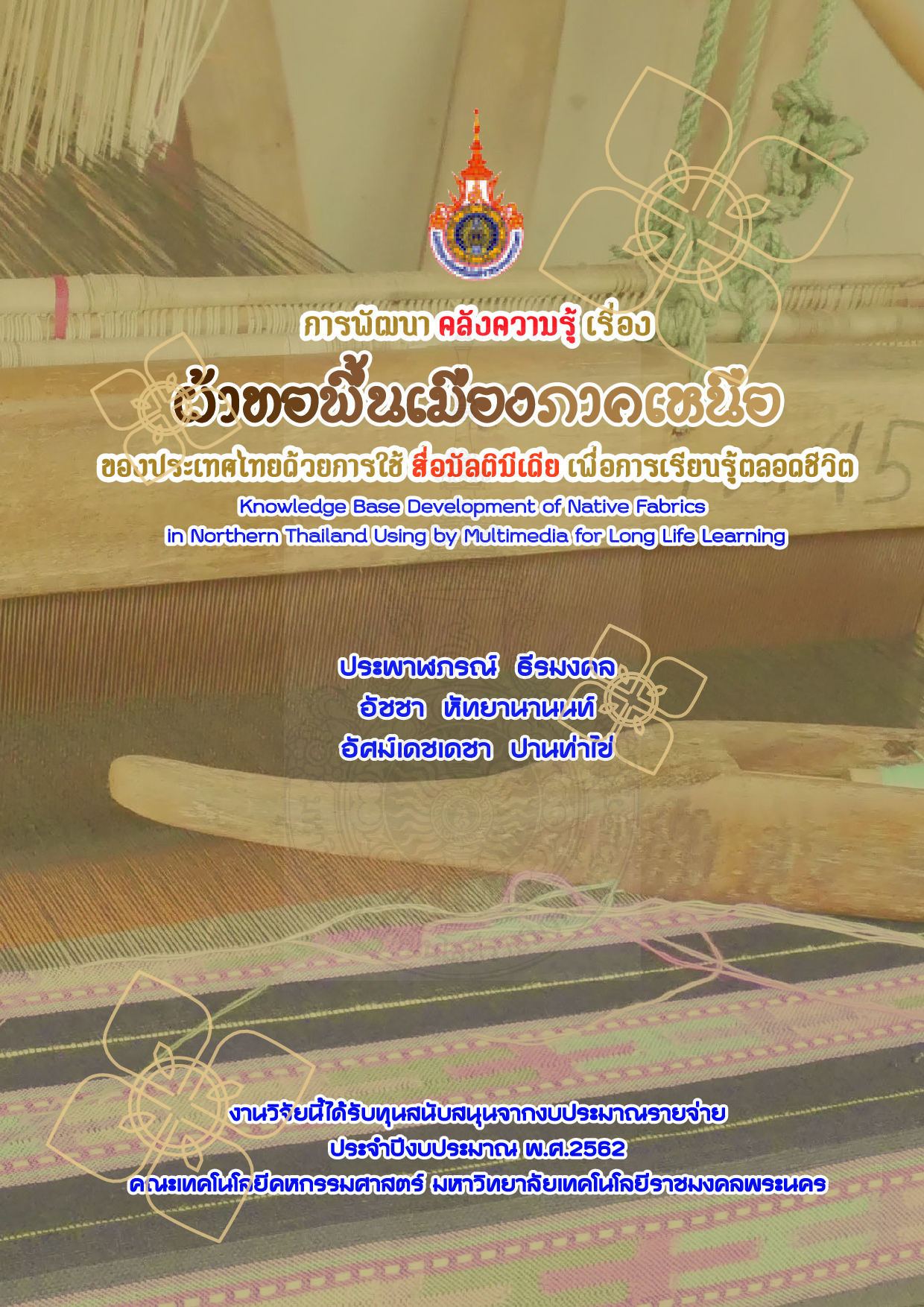
การพัฒนาคลังความรู้เรื่องผ้าทอพื้นเมืองภาคเหนือของ ประเทศไทยด้วย การใช้สื่อมัลติมีเดียเพื่อการเรียนรู้ตลอดชีวิต
This research is the development of the knowledge base on local textiles of northern Thailand by using multimedia for lifelong learning. The aim is to study compile and gather information of local cloths in northern Thailand. Develop a knowledge base by using multimedia on the local textiles of northern Thailand for lifelong learning and transferring knowledge and disseminating the knowledge base on northern Thai fabric by using multimedia for lifelong learning to the community. The research team proceeded to gather primary knowledge from the roots of the researchers who are interested in the local woven fabric. Therefore proceeding further knowledge in the upper reaches from literature reviews Including from field trips for data collection through in-depth interviews with important people Interviewing people who have knowledge about social context community local weaving characteristics weaving characteristics name of pattern type of fabric weaving technique of local textiles in northern Thailand in 9 provinces as well as studying primary data from textbooks textbooks and technical documents and in the internet. Thus the research shown that into 3 parts which are 1. Ethnic groups of Northern Thailand 2. Local woven fabric in northern Thailand and 3. Woven process and pattern. After that the knowledge library was developed by using multimedia on the local textiles of Northern Thailand for lifelong learning. This research can summarize the results in the form of a written description showing that the northern region of Thailand in the past was the Lanna Kingdom area. In the area of Xishuangbanna Before moving to the north of Thailand including the Tai Lue Tai Kheen Thai people Tai Yai people Meng (Mon) Lua people villages scattered throughout the highlands of the Lanna region such as Karen (Pak Kahen M) Mien (Yao) Hmong (Meo) Akha (Akha) Lahu (Mso) Lisu. In addition there are some groups in the Lanna fringe such as Khmu Labri (Tong Lueang). Each ethnic group has its own unique style especially Common skirt Has the same basis with the resin head the resin body and the resin tip but each part is not woven differently Have different colors Some ethnicities have a section called Lep which is the part that the weaver often weaves to keep the thread as for knowledge transfer. The research created a book Local woven cloth consists of videos from local knowledge sources and digital documents and to make the transfer of knowledge more complete Therefore held a forum and exhibition on the topic primary fabric of Lanna Kingdom as a medium for those interested in Local woven fabrics in the Lanna Kingdom of Thailand attended. Exchange ideas from various sources of knowledge from the research. While also receiving multimedia for lifelong learning from the inquiry regarding the satisfaction of the participants. The Keynote speakers are interesting and event condition caused the interest in the knowledge content that used to organize the exhibition. Overall the work is most satisfied.

พัฒนาภูมิปัญญาเสื้อผ้าชนกลุ่มน้อยไทย-จีน เพื่อสู่ประชาคมอาเซียน กรณีศึกษาชาวไททรงดำกับชาวจ้วงกวางสี
This research aims to study the wisdom on costumes of Thai-Chinese minorities in order to develop and integrate on costumes of Thai - Chinese minorities and transfer technology to target groups by training and workshop. This research is for the purpose of Research and Development. The instruments used in research were included 10 prototype costumes training assessment questionnaire regarding costumes of Thai-Chinese minorities Lao-Song or Tai Song Dam and Zhuang. The sample consisted of 100 interested people from Thai Song Dam Loincloth Weaving Group in Tambon Donmanow No.39 Moo 2 Tambon Donmanow Songpeenong district Suphanburi Province and 2 groups of 20 trainees each from Thai Song Dam group in Tambon Ban Don Amphoe U Thong Suphanburi Province and Thai Song Dam group in Tambon Bang rakam Amhoe Bang rakam Phitsanulok Province. The statistics tools used in data analyzing were frequency percentage mean and standard deviation. The research result in prototype costumes evaluation in a mixing Tai Song Dam weaving and Zhuang style found that most interested people who responded to the questionnaires were female aged 31 to 40 years employee below a Bachelors degree and having an average income 5001 to 10000 baht. These interested people had a positive attitude level in Prototype costume No.10 regarding pattern design application and the overall average were at 4.79 4.78 and 4.28 respectively. The transfer of technology evaluation regarding training workshop on costumes of Tai Song Dam and Zhuang were combined with 2 groups of 20 trainees each from Thai Song Dam group in Tambon Ban Don Amphoe U Thong Suphanburi Province and Thai Song Dam group in Tambon Bang rakam Amphoe Bang rakam Phitsanulok Province. The results showed that most respondents from Thai Song Dam group in Tambon Ban Don Amphoe U Thong Suphanburi Province were female age above 40 years weavers having a primary school certificate and having an average income below 5000 baht. Before initiating the training workshop most trainees had pattern design skills sewing skills and decorating were at moderate level. After the training workshop showed significant improvement in the high level. And most respondents from Thai Song Dam group in Tambon Bang rakam Amphoe Bang rakam Phitsanulok Province were female age above 40 years weavers having a primary school certificate and having an average income below 5000 baht. Before initiating the training workshop most trainees had pattern design skills sewing skills and decorating were at moderate level. Affter the training workshop showed significant improvement in the high level.
การพัฒนาลวดลายผ้าจกไทยวนเพื่องานออกแบบแฟชั่น
The purposes of Motifs Development of Chok Tai-Yuan Fabrics for Fashion Design are to develop the Tai-Yuan Jok fabric’s patterns in Ratchaburi for fashion designing; and to create the patterns that can be applied for men and women apparel designing.The study aims to develop the Tai-Yuan Jok fabric’s patterns in Ratchaburi province by applying the unique pattern for the design; and to re-design the pattern by using the principles of pattern design to be suit with men and women apparel designing. Researchers selected the descriptive analysis method with the statistical data for analyzing the data of Tai-Yuan Jok fabric’s patterns. The collected data were all applied in developing the styles of Tai-Yuan Jok fabric’s patterns in Ratchaburi. Also the authors has surveyed the satisfaction of 100 samples for the work pieces of developing the Tai- Yuan Jok fabric’s patterns for fashion designing. The survey is to conclude the satisfaction for the developed patterns’ styles. The results showed that nowadays the Tai-Yuan Jok fabrics in Ratchaburi are consisted of patterns applied from the weavers by using their experiences in weaving the Jok fabrics. Thus the patterns have been combined with the traditional styles and the applied ones which are done in accordance with the age.Those patterns have different composition that depends on the weavers’ desire. Patterns can be categorized in three groups: 1. traditional pattern; 2. the combination of traditional pattern and the applied one; and 3. the applied pattern. So this study has selected the feature of traditional pattern and the dominant feature of applied pattern to be the concepts in developing the Tai-Yuan Jok fabric’s patterns for fashion designing for 4 patterns. The results of the survey of the satisfaction from the samples found that they are content with the fabric’s patterns development. Also they think that this development of the patterns will maintain the unique of Tai-Yuan Jok fabric’s patterns in Ratchaburi province and they will be able to apply these concepts of fabric’s pattern developing with the support of textile production for fashion design.