จำนวน Repository ( 171 )
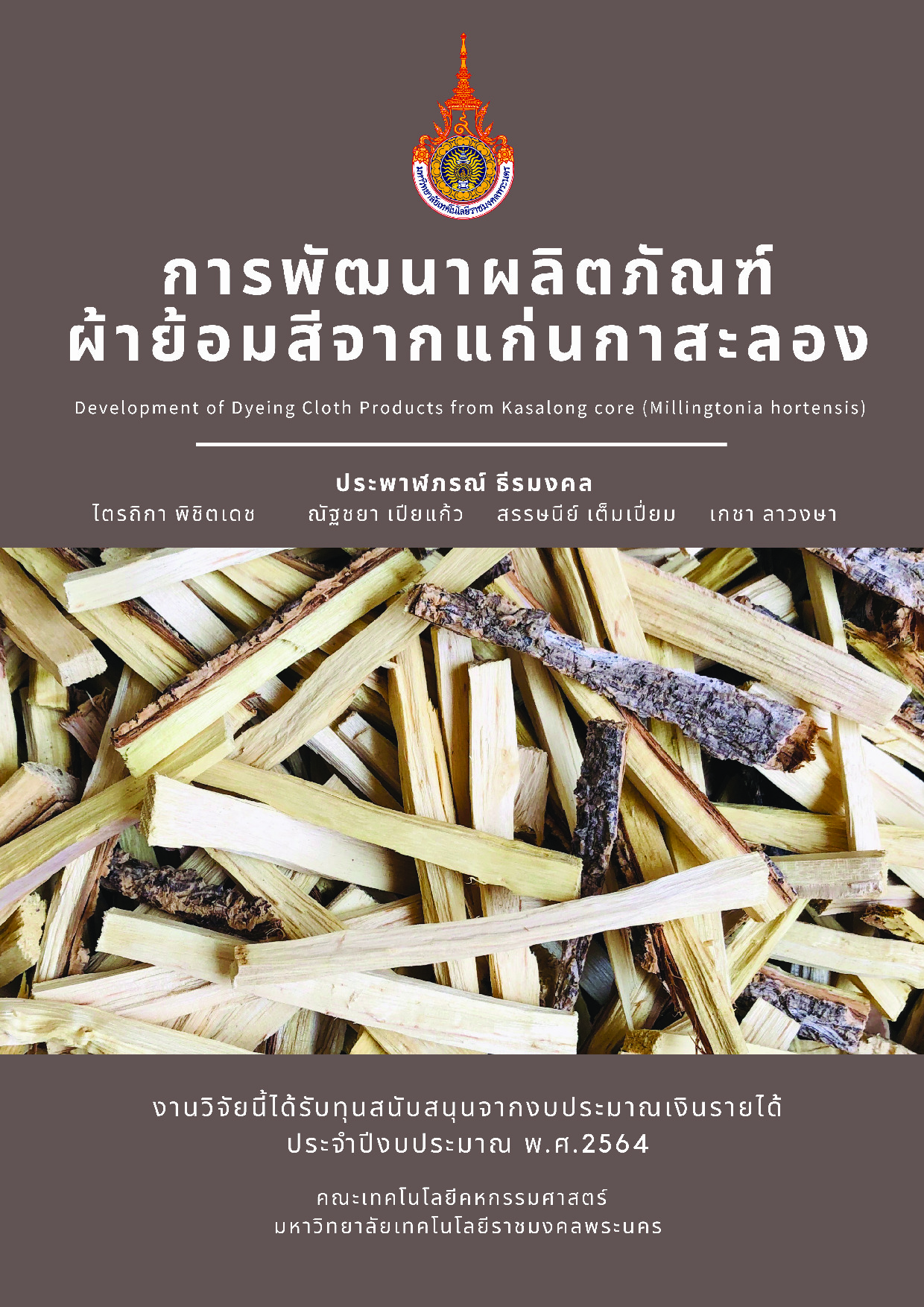
การพัฒนาผลิตภัณฑ์ผ้าย้อมสีจากแก่นกาสะลอง
Promotion of handicrafts in the field of natural dyes in the country. Increase the potential of the community and use the strengths of the cultural community. way of life and wisdom by finding ways to develop textile products by using creative textile innovations based on local wisdom in sustainable community areas To add added value to products in the ECO PRODUCT and ZERO WASTE product groups from the aforementioned concept To conserve plant genetics that exist throughout the country. The researcher therefore studied the process of dyeing fabrics by natural methods. By taking natural ingredients that are locally available and transforming them into environmentally friendly home products. This research is to study the natural dyeing of cotton fabric from Kasalong core. have a purpose Study on the effect of dyeing and the use of adjunctive agents in natural dyeing from Kasalong kernels. To develop dyed fabric products from Kasalong core and to pass on the knowledge and technology of developing dyed fabric products from Kasalong core for the general public. The result of dyeing cotton with natural dyes from Kasalong core. Four types of adhesives were used at a concentration of 20 percent as tamarind juice lime juice lime juice ash water and to test the washing fastness and sunlight resistance with the AATCC standard. The results can be summarized as follows. 1. The results of the study found that from the extraction of color from Kasalong kernels and then filtered with cloth. The color water extracted from Kasalong essence is brown. and when left for 24 hours the water color is dark brown and in this research using hot dyeing methods. 2. The result of dyeing cotton with natural dyes from Kasalong core without mordant using was found to yellow-brown but after washing the color intensity on the fabric fades slightly. 3. The result of dyeing cotton with natural color from Kasalong core. It was found that after washing the color intensity on the fabric was moderately fading. 4. The color measurement L* a* b* found that when the dye was measured in the CIELab system L* = 26.81 a* = 33.33 b* = 45.69 dL = 0.36 and dE*ab = 0.85 water. The resulting color from Kasalong will be reddish yellow. 5. Make the research prototypes as 10 of bag products. 6. Conducting technology transfer by organizing workshops dyeing course and sewing durating of the workshop for students and the general public was 1 day. Most of the participants had the highest level of satisfaction in all questions.
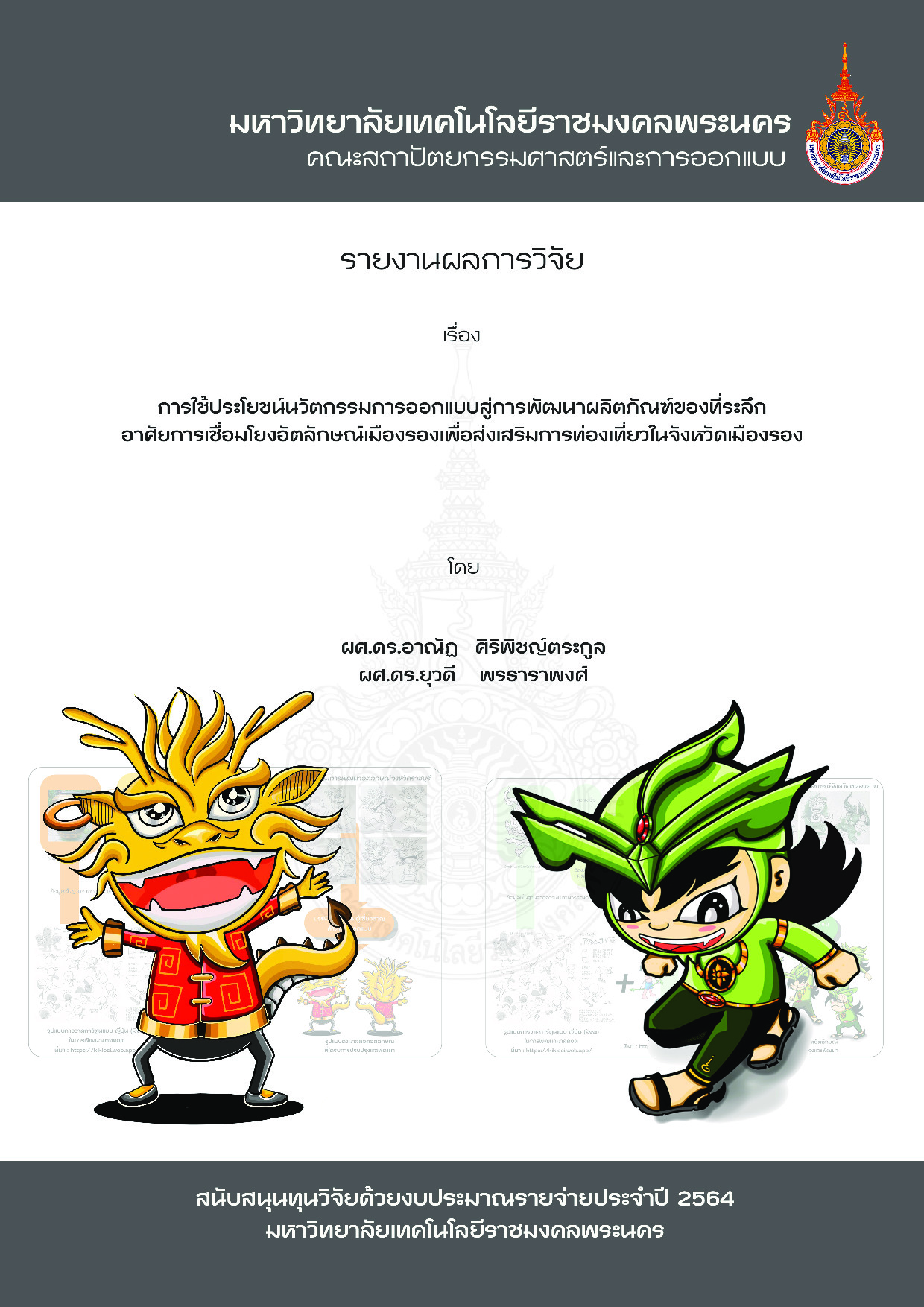
การใช้ประโยชน์นวัตกรรมการออกแบบสู่การพัฒนาผลิตภัณฑ์ของที่ระลึกอาศัยการเชื่อมโยงอัตลักษณ์เมืองรองเพื่อส่งเสริมการท่องเที่ยวในจังหวัดเมืองรอง
A research project on the utilization of design innovations into souvenir product development based on linking secondary city identities to promote tourism in secondary city provinces. It is a project that has objects to study the identity of a secondary city to be used to design souvenirs packaging public relations materials. to stimulate tourism in secondary cities which is in line with tourism strategies In a research project that has a design and development process Using technology to assist in product design and development Creation of identity from cultural capital in secondary cities. which the results of each aspect are at a very good level. by using the design of the secondary city area in Nong Khai Province and Ratchaburi which is a province with identity and culture by the researcher make character development souvenir products public relations media Characters show theidentity of the city. to create a memory for tourists and create an identity for the provinces of secondary cities
การจัดการความรู้รูปแบบการพัฒนาผลิตภัณฑ์ชุมชนภูมิปัญญาท้องถิ่นของกลุ่มวิสาหกิจชุมชนอำเภอกระทุ่มแบน จังหวัดสมุทรสาคร ตามศาสตร์พระราชาสู่การพัฒนาที่ยั่งยืน
This study aims to examine the knowledge management in the development of community products from the local wisdom of the community enterprise Amphoe Krathum Baen in Samut Sakorn according to the king’s philosophy to create sustainable development. Three main objectives were: 1) To explore the knowledge management in community product development based on the local wisdom of Amphoe Krathum Baen in Samut Sakorn 2) To find out the form of product development based on the local wisdom of Amphoe Krathum Baen in Samut Sakorn that applied the Sufficiency Economy Philosophy (SEP) to sustainable development. 3) To empower the community through the development of community products based on the king’s philosophy to sustainable development according to government policy. The methodology used for data collection involved constructing a questionnaire and collecting data in small meetings sessions. The participants in the study were general people associated with the community enterprise of Amphoe Krathum Baen in Samut Sakorn. The sample consisted of 20 participants drawn from the simple random sampling. The questionnaire was used as a research instrument in this study. The data were then analyzed by using descriptive statistics: percentage mean (x ) and standard deviation (S.D.). The results of the study can be summarized as follows: The results present the knowledge management in the development community products based on local wisdom in Amphoe Krathum Baen Samut Sakhorn following the king’s philosophy to sustainable development. This knowledge was managed systematically according to family beliefs the relationship between family members and the transmission of knowledge in local wisdom from one to others to inherit this local wisdom treasure. Overall the knowledge management of local wisdom was at the moderate level. For the development of community products based on local wisdom the results shows that the participants paid attention to the form of packaging according to geographic indicator that was available in their local area at the highest level. In addition to strengthening the community these community products allowed the community to generate profitable income by building commercialization and setting up a community enterprise rather than doing business within the family. When considering all these items the results show that all items were at a high level.
การพัฒนาผลิตภัณฑ์ข้าวตังเห็ดนางฟ้า
This special project. The objective is to study the basic formulas and processes of rice crust production. Study the suitable amount of mushrooms in the production of rice crust. Study the suitable flavor in the production of rice crust Phoenix Mushroom. and study the quality changes during storage of Rice crust Phoenix Mushroom. from the study of the basic formula and the production process of rice crust the sensory evaluation results from 50 tasting testers. Found that formula 2 contains a mixture of steamed rice (Rice Sao Hai) steamed rice (Thai jasmine rice) and salt. The highest average rating. Study the suitable amount of mushrooms in the production of rice crust. Found that the formula with the amount of mushrooms: steamed rice 30% : 70% The highest average rating. The brightness (L*) red (a*) and yellow (b*) were 58.17±0.42 9.23±0.10 and 23.04±0.03 respectively. The aw value is 0.48±0.01. The moisture content is 2.60±0.01 percent. Study the suitable flavor in the production of rice crust Phoenix Mushroom. From the sensory tests of 3 flavors : Tom Yum flavors chilli flavors and pizza flavors showed that taste testers rated their liking for appearance color aroma flavor taste texture (Crispness) and overall liking Of the rice crust with the highest chilli flavor. Quality analysis chemical moisture protein fat ash fiber carbohydrate and peroxide values equal to 2.35±0.12 7.23±0.85 15.71±0.20 2.85±0.02 7.16±0.67 64.70±0.01 and 0.93±0.06 respectively. Study the quality changes during storage of rice crust Phoenix Mushroom. It was found that the brightness (L*) red (a*) and yellow (b*) increased from week 2 to week 6. The hardness value increases every week causing the breakage value to decrease. Moisture content not more than 4.0% and peroxide value not more than 30 mg. Equivalent Not exceeding the standards set by the industrial products. Therefore Phoenix Mushroom Rice Crust Products (chilli flavor). Therefore can be stored for more than 6 weeks
การพัฒนาผลิตภัณฑ์สเปรดขนมปังจากปลายข้าวไรซ์เบอรี่เสริมควินัว
This research aims to (1) Study the Improved the spreading feature on the bread of products (2) Study the Increase nutrition by using quinoa in products (3) Study the shelf life of products. the study indicated that When improving spreading characteristics on the bread by using different levels of corn starch in 3 levels Include 2 3 and 4 % From the results Found that Sensory evaluation results (9 point-hedonic scale). recipe that highest score in terms of overall liking was the 3% at 7.98 points. For the physical properties of the developed product showed that this lightness (L*) redness (a*) and yellowness (b*) were 23.19 7.23 and 2.83 respectively while a viscosity of 96436 cp. When Study the Increase nutrition by using quinoa in the product in 3 levels Include 1 3 and 5 % From the results Found that Sensory evaluation results (9 point-hedonic scale). recipe that highest score in terms of overall liking was the 5% at 8.14 points. For the physical properties of the developed product showed that this lightness (L*) redness (a*) and yellowness (b*) were 24.32 7.59 and 3.69 respectively with viscosity of 184800 cp. In terms of chemical composition it was found to consist of moisture protein fat coarse fiber ash and carbohydrates. 49.64 3.83 4.13 1.81 1.56 and 39.03 % respectively. When stored at temperature 4±1 ๐C 1 week found that Can be stored for 4 weeks to be safe for consumers According to (peanut butter community product standard)