จำนวน Repository ( 49 )

การควบคุมคุณภาพการย้อมสีและตกแต่งสำเร็จเส้นด้ายผักตบชวาและวัสดุประกอบเพื่อการแปรรูปผลิตภัณฑ์เชิงพาณิชย์
Quality control of dyeing and finishing of Water Hyacinth yarns and their transformed materials for commercial was a main objective to establish the dye database of synthetic dye and natural dye. The dye database was a data for quality control in dyeing process of raw material as Water Hyacinth yarns also it resolved the un-repeatability dyeing problem. Reactive dye was used for synthetic dye database creation on dry Water Hyacinth yarns at 80oC for 30 minutes. Red as Hicion Red He-3B yellow as Hicion Yellow HE-4RN Blue as Hicion Navy Blue HER 150% and black as Hifix Black KNN were the represent synthetic dye and Sodim sulphate 20 g/l and sodium carbo nate 20 g/l were used as auxiliaries. The other hands the natural dye database was forming from Ebony tree Caesalpinia sappan and Turmeric. They were dye on dry Water Hyacinth yarns at 80oC for 30 minutes and Sodim sulphate 20 g/l was the auxiliary. Whereas Butterfly pea were dye at 80oC for 30 minutes by Sodim sulphate 20 g/l and sodium carbonate 20 g/l were the auxiliaries. The whole dye database was defined the totally in Primary Secondary and ternary dye cycle. The transfer knowledge was distributed to the enterprise at Nakhon Prathom Provincd as “Chumchonjaksanpaktobchawha Bann klongnokkratum”. The topics were “How to establish the synthetic and natural dye database” “Water repel lent finishing” and “developed and transformed the Water Hyacinth to products”. The target group was very satisfied in this topic as 4.39. In the result the proportion between economic and social factor by the income increasing in 1 year was 5.04. So the research project was achievement.
การพัฒนาผลิตภัณฑ์กระดาษและบรรจุภัณฑ์จากแกลบ และส่วนเหลือทิ้งในการแปรรูปข้าว เพื่ออนุรักษ์ศิลปไทย
This research is a study on the Development of Paper and Packaging from Rice Husk and Rice Processing Wastes for producing for Thai Art Conservation. This research purpose to develop products and packaging from the rice husk in rice processing to study the processes of paper production and forming products to design and develop products and packaging and to transfer technology products and packaging from the leftovers in rice processing to conserve Thai arts to the community and to study the satisfaction of the product and packaging development program from the leftovers in rice processing in order to conserve Thai arts to the community. The research findings can be summarized as follows: 1. In this research the research team produced paper and molded products experimenting with the ratio of RICE HUSK and paper SA fibers and find the best ratio of rice husk 50: paper SA fibers 50 so that rice husk can better adhere to paper and creates a beautiful texture for making products. Moreover this research uses the waste from the rice processing process it able to develop products according to objectives. At the same time can be produced at the household level. As well as finding marketing methods for new products to be able to sell which generates income for the community. 2. The results of the physical characteristics of paper produced from rice husk paper with the ratio of rice husk 50 to 50 has a moderate weight. The paper can be folded. The tensile strength of the paper is moderate. The surface is good. The characteristics of the paper after coated with waterproofing it was coated with natural extracts and environmentally friendly. When testing the water color paint on paper the water color slowly absorbed but does not spread along the paper fibers and also slightly absorbed in the backside paper. 3. In this research the development of products and packaging from the leftovers in rice processing for preserving Thai art into 2 categories 1. Develop paper from rice husk for processing into products and developing molded products from rice husk consisting of 3 sets of ornaments consisting of necklaces bracelets earrings 4 sets of home decor consisting of pans wall paintings and 3 sets of household items consisting of 4 multipurpose boxes fruit trays altar table 4. The knowledge transfer by organizing a workshop for theoretical and practical work the duration of knowledge transfer was 2 days 50 participants between 11 - 12 august 2019 at Bang Tachong Community Enterprise Village No.8 Tha Ngam Subdistrict and District in Buri Sing Buri province. Most participants are satisfied with the highest levels in all questions.
การพัฒนาผลิตภัณฑ์เบเกอรี่จากราข้าวและส่วนเหลือทิ้งในการแปรรูปข้าว
Development of Bakery Products from Rice Bran and Rice Processing Wastes to 1. Develop bakery products from rice bran and wastes amount 4 types 2. Study the formulas and processes of food production from rice bran and wastes for the appropriate 4 types 3. Study consumer acceptance of food products from rice bran and wastes in 4 types and 4. Transfer technology of bakery products from rice bran and wastes in 4 types to the community After that the storage life of each condition will be studied from 0-10 days and the physical properties are compared. Chemical and microorganisms such as pH value color measurement and total number of microorganisms found that Khanom Jeen noodles stored in modified atmosphere conditions have longer shelf life than those stored. At normal atmospheric conditions and vacuum conditions. Chemical analysis results showed that the bakery products decreased their pH over time. With values between 4.31 ± 0.00 and 2.99 ± 0.01 and bakery products Stored at 100% carbon dioxide (CO2) modified atmosphere packed in a sealed nylon / PET vacuum plastic bag. Store at room temperature. Can be stored for up to 10 days and found that the total number of microbes increased when the storage life is longer But not over the standard of community products (PhorChor. 500/2547 Knmhin) so the products are safe and not harmful to consumers. Consumer test results show that consumers like and are interested in buying bakery products that use 100 percent carbon dioxide (CO2) at 75 percent.
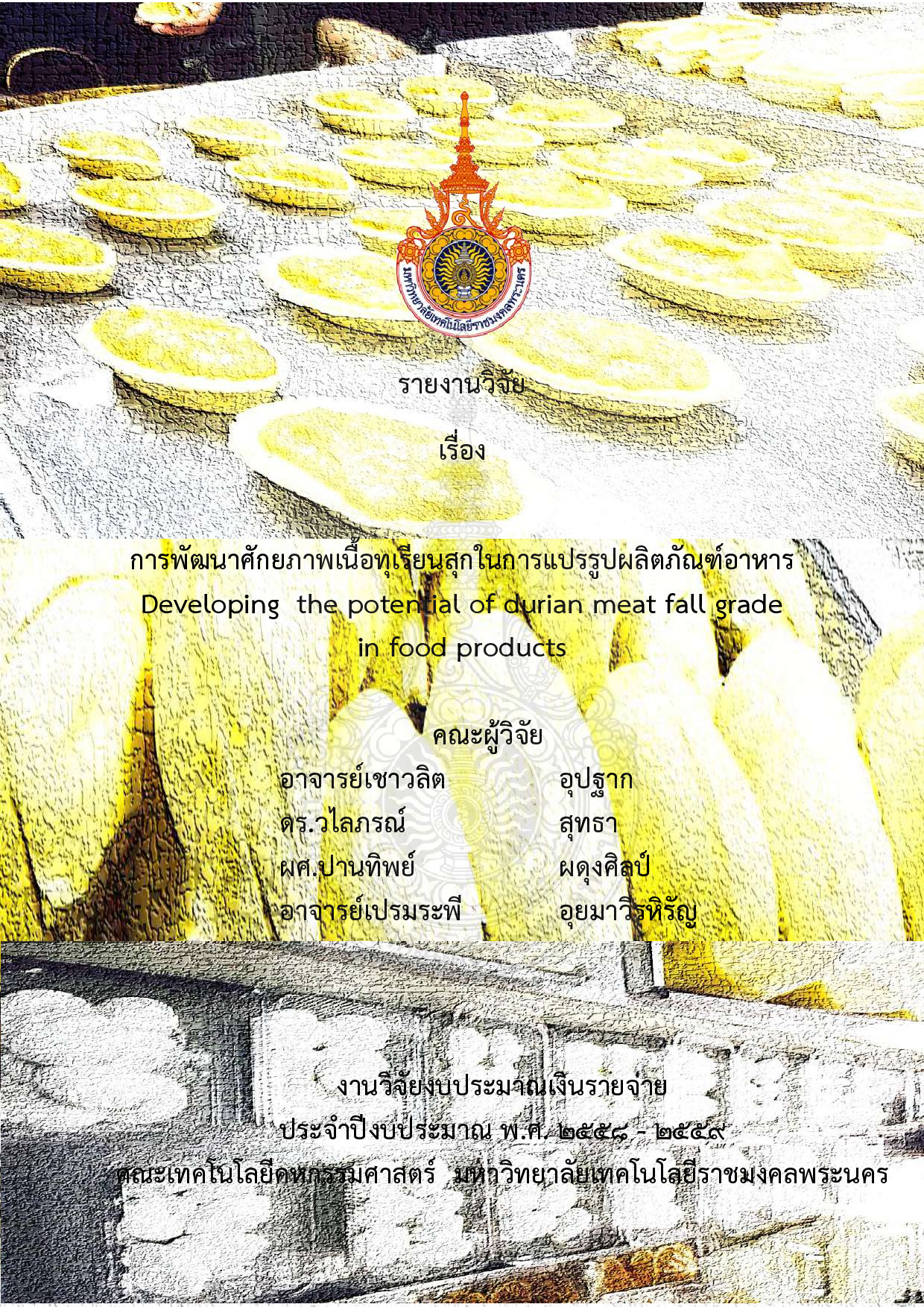
การพัฒนาศักยภาพเนื้อทุเรียนสุกในการแปรรูปผลิตภัณฑ์อาหาร
This research has the purpose to study about the process of transforming of food products supplemented with five types of ripe durian having grade failure. It aims to study about quality of food products transformed from ripe durian having grade failure. It is the study about consumer test having effect towards food products transformed from ripe durian having grade failure and transferring of technology for developing of processed food product from ripe durian texture to the community. The experiment found that study of suitable quantity of pipe durian having grade failure in supplementing food products in 5 types by testing about acceptance of testers who were 40 instructors in Field of Food and Nutrition Field of Food Science and Nutrition and Field of Food Service Industry. The researcher used methods of giving scores of favor in type of 9-point hedonic scale. The researcher added ripe durian having grade failure into durian coconut milk at levels of 0 30 60 and 90 per cent of total ingredients. It was found that testers accepted the durian coconut milk at level of 90 per cent which was in much favor level. Coconut Custard in golden cup (dessert stuffed ingredient) was supplemented at level of 0 50 75 and 100 per cent of all cooked taro ingredient it was found that testers accepted such coconut custard at level of 100 per cent. Coconut Custard in golden cup pastry flour ingredient) was supplemented at level of 0 10 20 and 30 per cent of total ingredient. It was found that testers accepted such coconut custard at level of 30 per cent which was in level of moderate favor to much favor (7-8). Moose supplemented with ripe durian texture having grade failure at level of 0 10 20 and 30 per cent of total ingredient it was found that testers accepted the moose at level of 20 per cent which was in the level of moderate favor to much favor (7-8). Marshmallow supplemented with ripe durian texture having grade failure at level of 10 20 and 30 per cent of total ingredient it was found that testers accepted such marshmallow at level of 20 per cent; which was in level of moderate favor to much favor (7-8). Ancient toffee supplemented with ripe durian texture having grade failure at level of 0 20 40 and 60 per cent of total ingredient it was found that testers accepted the ancient toffee at level of 40 per cent which was in the most level which was in the much favor (8). When physical feature of food products supplemented with five types of ripe durian having grade failure was studied it was found that only one product of durian coconut milk had value of 88.933 cp or centipoises. Regarding nutritional value of processed food product with ripe durian having grade failure it was found that durian coconut milk supplemented with 100% ripe durian having grade failure had protein for 3.23 per cent fat for 8.58 per cent ash for 0.78 per cent fiber residue for 2.01 per cent and moisture quantity for 54.87 per cent. It was found that coconut custard in golden cup with stuffed pastry supplemented with ripe durian having grade failure for 100 per cent and coconut custard with pastry flour in golden cup with ripe durian having grade failure for 30 per cent had protein for 10.87 per cent fat for 18.67 per cent ash for 0.91 per cent fiber residue for 2.35 per cent and moisture quantity for 25.31 per cent. It was found that moose supplemented with 20% ripe durian having grade failure had protein for 3.67 per cent fat for 17.09 per cent ash for 0.55 per cent fiber residue for 1.45 per cent and moisture quantity for 62.26 per cent. It was found that marshmallow supplemented with 20% ripe durian having grade failure had protein for 5.89 per cent fat for 0.68 per cent ash for 0.28 per cent fiber residue for 0.56 per cent and moisture quantity for 41.64 per cent. It was found that ancient toffee supplemented with 40% ripe durian having grade failure had protein for 18.22 per cent fat for 23.11 per cent ash for 12.1 per cent fiber residue for 1.10 per cent and moisture quantity for 8.91 per cent. However supplementing with ripe durian having grade failure in five types of food product can be done but there should be realizing about chemical elements of the initial components for example moisture quantity and fat. These components may affect physical features such as smell taste and texture. These features have effect on product acceptance. From transfer of food product technology from ripe durian texture having grade failure at Faculty of Home Economics Technology Rajamangala University of Technology Phra Nakhon there were 40 receivers of technology transfer. Result of evaluation of satisfaction for 5 aspects of providing service including providing service of officials resource persons service providing process/step facilities and benefit from service receiving all these aspects obtained scores in much satisfaction level in every aspect.