จำนวน Repository ( 9 )

Method for working-life enhancement of epoxy-based adhesive
For one-part adhesive systems a long working-life adhesive which can be cured rapidly at processing temperature is required in industrial applications because it provides assembly process versatility. The aim of this research was to study the methods for extending the working-life of an epoxy-based adhesive with anhydride curing agent. This adhesive formulation is used as an underfill material in electronic industry. The scope of this study was divided into two parts: 1) modification of adhesive formulation process 2) determination of the component in adhesive which causes the adhesive viscosity increased at ambient temperature. The results showed that the adhesive working-life extended from 2 hours to 6 hours with reducing formulation process time removing the moisture in filler and reducing fluxing precursor loading in adhesive. In addition the fluxing precursor loading also affects the thermo-mechanical properties of adhesive. For characterization the working-life and thermo-mechanical properties of this formulation were investigated using rheological technique and dynamic mechanical analysis (DMA) respectively.
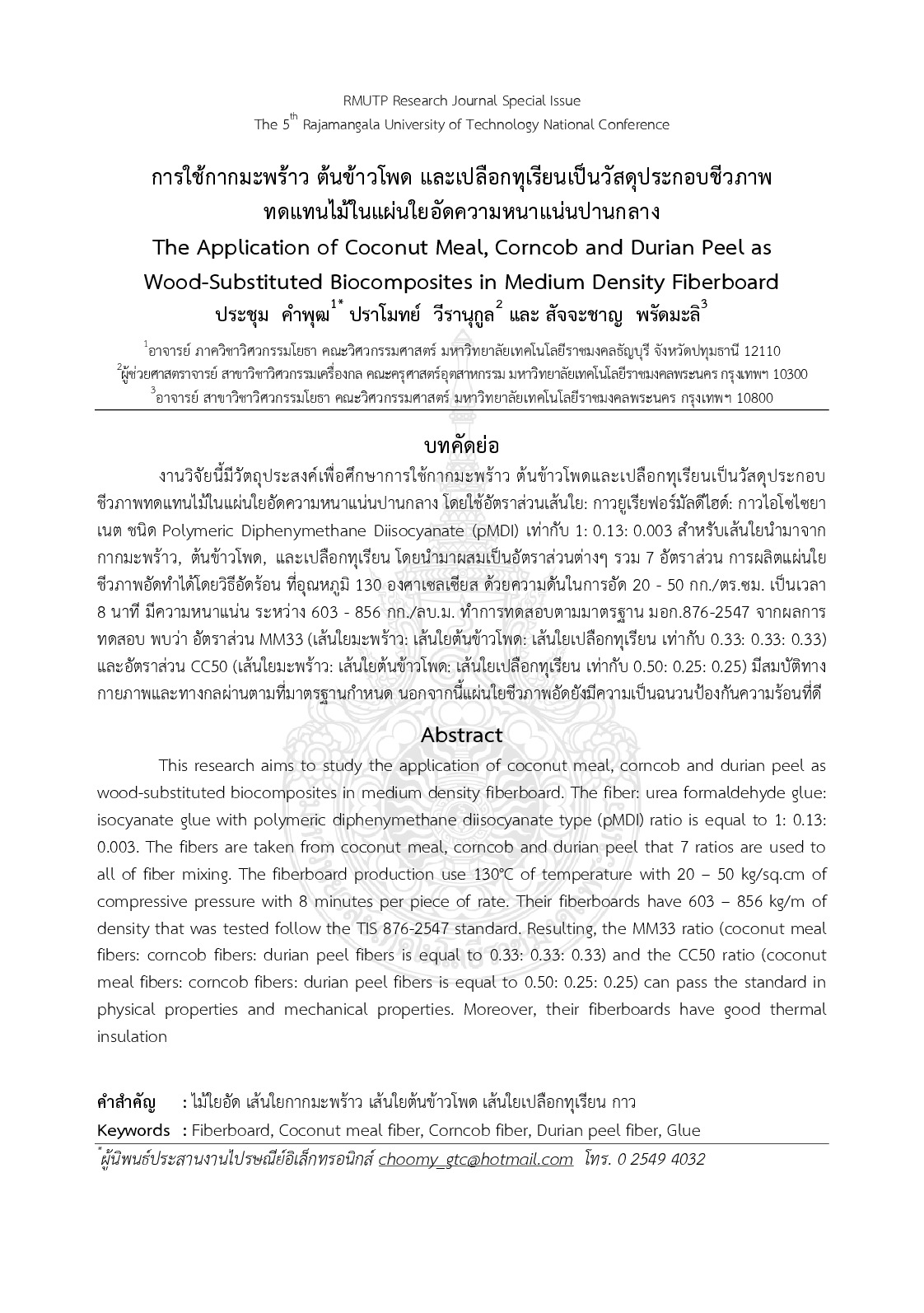
The application of coconut meal, corncob and durian peel as wood-substituted biocomposites in medium density fiberboard
This research aims to study the application of coconut meal corncob and durian peel as wood-substituted biocomposites in medium density fiberboard. The fiber: urea formaldehyde glue: isocyanate glue with polymeric diphenymethane diisocyanate type (pMDI) ratio is equal to 1: 0.13: 0.003. The fibers are taken from coconut meal corncob and durian peel that 7 ratios are used to all of fiber mixing. The fiberboard production use 130?C of temperature with 20 – 50 kg/sq.cm of compressive pressure with 8 minutes per piece of rate. Their fiberboards have 603 – 856 kg/m of density that was tested follow the TIS 876-2547 standard. Resulting the MM33 ratio (coconut meal fibers: corncob fibers: durian peel fibers is equal to 0.33: 0.33: 0.33) and the CC50 ratio (coconut meal fibers: corncob fibers: durian peel fibers is equal to 0.50: 0.25: 0.25) can pass the standard in physical properties and mechanical properties. Moreover their fiberboards have good thermal insulation
แผ่นใยอัดจากเส้นใยต้นมันสำปะหลัง
This research aims to study the application of cassava fiber. The fibers are taken from cassava and pineapple Head that 3 ratios are used to all of fiber mixing. The fiberboard production use 130°C of temperature with 20 – 50 kg/sq.cm of compressive pressure with 10 minutes per piece of rate. Their fiberboards have 681 – 724 kg/cu.m of density and 7.1 – 7.6 % of moisture. Resulting the CF 05 ratio (cassava: urea is equal to 0.95:0.13) is suitable ratio which has good physical and mechanical properties.
การใช้กากมะพร้าว ตันข้าวโพดและเปลือกทุเรียนเป็นวัสดุประกอบชีวภาพทดแทนไม้ในแผ่นใยอัดความหนาแน่นปานกลาง
This research aims to study the application of coconut meal corn cob and durian peel as wood-substituted biocomposites in medium density fiberboard. The fiber: urea formaldehyde glue: isocyanate glue with polymeric diphenymethane diisocyanate type (pMDI) ratio is equal to 1: 0.13: 0.003. The fibers are taken from coconut meal corn cob and durian peel that 7 ratios are used to all of fiber mixing. The fiberboard production use 130°C of temperature with 20 – 50 kg/sq.cm of compressive pressure with 8 minutes per piece of rate. Their fiberboards have 603 – 856 kg/m of density that was tested follow the TIS 876-2547 standard. Resulting the MM33 ratio (coconut meal fibers: corn cob fibers: durian peel fibers is equal to 0.33: 0.33: 0.33) and the CC50 ratio (coconut meal fibers: corn cob fibers: durian peel fibers is equal to 0.50: 0.25: 0.25) can pass the standard in physical properties and mechanical properties. Moreover their fiberboards have good thermal insulation.