จำนวน Repository ( 12 )

ศักยภาพภูมิปัญญาท้องถิ่นด้านอาหารพื้นบ้านของชุมชนแพรกหนามแดง อำเภออัมพวา จังหวัดสมุทรสงคราม
The purposes of this research were to investigate the types of local foods of Praknamdaeng Community The potential of local wisdom of the community’s traditional foods in the aspect of raw material resources production process commercial production wisdom transfer in Praknamdaeng Community and Study knowledge of food ingredients method traditional food in Praknamdaeng Community. This research design was survey research conducted by in-depth interviews with 12 local food experts who have lived in six villages of Praknamdaeng Community. Two people per village were purposively selected. The research tools were interview forms a tape recorder and a camera. The data were analyzed by mean percentage and rating scales. The study revealed that 1. There are 132 types of local foods were found and classified into three groups namely main dish dessert as well as preserved and processed foods. 2. As for the potential in raw material resources two types of traditional foods were at a high level and in the aspect of the potential in production process all kinds of the foods were also at a high level preserved and processed foods .From the result of wisdom transfer all types of the foods were at a moderate level 3. As a result of the collection of the knowledge of food ingredients and cooking methods the commonly used meat to cook main dishes were found in the local areas and Meats such as Thai fish tilapia mullet sea catfish snapper mackerel shrimp shrimp shrimp crab sea crab etc. Vegetables such as vegetables vegetables sprout etc. Most sweeteners use coconut milk coconut sugar and sugar. Food preservation and food processing will use raw materials such as fish shrimp and use salt as an ingredient in preserving such as drying preserving by using salt etc. In addition the traditional cooking methods of the local in Praknamdaeng Community most of the red curry dishes are made from curry with local vegetables are used in the local cooking such as hot and sour soup with phak kom hin (Trianthema portulacastrum) hot and sour soup with cha-kram (seablite) hot and sour soup with phak plang (Bacella alba Linn.) hot and sour soup with sano (Sesbania javanica Mig.) flower kaeng liang (spicy herb soup) with phak kom hin (Trianthema portulacastrum) kaeng oom (dill soup) with nam pung do. Nowadays the ready-made curry paste which is available in the market is normally used. If any vegetables used were bitter salty or astringent they would be boiled before cooking. Most of the desserts such as khanom tom (Thai coconut munchkins) khuay buat chi (banana in sweet coconut milk) buat fak thong (pumpkin in sweet coconut milk) soft sweet sticky rice pudding with young coconut meat and tapioca pearl pudding with young coconut meat.There is no easy way to do that. Food preservation and processing were sun-dried fish and deep-fried marinated fish
การพัฒนาศักยภาพผลิตภัณฑ์เนื้อสัตว์แปรรูปเสริมกากสับปะรดที่เหลือจากการคั้นน้ำ
The potential development the of processed meat products enhancing pineapple pulp left by juicing. Pattawia pineapple pulp used in research. Boil to extract the acid and sugar. The pulp looks like fresh pulp light yellow. The processed meat products used includecoarse ground pork sausage pork ball and Moo Yor. Pineapple pulp supplementation in coarse ground pork sausages could be supplemented by up to 15 percent. Pork balls can be supplemented up to 20 percent and Moo Yor can be added up to 10 percent. The addition of pineapple pulp to processed meat products resulted in an increase in crude fiber content in all 3 processed meat products. At the same time resulting in light processed meat products and has a reduced texture characteristics score which affects acceptance. Consumer acceptance test in The potential development the of processed meat products enhancing pineapple pulp left by juicing for 100 tester found that most testers are more than 80 percent acceptance in the product of The potential development the of processed meat products enhancing pineapple pulp left by juicing.
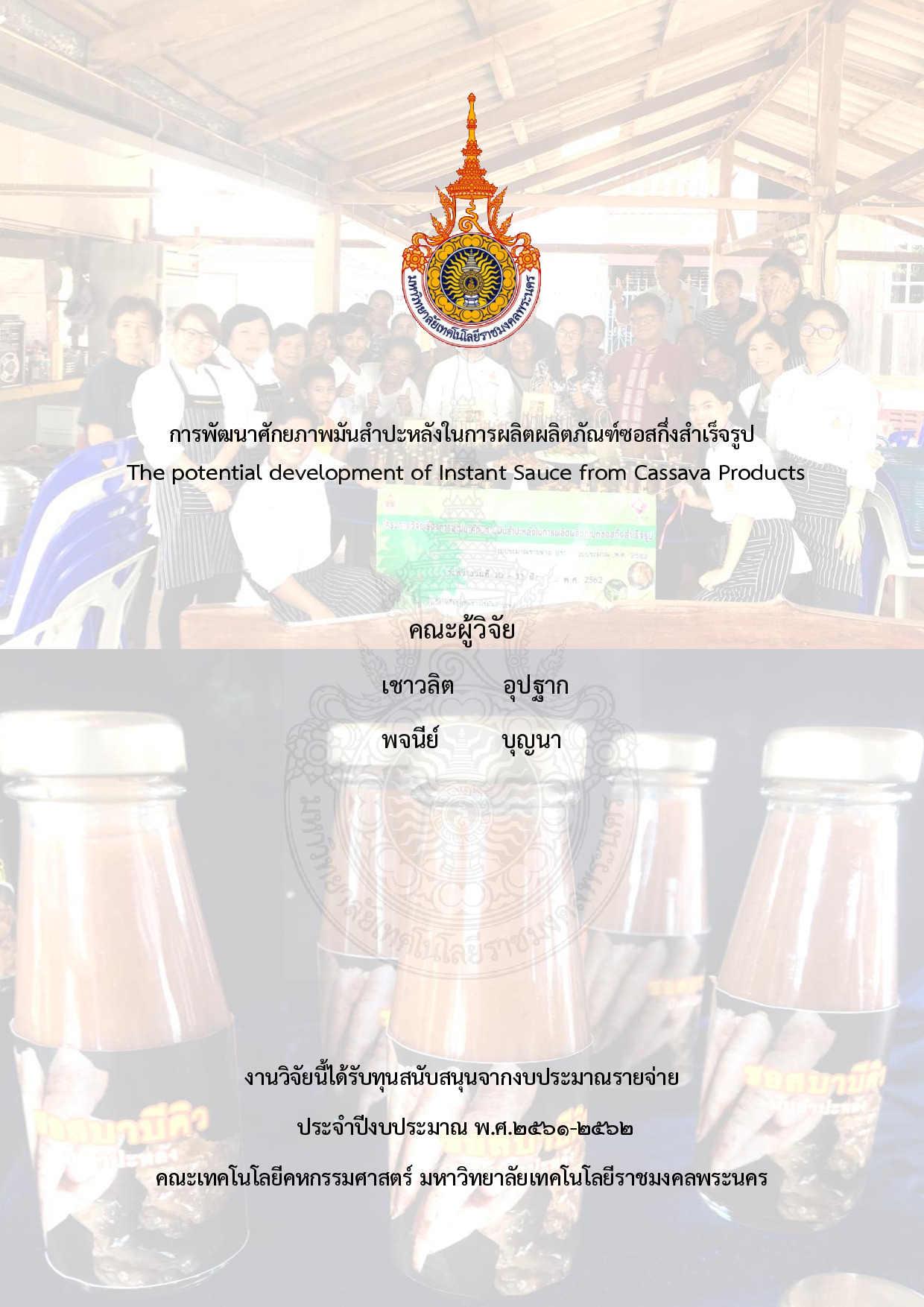
การพัฒนาศักยภาพมันสำปะหลังในการผลิตผลิตภัณฑ์ซอสกึ่งสำเร็จรูป
This research has objectives to study about production process of four types of finished sauce product made from cassava to study about quality of finished sauce product made from cassava to study about consumer test towards finished sauce product made from cassava. From the test it was found that study about quantity of suitable cassava supplement to the four types of finished cassava product by testing about acceptance of testers who were 40 instructors in field of Food and Nutrition field of Food and Nutrition Science and field of Food Service Industry. The method was to give marks for favor in type of 9-point hedonic scale by supplementing cassava into Teriyaki Sauce at levels of 0 20 40 and 60 percent of total ingredient. It was found that the testers accepted the sauce at level of 20 percent which was in the most favorite level. Semi-finished frying sauce supplemented with cassava at level of 0 40 60 and 80 percent of total ingredient; it was found that the testers accepted the level of 60 percent of Barbeque sauce supplemented with cassava at level of 0 40 60 and 80 percent of total ingredient; it was found that the testers accepted level of 40 percent in the level of much favor of semi-finished flavored fermented frying sauce supplemented with cassava at level of 0 20 40 and 60 percent of total ingredient it was found that the testers accepted the sauce at level of 40 percent which is in the level of much favor. Nutritional value of semi-finished sauce product it was found that Teriyaki sauce for 20 percent has moisture value of 78.66 percent fat value of 1.08 percent fiber for 1.36 percent ash for 2.29 percent and protein for 3.34 percent. Semi-finished frying sauce it was found that semi-finished frying sauce supplemented with cassava for 60 percent had moisture value of 80.85 percent fat value of 0.55 percent fiber for 1.35 percent ash for 3.35 and percent and protein for 3.29 percent. cassava for 60 percent it was found that chemical quality had moisture for 82.31 percent fat value for 0.75 percent fiber for 1.51 percent ash for 2.41 percent and protein for 3.37 percent. Semi-finished fermented flavored sauce it was found that semi-finished fermented flavor sauce supplemented with cassava for 40 percent it was found that chemical quality had moisture value for 83.67 percent fat value for 0.07 percent fiber 4.54 percent ash for 4.54 percent and protein for 2.42 percent. However supplementing of cassava into process of finished food products of 4 types; supplementing can be made but there shall be realizing about chemical elements of starting components for example moisture and fat quantity. These components may have effect on physical features for example smell smell and taste and texture. These features affected acceptance of products. The result of study about acceptance of consumers (Consumer test) towards product of semi-finished sauce supplemented with cassava and 100 consumers in Faculty of Home Economics Technology Rajamangala University of Technology Phra Nakhon and people in Tevet Market. Feeling towards acceptance of semi-finished sauce product supplemented with cassava it was found that consumers were satisfactory towards Teriyaki sauce product in moderate favor level having feeling on product in appearance color smell smell and taste in moderate favor level. Feeling towards acceptance of semi-finished sauce product it was found that consumers were satisfactory towards semi-finished frying sauce product 60 percent in moderate favor level having feeling on product in appearance color smell smell and taste in moderate favor level. Feeling towards acceptance of semi-finished fermented sauce product it was found that consumers were satisfactory towards semi-finished fermented sauce product 75 percent in moderate favor level having feeling on product in appearance color smell smell and taste in moderate favor level. Result of technology transfer in project of cassava potential development in production of semi-finished sauce product Tapioca Farmer Community Enterprise Group 480 Khon Buri District and Nong Bunmak District Nakhon Ratchasima Province 45 trainees; most were female having age of 36-45 years to be 96.00 percent. From evaluation it was found that 45 respondents used knowledge to be 100 percent and satisfactory of service receivers in academic aspect and professional aspect towards benefit from service of trainees in level from much to the most to be 100 percent.
ศักยภาพภูมิปัญญาท้องถิ่นด้านอาหารพื้นบ้านเพื่อเพิ่มมูลค่าพืชท้องถิ่น ของชุมชนแพรกหนามแดง อำเภออัมพวา จังหวัดสมุทรสงคราม
The purposes of this research were to investigate the types of local foods of Praknamdaeng Community and the potential of local wisdom of the community’s traditional foods in the aspect of raw material resources production process commercial production wisdom transfer as well as to collect the knowledge of food ingredients and cooking methods in Praknamdaeng Community Amphawa Samutsongkhram. This research was conducted by in-depth interviews with 12 local food experts who have lived in six villages of Praknamdaeng Community. Two people per village were purposively selected. The research tools were interview forms a tape recorder and a camera. The data were analyzed by mean percentage and rating scales. The study revealed that 132 types of local foods were found and classified into three groups namely main dish (75%) dessert (15.15%) as well as preserved and processed foods (9.85%). As for the potential in raw material resources two types of traditional foods were at a high level (100%) and in the aspect of the potential in production process all kinds of the foods were also at a high level preserved and processed foods (84.62%) and dessert (80%) and main dish was at a moderate level (54.55%) Furthermore the potential in preserved and processed food’s commercial production was at a high level (53.85%) whereas the potential in dessert’s commercial production was at a moderate level (45%) and the potential in main dish was at a low level (59.60%). From the result of wisdom transfer all types of the foods were at a moderate level including dessert (100%) preserved and processed foods (100%) and main dish (67.67%). As a result of the collection of the knowledge of food ingredients and cooking methods the commonly used meat to cook main dishes were found in the local areas and consisted of cuttle fish tilapia long-whiskered catfish mullet sea catfish sea bass rock cod mackerel bream white bait nile tilapia shakehead fish giant tiger prawn banana shrimp jinga shrimp sea crab and salt mardi crab. Moreover the vegetable ingredients were phak plang (Bacella alba Linn.) cha-kram (seablite) luk sam sip (Asparagus race mosus willd) phak bia (rose moss) nam pung do (Azima sarmentosa Benth) and phak kom hin (Trianthema portulacastrum). Most dessert ingredients were coconut milk palm sugar and granulated sugar whereas the ingredients of preserved and processed foods were fishes shrimps and salt which were used to preserve foods; for example drying salting etc. In addition the findings showed that the main dishes’ cooking methods of six villages were curries with local vegetables including hot and sour soup with phak kom hin (Trianthema portulacastrum) hot and sour soup with cha-kram (seablite) hot and sour soup with phak plang (Bacella alba Linn.) hot and sour soup with tua tob tab (Derris trifoliate Lour.) hot and sour soup with yod prong thalee (queen sago leaf) hot and sour soup with sano (Sesbania javanica Mig.) flower kaeng liang (spicy herb soup) with phak kom hin (Trianthema portulacastrum) kaeng oom (dill soup) with nam pung do leaf and red curry with Nipa palm’s fruit. Nowadays the ready-made curry paste which is available in the market is normally used. If any vegetables used were bitter salty or astringent they would be boiled before cooking. Most of the desserts were boiled ones such as khanom tom (Thai coconut munchkins) khuay buat chi (banana in sweet coconut milk) buat fak thong (pumpkin in sweet coconut milk) green beans in light syrup soft sweet sticky rice pudding with young coconut meat and tapioca pearl pudding with young coconut meat. Due to lots of fishes all year-round most of the favorite preserved and processed foods in the community were sun-dried fish and deep-fried marinated fish.
การเปรียบเทียบผลสัมฤทธิ์ทางการศึกษาของนักศึกษาระดับปริญญาตรี ประเภทโควตาและ การสอบคัดเลือกของ มหาวิทยาลัยเทคโนโลยีราชมงคลพระนคร กรณีศึกษาคณะเทคโนโลยีคหกรรมศาสตร์
การเปรียบเทียบผลสัมฤทธิ์ทางการศึกษาของนักศึกษาระดับปริญญาตรี ประเภทโควตาและ การสอบคัดเลือกของ มหาวิทยาลัยเทคโนโลยีราชมงคลพระนคร กรณีศึกษา คณะเทคโนโลยีคหกรรม ศาสตร์ วัตถุประสงค์ของโครงการวิจัย เพื่อเปรียบเทียบผลการเรียนระหว่างนักศึกษาประเภทโควตา และการสอบคัดเลือกของมหาวิทยาลัยเทคโนโลยีราชมงคลพระนคร เพื่อเปรียบเทียบพัฒนาการ ทางการเรียนระหว่างนักศึกษาประเภทโควตา และการสอบคัดเลือกของมหาวิทยาลัยเทคโนโลยี ราชมงคลพระนคร ขอบเขตของโครงการวิจัยการศึกษาครั้งนี้เก็บรวบรวมข้อมูลโดยการใช้ แบบสอบถาม (Questionnaire) กลุ่มตัวอย่างในการศึกษาคือ นักศึกษาชั้นปีที่ 2 คณะเทคโนโลยี คหกรรมศาสตร์ ระยะเวลาในการศึกษา ปีการศึกษา 2555 ประเภทโควต้า และรับตรง จำนวน 292 คน เป็นนักศึกษาโควต้า จำนวน 203 คน นักศึกษารับตรง 89 คน ผลการศึกษา พบว่า ๑. การศึกษาเปรียบเทียบผลการเรียนระหว่างนักศึกษาประเภโควตาและการสอบคัดเลือก ของมหาวิทยาลัยเทคโนโลยีราชมงคลพระนคร ผลปรากฏว่านักศึกษาส่วนใหญ่มีผลการเรียนอยู่ที่ ระหว่าง ๓.๐๑ - ๓.๕๐ จำนวน ๑๒๙ คน รองลงอยู่ระหว่าง ๒.๕๑ – ๓.๐๐ จำนวน ๑๐๐ คน ทั้ง นักศึกษาประเภทโควตาและสอบคัดเลือกของมหาวิทยาลัยเทคโนโลยีราชมงคลพระนคร ทำให้ผลการ เปรียบเทียบของนักศึกษาทั้งสองประเภทไม่มีความแตกต่างกันทางนัยสำคัญทางสถิติที่ระดับ ๐.๐๕ ทั้งการเปรียบเทียบในสาขาเดียวกันและการเปรียบเทียบในภาพรวม ๒. ผลการเปรียบเทียบพัฒนาการทางการเรียนระหว่างนักศึกษาโควตาและการสอบ คัดเลือกของมหาวิทยาลัยเทคโนโลยีคหกรรมศาสตร์ ผลปรากฏว่าไม่แตกต่างกันเพราะนักศึกษาส่วน ใหญ่เป็นนักศึกษาระดับมัธยมศึกษาปีที่ ๖ จำนวน ๒๔๔ คน ซึ่งยังไม่มีทักษะทางด้านคหกรรม ศาสตร์มาก่อน มาได้รับความรู้จากการเรียนในห้องเรียนพร้อมกัน จึงมีพัฒนาการทางการเรียนรู้ใน ทุก ๆ ด้านใกล้เคียงกัน