จำนวน Repository ( 48 )
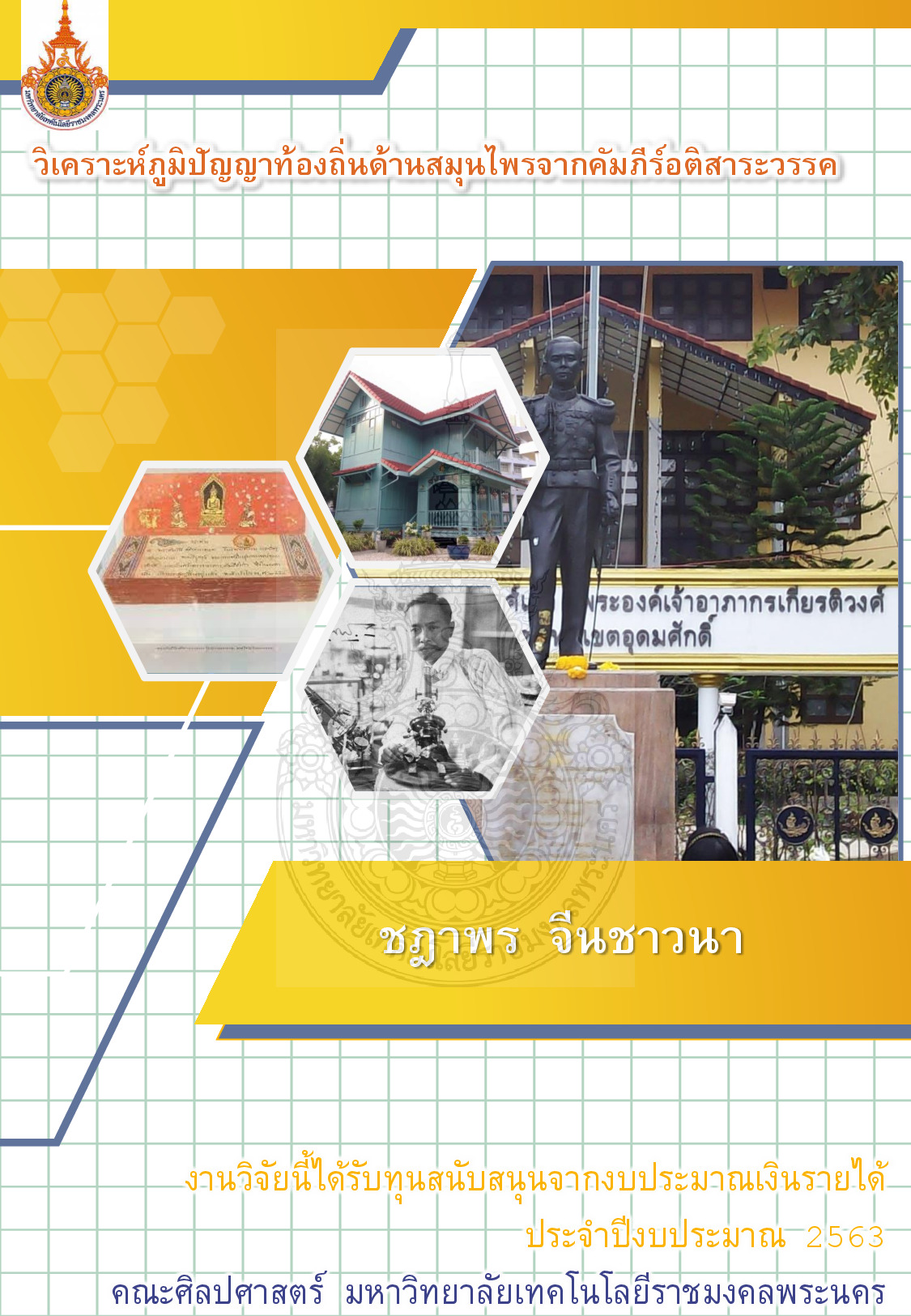
วิเคราะห์ภูมิปัญญาท้องถิ่นด้านสมุนไพรจากคัมภีร์อติสาระวรรค
The study entitled “An Analysis of Local Wisdom on Herbs from Anti Sara Wak Scripture” is a mixed-method research. The research objectives were to evaluate the value of Anti Sara Wak scripture and to analyze beliefs in Thai society which occurred in this scripture. The samples of the study obtained from a convenient sampling were five experts of Nang Leong community. The research instrument used for data collection was questionnaire consisting of 4 parts: part 1 respondents’ general information part 2 and 3 relevant to the experience in using herbal medicine and the faith in Admiral Prince Abhakara Kiartivongse Prince of Chumphon or the author of Anti Sara Wak scripture and part 4 the open-ended section asking suggestions to further investigate Anti Sara Wak and beliefs in Thai society which appeared in this scripture. In addition the depth interview was also used to collect the data from 5 experts of Nang Leong community. The data were then analyzed to find out the value of Anti Sara Wak and beliefs in Thai society from the scripture. The majority of the respondents were elderly people. The oldest respondent was 79 years old. These respondents rated the questionnaire: 5 for strongly agree 4 for agree 3 for neutral 2 for disagree and 1 for strongly disagree reporting their attitudes towards the use of Thai herbal medicine. The results of the study show that the respondents strongly agreed with the use of Thai herbal medicine in daily life (80%) because it was suitable responding to the objective. They also added that Anti Sara Wak scripture should be publicized (90%). However there was little information available on Thai herbal medicine (30%). Additionally the results showed a strong faith in Admiral Prince Abhakara Kiartivongse Prince of Chumphon (90%). The results of analyses show that there were beliefs in Thai society that appeared in Anti Sara Wak scripture especially folklore beliefs such as superstitious beliefs holy things as well as tips and forbidden rules. Therefore Anti Sara Wak scripture provided empirical evidence in Thai history showing its value as one of Thai traditional medicine recipes.
การจัดการความรู้ภูมิปัญญาท้องถิ่นเพื่อพัฒนาผลิตภัณฑ์ชุมชนสู่ความยั่งยืน
Area status of the Pak Chong Subdistrict Administrative Organization Chom Bueng District Ratchaburi Province Able to demonstrate community capital and potential In dealing with the situation In the area consists of 3 parts: ( 1) The context of the area It is information that gives rise to an understanding of the history of the district. Economic topography Society culture and traditions Domination Community environment including And the target population in the area (2) development path It is information of the situation or problem of the area. Tasks or activities that meet Affected people Associated social capital And performance demonstrated by the time it has taken place and in this section it reflects the concepts and principles for developing or dealing with the status or problems of the area that are consistent with the vision and mission. Of the local government organization And (3) the capital and potential of the area Social capital is an intriguing background used to deal with the situation and problems of the area. ( 1) Person ( 2) Social group Community organizations ( 3) self-managing agencies and villages It is to bring the problems and needs of the people in the area as the ones in their work. And social capital in the area Co-think co-do Until the effect led to the change Both the normal situation And crisis To happen in the future keeping pace with the events Which shows the potential of the area in which In self-management.
การจัดการนวัตกรรมและภูมิปัญญา : การเปลี่ยนผ่านของสถาบันการเงินชุมชนเขตภาคกลางตอนล่าง
This research is about the management of innovation and wisdom: transitions of community financial institutions in the lower central region. The objective is to study solutions to financial problems for members of financial institutions by recommending the knowledge of the _risk of incomes knowledge of credits arising from financial corporation loans and analyses of financial security conditions. It studies the process of hedging the income risks against the returns from credit or loan services. This is to be guidelines for developing and solving the financial problems of financial institutions in line with the lifestyle of financial organization members in the lower central region; Phetchaburi Kanchanaburi and Ratchaburi provinces. This research is mixed methods; both quantitative and qualitative. Quantitative data includes descriptive statistics to describe the status of household members in the lower central region classified by the nature of the information in terms of economy society households and infrastructure conditions. The total value percentage and mean are analyzed by logistic regression to determine the relationship of the variables. Qualitative data come from interview methods and focus groups as well as applications of participatory action research. The research results showed that: 1.The majority of the farmers was female (63.7 percent) and were in the age range of 51-55 years old (38.8%). There were farmers with marriage-marital status (55.3%) secondary-school-level education (34.25%)1-3 household members (51.2%) farmers with incomes ranging from 10001 -20000 baht (39%) and farmers with expenses from 5001 - 10000 baht (28.7%). There were the need to increase knowledge of risks from training. Knowledge of financial transactions showed that farmers have the need for training (78.8%) and the need of training about proper financial planning showed that farmers have 100 percent of training needs. 2.The causes of indebtedness for the farmers in the lower central region include new debts to repay existing debts (21.4%) housing debts (20.8%) consumption debts (19.6%) childrens education loans (18.8%) investment in agriculture (17.1 %) the impulse side of access to government policies (2.3%) as well as health problems. Most farmers who have debts from borrowing often encounter failures from borrowing to invest in agriculture. They lack professional knowledge lack financial disciplines among farmers such as borrowing to repay old debts causing insufficient funds for investment lack of planning for future savings and of accounting for income and expenses. Problem-solving suggestions: It is very important to educate the households as a partner of cooperation. Education about the financial risks will lead to the hedging process to be consistent with the way of life of the community leading to concrete actions and to development throughout the course. This also includes the ability to improve and modify operations to be successful during operational processes as well as development processes ranging from thinking decision-making planning its implementation and evaluation. Hedging against debt risks is essential for members to be educated. In financial management risk analysis is related to financial obligations. Financial knowledge will bring benefits to the public and will strengthen financial management capabilities leading to an increase of incomes. The learning process through practice has the following important steps of operational processes and practices. 1. Planning. It is a participatory process between the researchers and the target groups to solve financial problems as well as hedging financial risks of the target groups. It starts with a suNey of current conditions an exploration of the problems of the targets and data analyses as the main mechanism for participation. It also includes the process of using tools for recording incomes and expenses and the analyses of those data for solving problems at the household levels. 2. Making-it-real practice. It is about the method of credit analysis to implement the plan and about its improvement. It uses data from recording incomes and expenses of members. 3. Conclusion and reflection. It is the 3rd stage component of learning from practice to solving financial problems. It works through learning activities with the method of training-based education as well as the follow-up and evaluation of results leading to support the processes for the prevention of financial and debt problems. Especially providing knowledge on the recording of incomes expenditure savings risk management and personal finance management are needed to take into consideration in terms of their importance. 4. Exchange of knowledge. There are activities such as summarizing lessons and exchanging knowledge continuously. This is considered as an important element that will lead to the integrated solutions of the debt problems. It is the consequence of having the opportunity to summarize lessons on their own and then yielding personal development.
การพัฒนารูปแบบผลิตภัณฑ์หัตกรรมชุมชนเตยปาหนันจากภูมิปัญญาท้องถิ่น บ้านร่าหมาด ตำบลเกาะกลาง อำเภอเกาะลันตา จังหวัดกระบี่
Development guideline local wisdom product of Pandanus Odortissimus Linn. Banramad Lanta Krabi a purpose (1) the study local wisdom product of Pandanus Odortissimus Linn. (2) Develop guideline product for handicraft demand with the customer (3) Develop guideline productBased on local wisdom. The collect information local wisdom product of Pandanus Odortissimus Linn. Banramad Lanta Krabi With the method of interview and develop product for handicraft demand with the customer. The sample is People interested product of Pandanus Odortissimus Linn. The research results (1) product of Pandanus Odortissimus Linn. Banramad Lanta Krabi has evolved from a product of mats used since the ancestors and inherit. Developed according to usage until the group Pandanus Odortissimus Linn. Banramad Lanta Krabi Since 1999 has developed products for sale In other product. Emphasize the fairness in the form of traditional wisdom and the productivity of its members group Pandanus Odortissimus Linn. Banramad Lanta Krabi (2) Develop guideline product for handicraft demand with the customer provide feedback on product variations results Most of the respondents were female 198 representing 80.77 % age range 51-60 years 102 persons or 38.46%. And give opinions aspect convenience on form bag (=4.6) pattern ( =4.5) and benefit ( =4.4)
การออกแบบเครื่องแต่งกายที่สะท้อนความงามของภูมิปัญญาการทอผ้าไหมแพรวา
This thesis fashion is intended to study the development of a apparel model that reflects the beauty of wisdom. Silk cloth by study of patterns and Yotkan woven silk weaving to develop a ladies style costume. By bringing the appearance of the material and that can be taken and the pattern and color of silk to blend with clothing techniques. On the costume make the wearer elegant and reduce the cost of Dasuea fabric from the silk cloth. The tools used in this study are two analytical types including material and weaving equipment with 2 aspects of analytical analysis. 1) Layout 2) pattern and type fabric analysis silk prairie with 2 side analysis criteria 1) pattern 2) color focuses on physical characteristics and overall analysis to create a apparel model. The outcome of the study showed that the appearance of the material and weaving equipment looks as a geometric shape. There is a clear layout and appearance of silk fabric Khit and Jok fabric providing a beautiful pattern and the information that has been applied to the apparel design by pay attention to the theme and choosing the right silk cloth to cut into the clothes to make the costumes look beautiful and attractive. It also reduces production costs.