จำนวน Repository ( 12 )

การศึกษาและพัฒนากรรมวิธีการบ่มมะม่วงเพื่อการบรรจุกระป๋อง
This research is conducted in order to increase % yield of mango cannig. It is found that using 1800 ppm ethtlene solution can increase % yield up to 87.5% more than using calcium carbide which could reach 57.25% yield. Next mango canning process is analyzed. In sterilization process two temperature levels.are controlled:103 C for 15 minutes F=1 minute 107 C for 9 minutes F=1 minute physical property of the product is analyzed and found that both temperature levels give the identical results; statistical significance (p 0.05). Canned mango sterilized at 107 C for 9 minutes is selected. Chemical analysis indicates that total soluble solids content is 27.5 Brix pH = 4.6 dietary fiber = 0.43 grams for mango 100 grams
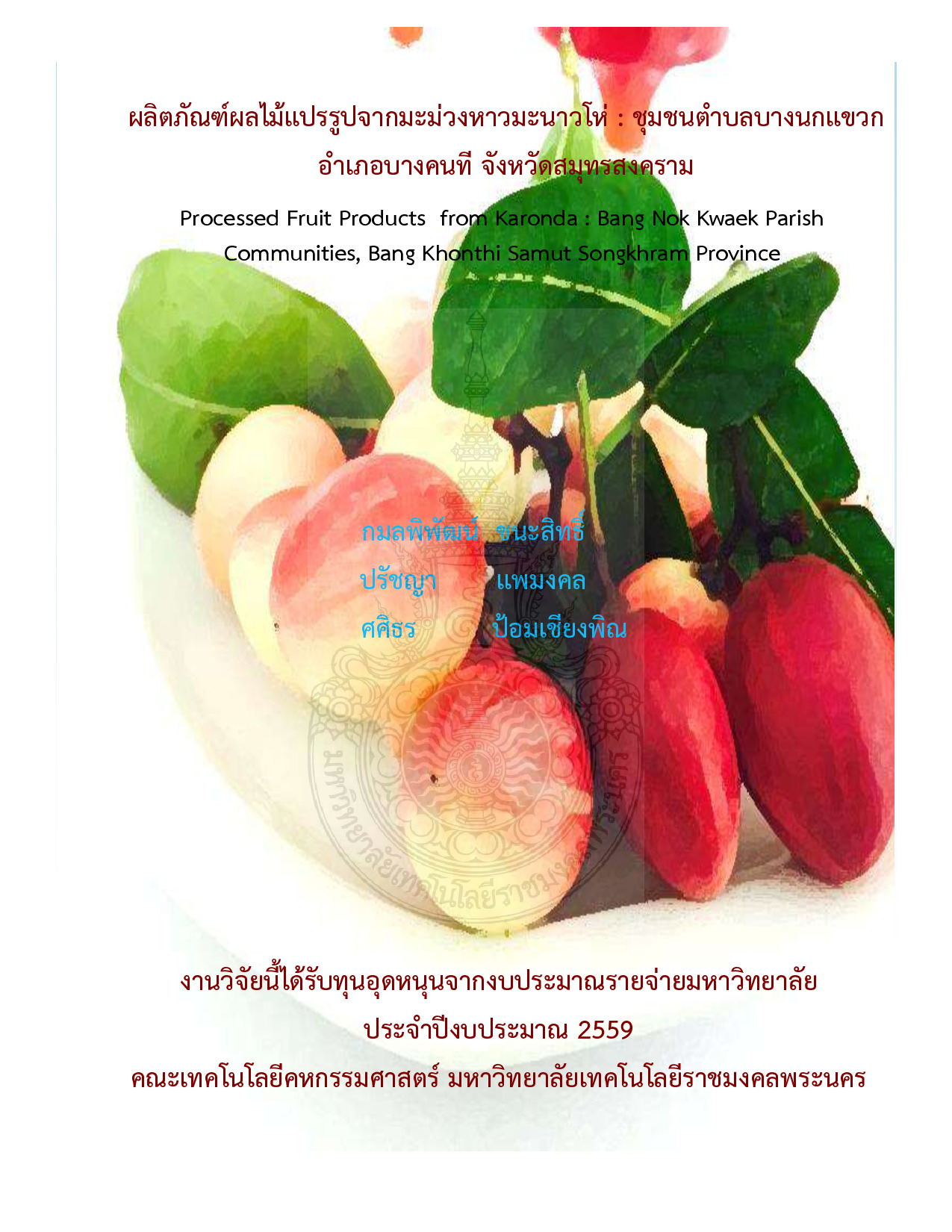
ผลิตภัณฑ์ผลไม้แปรรูปจากมะม่วงหาวมะนาวโห่ : ชุมชนตำบลบางนกแขวก อำเภอบางคนที จังหวัดสมุทรสงคราม
The purpose of the study of processed fruit products from Karonda : Bang Nok Kwaek parish communities Bang Khonthi Samut Songkhram Province is to study the proper quantity of the Koranda fruit in the product the quality in the product’s process and the consumers’ acceptance (Consumer Test) in the product. The processed products are Karonda fruit jelly instant pasteurized Karonda fruit juice with extra fiber Karonda fruit sorbet Karonda fruit yoghurt ice-cream and concentrated juice (sauce) for drink mixing. The product has been tested by Randomized Complete Block Design (RCBD) method. The process was consisted with offering a tasting and evaluated in color scent taste matter and overall satisfaction by giving 9 point Hedonic scale from 70 consumers. And has been compared the difference of average means at 95% trustiness by Duncan’s New Multiple Range Test (DMRT) by an instant statistical analysis software. The result information is as the followings; The physical properties indicates of Karonda fruit the total acidity of 2.30 with the pH and the color was found that the brightness (L *) of 16.52 fee (a *) equal to 8.95 and (b. *) equals 5.37. The study of the chemical quality of Karonda fruit amount of energy in calories carbohydrates 73.2 percent 18.3 percent protein 1.57 percent 1.32 percent humidity fats fiber 83.7 percent ash 4.26 percent and 0.75 Vitamin C is found. The duration of ripening fruit yawning lemon booed affect the vitamin C in the fruit of the mango yawning lemon booed the oil will have more vitamin C than ripe to t 2 so I scratched the reduction of vitamin C may. Is due to be deployed as a compound to breathe. And led to the synthesis of new carbon structures during ripening. Karonda fruit jelly. The most acceptances level for Karonda fruit juice in the product is at 1:6 for its best flexibility. Since the juice concentration affects the jelly as it lowers the matter (flexibility). Too much of acid in Karonda fruit juice is able to unstabilize jelly matter. From the study of Pectin quantity the consumer has the most acceptance at the level of 10 grams which is the best recipe that keeps the good jelly matter (flexibility) stabilized. The physical properties indicates that there are the level of color hue at 5R color brightness at Value 4 Chroma at 14 sweetness at 35 Brix and pH at 3.05. The study of the chemical quality of Karonda fruit jelly in each 100 grams provides 120 kilocalories of energy 69.60 grams of humidity 0.11 gram of fat 29.80 grams of carbohydrate 0.41 gram of fiber 0.50 gram of ash and 0.45 gram of acidity. The consumer satisfaction is at 97.30 percent. Instant pasteurized Karonda fruit juice with extra fiber. The acceptance is at 100 percent of replacing Okra fruit juice by Karonda fruit juice. The acceptance study shows that the most proper fiber quantity adding to Karonda fruit juice is at 15 percent. The acceptance study shows that the most proper Pectin quantity affecting coconut jelly spreading is at 3 percent. The analysis results of the physical properties indicate that instant pasteurized Karonda fruit juice with extra fiber has color hue level at 5R value at 4 and Chroma at 12 which rendered the product to dark red. Also the pH level is at 3.29 sweetness is at 17 Brix firness g force 1 is at 11.29 g Viscosityag.sec AREA F-T 1:2 is at 339.507 ag.sec. The study of the chemical quality of Karonda fruit juice in each 100 grams provides 63.3 kilocalories of energy 83.9 grams of humidity 0.01 gram of fat 0.10 gram of protein 15.8 grams of carbohydrate 0.41 gram of fiber 0.24 gram of ash and 0.18 gram of pH balance. The consumer satisfaction to instant pasteurized Karonda fruit juice with extra fiber is at 98.66 percent. Karonda fruit sorbet. The most proper quantity of Karonda fruit juice is at 30 percent. The physical properties of Karonda fruit sorbet contain the brightness level at L*34.32 red color level at a*41.26 yellow color level at b*21.18 meltable solid quantity at 30*Brix and pH balance at 2.40. The study of the chemical quality of Karonda fruit sorbet in each 100 grams provides 91.8 kilocalories of energy 77.1 grams of humidity 0.15 gram of fat <0.20 gram of protein 22.6 grams of carbohydrate 0.11 gram of fiber and 0.12 gram of ash. The consumer satisfaction to Karonda fruit sorbet is at 100 percent. Karonda fruit yoghurt ice-cream. The most proper quantity of Karonda fruit added in the yoghurt ice-cream is at 10 percent of the whole ingredient. The consumers’ acceptance has been given the most for its scent taste matter (smoothness) and overall satisfaction which has the average mean at 7.24 7.77 7.17 and 7.67 consequently. The physical properties of Karonda fruit yoghurt ice-cream contain the viscosity level at 364.798 cps. color hue at 10P Value at 8/6 Chroma at N9/.5 overrun statistics at 4.55 and Karonda fruit yoghurt ice-cream melting rate at 89.90. The chemical quality of Karonda fruit yoghurt ice-cream in each 100 grams provides 214 kilocalories of energy 64.0 grams of humidity 14.6 gram of fat 3.14 gram of protein 17.5 grams of carbohydrate 0.76 gram of fiber 0.74 gram of ash and 5.67 pH balance. The consumer satisfaction to Karonda fruit yoghurt ice-cream is at 100 percent. Concentrated juice (sauce) for drink mixing. The most acceptance recipe is the strawberry sauce recipe number 1 with the replacement of Karonda fruit at 80 percent. The physical properties contain the viscosity level at 9.28 cps sweetness at 21 Brix color hue at 5R Value at 2 and Chroma at 4. The chemical quality of concentrated juice (sauce) for drink mixing in each 100 grams provides 91.1 kilocalories of energy 77.2 grams of humidity 0.30 gram of fat 0.1 gram of protein 22.3 grams of carbohydrate 0.76 gram of fiber 0.4 gram of vitamin C and 0.56 of pH balance. The consumer satisfaction concentrated juice (sauce) for drink mixing is at the maximum satisfaction at 92.0 percent as the concentrated juice (sauce) emphasizes the better taste of smoothie drink mixing and easy to consume.
การพัฒนาผลิตภัณฑ์ข้าวแต๋นแบบไม่ทอดจากข้าวเหนียว
The objective of this thesis was to study the ratio of the black and white sticky rice in the recipe of non-fried rice cracker (Khao-tan) to develop syrup for product topping and to study the appropriate quantity of a cashew nuts for adding in the product. To study a physical and chemical nature of the product. To study the customers satisfaction in product. Firstly the appropriate ratio of the black and white sticky rice was studied. The result was the recipe that had 80% of white sticky rice and 20% of black sticky rice was voted to be the best. For the product topping that had a combination of glucose syrup and sugar was the best. Moreover the quantity of glucose syrup and sugar on product effects the customer’s satisfaction (color smell taste texture and the overall score). For the appropriate quantity of the cashew nut the formula 2 which has a 25% of cashew nuts was voted to be the best. Comparison of which non-cashew nuts and 25% cashew nuts formula the study revealed that the 25% cashew nuts formula had more nutrition (protein fat and fiber). Microbial population count <10 cfu/g. The product is able to keep in room temperature. The customer’s satisfaction reach to 94% in 25% cashew nuts formula.
Consumer acceptance and quality of ready to drink mahajanaka mango juice
Mahajanaka mango juice was health benefits and was a source of vitamins especially vitamin A in the form of beta carotene which a potent antioxidant. The purpose of this study was to consumer acceptance and quality of ready to drink mahajanaka mango juice the optimum ratio of mango pulp and water at 1:2 and 1:2.5 to 1:3. Result showed that the optimum ratio of mango pulp to water was 1:2. The mango juice contain of malic tartaric citric succinic and ascorbic acid at 0.005 0.053 0.180 0.005 and 0.138% respectively. The selected juice had 3.49 12.20oBrix 62.25 7.71 59.24 and 5.26 micrograms per gram of pH total soluble solids L * a * b * color values and beta-carotene content respectively. Sensory evaluation result revealed that the selected mango juice was accepted by 30 panelists which was medium like in color appearance odor taste and overall acceptability. Result of consumer test had shown that 97 % of 100 consumers from Lampang province were accepted and 65 % decided to buy the product.
Effects of foaming agents on the quality of mahajanaka mango by foam-mat drying
Mahajanaka mango (Mangifera indica L.) the yellow fruit had identity on color aroma and sweet taste. It had the highly potential to develop into a powdered beverage with a aroma and flavor similar to fresh fruit juices as possible. The objective of this study was to determine an appropriate foaming substance from 6 types ; Methocel? 65 HG Glyceryl monostearate (GMS) Carboxy methyl cellulose (CMC) Methocel? 65 HG mixed with GMS Methocel? 65 HG mixed with CMC and GMS mixed with CMC with 1:1 w/w with completely Randomized experimental design. Physicochemical properties of mahajanaka mango juice the color values L* a* b* pH total soluble solid citric acid and total solid equals 39.02 18.79 67.36 3.96 14.00๐Brix 0.40 milligram per 100 grams and 15.14%. The mahajanaka mango juice was adjusted 0.70% total acidity (as citric acid) 25๐Brix of total soluble solid and added 2.0% of maltodextrin. The result showed that an appropriate foaming agent was added 45% of 1.8% mixture of Methocel? 65 HG with CMC into mahachanaka mango juice. It had foam stability and density. The mahajanaka mango juice foam had values of stability density and overrun equals 0.001 milligram per min 0.14 gram per milligram and 602.11% respectively and Scanning Electron Microscope (SEM) had a porous structure with sphere and ellipsoid particle.