จำนวน Repository ( 9 )
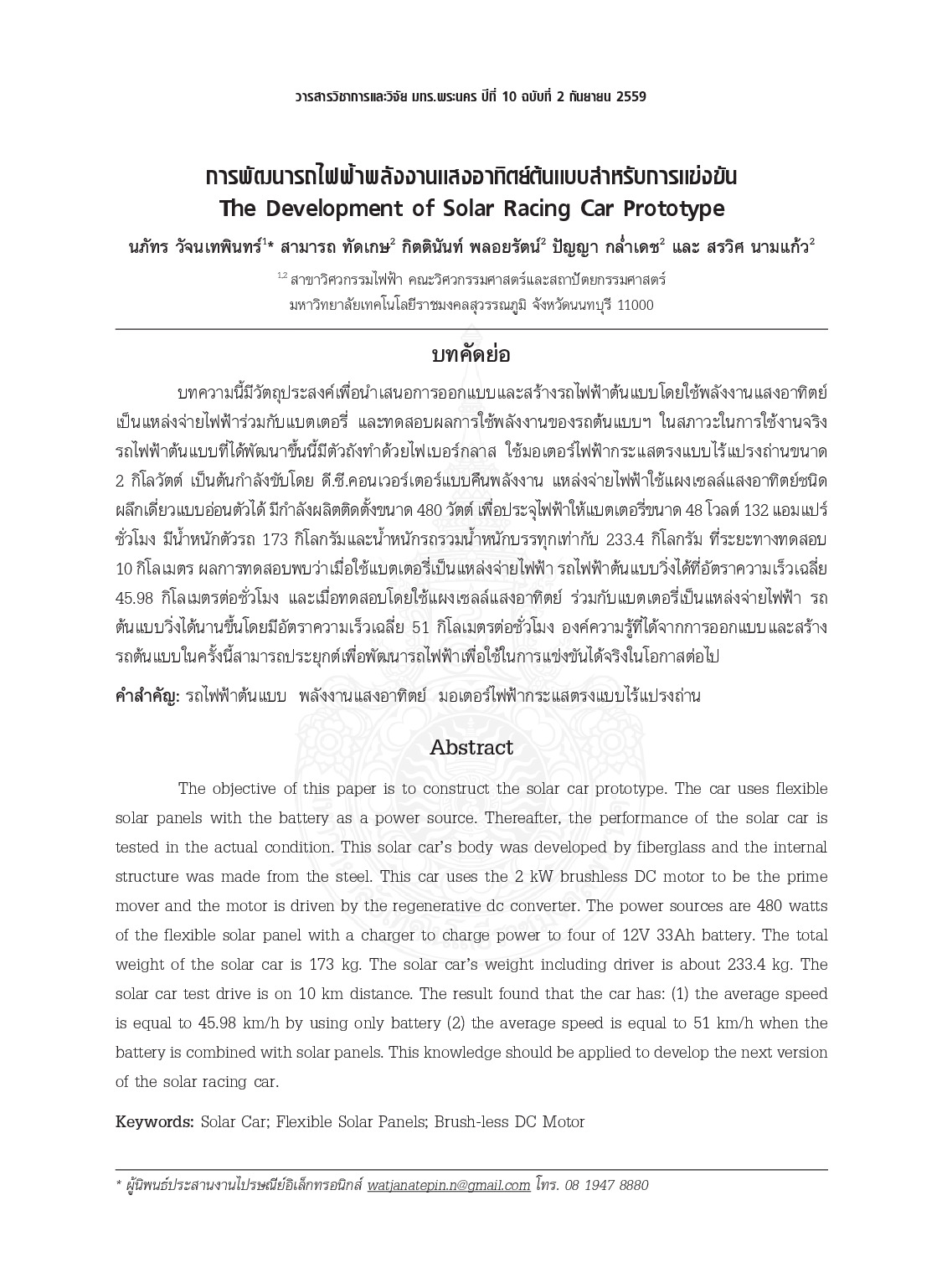
การพัฒนารถไฟฟ้าพลังงานแสงอาทิตย์ต้นแบบสำหรับการแข่งขัน
The objective of this paper is to construct the solar car prototype. The car uses flexible solar panels with the battery as a power source. Thereafter the performance of the solar car is tested in the actual condition. This solar car’s body was developed by fiberglass and the internal structure was made from the steel. This car uses the 2 kW brushless DC motor to be the prime mover and the motor is driven by the regenerative dc converter. The power sources are 480 watts of the flexible solar panel with a charger to charge power to four of 12V 33Ah battery. The total weight of the solar car is 173 kg. The solar car’s weight including driver is about 233.4 kg. The solar car test drive is on 10 km distance. The result found that the car has: (1) the average speed is equal to 45.98km/h by using only battery (2) the average speed is equal to 51 km/h when the battery is combined with solar panels. This knowledge should be applied to develop the next version of the solar racing car.
การประยุกต์เทคนิคการควบคุมกระบวนการทางสถิติในการตรวจติดตามการปล่อยก๊าซคาร์บอนไดออกไซด์จากการเดินทางโดยรถไฟฟ้าบีทีเอส
CO2 emission of rail transportation system plays more important role including the expansion of BTS route that consume the energy and emit CO2 gas more and more. The purpose of this research was to find out amount of CO2 emission from travelling by BTS train and determine specific CO2 emission per product in the form of gCO2e/passenger/km then forecasting on CO2 emission from BTS operations. Research process was initiated from collecting monthly data on ridership distance and electricity for 55 months continuously then regression analysis CUSUM and time series analysis were used for prediction and analysis of CO2 emission. The finding indicated that BTS’s specific CO2 emission was 24.7 gCO2e/passenger/km. Forecasting CO2 Emission from BTS result that Winters Exponential Smoothing Method is most accuracy then Double Exponential Smoothing Method Trend Analysis Method and Decomposition Method respectively. The result of these analysis could be used to calculate carbon footprint from staff travelling by BTS train and promote people to use public transport by government as sustainable transportation concept.

แนวทางการใช้ประโยชน์ที่ดินเพื่อที่อยู่อาศัยเพื่อรองรับระบบรถไฟฟ้าสายสีม่วง
การศึกษาในครั้งนี้มีวัตถุประสงค์เพื่อวิเคราะห์ถึงปัจจัยการขยายตัวของที่อยู่อาศัยในพื้นที่อำเภอเมือง นนทบุรี อำเภอบางใหญ่ และอำเภอบางบัวทอง ตลอดจนศึกษาถึงผลกระทบที่เกิดจากโครงการรถไฟฟ้าสายสีม่วง ต่อที่อยู่อาศัยในพื้นที่ศึกษาและเสนอแนะแนวทางการใช้ประโยชน์ที่ดินเพื่อที่อยู่อาศัยในพื้นที่ศึกษาวิธีการศึกษา ประกอบด้วยการสำรวจพื้นที่ และการเก็บข้อมูลแบบสอบถามจำนวน 399 ชุด โดยวิธีการสุ่มตัวอย่างแบบเจาะจง ในการศึกษาครั้งนี้ กลุ่มตัวอย่างจะเป็นผู้ที่พักอาศัยในนนทบุรี และมีแหล่งงานอยู่ในกรุงเทพฯ เหตุผลการย้าย ถิ่นฐานเพราะนนทบุรีอยู่ใกล้กรุงเทพฯ ผลที่ตามมาทำให้ที่อยู่อาศัยเพิ่มมากขึ้น การประมวลผลโดยโปรแกรม SPSS ในการแจกแจงความถี่แบบร้อยละ และใช้ Crosstab เพื่อหาความสัมพันธ์ของข้อมูล ส่วนการหาศักยภาพ ของพื้นที่ศึกษาเพื่อการพัฒนาที่อยู่อาศัยใช้เทคนิค Potential Surface Analysis (PSA) ผลการศึกษา พบว่า เมื่อ เกิดโครงการรถไฟฟ้าสายสีม่วงจะส่งผลให้การคมนาคมสะดวกขึ้นเป็นแรงจูงใจให้ผู้ที่อยู่อาศัยในบริเวณนี้หันมาใช้ ระบบขนส่งมวลชนมากขึ้น ดังนั้น การพัฒนาโครงการรถไฟฟ้าสายสีม่วงจึงเป็นปัจจัยที่เพิ่มศักยภาพการพัฒนาให้ พื้นที่และดึงดูดคนให้เข้ามาในพื้นที่มากขึ้น การพัฒนาที่อยู่อาศัยก็จะมากขึ้น เนื่องจากการเดินทางที่สะดวกขึ้น
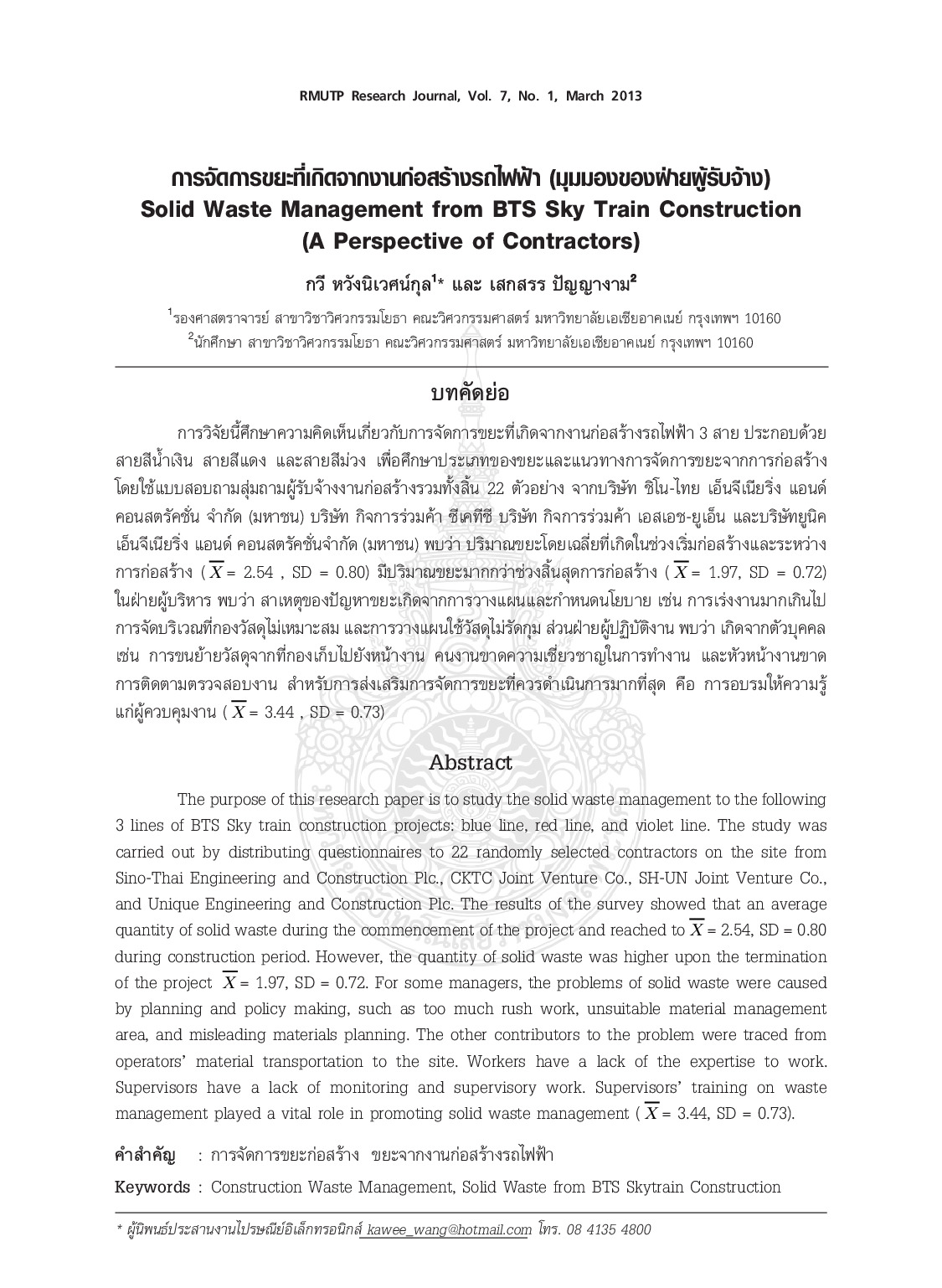
Solid waste management from BTS Sky train construction (a perspective of contractors)
The purpose of this research paper is to study the solid waste management to the following 3 lines of BTS Sky train construction projects: blue linered line and violet line.The study was carried out by distributing questionnaires to 22 randomly selected contractors on the site from Sino-Thai Engineering and Construction Plc. CKTC Joint Venture Co. SH-UN Joint Venture Co. and Unique Engineering and Construction Plc. The results of the survey showed that an average quantity of solid waste during the commencement ot the project and reached to x=2.54SD=0.80 during construction period. However the quantity lf solid waste was higher upon the termination of the project X=1.97 SD=0.72. For some managers the problems of solid waste were caused by planning and policy maling such as too much rush work unsuitable material management area and misleading materials planning. The other contributors to the problem were traced from operators material transportation to the site. Workers have a lack ot the expertise to work. Supervisors have a lack of monitoring and supervisory work. Supervisors training on waste management played a vital role in promoting solid waste management(X = 3.44 SD = 0.73).