จำนวน Repository ( 11 )
การพัฒนาโครงสร้างผ้าของเครื่องแต่งกายเชฟที่เหมาะสมกับการปฏิบัติงานของเชฟในครัวอาหารไทย
The purpose of this research were 1) Development and production of the cotton fabric suitable for use in the kitchen apparel chef Thailand 2) test the suitability of the fabric from the fabric used to make kitchen apparel chef in Thailand. Tools used in the study are the fabrics used to make clothing chef woven pattern 2/1 for 3 structures 1) Cotton100 2) Polyester Microfiber and 3) TR. Being three fabrics to test of the fabric aspects of the durability of color to light color fastness to washing colorfastness to perspiration strength of the yarn yarn number weight yarn yarn twist yarn thickness weaving and resistance to abrasion properties of the fabric the effect of moisture. The quantitative data were analyzed by descriptive statistics from assessment and feedback of chef’s uniforms by the establishment of a laboratory in the kitchen by cooking in Thailand 15 Thailand kitchen. The chefs were wearing 3 sets each 5 days per a types of them for 15 days. Each of chef’s uniform made from the different types of fabrics. Data analysis and interpretation with the average 5 level content analysis and evaluation. Data analysis in descriptive and narrative. The results founded that Chef of food establishments restaurants Hotel and restaurant with 15 people most of the food is the leader in working kitchen (Executive chef) the timetable of working in the evening in the Thai-kitchen from 12:00 to 21:00 o’clock for 5 days a week. It’s about environments of Thai-Kitchen The temperature of the kitchen operations in restaurants and room temperature and after the experimental wear three types of 15 day Chef has been satisfied in sample number 2. It is Micro Fiber fabrics because there is good ventilation not get heat easy to clean fabric good reflect of oil or anti-oil water absorption and drying rate of the normal range. Micro Fiber fabric when Chef wear it not heavy able to wear at all times. The results of the test and analysis Micro Fiber Cloth material that is resistant to very light. The fabric is not easily broken. Strength and abrasion resistance as possible. It is oil on fabric and yarn on the oil splash in the Kitchen. Including the ability to absorb water and the distribution of water as much as possible.
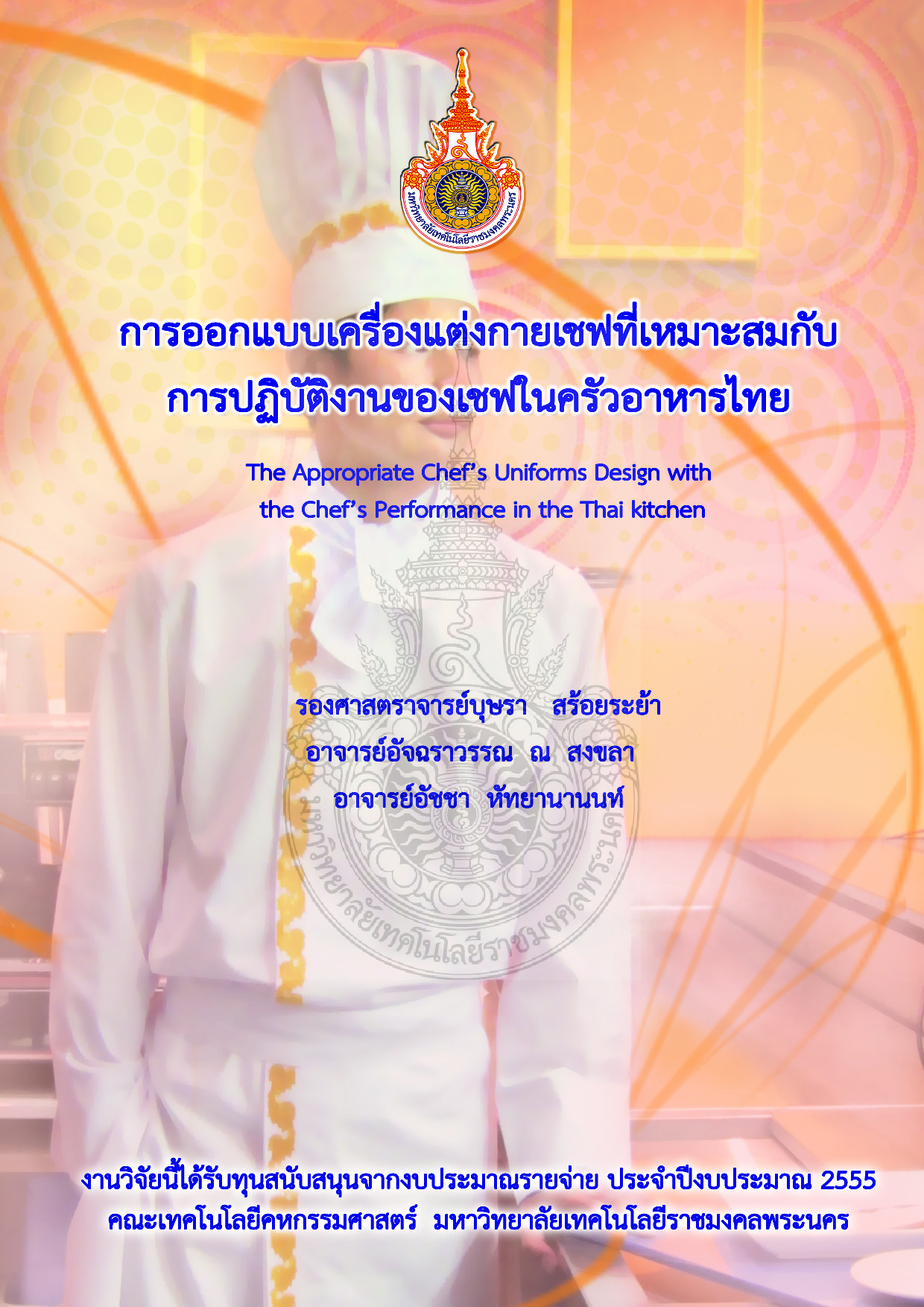
การออกแบบเครื่องแต่งกายเชพที่เหมาะสมกับการปฏิบัติงานของเชฟในครัวอาหารไทย
This research is the designing of chef apparel in order to appropriate with their tasks in Thai kitchen. The objective of this research are to design the appropriate chef apparel to work in the Thai kitchen and study the consumer satisfaction of apparel designing for the chef in Thai kitchen. Starting from sketching chef outfits. There are 60 styles from 15 styles of each category. For example hat chef jacket scarf and napkin. There are 5 sketches selection of each category by specialist. Therefore researchers set in to five outfits for sewing and survey the satisfaction amount 200 random sampling using 100 customers at Central Pinklao and 100 Thai kitchen chefs or Thai food business investor. The assessment and questionnaire was analyses through statistical and percentage to demonstrate in table. The study result in consumers’ satisfaction with regard the designing of chef apparel in order to appropriate with their tasks in Thai kitchen found that were mostly 59.5 percentages’ samples as male and 39 percent in an age range between 46 years. There are 50 percent of samples was professional chef sample with 47.5 percent of Bachelors degree and 33 percent of receiving monthly income from 30001 baht upwards. From the mostly research of consumer used to take the service in restaurant with a chef uniform was 90 percent. The 94 percent of opinions about Thai identity not show in chef uniform and also they agree with Thai identity in chef uniform 96 percent. The analysis of the satisfaction of consumers to the appropriate chef’s uniforms design with the chef’s performance in the Thai kitchen The analysis results showed that the overall images of all design as follow the first design is number 2 average in 31.04 in the highest level of satisfaction. Next the second design is number 3 average in 4.16 in the satisfaction level. Then the third design is number 4 average in 4.15 in the highest level of satisfaction. The fifth design is number 5 average in 3.92 in the high level of satisfaction and the last design is number 1 average in 3.29 satisfaction level was moderate.
ทัศนคติของเซฟต่อการออกแบบชุดเซฟที่มีเอกลักษณ์ไทยเพื่อใช้ในครัวอาหารไทยที่มีลักษณะเป็นครัวเปิด
The objectives of this research were 1) to study the Thai chefs attitudes toward Thai cuisine chef apparel 2) to study the designing of Thai ornamental pattern and suitable colors of embroidery thread for embellishment on Thai cuisine chef apparel 3) to study the design of embellishment of Thai ornamental pattern on Thai cuisine chef apparel. The sample used were the chefs who are the members of Thai Chef Association working in Thai cuisine of restaurants and other shops located within Bangkok metropolitan and circles. The total numbers were 300. Tool used was a questionnaire divided into 3 sections. The first section was the questions about general information of the chef status. The second one was the section concerning attitude and basic data on chef apparel featuring inspecting lists 6 and 14 items respectively. The last one was 40 items asking about the chefs opinion in order to rate the agreement characterizing as estimated measurement. The statistical tools used to analyze were percentage. means and standard deviation. Consequently the apparel chefs wanted was formed. After that 5 Thai ornamental patterns were designed and layout the decorative design on 10 chef apparels with embroidering by 9 colored embroidery threads. In order to select the suitable design 7 experts consisting of experts on fashion design and experts on Culinary Art. Food Science and Education cooperatively answering the questions of visual satisfaction using 9 -points Hedonic ScaleQuestionnaire. The analyzing of variation was used One Way ANOVA and differential analysis of means used Duncans New Multiple Range Test at significant 95%. The result is that most chef are women 69% and men 31% age range 21-30 years of age 92.67% earning between 10000-30000 baht per month 85.53% holding Bachelor degree 90.00% working experience in food 1-5 years 89.00% most of them are assistant chef 48.00%. Most chefs knew the priority of apparel used while working is consist of shirt pant apron and head wear. They must be white and can be suitably useful for working which affected the hygiene for chef food cooked. On the part of the beauty of the apparel embroidering Thai ornamental pattern is considered as middle rank of priority. The desirable chef apparel was apparel with one pocket on the right side of jacket breast and another one on the right side of jacket waist. The sleeves are type of three quarter. In the front of jacket is double-breast that fully overlapping style round neck line Chinese collar and middy length apron with a cincture. The designing of Thai ornamental pattern is found that Kan Tor Dork pattern has got the most satisfactory score at 7.397?1.306. On the part of designing of embroidery thread colors 7: the embroidery thread color number 6083 6055 and 6087 has got the most satisfactory score at 7.086?1.687 which is the most: that is the ornament which is used the color of Sand Blonde and Muted Yellow. The designing of laying out the ornamental pattern on the apparel is found that the type number 8 has got the most satisfactory score at 8.00?0.817. It is the type of apparel which was designed by using straight line going from the middle of the left shoulder to the waist making acute angle and then apparel to the arm continuing to the round of the sleeves and finally ended at the seam on inner arm. For apron the ornamental pattern used parallel line and transverse lines on the apparel. Whose end meets the edge of front fold at the edge of the apron and then paSSing through on the back those lines passed to meet the edge of the right side of the apron.
โครงการพัฒนาขีดความสามารถด้านฐานข้อมูลเทคโนโลยีเพื่อการถ่ายทอดเผยแพร่ผ่านอินเทอร์เน็ต: ฐานข้อมูลอาหารไทยสี่ภาค
The purposes of this research were to collect the data about Thai cuisine from four regions to design and implement database about Thai cuisine and transfer on internet and to tranfer the technological database about Thai cuisine from four regions. The research process involved studying data collecting the lists of regional Thai cuisine : the North Northeast Central and Southern collecting the information about food recipes materials and tools choosing the appropriate data taking pictures materials and tools designing and implementing web database creating computer system developing computer system installing computer software in order to input data testing the system and transferring web database on internet. The result was found that regional Thai cuisine web database was divided into 4 categories21 Kinds of cooking methods 293 data of food with recipes 108 data of food without recipes 138 items of materials and 39 items of tools for perparing and serving food. Interested persons could reach our information about Thai cuisine from four regions at http://www.thaicuisinenetwork.com
การใช้แป้งข้าวกล้องทับทิมชุมแพทดแทนแป้งข้าวเจ้าในขนมเรไร
The objectives of this study were 1) to study the basic recipe of Khanom Raerai and 2) to study the substitute amount of rice flour by using Tubtim Chumphae Brown rice flour in Khanom Raerai at four different levels of 0% 40% 50% and 60% by total rice flour weight. Randomized Complete Block Design (RCBD) to apply the sensory quality in terms of appearance color odor texture and overall preference using a 9-Point Hedonic Scale tasting method tasted by 40 untrained students from Foods and Nutrition Program Faculty of Home Economics Technology Rajamangala University of Technology Phra Nakhon. The data was verified by mean Analysis of Variance (ANOVA) and then compared the mean difference at a 0.05 confidence level by using Duncans New Multiple Range Test (DMRT) method. The results were analyzed by a computer software program. The results found that 1) the basic Khanom Raerai recipe made from rice flour tapioca flour arrowroot flour soybean oil and water was 27.25% 1.63% 1.63% 4.09% and 65.40% by total ingredients weight. The tasters verified the sensory quality in appearance color odor texture and overall preference. The mean values were 7.80 7.40 7.27 7.67 and 7.93 respectively at a moderate level of liking. The results found that almost all sensory aspects were significantly different at the 0.05 level except for color and odor. 2) the amount of Tubtim Chumphae brown rice flour substitutes for rice flour in Khanom Raerai it was found that the tasters accepted 40% by weight of rice flour in terms of appearance color odor texture and overall preferences. The mean values were 8.60 8.20 8.40 8.33 and 8.67 respectively at the level of liking the most. The sensory results found that all sensory characteristics were not different at the 0.05 level. Therefore the Khanom Raerai recipe uses Tubtim Chumphae brown rice flour substitutes for rice flour at the 40% level as the formula accepted in this study.