จำนวน Repository ( 30 )
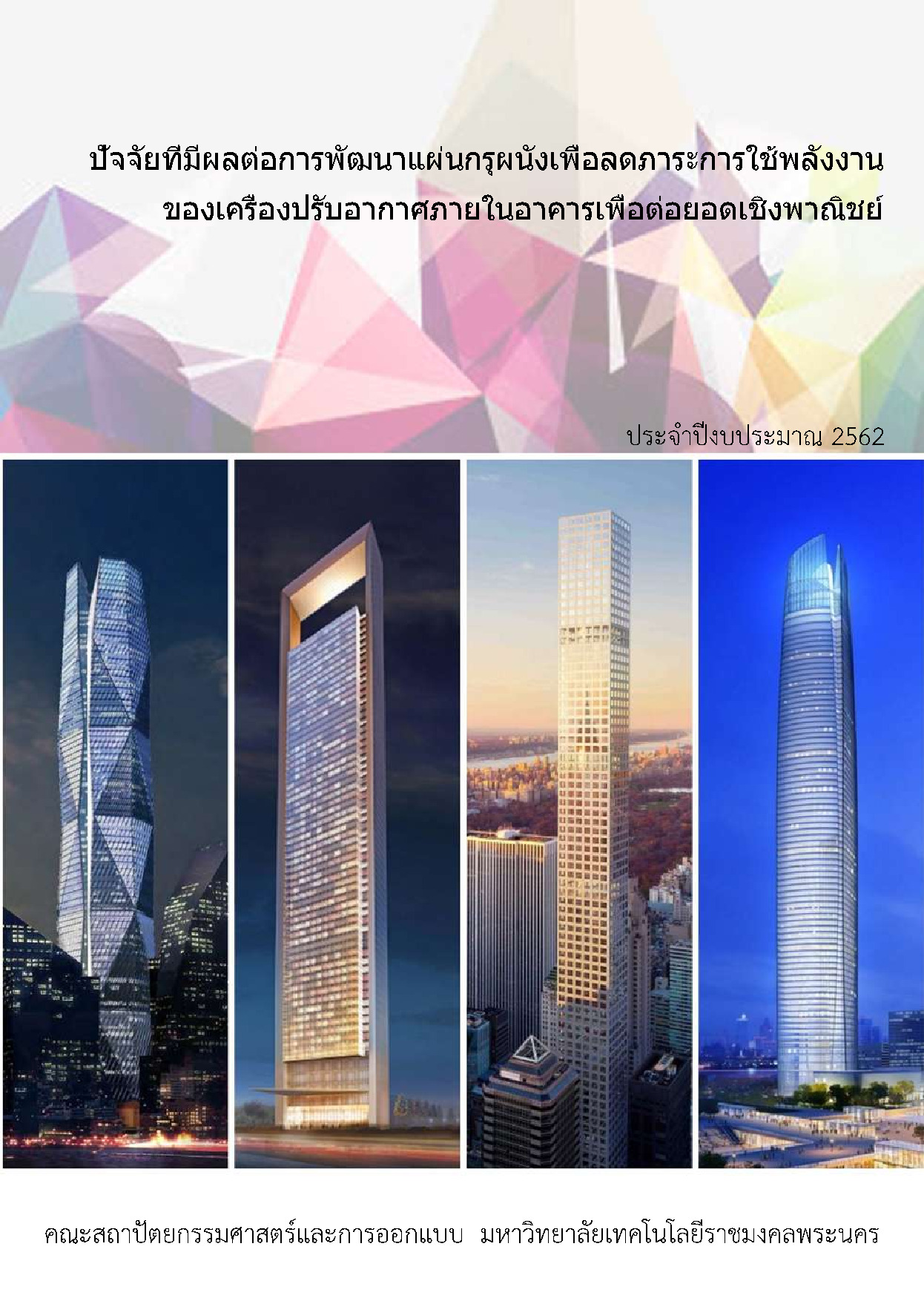
ปัจจัยที่มีผลต่อการพัฒนาแผ่นกรุผนังเพื่อลดภาระการใช้พลังงานของเครื่องปรับอากาศภายในอาคารเพื่อต่อยอดเชิงพาณิชย์
This research approach to study the development of interior wall for reduce energy consumption by air conditioning in the building. In order to be a prototype in the development of an industrial system for the export of green architecture in order to generate income for the community or entrepreneurs to bring money into the country to upgrade the industrial economy to be sustainable It is an architectural material that is compatible with the weather in Thailand. It can be used as a guideline for people interested in applying it to their own home building or disseminating through various media to reduce energy costs for a comfortable living. The objective is to study the factors that affect the development of wall paneling in order to reduce the energy burden of the air conditioner in the building in order to further the commercial production. The researcher collected data for the past 6 months not including other thermal energy. Used to calculate the energy consumption index for 2 building groups it was found that the electricity consumption of green buildings were 531100 kilowatt hours. And an average of 5.31 kilowatt hours per square meter While the non-green building has an average of 653360 kilowatt hours. And an average of 6.53 kilowatt hours per square meter As for the results of the data analysis the damage level is mostly at level 1 which is the wall surface and no obvious damage. Especially the 4th and 5th height is 1.55 meters and 1.85 meters from the floor level in the building. Damage level 3 is found at the height level 3 at a height of 1.00 meters from the floor level in the building. Assessment of damage caused to the interior wall of the building that occurred in 3 levels. The results of the data analysis showed that most damage levels were at level 1 namely the wall surface without obvious damage. Especially the 4th and 5th height is 1.55 meters and 1.85 meters from the floor level in the building. Damage level 3 is found at the height level 3 at a height of 1.00 meters and from the results of collecting moisture content in the exterior wall materials And analyzed to find the average for each of the 5 levels of height which are 0.55 meters 0.75 meters 0.95 meters 1.55 meters and 1.85 meters found that the buildings have different moisture content in each wall level (p <0.05). In conclusion this green building index equation can be applied to other buildings to reduce energy consumption and meet the standards of the green building. From the equation the electricity consumption can be predicted using the electricity usage index and systematically designed energy management in buildings. The area with the most damage will find the humidity in the range of 47% -98% the highest damage level 3 at an elevation of 0.80 meters from the floor level in the building

การพัฒนาผลิตภัณฑ์อาหารจากปลายข้าวไรสเบอร์รี่เพื่อผู้สูงอายุสู่เชิงพาณิชย์
From the development of broken-milled rice berry for the elderly to commercial overall it was found that there are 4 types of products that the elderly accept included 1.Ready to consume broken-milled rice berry with fried mackerel with shrimp paste sauce. 2. Ready to consume rich ingredient rice berry grains. 3. Ready to consume Stir died broken-milled rice berry with hot yellow curry paste. and 4.broken-milled rice berry burger. Found that the consumer rated the features in terms of color smell texture taste and the allover liking is very much to the most. The consumers gives the score of the product likelihood score 3 is highest. Nutrition studies of all four products which are 1.Ready to consume broken-milled rice berry with fried mackerel with shrimp paste sauce. 2. Ready to consume rich ingredient rice berry grains. 3. Ready to consume Stir died broken-milled rice berry with hot yellow curry paste. and 4.broken-milled rice berry burger found that: all four products are healthful and provide nutrients including essential and beneficial vitamins for elderly whether it be vitamin A D B12 K calcium Thymine Niacin phosphorus etc. Which these nutrients and vitamins cannot be synthesized by the body itself also inhibits the deterioration of the organs of the body and prevents various diseases that commonly occur in the elderly. And from microbiological examination for storage study by containing all four products in an opaque package with a list and can withstand over 110 degrees Celsius storage by temperature control does not exceed four degree Celsius for seven days. The results that within seven days there are no microorganisms yeast and mold have been found in four kinds of products which shows that storage by temperature control does not exceed four degree Celsius can be stored without harm to the consumers.
การพัฒนาผลิตภัณฑ์เส้นก๋วยเตี๋ยวผัดไทยกึ่งสำเร็จรูป เพื่อคุณภาพในเชิงพาณิชย์
This research aims to study the base formulation of Pad Thai noodle to study on type and quantity of modified starch in Instant Pad-Thai noodle. To study on the amount of Pad Thai sauce to supplement in Pad Thai noodle. To study on the quality of Instant Pad Thai noodle with Pad Thai source to design the optimal packaging for Instant Pad Thai noodle and to study of consumers acceptance of Instant Pad-Thai noodle with Pad Thai source. The results of this study showed that the optimal formula of Pad Thai noodle was 80 grams of rice starch 100 grams of tapioca and 300 grams of water. The color values of L * (brightness) a * (red) and b * (Yellow) was 64.13 ± 0.01 -0.92 ± 0.02 and 14.52 ± 0.02 respectively. This Pad-Thai noodle has a slightly yellowish white color with a moisture content of 5.31 ± 0.03 %. The optimum amount of modified starch used in the semi-finished fried Thai noodle formula by replacing the tapioca starch in the basic formula was modified starch 30 per 70 grams of tapioca starch. The modified formula of Pad Thai noodle has a slightly yellowish white color with L * (brightness) a * (red) and b * (yellow) equal to 62.82 ± 0.01 -1.10 ± 0.01 13.45 ± 0.01 respectively with a moisture content of 5.66 ± 0.11 %. The amount of Thai stir-fried sauce used in the semi-finished fried Thai noodle recipe by replacing the amount of water in the recipe was 80 grams of rice flour 70 grams of tapioca flour 30 grams of modified flour and 100 grams of Thai stir-fried sauce and 200 grams of water. The color of modified Pad-Thai noodle was L * (brightness) a * (red) and b * (yellow) equal to 43.67 ± 0.01 8.25 ± 0.02 and 22.42 ± 0.10 respectively with moisture content of 2.58 ± 1.36 %. The number of microorganisms was less than 10 CFU/g. The amount of yeast and mold was less than 10 CFU/g and E. coli content was less than 3 MPN /g. Semi-finished Thai stir-fried noodles with sauce were slightly brownish. The noodle was soft and sticky and had the smell of Pad Thai sauce. There was a taste of Thai stir-fried sauce added in the Pad Thai noodle was tear more difficult than the other commercial noodle.
การควบคุมคุณภาพการย้อมสีและตกแต่งสำเร็จเส้นด้ายผักตบชวาและวัสดุประกอบเพื่อการแปรรูปผลิตภัณฑ์เชิงพาณิชย์
Quality control of dyeing and finishing of Water Hyacinth yarns and their transformed materials for commercial was a main objective to establish the dye database of synthetic dye and natural dye. The dye database was a data for quality control in dyeing process of raw material as Water Hyacinth yarns also it resolved the un-repeatability dyeing problem. Reactive dye was used for synthetic dye database creation on dry Water Hyacinth yarns at 80oC for 30 minutes. Red as Hicion Red He-3B yellow as Hicion Yellow HE-4RN Blue as Hicion Navy Blue HER 150% and black as Hifix Black KNN were the represent synthetic dye and Sodim sulphate 20 g/l and sodium carbo nate 20 g/l were used as auxiliaries. The other hands the natural dye database was forming from Ebony tree Caesalpinia sappan and Turmeric. They were dye on dry Water Hyacinth yarns at 80oC for 30 minutes and Sodim sulphate 20 g/l was the auxiliary. Whereas Butterfly pea were dye at 80oC for 30 minutes by Sodim sulphate 20 g/l and sodium carbonate 20 g/l were the auxiliaries. The whole dye database was defined the totally in Primary Secondary and ternary dye cycle. The transfer knowledge was distributed to the enterprise at Nakhon Prathom Provincd as “Chumchonjaksanpaktobchawha Bann klongnokkratum”. The topics were “How to establish the synthetic and natural dye database” “Water repel lent finishing” and “developed and transformed the Water Hyacinth to products”. The target group was very satisfied in this topic as 4.39. In the result the proportion between economic and social factor by the income increasing in 1 year was 5.04. So the research project was achievement.
การแปรรูปผลิตภัณฑ์อาหารจากน้ำตาลโตนด เพื่อส่งเสริมรายได้เกษตรกรในเชิงพาณิชย์ : สวนตาลลุงถนอม แหล่งเรียนรู้ภูมิปัญญาตาลโตนด (กลุ่มอนุรักษ์และสืบสานตาลโตนด) อำเภอบ้านลาด จังหวัดเพชรบุรี
The purpose of this research is to study the suitable quantity of palm sugar in food products. Study on the quality of food products from the processing of palm sugar. And the study of consumer test on food products from the processing of palm sugar. Products from the processing of palm sugar: sorbets palm sugar palm sugar is ready to drink mixed bacterial cellulose palm sugar and Jelly palm sugar. By planned Randomized Complete Block Design (RCBD) by means of taste was rated as level 9 point hedonic scale .The number of people 70 and tastings people compare the differences of average at 95 percent confidence level by the way Duncans New Multiple Range Test (DMRT) with statistical software program. And the acceptance of consumers towards processed products derived from palm sugar to taste panelists by scoring a 5 level (5 Hedonic Scale) sensory. The appearance color aroma taste texture and overall liking. The sampling plan was not specific. Or random chance (Accidental Sampling) by testing with Consumer Test were 150 people which is the faculty and students. Faculty of Home Economics and individuals in the area Faculty of Home Economics Rajamangala University of Technology Phra Nakhon according to studies it has been found that. Sorbets palm sugar products. The study found that formulations 2 is a basic recipe that has scored the most respected. The amount of palm sugar the yellow and smell of palm sugar. The taste is very sweet and a smooth texture. The study of the physical quality of sorbets palm sugar found that the sweetness of 26 Brix 24 percent cost overrun an overrun of the ice cream is in the range of 20-150 percent. melting of ice Made from pasteurized cream in a range from 91.66 to 95 the percentage of melting ice cream is based on heat from the environment into the ice makes the ice crystals melt by early dissolution rates are low he added. Higher over a longer time. Chemical analysis showed that palm sugar sorbets energy consumption per unit of 110 kilocalories carbohydrates 27.6 grams protein <1.25 grams fiber 0.08 grams humidity 72.0 grams and ash 0.44 grams. Study on the acceptance of consumer acceptance of the products sorbets palm sugar. And to evaluate the sensory qualities of appearance color aroma taste texture and overall liking. The average is 4.42 4.34 4.08 4.20 4.38 and 4.42 respectively showed that consumer acceptance of products sorbets palm sugar 150 people representing 100 percent. Jelly Ready to drink products palm sugar. The amount of palm sugar levels at 70% of carrageenan to 5% and the amount of Bacterial cellulose palm sugar at 15% of the panelists for the most respected. Characterized by stable Pale yellow transparent palm (4) sugar moderate odor flexible texture with a medium The study on the physical properties of the Ready-to-drink products Jelly palm sugar found that the color Hue 2.5Y the brightness of the color Value 9 and the brightness / saturation Chroma 2 the sweetness of the jelly juice jaggery was 18 Brix and pH - 6.5. Study the nutritional Ready-to-drink products Jelly palm sugar 125 grams chemical analysis showed that the energy 50.8 kilocalories carbohydrates 12.7 gram protein 0.20 gram fiber 0.24 gram moisture 87.1 gram and ash 0.24 gram. Results of studies of consumer acceptance. It found that the testers tasting side appearance Color smell taste texture and overall preference. Average 4.46 4.47 4.37 4.06 4.23 4.41 and points respectively. Ready-to-drink products Jelly palm sugar to resemble the physical side is light brown. Resembles the aroma is sweet palm sugar because it has just the right amount of bacterial cellulose palm sugar so making the Jelly palm sugar is flexibility. There is a water medium consumers like and is consistent with the results most accepted tasting Jelly ready to drink products palm sugar 98.00 percent. Bacterial cellulose products palm sugar. It was found that the formulation 2 basic and score the most respected at the level of 1: 1 the sweetness of 11 Brix due to the sweetness in the appropriate range 9.5-13.5 Brix. If more or less too a little texture with flexibility. Study the quality of bacterial cellulose from palm sugar has found a physical quality thickness 1.50 centimeter weight 830 gram. pH-value equal to the value 4.80 of the sweetness equivalent to 11 Brix chemical quality found that the quantity of 100 gram Bacterial cellulose products palm sugar showed that the energy 133 kilocalories Carbohydrate 32.80 gram protein< 0.21 grams fat 1.25 grams of moisture 67.00 grams and fiber 0.69 grams the study found that in side to accept the appearance color smell taste texture and overall preference. This equals an average 4.39 4.41 3.66 4.33 4.40 and 4.28 respectively of the consumers. It found that consumers accepted tasting bacterial cellulose products palm sugar 100 percent. Palm sugar Ready to drink products mixed Bacterial cellulose palm sugar. The basic formulation of palm sugar formulations 3 and with the highest score on every side. Due to the muddy liquid palm sugar the natural flavor of adopting. Bacterial cellulose content was suitable 15 percent and the amount of pectin found that 3 percent is the optimum because the pectin substances causing gel. If there is a lot of water quantity will be thick and viscous too. Do not be the good characteristics of palm sugar is ready to drink. Physical analysis it was found that the quantity of the acid-base 6.5 the sweetness 16 degrees Brix. And the chemical analysis showed that the energy 60.4 kilocalories carbohydrate 15.1 grams protein less 1.25 grams fat 0 g fiber 0.39 grams and Ash 0.27 grams. The (5) adoption of palm sugar products ready to drink mixed bacterial cellulose it is found that the appearance of color smell taste texture (viscosity). And preference overall average of the 4.39 4.41 3.66 and 4.33 4.40 4.28 respectively. Consumer acceptance of Ready-to-drink products palm sugar mixed Bacterial cellulose palm sugar 150 people representing 88.76 percentage. The result of knowledge transfer and technology of processed food products from palm sugar into the community for the private sector. It found that the majority of respondents are female is 22 people aged between 30-40 years. Satisfied with the broadcast the participants were satisfied with the results. At the highest level of satisfaction.