จำนวน Repository ( 13 )
การพัฒนาชุดราตรีโดยการตกแต่งด้วยเทคนิคการสานจากเศษเส้นด้ายไหม เหลือทิ้ง ของกิจการผ้าไหมบ้านครัว เขตราชเทวี กรุงเทพมหานคร
The creation of nightgown decorated by woven silk yarn scrap from Baan Krua Cottage Industrial Village in Ratchathewi Bangkok Thailand. Objectives are: 1) to study the weaving technique using the silk yarn scrap 2) to design a nightgown decorated with woven silk yarn scrap and 3) to study the overall satisfaction of nightgown designs which utilize silk yarn scrap. The sample population in this research is 250 women found on Silom Road central Bangkok. The research instrument is a questionnaire with 9 prototype nightgowns decorated with woven silk yarn scrap. The collection consists of 3 sets one set with 3 short nightgowns another set with 3 long nightgowns and the last set with 3 short nightgowns with long tails. The research methodology is to hand out the questionnaire to 250 non-specific women on Silom Road. Data analysis is done by statistic percentage average and standard deviation. Results of studying the survey show that most of the sample populations are women age between 31 -35 years old with bachelor degrees or the equivalent. Most are married and work as state enterprise officers. Incomes are between 20001 - 30000 baht. Most of them have bought a silk nightgown before and chosen to buy at department stores. The reason that they do not prefer silk nightgowns is because most in the current market are not innovative enough. Most of the sample populations have never seen a nightgown decorated with woven silk yarn scrap before. The results of studying the satisfaction of the sample population found that for the short nightgown set most of the sample population prefer number 2 standard deviation is 4.48. For the long nightgown set most of the sample populations prefer number 2 standard deviation is 4.44. And for the short nightgown with long tail set most of the sample populations prefer number 2 standard deviation is 4.46.
การพัฒนาชุดราตรีโดยการตกแต่งด้วยเทคนิคการสานจากเศษเส้นด้ายไหม เหลือทิ้ง ของกิจการผ้าไหมบ้านครัว เขตราชเทวี กรุงเทพมหานคร
The creation of nightgown decorated by woven silk yarn scrap from Baan Krua Cottage Industrial Village in Ratchathewi Bangkok Thailand. Objectives are: 1) to study the weaving technique using the silk yarn scrap 2) to design a nightgown decorated with woven silk yarn scrap and 3) to study the overall satisfaction of nightgown designs which utilize silk yarn scrap. The sample population in this research is 250 women found on Silom Road central Bangkok. The research instrument is a questionnaire with 9 prototype nightgowns decorated with woven silk yarn scrap. The collection consists of 3 sets one set with 3 short nightgowns another set with 3 long nightgowns and the last set with 3 short nightgowns with long tails. The research methodology is to hand out the questionnaire to 250 non-specific women on Silom Road. Data analysis is done by statistic percentage average and standard deviation Results of studying the survey show that most of the sample populations are women age between 31 -35 years old with bachelor degrees or the equivalent. Most are married and work as state enterprise officers. Incomes are between 20001 - 30000 baht. Most of them have bought a silk nightgown before and chosen to buy at department stores. The reason that they do not prefer silk nightgowns is because most in the current market are not innovative enough. Most of the sample populations have never seen a nightgown decorated with woven silk yarn scrap before. The results of studying the satisfaction of the sample population found that for the short nightgown set most of the sample population prefer number 2 standard deviation is 4.48. For the long nightgown set most of the sample populations prefer number 2 standard deviation is 4.44. And for the short nightgown with long tail set most of the sample populations prefer number 2 standard deviation is 4.46.
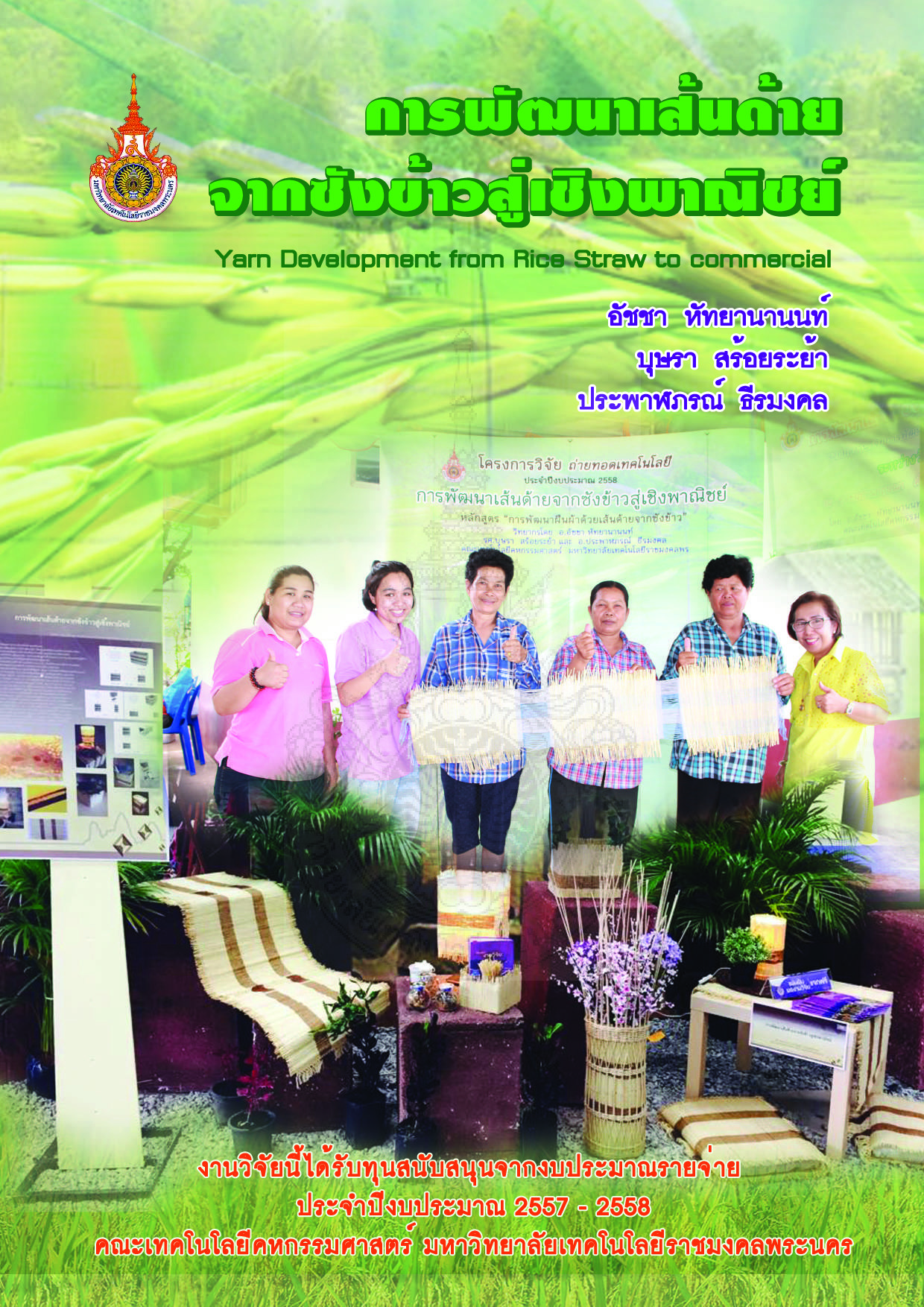
การพัฒนาเส้นด้ายจากซังข้าวสู่เชิงพาณิชย์
This research is Yarn Development from Rice straw to commercial. It aims to study the process of seperating fibers from rice straw. To study the physical properties of fibers from rice straw and to study the process of manufacturing yarn from rice straw fibers. The research material is rice straw fibers after that data was analyzed byphysical textile testing laboratory. The result of the first year’s research was the rice straw yarn has been developed as woven and develop into commercial products to promote. The process of separating fibers from rice straw which dried the sun for a few days. Selecting the rice straw fiber length at least 30 cm. to subtract the joints of the lower end of the stem by hand. peel off the rice straw fiber and place flat on a horizontal line. Then Rice straw fiber were tested in the physical laboratory was found that it is cellulose fibers tensile strength (Newton) at 28.18 elongation (percent) is at 2.01. The amounts of metals has plenty of CADMIUM at 0.1 mg/kg CHROMIUM (TOTAL) / (VI) at 0.5 mg/kg COPPER at 0.5 mg/kg and LEAD at 0.1 mg/kg which was not found to be risk for using. The fiber cross-section of rice straw fiber were found to be oval the middle is clearly. The fiber length is smooth and transparent when viewed from the side to see the clarity of the fiber. Rice straw fiber was weave in plain structure. Warp yarn uses a special brown cream and brown flat yarns. We use rice straw fiber with the same type of yarn. There are 2 warp yarn and using natural color without blench. Rice straw fabric was dyeing with dried hibiscus flowers (Kaa-Jeab herb) and mordant as ashes. The result is red light because of rice straw fiber surface is smooth and lustrous. Therefrom When woven as a fabric to develop be 4 products prototype : table lamps tablecloths in Japanese style potted plants and Accessories Box The result of the second year’s research there are focus group inquire for people it is interesting in this research and Date for transfer knowledge as: Ban-Krit-Sa- Na community Krit-Sa-Na sub-district bang-pra-ma district in Supanburi province. To plan the schedule and set the date place amount of participate and lectures 34 people The range of time to transfer as 3 days on 3 – 5 May 2015 and asking for consumer satisfaction of the curriculum and lecture for “transfer knowledge Yarn Development from Rice straw to commercial” by Questionnaire of participate satisfaction. Last the evaluation data was analyzed by using SPSS program in mean and percentage. The second year found that mostly participates were female aged under 21 years old finished the secondary school and also there are farmer. The participates are their income under 5000 baht and no income. For the participates questions relation to technology transfer of “Yarn Development from Rice straw to commercial” about course divided into 3 parts: The purpose The curriculum and The knowledge. The satisfaction of participates about project divided into 3 parts: Service process Lecturer and Facilities found that have been satisfied at maximum average and highest level of satisfaction in every parts of both satisfied participates questions. The participants are mainly used to provide benefits to themselves for one month to apply the gained after the training. Satisfaction with the benefits of technology transfer and utilization. Satisfaction at the highest level the participants used knowledge to apply with local and waste material. Moreover the participates make product as soon as finish course and they are planning to produce the table Hand Woven for weaving the Rice straw yarn fabric and push it to be OTOP products. The comments and suggestions of the participants found that they need for re-training again. They would like to have a longer period of training in order to gain more knowledge. All lecturer can transfer knowledge during the training as well.

การศึกษาการใช้ประโยชน์เศษเส้นด้ายไหมเหลือทิ้ง เพื่อใช้ทำเครื่องประดับสตรี
The objectives of this research are to use waste silk yarn for making women accessories and transfer the created technology to a women community in Surin Province. The required information for product design was collected. Subsequently 15 conceptual designs were made including necklace bracelet and bangle earring and pin. The experts were asked to choose the best 5 designs out of 15 designs. Then the prototypes were made by using waste silk yarn. Finally the most suitable product was selected for further technology transfer to a target group of 55 women who live in Surin. The questionnaires were used to asses the satisfactory of the training. The corresponding data was statistically analyzed. The results from the evaluated questionnaires show that most of the attended women are 31–40 years old and graduated from lower secondary schools. They are merchants and their average earnings are below 5000 Baht/month. Regard to the training program in terms of preparation instructors and overview most of them are satisfied the program in the high level to very high level. The average satisfactory for all of 3 aspects is in the high level.
การพัฒนาผืนผ้าด้วยเส้นด้ายพิเศษจากเศษวัสดุสิ่งทอเหลือทิ้ง
The research aimed to Develop of textile in SLUB Yarn fabric from textile material waste. The purpose is to develop Fancy yarn (SLUB Yarn) from textile material waste. To develop woven with Fancy yarn (SLUB Yarn) textile material waste. To study Fancy yarn (SLUB Yarn) properties and woven with Fancy yarn (SLUB Yarn) from textile material waste. The First step is sorting and scouring textile material waste from silk yarn and to spin 2 types of Fancy yarn SLUB Yarn as 50 percent silk fiber blended with 50 percent Cotton and other type as 100 percent Silk. The Second steps is to testing of physical properties in the textile testing laboratory. The testing results are Silk Fancy yarn (SLUB Yarn) from textile material waste have twisted more than Silk blended with Cotton. It make textile material waste from Silk yarn smaller and stronger than Silk blended with Cotton and also more tenacity meanwhile it has highest tensile strength and elongation than Silk blended with Cotton. The Third steps to produce woven fabrics with plain weave structure. The weaving results have 2 fabrics the first types from Fancy yarn (SLUB Yarn) weaved by 50 percent Silk fiber blended with 50 percent Cotton in Industrial woven system and the second types from Fancy yarn (SLUB Yarn) weaved by 100 percent silk in hand woven system or with traditional weaving loom. The Last steps are to test the 8 topics physical properties of 2 woven in the textile testing laboratory. First Colorfastness to washing testing was found that Silk fabrics of Fancy yarn (SLUB Yarn) from textile material waste is durable to washing than 4.58 percent. Second Water absorbency Testing was found that both of two fabric types are equal to 60 (seconds). Third Moistures Management testing was found that the moisture absorption and wet textile as follows at 6 parts : the duration of the wet cloth was found that Silk fabrics of Fancy yarn (SLUB Yarn) from textile material waste is more absorbed than Silk fiber blended with Cotton and the duration of adsorption rate was found that Silk fiber blended with Cotton fabrics of Fancy yarn (SLUB Yarn) from textile material waste is better than Silk fabrics. The radial distribution of moisture on the both side of fabric surface was found that Silk fiber blended with Cotton fabrics of Fancy yarn (SLUB Yarn) from textile material waste is better and more effective and also there are the distribution and direction of motion better than Silk fabrics of Fancy yarn (SLUB Yarn) from textile material waste. MoreoverIt was humidity control overall properties. Forth Pilling Resistance Testing was found that both of 2 fabrics are Pilling Resistance fur and beads up on the surface slightly. Fifth Fabrics Thickness testing was found that Silk fabrics of Fancy yarn (SLUB Yarn) from textile material waste more over was 0.10 mm. Sixth Dimensional stability to washing after 5 times Testing (changes size after washing) was found that Silk fiber blended with Cotton fabrics of Fancy yarn (SLUB Yarn) from textile material waste was shrinkage after washing in the warp yarn more than -7.6 and shrinkage after washing in the weft yarn more than -7.0. Seventh pH-Acid Value Testing was found that Silk fiber blended with Cotton fabrics of Fancy yarn (SLUB Yarn) from textile material waste has pH-Acid less than 0.07. Eighth Heavy Metal Testing was found that Silk fiber blended with Cotton fabrics of Fancy yarn (SLUB Yarn) from textile material waste has 3 Heavy Metals such as chromium lead and copper while Silk fabrics of Fancy yarn (SLUB Yarn) from textile material waste has 2 Heavy Metals such as copper and lead.