จำนวน Repository ( 14 )

การปรับปรุงความเหนียวและความทนแรงกระแทกของพอลิแลกติกแอซิดโดยการใช้น้ำมันถั่วเหลืองที่ผ่านการดัดแปรและเส้นใยธรรมชาติ
This research work was to study the improvement of toughness and impact resistance of polylactic acid (PLA) with modified soybean oil (MSBO) and palm fiber (PF). The detail of this work was divided into three parts. The first was to find the suitable condition for modification of soybean oil with ozonolysis. The second and last parts were to study the effects of MSBO and PF contents on the properties of PLA respectively. For oil modification the reaction times were varied from 0 to 3 hours and the chemical changes in molecules of soybean oil were investigated by Nuclear magnetic resonance (NMR) and Fourier transform infrared (FTIR) spectroscopies. The result suggested that the most suitable condition for ozonolysis reaction was 2 hours considering the decrease in double bond between carbon atoms and the increase in hydroxyl group into molecular structure of MSBO. For the effect of MSBO content on mechanical properties it was evaluated by tensile and impact testing. Differential scanning calorimeter (DSC) and scanning electron microscope (SEM) were used for thermal and morphology analyses. The result showed that elongation at break and impact strength of modified PLA by MSBO increased about 89 and 25 % compared to those of neat PLA respectively. MSBO act as the efficient plasticizer for PLA considering the conversion of fracture behavior from brittle to ductile good dispersions of MSBO droplets in PLA and the decrease of glass transition temperature (Tg) with addition of MSBO. The addition of PF improved the impact strength of modified PLA. Strong interfacial bonding between PLA and PF indicated MSBO being both coupling agent for PLA and natural fiber and plasticizer for PLA. For migration test it was found that contents of released heavy metal and migrated chemical from specimens of PLA and PLA/PF composite were under the criteria according to Notification of the Ministry of Public Health (No. 295) B.E. 2548.
การผลิตวัสดุดูดซับเสียงจากวัสดุผสม ยางโฟมธรรมชาติและเส้นใยธรรมชาติ
This research work was to study the effect of surface treatment of natural fiber and the effects of type and content of natural fiber on the development of acoustic material from natural rubber foam /natural fiber composites. The surface treatment used for this research work was sodium hydroxide (NaOH) treatment. NaOH Concentrations and treatment times were varied from 0 to 15 %wt. and 0 to 30 min respectively. Natural fibers used for this work were bagasse fiber (BF) and oil palm fiber (OPF). The suitable condition for surface treatment was estimated by fiber length and diameter (L/D) ratio and morphology of natural fiber. The result suggested that L/D ratios tended to increase when NaOH concentrations and/or treatment times increased except for NaOH concentration of 15 %wt. L/D ratios of OPF after surface treatment were changed more than those of BF. The suitable conditions of NaOH treatment for BF and OPF were NaOH concentration of 10 %wt. and surface treatment times of 30 and 10 min respectively. The effects of fiber type and content on sound absorption properties of natural rubber foam /natural fiber composites were investigated by cell characteristics sound absorption coefficient DMA analysis and bulk density. Both treated BF and OPF with suitable treatment condition were varied from content of 0.0 to 10.0 %wt. The result showed that the cell size of composites tended to decrease with addition of natural fiber whereas number of foam cell per unit volume increased. After adding natural fiber more than 2.5 %wt. cell size of composite foam and number of foam cell per unit volume tended to change the inverse direction. Natural fiber in composites enhanced the sound absorption efficiency. Sound absorption coefficient of composites adding BF was more than that of composite adding OPF. The addition of natural fiber enhanced the elasticity of composites and that increased sound absorption efficiency. NaOH treatment led to creation of strong interfacial bonding between natural fiber and natural rubber and enhanced the sound absorption efficiency. Density of NR composite foam increased with increasing natural fiber content.
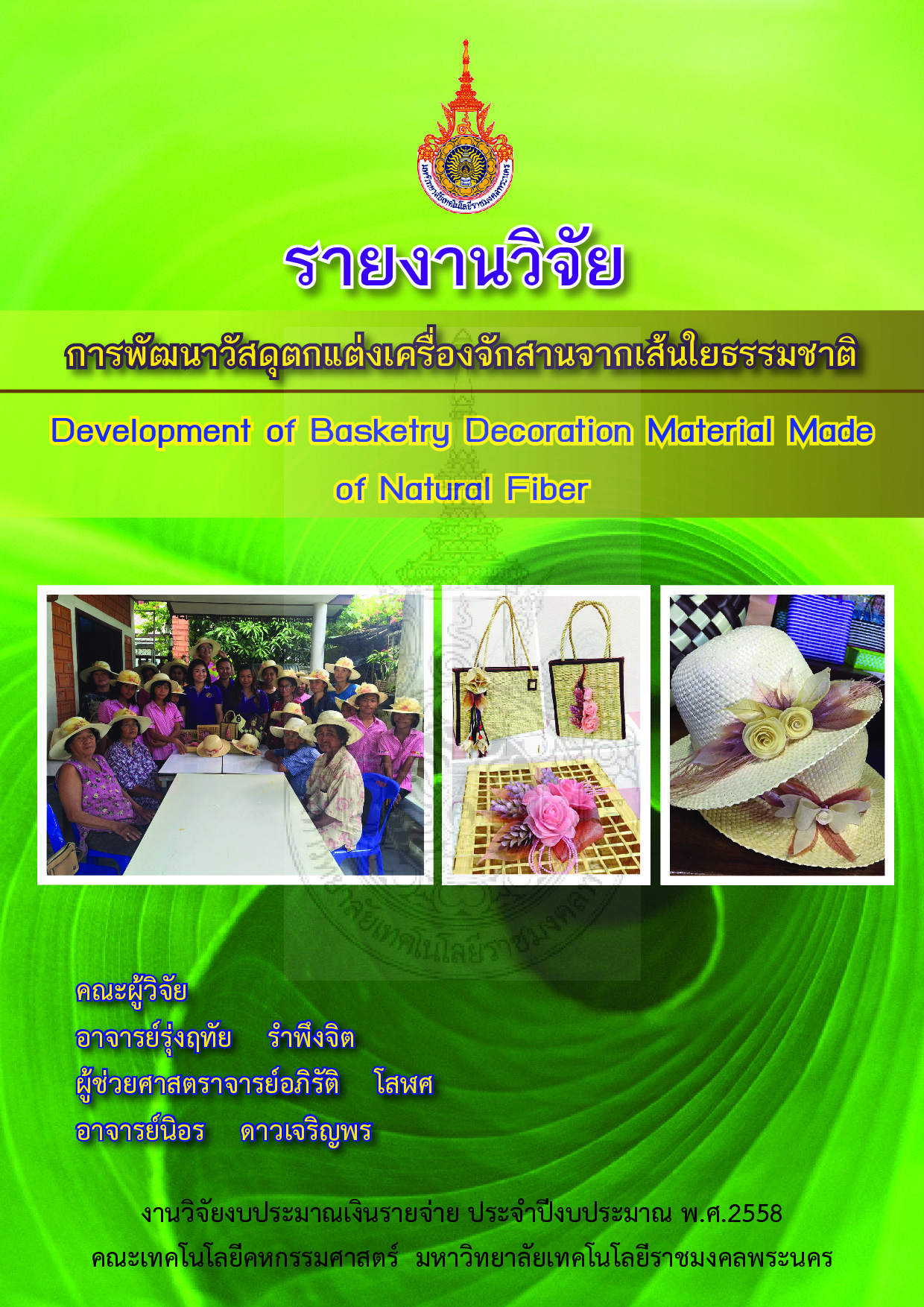
การพัฒนาวัสดุตกแต่งเครื่องจักสานจากเส้นใยธรรมชาติ
The study was aimed to investigate the production of banana fiber that was suitable for decorating handicraft basketry examine its effectiveness develop decorative handicraft materials for basketry from fibrous layer on the trunk of the banana tree and promote the obtained knowledge in the community of Plasticseeroong Baanmor Promburi District Singburi Province. The research result could be summarized that the most appropriate production process of dry fibrous layer on the trunk of the banana tree mixed with fibrous layer of paper mulberry was done through mechanical process. After bleaching the mixed fibrous layer was stirred by Hollander beater with the proportion of wet fibrous layer and water at 1:40; 10% of dry of paper mulberry was boiled for three hours in sodium hydroxide at 100 degree Celsius then bleached with 1.5% of hydrogen peroxide with 4% of the dry fibrous layer weight at 90 to 95 degree Celsius for two hours. The mixture of wet fibrous layer on the trunk of the banana tree with wet fibrous layer of paper mulberry was 70:30 which was considered appropriate for decorating handicraft basketry. Concerning the examination of mechanical properties of banana tree fibrous layer according to the standard of TAPPI T it was found that the folding endurance of paper value was 144 (N. m/g); the tensile strength value was 32.16 (N. m/g); the tear resistance value was 26.56 (mN.m2/g); and the bursting strength value was at 1.94 (KPa.m2/g). The fibrous layer obtained from on the trunk of the banana tree was fabricated into decorative basketry materials for example flowers palm leave hats flower key chains bags and paraffin coated flowers for bamboo boxed. The attendants’ satisfaction on the training of the production of decorative handicraft materials of basketry from fibrous layer on the trunk of the banana tree to 30 members of the community of Plasticseeroong Baanmor Promburi District Singburi Province concerning the training service speakers training procedures facilities and training benefits was at high level (90.67%) and at average level (9.33%).
การพัฒนาวัสดุตกแต่งเครื่องจักสานจากเส้นใยธรรมชาติ
The purpose of this research was to investigate the development of basketry decoration material made of natural fiber by studying (1) the process of papermaking made of Typha Angustifolia fiber mixed with banana fiber (2) the development of the prototype of basketry decoration material made of natural fiber and (3) the target group’s comments on the prototype of basketry decoration material made of natural fiber. banana fiber the researchers (1) studied the process of paper making by handcraft method without using chemicals (2) used fiber preparation as the digestion of raw material with mechanical process by crushing the raw material into fiber and (3) studied the proper proportion of fibers for paper-making process which had 3 formulas. The researchers found out that the third formula suited best for making paper made of natural fiber in order to use in the production of basketry decoration material and also for making basketry decoration material made of natural fiber. The proportion of the third formula was (1) 20 grams of Typha Angustifolia leaves (2) 30 grams of banana tree (3) 20 grams of paper pulp and (4) 3 liters of waters. Then the researchers studied the comments of target group received from fifty people. 95% of the target group were satisfied with the beauty of basketry decoration material made of natural fiber 95% were satisfied with the usage of products as a sample for the production of other art forms 95 % were satisfied with the product’s weight which was suitable 95% were satisfied with the usage of Typha Angustifolia leaves and banana fiber in production 95% were satisfied with the property of product distribution. 90% were satisfied with the convenience of the product usage 90% were satisfied with the surface of the product and 80% were satisfied with the durability of product.
การพัฒนาแผ่นใยไม้อัดซีเมนต์จากาการประยุกต์ใช้เส้นใยธรรมชาติจากกากมะพร้าวและต้นข้าวโพด
This research aims to study the application of coconut meal and corncob fiber as high density cement-bonded fiberboard. The cement: fine sand: coconut meal and corncob fiber: water: cement setting accelerator (aluminium sulphate (Al2(SO4)3) calcium chloride (CaCl2) sodium silicate (Na2SiO3)) ratio is equal to 1: 0.2: 0.05: 0.3: 0.03 by weight. The fibers are taken from coconut meal: corncob that 5 ratios are used following: 0.0500: 0 (CN0) 0.0375: 0.0125 (CN25) 0.0250: 0.0250 (CN50) 0.0125: 0.0375 (CN75) and 0: 0.0500 (CN100) by weight. 12% of Sodium Hydroxide (NaOH) was used to modify the fibers by using 1: 10 of fiber: solution and boiling 100 degree of Celsius (1-3 hours). The fiberboard production use pressure casting in normal temperature (30 – 35 degree of Celsius) and 0.75 g/cm3 of density. Resulting the CN75 ratio is suitable ratio which pass TIS 878-2537 standard (cement bonded particle board: high density) and has good physical properties mechanical properties and thermal insulation. The most suitable cement setting accelerator is calcium chloride (CaCl2).