จำนวน Repository ( 7 )
การศึกษาระดับปัจจัยที่เหมาะสมสำหรับการปรับปรุงกระบวนการอบอ่อนเหล็กแผ่นม้วน
The objective of this research is to study the suitable factor level for the improvement of annealing furnace for rolled coils steel sheet. The experimenting has been performed to find suitable oxygen level by 5 annealing furnace experiment. The research has been started by collection the combustion. After that the burning adjustment by changing combustion technology with 5 levels of BGCV control valve open as 23% 40% 50% 75% and 100% has been implemented. The combustion adjustment data are recorded analyzed and compared with incomplete combustion value. The research result has been found that after improvement the combustion value. The percentage of oxygen level are improved to the better quality which standard at MV0-49% equal 2.5-4 O2% and MV50-100% equal 1.5-2.5 O2% conclusion 1 furnace as follows at the MV23.1% MV40% MV50% MV75% and MV100% level of oxygen as 2.5% 3% 3% 2% 1.5% and level of carbon monoxide as 0 ppm 2 ppm 2 ppm 2 ppm and 0 ppm respectively. Resulting of fuel energy consumption in the annealing process has been reduced around 225608 baht /year/furnace. Therefore it can depict that energy saving and annealing furnace efficiency improving are increased. The modified parameters will be applied to be the new standard reference values for the further engineer’s operational manual.
Abrasive wear behavior of diffusion layer by Pack Cementation on low carbon steel
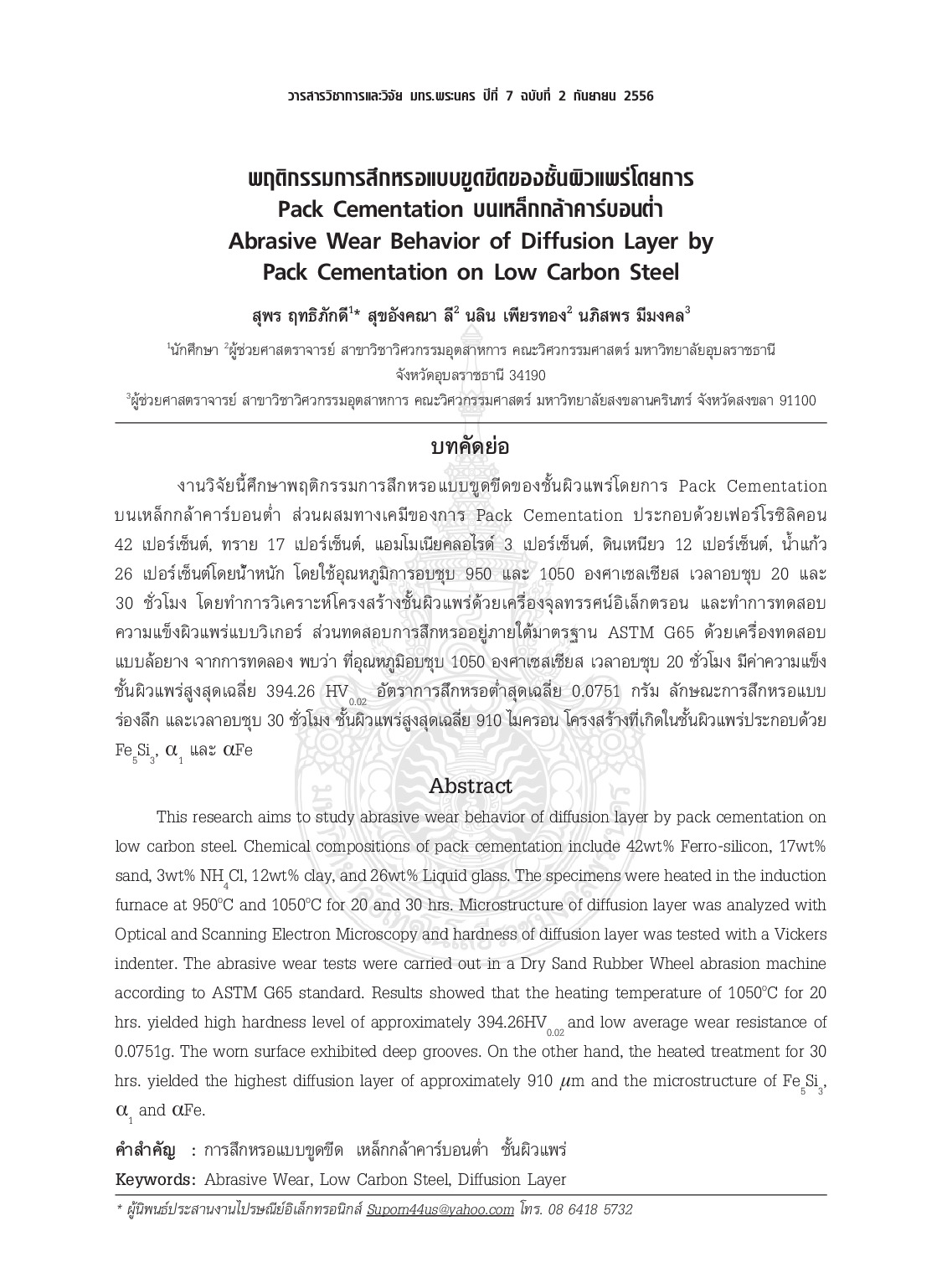
This research aims to study abrasive wear behavior of diffusion layer by pack cementation on low carbon steel. Chemical compositions of pack cementation include 42wt% Ferro-silicon 17wt% sand 3wt% NH4Cl 12wt% clay and 26wt% Liquid glass. The specimens were heated in the induction furnace at 950?C and 1050?C for 20 and 30 hrs. Microstructure of diffusion layer was analyzed with Optical and Scanning Electron Microscopy and hardness of diffusion layer was tested with a Vickers indenter. The abrasive wear tests were carried out in a Dry Sand Rubber Wheel abrasion machine according to ASTM G65 standard. Results showed that the heating temperature of 1050?C for 20 hrs. yielded high hardness level of approximately 394.26HV0.02 and low average wear resistance of 0.0751g. The worn surface exhibited deep grooves. On the other hand the heated treatment for 30 hrs. yielded the highest diffusion layer of approximately 910?m and the microstructure of Fe5Si3 ?1 and ?Fe.