จำนวน Repository ( 14 )

Extraction of plastic and aluminum foil from beverage cartons with biological processes
Extraction of plastic and aluminum foil from beverage cartons with biological processes is one environmentally friendly approach that is appropriated for paper recycling. The other remained parts including plastic and foils can thus be utilized. This research aimed to improve the capability in digestion of cellulose paper of microbes isolated and screen from fruit durian and jackfruit in degradation of beverage cartons. In the small scale processes reducing sugar indicating the efficiency of the degradation process of the boxes was released from the hydrolysis of paper and determined by biochemical method of Benedict test. The controls of alkali and water immersion were utilized for these experiments. In the medium and large scale digestion processes the results showed that microorganisms helped separate sheet papers from the plastic and aluminum foils shortly in 14 days after boiling in water for 10 min. The bacteria digestion were well adapted within 14 days and prolonged their high degradability until 28 days. They could degrade the cellulose components better than the fungi with the separation efficiency of 70 percent and 66 percent respectively. Therefore from overall the biodegradation process of microorganisms have a high potential in digestion of various paper products for recycling and can be applied in industrial applications.
การวิจัยและพัฒนาการหล่ออลูมิเนียมเพื่อผลิตตัวเรือนเครื่องประดับด้วยการหล่อระบบเหวี่ยง
This paper describes an aluminum casting jewelry manufacturing because of the current manufacturing costs are higher. Material or metal that is commonly used to cast jewelry is silver which aluminum Alternatives to metal. Melting is There is a close color and surface finish can be beautiful. But aluminum is a material that is cheap has studied and tested. Replacement aluminum casting body jewelry. The temperature in the baking mold before casting to test all five temperatures are 550 500 450 400 350 degrees Celsius then casting body jewelry in the next stage of the research process casting jewelry with the. aluminum to Experimental temperatures used in baking mold casting plaster for the mold temperature of 400 is appropriate. Best of casting jewelry with aluminum. The results showed that there is minimal waste and a 102 pieces of 48 pieces and has a smooth surface. A similar performance to the other materials available. Similar properties
การเปรียบเทียบวัสดุที่ใช้ทำแม่พิมพ์ฉีดที่ทำจากอลูมิเนียมเกรด A7075 กับ เหล็กเกรด P20
Material selection for mold making are not only material prices wages but also there are other factors such as thermal strength shine and resistance to temperature changing that caused distortion and cracks. Preform injection molding from Polyethylene Terephthalate (PET) consumes time for drying granulated plastic in 4 – 6 hours at 140 - 160°C and injects at 280 – 300 °C. This is a very high temperature to inject into mold at 10 – 15°C in cool area. The material for mold making must be able to resist to thermal shock. Today molding machines are made of grade P20 steel (Standard JIS) to produce preform that takes long cycle time due to poor cooling. The research aims to compare the pricing time in mold making to preform injection time that made of aluminum -A7075 grade and grade P20 steel. The experiment is to make a mold that made of aluminum A7075 grade and grade P20 steel injects 15 gram preform. The PET is used to blow into a blow mold with pressure at 30 – 35 bar (Two – Stage) that are 2 bottles of 350 ML. The results of material selection for preform mold making showed that aluminum A7075 grade is cheaper 27.04% the mold price is cheaper 23.6% and consumes less cycle time than grade P20 steel.

Aluminum Can Recycle Machine
This research report of the Aluminum Can Recycle Machine Project is contrived the experiments at Rajamangala University of Technology Phra Nakhon by the hydraulic pressure. Nowadays the cans make by luminum material very useful in several liquid packaging industries. When people consumed the liquid inside the cans then the cans are worthless. But the cans can be recycling from the waste material. Although we have to reduce the waste materials to follow our world as improvement. From the reasons that we mentioned we decided to start the Aluminum Can Recycle Machine research project to keep him or her eager to put the cans to the machine for consumer then encourage them by giving something back such as a candy or a rubber etc. The system working by a PLC it controls the hydraulic pressure receives the sensor signals and displays status via the 7-segment panel. The machine accepts the standard beer can and the soda can for 10 cans a time in a slot when consumer put the cans into the can receiver block the machine gives a candy back to a consumer. After a receiver-block has the 40 cans inside the machine pressing the cans at once then releasing it to collector block.
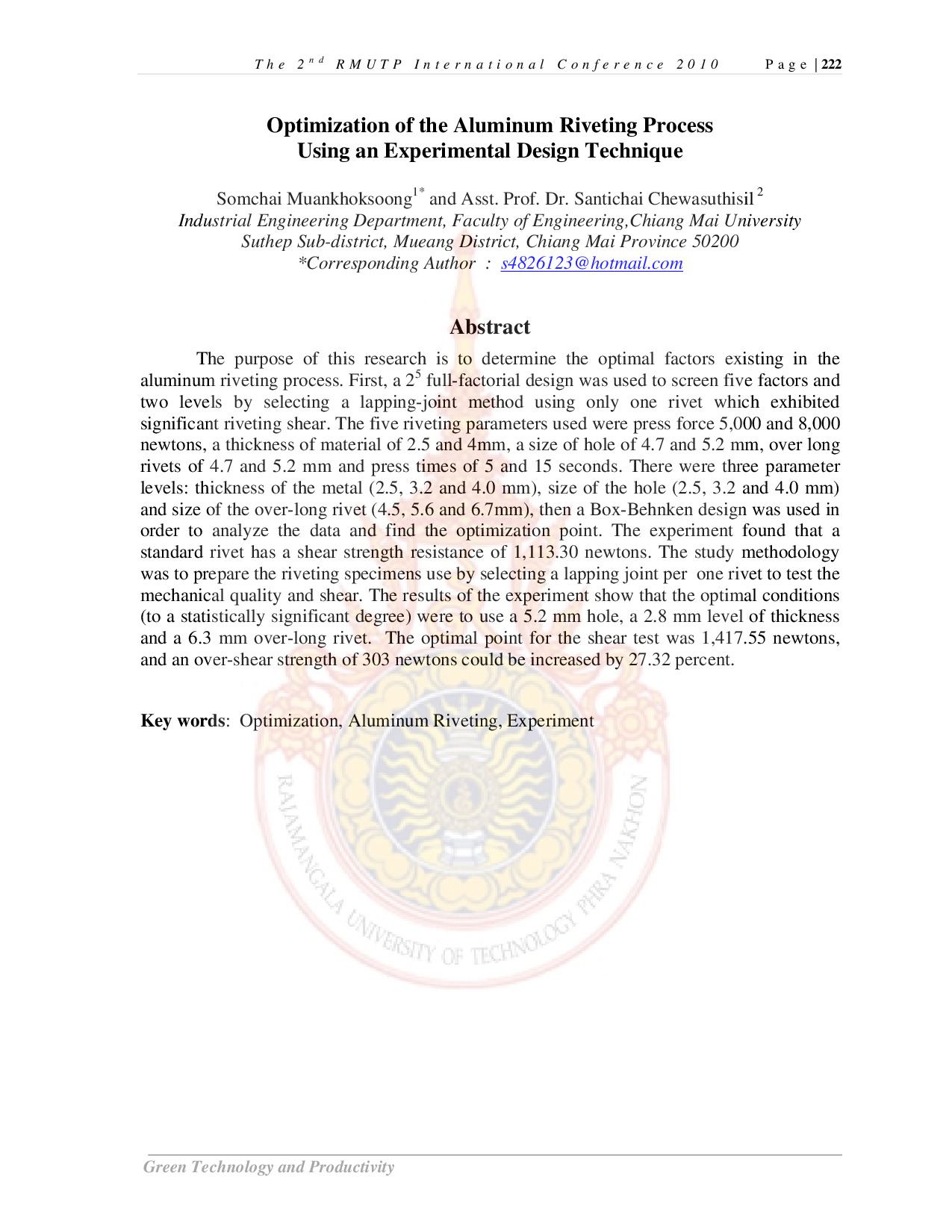
Optimization of the Aluminum Riveting Process Using an Experimental Design Technique
The purpose of this research is to determine the optimal factors existing in the aluminum riveting process. First a 25 full-factorial design was used to screen five factors and two levels by selecting a lapping-joint method using only one rivet which exhibited significant riveting shear. The five riveting parameters used were press force 5000 and 8000 newtons a thickness of material of 2.5 and 4mm a size of hole of 4.7 and 5.2 mm over long rivets of 4.7 and 5.2 mm and press times of 5 and 15 seconds. There were three parameter levels: thickness of the metal (2.5 3.2 and 4.0 mm) size of the hole (2.5 3.2 and 4.0 mm) and size of the over-long rivet (4.5 5.6 and 6.7mm) then a Box-Behnken design was used in order to analyze the data and find the optimization point. The experiment found that a standard rivet has a shear strength resistance of 1113.30 newtons. The study methodology was to prepare the riveting specimens use by selecting a lapping joint per one rivet to test the mechanical quality and shear. The results of the experiment show that the optimal conditions (to a statistically significant degree) were to use a 5.2 mm hole a 2.8 mm level of thickness and a 6.3 mm over-long rivet. The optimal point for the shear test was 1417.55 newtons and an over-shear strength of 303 newtons could be increased by 27.32 percent.