จำนวน Repository ( 11 )
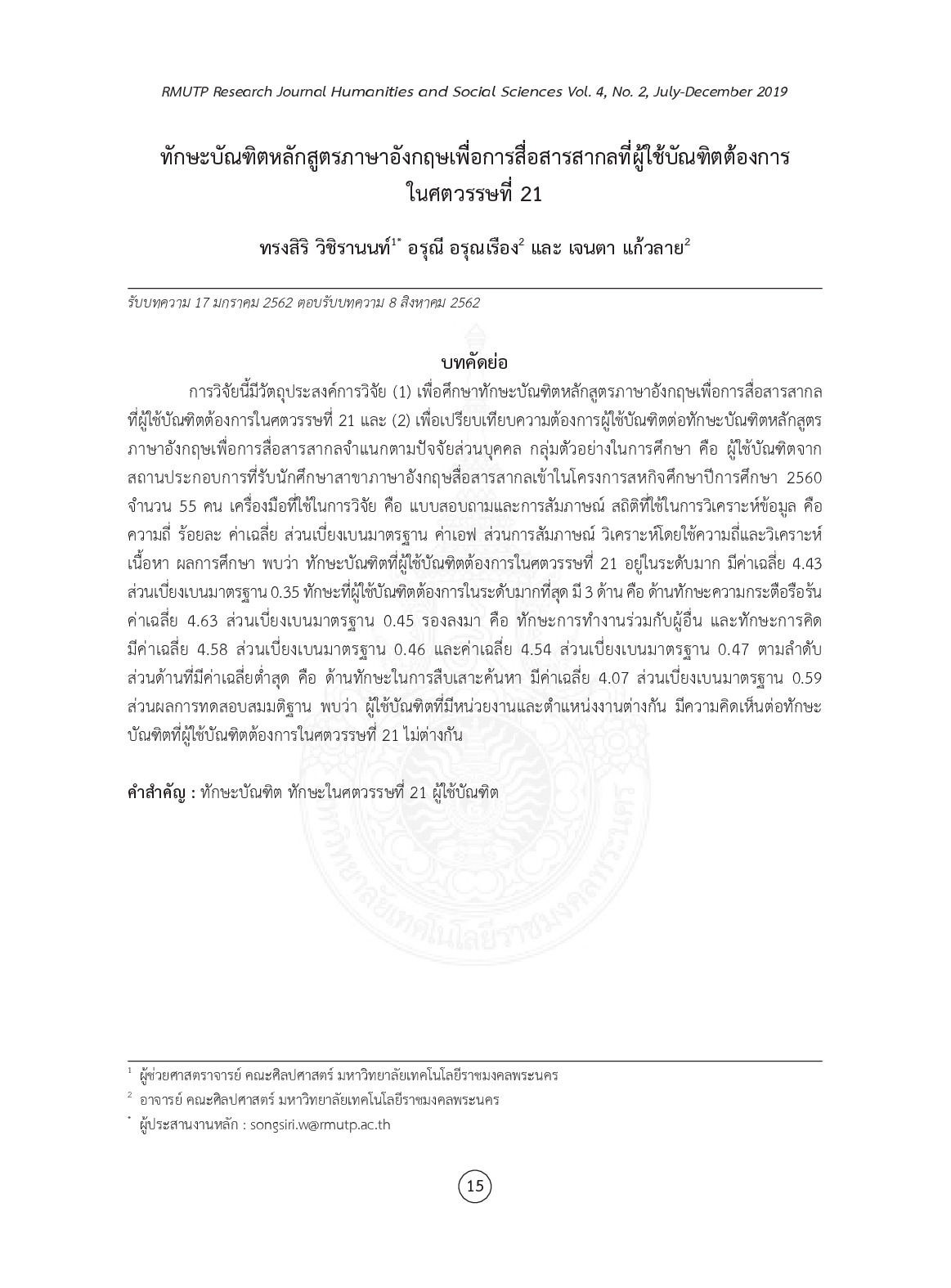
ทักษะบัณฑิตหลักสูตรภาษาอังกฤษเพื่อการสื่อสารสากลที่ผู้ใช้บัณฑิตต้องการในศตวรรษที่ 21
The purposes of the research were to 1) study the 21st century skills of English for International Communication graduates desired by employers and 2) compare the employers’ requirements to skills of English for International Communication graduates categorized by the individual factors. The sample were 55 employers participating in the cooperative education project in the academic year 2017. The research tools were questionnaires and interviews. The statistical data analysis was performed by frequency percentage mean standard deviation and F distribution and the interview data analysis was performed by frequency and content analysis. It was found that the overall requirement of the employers for the 21st century skills of the graduates was at the high level (χ = 4.43 S.D = .35). As for each attribute the highest level was enthusiasm (χ = 4.63 S.D = .45) followed by collaboration (χ = 4.58 S.D = .46) and thinking skills (χ = 4.54 S.D = .47) respectively. The lowest level was the inquiry skills (χ = 4.07 S.D = .59). The result of the research hypothesis revealed that there is no significant difference between the employers with different employment sectors and working status and the requirement of the graduates’ attributes.

การศึกษากลวิธีการเรียนภาษาอังกฤษของนักศึกษาคณะศิลปศาสตร์ มหาวิทยาลัยเทคโนโลยีราชมงคลพระนคร
This research intends to study the English language learning strategies of students in the faculty of Liberal Arts Rajamangala University of Technology Phra Nakhon and to compare the learning strategies among gender three fields of study and English language achievement. The population group is 215 second-year Liberal Arts students in the second semester of the academic year 2016. The instrument was the Strategy Inventory for Language Learning (SILL) questionnaire. The obtained data were analyzed to find percentage mean and standard deviation. The study findings revealed that the overall use of English language learning strategies was at the medium level (=3.19). When considering each strategy the highly used learning strategy was compensation learning strategies (=3.46) and followed by affective learning strategies (=3.36) metacognitive strategies (=3.15) social strategies (=3.13) memory strategies (=3.03) and cognitive strategies (=3.01) respectively. The result also indicated that the learners’ fields of study and English language achievement significantly affected the overall learning strategies but gender did not show significant differences.
การประเมินความต้องการจำเป็นในการจัดสภาพแวดล้อมที่เอื้อต่อการพัฒนาการเรียนรู้ของนักศึกษา มหาวิทยาลัยเทคโนโลยีราชมงคลพระนคร
The purposes of this research were (1) to study and (2) to rank the needs of RMUTP environment management on undergraduate students’ learning development as well as (3) to present a proposed guideline to improve RMUTP environment. 343 students enrolling in the first semester of the academic year 2015 were selected with simple random sampling. The research tool was questionnaire. The data were analyzed through percentage (%) mean ( ) standard deviation (S.D) t-test modified priority needs index: PNI modified and content analysis. The results demonstrated that: (1) The overall mean scores of the reality and expectation of RMUTP environment on students’ learning are statistically different at 0.01. (2) The physical environment needs for supporting students’ quality of life was ranked the first. The second was university facilities to enhance their learning and the third was help and information service. The curriculum management was ranked the fourth. The last one was instructors. (3) A students’ proposed guideline: 3.1 As for physical environment needs for supporting students’ quality of life the highest was more relaxing space. 3.2 As for university facilities to enhance their learning the highest was that learning equipments should be adequate for them. 3.3 As for help and information service public relation and university information for students should be improved at a high level. 3.4 As for curriculum management the study suggested students’ needs for curriculum development to meet current employment demand and to implement effectively at the workplaces. 3.5 As for instructors the highest rank was that instructors ought to understand and listen to students’ needs. They should let students express their opinions.
สภาพและปัญหาการเรียนการสอนหมวดวิชาศึกษาทั่วไปตามกรอบมาตรฐานคุณวุฒิระดับอุดมศึกษาแห่งชาติ
The purpose of this research was to study state and problems of teaching management in general education. The research samples were 54 instructors of general education program and 364 students enrolling in general education courses Rajamangala University of Technology Phra nakhon in the second semester of the academic year 2014. The research tools were questionnaire interview and focus group discussion. The data were analyzed by frequency percentage mean and standard deviation. The findings were as follows: 1. As for students’ opinions on the general education content the overall opinions are at the high level and due to each program of general education the students’ opinions towards the implementation of Thai language ( = 4.00) social science and humanity ( = 3.67) and physical education ( = 3.38) are at the highest level. The students’ opinions towards foreign language for basic principles of further education are at the highest level ( = 4.01). 2. As for students’ opinions on state of teaching management in general education the students’ opinions towards the development of general education instruction according to Thai qualification framework for higher education are at the high level and within each aspect the students’ opinions towards interpersonal skills and responsibility are at the highest level ( = 3.81) followed by moral and ethical behavior ( = 3.79) and knowledge ( = 3.72) while mathematical analysis skills communication skills and information technology application skills rated the lowest ( = 3.52). 3. As for students’ opinions on problems of teaching management in general education the students’ opinions towards problems of general education instruction according to Thai qualification framework for higher education are at the moderate level and within each aspect the students’ opinions towards mathematical analysis skills communication skills and information technology application skills rated the highest ( = 2.80) followed by moral and ethical behavior ( = 2.75) and knowledge ( = 2.63) while interpersonal skills and responsibility are at the lowest level ( = 2.54). 4. As for the comparison of the students’ opinions on state and problems of teaching management in general education according to Thai qualification framework for higher education it was found that every aspect was statistically significant at 0.00 level. 5. As for instructors’ opinions on state of teaching management in general education the instructors’ opinions towards the development of general education instruction according to Thai qualification framework for higher education are at the high level and within each aspect the instructors’ opinions towards interpersonal skills and responsibility are at the highest level ( = 3.59) followed by moral and ethical behavior ( = 3.52) and cognitive skills ( = 3.34) while mathematical analysis skills communication skills and information technology application skills rated the lowest ( = 3.18). 6. As for instructors’ opinions on problems of teaching management in general education the instructors’ opinions towards problems of general education instruction according to Thai qualification framework for higher education are at the moderate level and within each aspect the instructors’ opinions towards mathematical analysis skills communication skills and information technology application skills rated the highest ( = 3.10) followed by knowledge ( = 3.05) and cognitive skills ( = 3.02) while interpersonal skills and responsibility are at the lowest level ( = 2.78). 7. As for the comparison of the instructors’ opinions on state and problems of teaching management in general education according to Thai qualification framework for higher education it was found that moral and ethical behavior interpersonal skills and responsibility were statistically significant at 0.00 level.
คุณลักษณะบัณฑิตสาขาวิชาภาษาไทยประยุกต์ที่พึงประสงค์ของสถานประกอบการ
The purposes of this research were to investigate the desired characteristics of the Applied Thai Program’s graduates of the faculty of Liberal Arts and to compare the graduate users’ personal factors. The subjects were business organizations and executive managers. The research tools were questionnaire and interview. The data were analyzed by percentage mean standard deviation and F-test. The findings were as follows: As for employers’ satisfaction towards the graduates’ qualifications the desirable characteristics of the graduates both overall and within each aspect are at the high level ( x= 3.84). Moral and ethical behavior rated the highest desirable characteristics (x= 4.01) followed by domain of psychomotor skills (x= 3.99) as well as interpersonal skills and responsibility (x= 3.84). As for the comparison of the graduate users’ personal factors it was found that: as for types of business organizations the overall mean value of types of business organizations was not different but the mean scores of moral and ethical behavior and domain of psychomotor skills were statistically significant at 0.01 level. As for positions of graduate users the overall mean value of positions of graduate users was statistically significant at 0.01level. Moreover the mean scores of knowledge and university identity were statistically significant at the level 0.01 while the mean scores of moral and ethical behavior mathematical analysis skills communication skills information technology application skills and domain of psychomotor skills were statistically significant at 0.05 level. As for working experiences the overall mean value of working experiences was not different but the mean scores of university identity was statistically significant at the level 0.05. As for working tenure the overall mean value of working tenure was statistically significant at 0.01level. Moreover the mean scores of moral and ethical behavior knowledge cognitive skills interpersonal skills and responsibility mathematical analysis skills communication skills information technology application skills and domain of psychomotor skills were statistically significant at 0.01level while the mean scores of university identity was statistically significant at the level 0.05. As for employers’ needs the first desired characteristics of the graduates were information technology application skills and basic computer knowledge. Thai and English oral communication skills were the second desired characteristics.