จำนวน Repository ( 9 )
การศึกษากรรมวิธีการทำเปลือกแตงโมปรุงรส
The research on “A Study of Seasoning Watermelon shell Process ” had objectives of study to develop product of Watermelon shell jam from changing the prototype recipe of pineapple jam. The researchers altered the recipe by using Watermelon shell to replace 100 per cent pineapple texture in three recipes to be put additionally into water melon texture in three different content 20 per cent 30 per cent and 40 per cent of the total weight of Watermelon shell . The researcher studied about the process of making flavored Watermelon shell in order to study three types of appropriate and different processes of Watermelon shell including diced Watermelon shell chopped Watermelon shell and ground Watermelon shell in homogenous texture. From the study it was found that study of pineapple jam recipe was in prototype recipe; altering the recipe by using Watermelon shell to replace 100% pineapple texture. Then the researchers had tasting persons taste three basic recipes and found that tasting persons accepted recipe No. 2 in the total aspects of color scent flavor texture and fondness. The scores were 7.93?0.62 8.25?0.56 7.80?0.54 7.63?0.70 and 7.68?0.57 respectively; the fondness was from moderate level to much fondness. When variance was analyzed and statistical difference was searched it was found that total features of color scent flavor texture and fondness did not have significant difference at level of 0.05. From study it was found that study of process of making flavored Watermelon shell in three types including diced watermelon shell chopped watermelon shell and ground Watermelon shell in homogenous texture it was found that tasting persons accepted recipe No. 1 (diced Watermelon shell ) in total color scent flavor texture and fondness having mean value at 8.03?0.66 8.50?0.64 8.28?0.55 7.98?0.66 and 7.93?0.35 respectively in the level of moderate fondness to much fondness. When variance was analyzed and statistical difference was searched it was found that total features of color scent flavor texture and fondness had significant difference at level of 0.05.
การพัฒนาผลิตภัณฑ์ขนมไทยจากกากมะพร้าวเหลือใช้
The purposes of the study regarding the development of Thai dessert products from used coconut residue are to study about appropriate amount of used coconut residue from oil extraction to study quality of Thai dessert products by using used coconut residue from oil extraction and to study acceptance of consumers towards Thai dessert products by using used coconut residue from oil extraction.

การศึกษากรรมวิธีการผลิตเครื่องปรุงผงก๋วยเตี๋ยวผัดไทย
This paper aimed to study the process of making instant Pad Thai powder by Spray Drying method. The appropriate temperature of hot gas and the quantity of Maltodextrin in processing instant Pad Thai powder by Spray Drying method were studied. Factorial in Completely Randomized Design (CRD) was used. The study found that the appropriate quantity of Maltodextrin was 20% and the appropriate temperature for in and out hot gas was 150/90 ºC. The color variation of the finishing instant Pad Thai powder was as follow: Bright colors L* 88.32 Red a* 0.99 Yellow b* 8.26. The color variation after cooking the product was: Bright colors L* 30.73 Red a* 3.08 Yellow b* 8.25. aw 0.22. The moisture of the powder was 1.24. Then the consumer satisfaction was studied by using 3 types of Pad Thai Noodles; Pad Thai Noodles with Instant pad Thai Powder Pad Thai Noodles with regular Pad Thai sauce and Pad Thai Noodles sold in general market. Randomized Complete Block Design RCBD was used. The study of the consumer satisfaction revealed that there was no difference between pad Thai Noodles made with Instant Pad Thai Powder and Pad Thai Noodles made with regular Pad Thai sauce at the statistical significance (p>0.05). The testers rated the overall taste of Pad Thai Noodles at 7.57. Next the researcher studied the expiration period of Instant Pad Thai Powder by packing the product in double vacuum foil and storage the product at 4 different temperatures 30 35 45 and 55 degree Celsius. Then the product was studied to evaluate the physical chemical microorganism and sensory property. The product kept at 55 ºC was the most different of the four storage products at p ≥ 0.05 with the highest level of consumer satisfaction at color = 7.33 smell = 7.30 taste = 7.90 texture = 7.57 and total = 7.40. The amount of microorganism yeast and fungus were at the safe level to comsume.
The Study of Instant Pad Thai Powder Processing
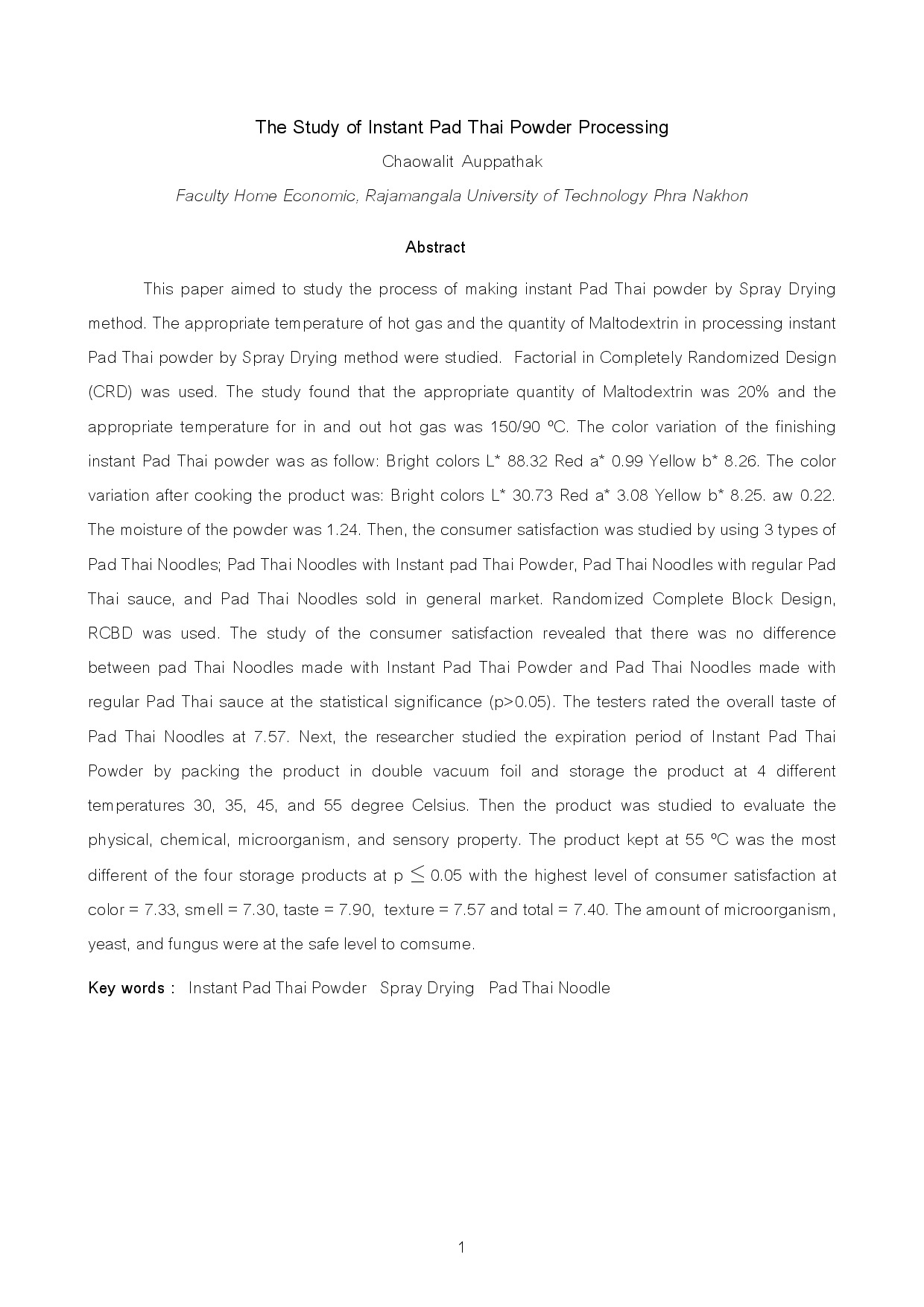
This paper aimed to study the process of making instant Pad Thai powder by Spray Drying method. The appropriate temperature of hot gas and the quantity of Maltodextrin in processing instant Pad Thai powder by Spray Drying method were studied. Factorial in Completely Randomized Design (CRD) was used. The study found that the appropriate quantity of Maltodextrin was 20% and the appropriate temperature for in and out hot gas was 150/90 ºC. The color variation of the finishing instant Pad Thai powder was as follow: Bright colors L* 88.32 Red a* 0.99 Yellow b* 8.26. The color variation after cooking the product was: Bright colors L* 30.73 Red a* 3.08 Yellow b* 8.25. aw 0.22. The moisture of the powder was 1.24. Then the consumer satisfaction was studied by using 3 types of Pad Thai Noodles; Pad Thai Noodles with Instant pad Thai Powder Pad Thai Noodles with regular Pad Thai sauce and Pad Thai Noodles sold in general market. Randomized Complete Block Design RCBD was used. The study of the consumer satisfaction revealed that there was no difference between pad Thai Noodles made with Instant Pad Thai Powder and Pad Thai Noodles made with regular Pad Thai sauce at the statistical significance (p>0.05). The testers rated the overall taste of Pad Thai Noodles at 7.57. Next the researcher studied the expiration period of Instant Pad Thai Powder by packing the product in double vacuum foil and storage the product at 4 different temperatures 30 35 45 and 55 degree Celsius. Then the product was studied to evaluate the physical chemical microorganism and sensory property. The product kept at 55 ºC was the most different of the four storage products at p ≤ 0.05 with the highest level of consumer satisfaction at color = 7.33 smell = 7.30 taste = 7.90 texture = 7.57 and total = 7.40. The amount of microorganism yeast and fungus were at the safe level to comsume.