จำนวน Repository ( 12 )

Physical settings, sense of place, safety perception and quality of life: a case study of buildings in rmutp
ความรู้สึกไม่ปลอดภัยอาจก่อให้เกิดปัญหาด้านสุขภาพจิต ด้านสังคม และความรู้สึกไม่ หวงแหนต่อสถานที่ ( Lack in Sence of Place ) ให้แก่ผู้ที่ใช้พื้นได้ สภาวะดังกล่าวอาจส่งผลให้เกิด การก่อให้เกิดอาชญากรรม การวิจัยนี้ต้องการพิสูจน์ว่ามีปัจจัยทางกายภาพอะไรบ้างที่ก่อให้เกิดความ รู้สึกต่อสถานที่ ( sense of place ) ความรู้สึกปลอดภัย และคุณภาพชีวิต โดยศึกษาลักษณะทาง กายภาพอาคารของมหาวิทยาลัยเทคโนโลยีราชมงคลพระนคร แบ่งพื้นที่ให้มีลักษณะที่แตกต่างกัน ทางกายภาพเป็น 2 กลุ่มประเภทอาคารจาก 5 วิทยาเขต โดยมีจุดประสงค์การวิจัยเพื่อ หนึ่งศึกษาปัจจัยของทางสภาพแวดล้อมที่ส่งผลต่อการรับรู้สถาน ที่ ความปลอดภัย และคุณภาพชีวิต สองศึกษาอิทธิพลของปัจจัยทางกายภาพ และปัจจัยทางด้าน บุคคลต่อการรับรู้ สามสรุปปัจจัยที่มีผลต่อการรับรู้ และเสนอแนะแนวทางการจัดการสภาพแวดล้อม ซึ่งในการวิจัยใช้ทฤษฎี หลักการออกแบบชุมชน การรับรู้ (ทฤษฎี เกรสตอล) และการจัดการสภาพ แวดล้อม เพื่อให้ได้มาซึ่งตัวแปรและวิธีการในการดำเนินงาน ผู้วิจัยได้แปลงตัวแปรเชิงทฤษฏีสู่ตัวแปร เชิงปฎิบัติการจากนั้นจึงนำไปใช้สร้างเครื่องมือในการวิจัย โดยเครื่องมือแบ่งออกเป็นสองส่วนด้วยกัน ในส่วนแรกเป็นแบบสำรวจลักษณะทางกายภาพของอาคาร ( PHYSICAL MEASUREMENT ) ตาม การแบ่งพื้นที่เพื่อสำรวจสิ่งแสดงความเป็นเจ้าของและความไม่ศิวิไลย์ ในส่วนที่สองคือแบบสอบถาม เพื่อวัดระดับการรับรู้ความรู้สึกปลอดภัย ( QUESTIONNAIRE ) และส่วนที่สามคือการวัดระดับ ลักษณะกายภาพ ( OBSERVATION MAPPING ) จากนั้นการวิจัยจะเชื่อมโยงระหว่างลักษณะทาง กายภาพทั้งสองประเภทกลุ่มอาคารจาก 5 วิทยาเขต (วิทยาเขตเทเวศร์ วิทยาเขตโชติเวช วิทยาเขต Iพณิชยการพระนคร วิทยาเขตชุมพรเขตรอุดมศักดิ์ วิทยาเขตพระนครเหนือ ) กับการรับรู้ความรู้สึก ปลอดภัย ความเป็นสถานที่ และคุณภาพชีวิตของนักศึกษาในมหาวิทยาลัย
การพัฒนาวัสดุอาหารจากวัสดุเหลือทิ้งทางการเกษตรเพื่อการประหยัดพลังงานและลดการถ่ายเทความร้อนเข้าสู่อาคาร
The objective of this research is to study the implementing the agricultural residue to the design of outdoor paving block for lowering the building temperature. The base layer admixture (layer no.1) is selected from cement type1: quarry dust: rice husk: rice straw: water ratios equal to 1: 3: 0: 0: 0.3 1: 1: 0: 1: 0.5 1: 1. 0.25: 0.75: 0.5 1: 1: 0.5: 0.5: 0.5 1: 1: 0.75: 0.25: 0.5 and 1: 1: 1: 0: 0.5 by weight. The surface layer admixture (layer no.2) is white silica cement: yellow stone chip no.4: water equals to 1: 4: 0.3 by weight. The exterior floor-covering blocks were tested following density testing water absorption testing compressive testing and surface temperature testing compare with laterite sandstone paving concrete block marble and granite. Resulting the best ratio of cement type1: quarry dust: rice husk: rice straw: water is 1: 1: 0.75: 0.25: 0.5 that has properties at 28 days following 1939.43 kg/m of density 14.97 % of water absorption 284.69 ksc of compressive strength and lower than other paving blocks around 3 – 13 degrees Celsius of surface temperature
การศึกษาความเหมาะสมของการใช้ระบบปรับอากาศในสำนักงานเพื่อการอนุรักษ์พลังงานและสภาวะความสบาย
Presently Rental office is famous in downtown that near food center and have good transportation. In Thailand office buildings usually have operating time 8-10 hours per day. So need to improve the building for energy conservation and employee’s comfort. Glasses are one way that heat transfers occur highly. Overall Thermal Transfer Value (OTTV) is a tool for measure heat transfers through building envelope. From OTTV calculation for existing building OTTV is 92.94 W/m2 that over ministerial regulations indicate 50 W/m2. Improving building envelope by add more thickness of glasses can reduce OTTV 1.3% and improving building envelope by film installation can reduce OTTV 47.2% and improving building envelope by add shading can reduce OTTV 48.5%. However each improving policy have each investment cost. Conjoint analysis is consider of many factor to find willingness to pay for each choice. So set policies for energy conservation water and waste management and increase comfort are employees to improve energy conservation water and waste management and increase comfort are 19935.90 17590.50 and 1563.60 baht respectively so can improve building envelope by add shading result in OTTV to 47.8 W/m2 Budget 18000 Baht can be improve organization that payback about 5400 Baht per year. Increase thermal comfort by install table fan. From the result of research expect to apply to improve rental office in the future.
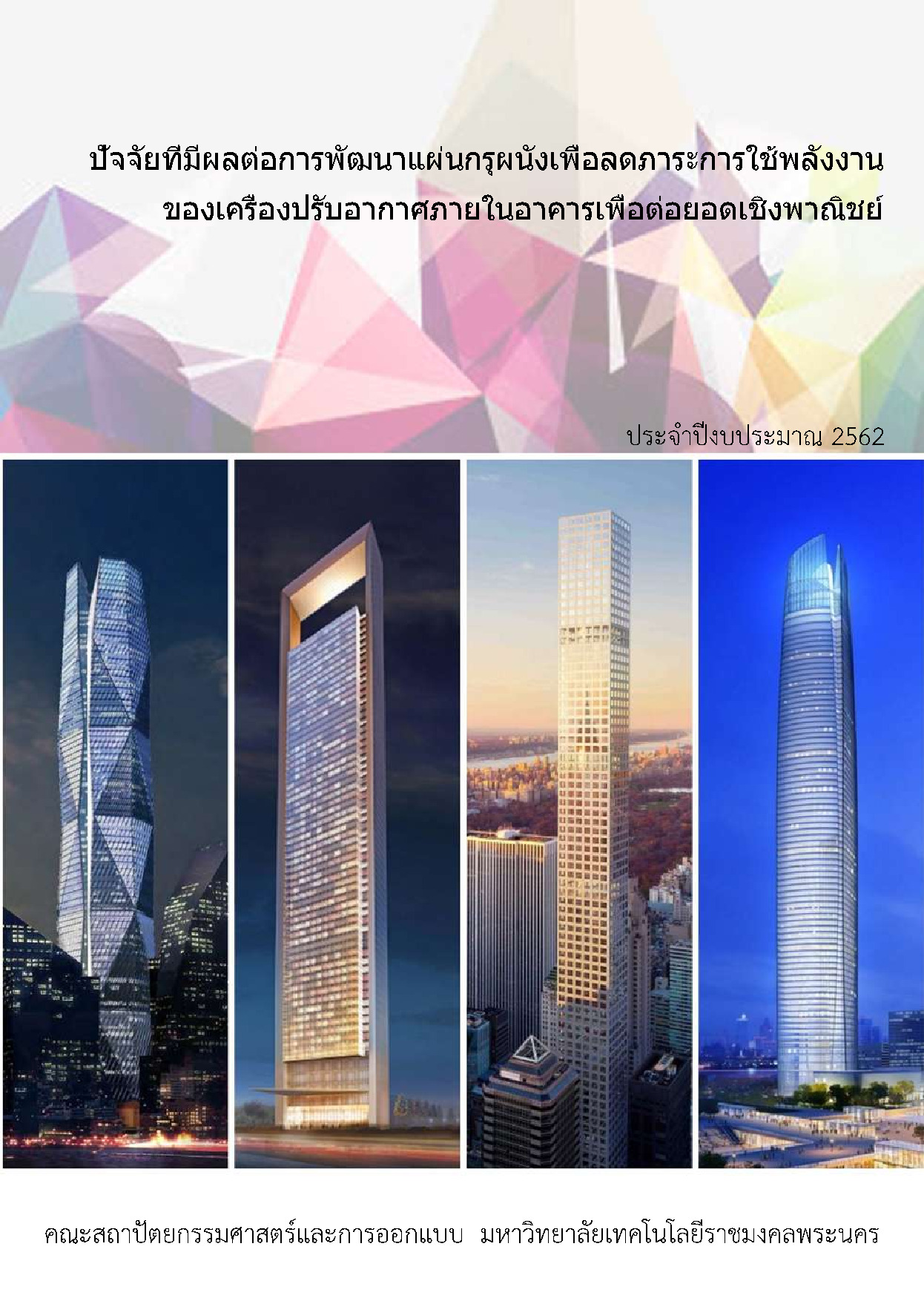
ปัจจัยที่มีผลต่อการพัฒนาแผ่นกรุผนังเพื่อลดภาระการใช้พลังงานของเครื่องปรับอากาศภายในอาคารเพื่อต่อยอดเชิงพาณิชย์
This research approach to study the development of interior wall for reduce energy consumption by air conditioning in the building. In order to be a prototype in the development of an industrial system for the export of green architecture in order to generate income for the community or entrepreneurs to bring money into the country to upgrade the industrial economy to be sustainable It is an architectural material that is compatible with the weather in Thailand. It can be used as a guideline for people interested in applying it to their own home building or disseminating through various media to reduce energy costs for a comfortable living. The objective is to study the factors that affect the development of wall paneling in order to reduce the energy burden of the air conditioner in the building in order to further the commercial production. The researcher collected data for the past 6 months not including other thermal energy. Used to calculate the energy consumption index for 2 building groups it was found that the electricity consumption of green buildings were 531100 kilowatt hours. And an average of 5.31 kilowatt hours per square meter While the non-green building has an average of 653360 kilowatt hours. And an average of 6.53 kilowatt hours per square meter As for the results of the data analysis the damage level is mostly at level 1 which is the wall surface and no obvious damage. Especially the 4th and 5th height is 1.55 meters and 1.85 meters from the floor level in the building. Damage level 3 is found at the height level 3 at a height of 1.00 meters from the floor level in the building. Assessment of damage caused to the interior wall of the building that occurred in 3 levels. The results of the data analysis showed that most damage levels were at level 1 namely the wall surface without obvious damage. Especially the 4th and 5th height is 1.55 meters and 1.85 meters from the floor level in the building. Damage level 3 is found at the height level 3 at a height of 1.00 meters and from the results of collecting moisture content in the exterior wall materials And analyzed to find the average for each of the 5 levels of height which are 0.55 meters 0.75 meters 0.95 meters 1.55 meters and 1.85 meters found that the buildings have different moisture content in each wall level (p <0.05). In conclusion this green building index equation can be applied to other buildings to reduce energy consumption and meet the standards of the green building. From the equation the electricity consumption can be predicted using the electricity usage index and systematically designed energy management in buildings. The area with the most damage will find the humidity in the range of 47% -98% the highest damage level 3 at an elevation of 0.80 meters from the floor level in the building
การพัฒนาผลิตภัณฑ์แผ่นยิปซัมประเภททนไฟผสมเส้นใยจากใบต้นข้าวโพดสำหรับใช้ในอาคารประหยัดพลังงาน
This research aims to develop the gypsum refractory board mixed with corn leaf coir. The 5 ratios of gypsum plaster: corn leaf coir: tap water: sodium silicate are equal to 1: 0: 1: 0.03 1: 0.100: 1: 0.03 1: 0.150: 1: 0.03 1: 0.200: 1: 0.03 1: 0.250: 1: 0.03 และ 1: 0.300: 1: 0.03 by weighted. The gypsum refractory boards were produce by casting in normal temperature (30 – 35 degree of Celsius). The properties testing of gypsum refractory board mixed with corn leaf coir followed the TIS 219-2009 standard (gypsum plasterboard) included: breaking load nail pull resistance deflection water absorption density and thermal conductivity coefficient. From the results 1: 150: 1: 0.03 is the most suitable ratio of gypsum refractory board mixed with corn leaf coir. This developed gypsum refractory boards can reduce the quantity of corn leaf waste and get the good thermal insulation gypsum refractory board products.