จำนวน Repository ( 13 )
การพัฒนาศักยภาพมันสำปะหลังในการผลิต ผลิตภัณฑ์น้ำพริก
The purpose of this research to study the process of destruction of cyanide in cassava. Prior to use in product of Thai pastes and study use of cassava in Thai pastes production of 4 types in tha dang pastes roasted chili paste lohng reuua paste Tamarind chili paste. study physical properties and chemical properties of product and consumer test studies in cassava products affective. in order that transfer technology of development products to the community. The study process to destroy cyanide in cassava before to use in products of pastes. The steaming process in cassava is the low dose of cyanide 18.9 ppm. Studies using cassava to produce 4 types of pastes. The average score of tha dang pastes supplement of cassava 15 percentage in terms of appearance color taste texture and overall liking. The average score was 7.20.7.30.7.00.7.20 and 7.50. This is a preference at a moderate level. Sensory evaluation of roasted paste supplement of cassava 40 percent in terms of appearance color taste texture and overall liking. The average score was 7.86 8.05 7.79 7.86 7.71 and 7.79 This is a preference at a moderate level. Sensory evaluation of lohng reuua paste supplement of cassava 10 percent in terms of appearance color aroma taste texture and overall liking. The average score was 7.30 6.70 7.00 7.50 7.30 and 7.25. This is a preference small and medium-like. Sensory evaluation of tamarind paste supplement of cassava 20 percent in terms of appearance color aroma taste texture and overall liking. The average score was 7.40 7.15 7.15 7.20 7.20 and 7.50. there is a preference moderate inclination. When all 4 types of products were tested for physical chemical and microbiological. we found increasing the amount of cassava in products has affect the color of the products and increase of fat and fiber in the products. All 4 types of cassava products of biomass are no harmful by Thai Industrial Standards Institute. The study on consumer acceptance of the products cassava paste the 4 types. The consumers test responded to the questionnaire were female. The age of the respondents is 21-30year and occupation of the respondents are students. Most of the revenue will be at 10001-15000 baht. The consumers liking the product in rate like very much to like most and accept all 4 types of cassava products. Most consumers buy for storing themselves including buying as souvenirs. The price of products in consumers agree on the price of 35 baht.
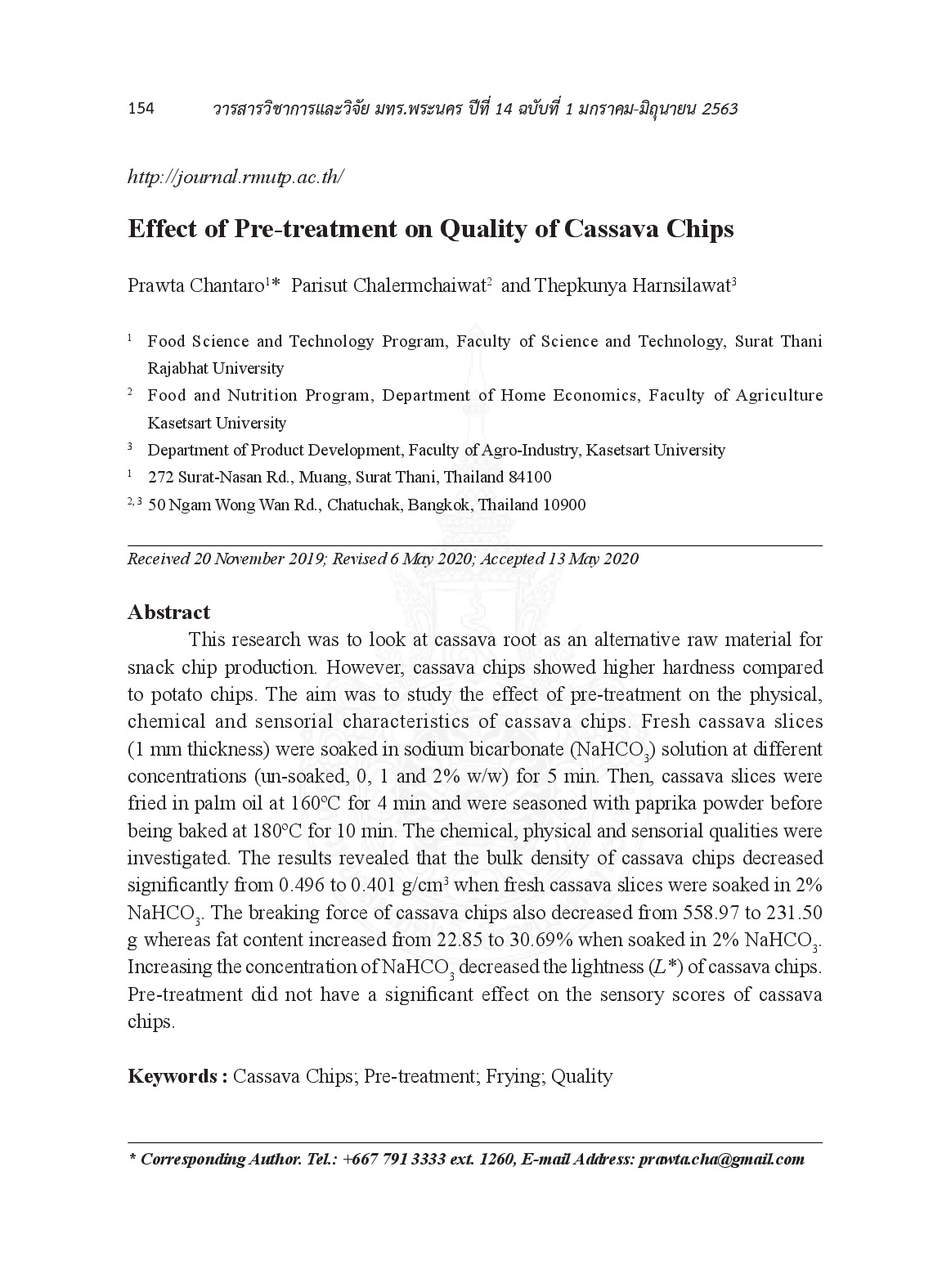
Effect of pre-treatment on quality of cassava chips
This research was to look at cassava root as an alternative raw material for snack chip production. However cassava chips showed higher hardness compared to potato chips. The aim was to study the effect of pre-treatment on the physical chemical and sensorial characteristics of cassava chips. Fresh cassava slices (1 mm thickness) were soaked in sodium bicarbonate (NaHCO3) solution at different concentrations (un-soaked 0 1 and 2% w/w) for 5 min. Then cassava slices were fried in palm oil at 160ºC for 4 min and were seasoned with paprika powder before being baked at 180ºC for 10 min. The chemical physical and sensorial qualities were investigated. The results revealed that the bulk density of cassava chips decreased significantly from 0.496 to 0.401 g/cm3 when fresh cassava slices were soaked in 2% NaHCO3. The breaking force of cassava chips also decreased from 558.97 to 231.50 g whereas fat content increased from 22.85 to 30.69% when soaked in 2% NaHCO3. Increasing the concentration of NaHCO3 decreased the lightness (L*) of cassava chips. Pre-treatment did not have a significant effect on the sensory scores of cassava chips.
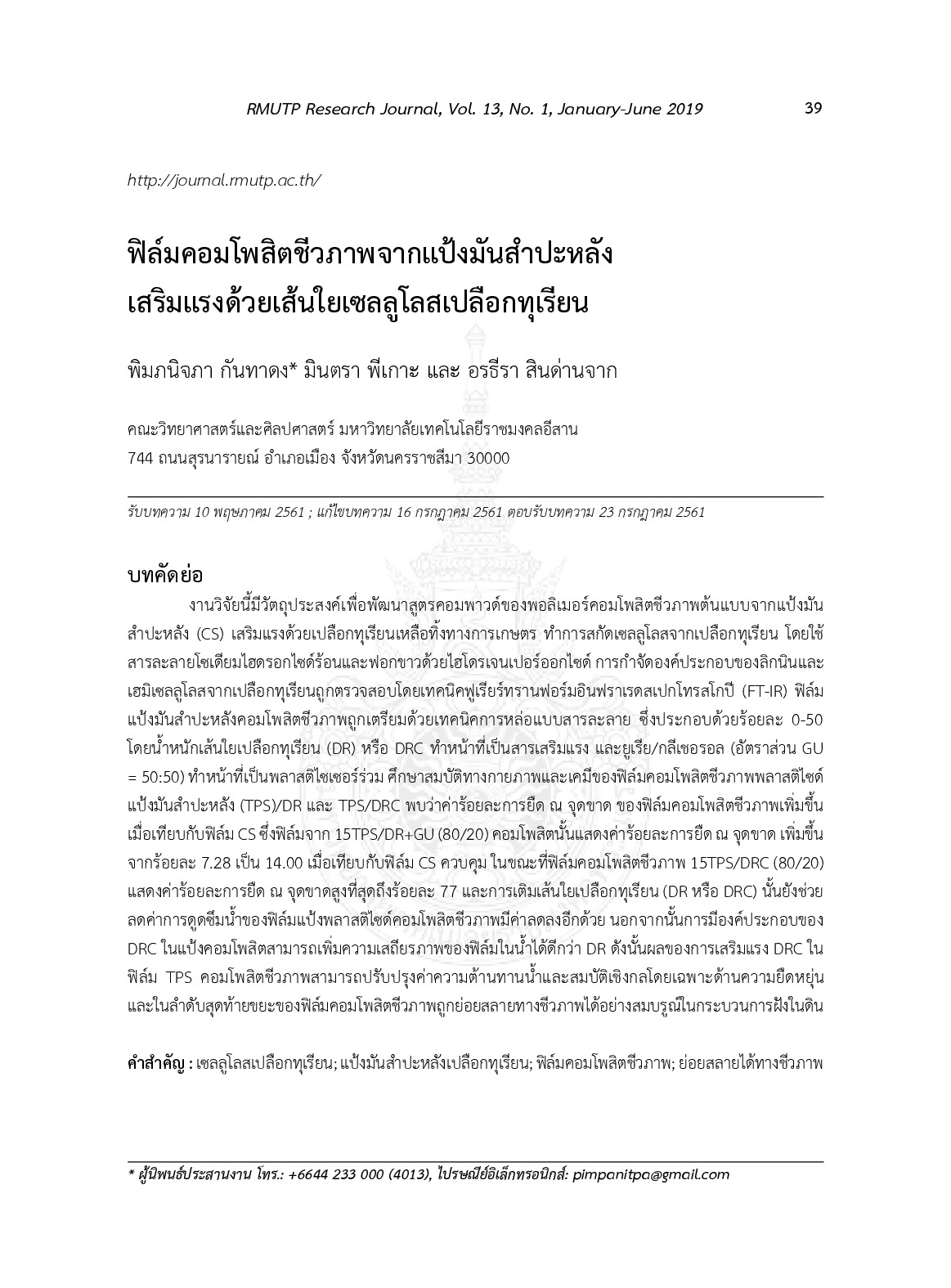
ฟิล์มคอมโพสิตชีวภาพจากแป้งมันสำปะหลังเสริมแรงด้วยเส้นใยเซลลูโลสเปลือกทุเรียน
This research aimed to develop compound of prototypes polymer bio-composites from cassava starch (CS) reinforced with agriculture residue the rind of durian fruit. Cellulose extracted from durian rind using hot sodium hydroxide and bleaching treatment with hydrogen peroxide. The removal of lignin and hemicellulose components from durian rind were investigated by fourier transform infrared spectroscopy (FT-IR). Cassava starch bio-composite films were prepared by solution-casting technique which includes 0-50 wt% of durian rind (DR) or durian rind cellulose (DRC) as reinforcement agent and urea/glycerol (GU ratio = 50:50) as plasticizer. The physical and chemical properties of thermoplastic starch (TPS)/DR and TPS/DRC bio-composite films were investigated. The percent elongation at break of bio-composite films were increased when compared to control CS film. From 15TPS/DR (80/20) films showed increase the elongation at break from 7.28 to 14.00% when compared to CS control films. While 15TPS/DRC (80/20) bio-composite films exhibited that the highest elongation at break to 77%. Durian fiber (DR or DRC) loading decreased the water absorption of plasticized bio-composite films. Furthermore incorporation of DRC in composite can be enhanced film stability in water better than DR. Therefore the effect of DRC reinforcement agent on TPS bio-composite films can improve water resistance and mechanical properties especially in terms of flexibility. Finally the waste of bio-composite films was degraded completely in soil burial test.
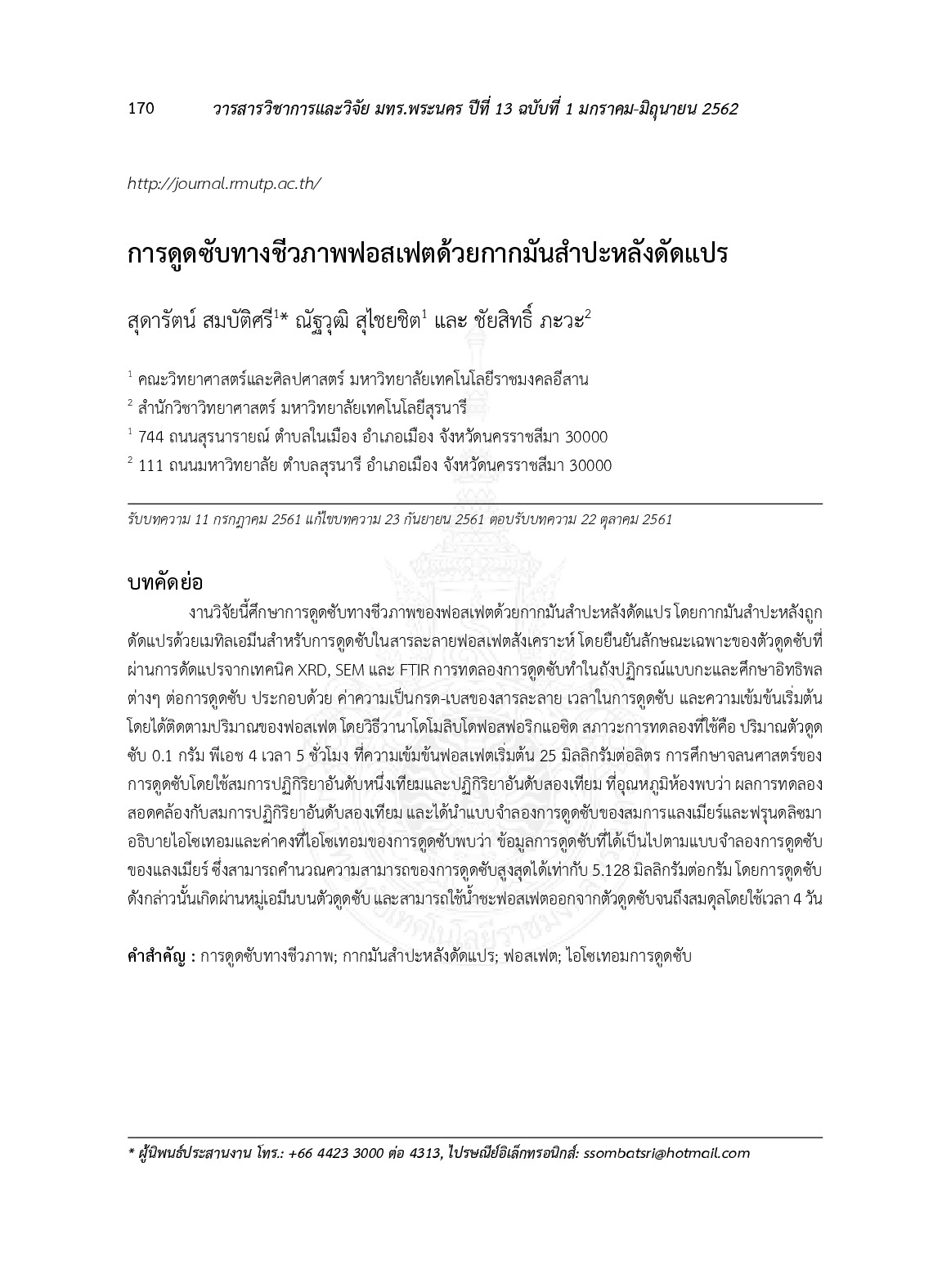
การดูดซับทางชีวภาพฟอสเฟตด้วยกากมันสำปะหลังดัดแปร
The biosorption of phosphate using modified cassava waste were studied. Cassava pulp was modified in methylamine for the adsorption of phosphate ion in aqueous solution. XRD SEM and FTIR result confirmed the surface modification of modified cassava waste. The adsorption experiments were conducted in a batch reactor. The studied parameters included pH contact time and initial concentrations. The amount of phosphate in the solution was measured by Vanadomolybdophosphoric acid method. Optimum conditions of adsorption were 0.10 g of modified cassava waste pH 4 and 5 hour of contact time at 25 mg/L of initial phosphate concentration. Kinetic of adsorption were studied by using the pseudo-first and pseudo-secondorder models at room temperature. The results indicated that the pseudo-second-order model best described adsorption kinetic data. The Langmuir and Freundlich adsorption models were applied to describe the isotherms and isotherm constants. The adsorption of modified cassava fitted well with the Langmuir model and the maximum adsorption capacity of 5.128 mg/g; and the active site of adsorption was amine functional group. Phosphate released in water reach equilibrium within 4 days.
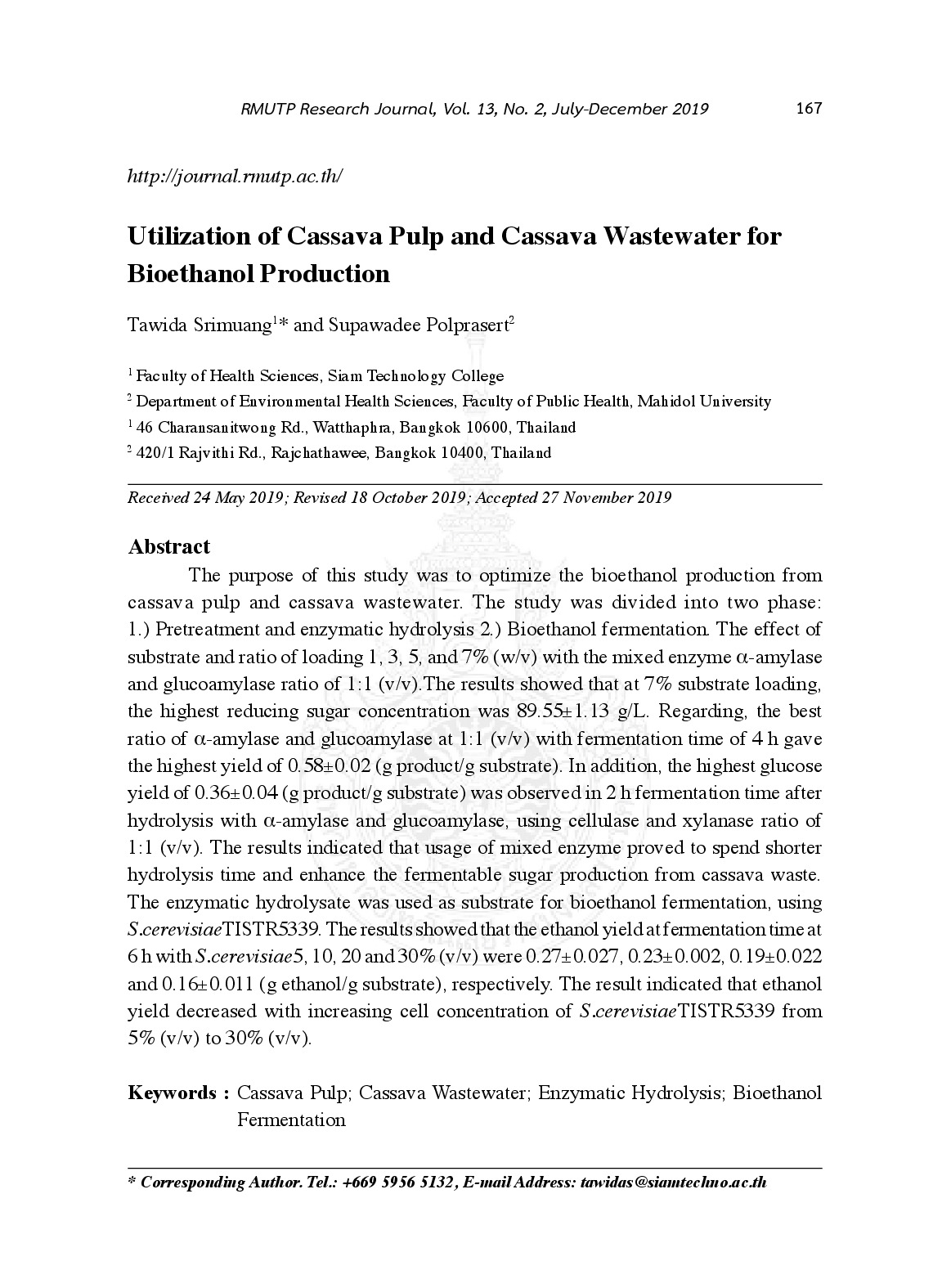
Utilization of cassava pulp and cassava wastewater for bioethanol production
The purpose of this study was to optimize the bioethanol production from cassava pulp and cassava wastewater. The study was divided into two phase: 1.) Pretreatment and enzymatic hydrolysis 2.) Bioethanol fermentation. The effect of substrate and ratio of loading 1 3 5 and 7% (w/v) with the mixed enzyme α-amylase and glucoamylase ratio of 1:1 (v/v).The results showed that at 7% substrate loading the highest reducing sugar concentration was 89.55±1.13 g/L. Regarding the best ratio of α-amylase and glucoamylase at 1:1 (v/v) with fermentation time of 4 h gave the highest yield of 0.58±0.02 (g product/g substrate). In addition the highest glucose yield of 0.36±0.04 (g product/g substrate) was observed in 2 h fermentation time after hydrolysis with α-amylase and glucoamylase using cellulase and xylanase ratio of 1:1 (v/v). The results indicated that usage of mixed enzyme proved to spend shorter hydrolysis time and enhance the fermentable sugar production from cassava waste. The enzymatic hydrolysate was used as substrate for bioethanol fermentation using S.cerevisiaeTISTR5339. The results showed that the ethanol yield at fermentation time at 6 h with S.cerevisiae5 10 20 and 30% (v/v) were 0.27±0.027 0.23±0.002 0.19±0.022 and 0.16±0.011 (g ethanol/g substrate) respectively. The result indicated that ethanol yield decreased with increasing cell concentration of S.cerevisiaeTISTR5339 from 5% (v/v) to 30% (v/v).