จำนวน Repository ( 9 )
ผลของระดับอุณหภูมิในการอบแห้งถ่านอัดแท่งด้วยเครื่องอบแห้งพลังงานแสงอาทิตย์ร่วมกับรังสีอินฟราเรดไกล และเครื่องอบแห้งรังสีอินฟราเรดไกล
This research aims to study the effect of drying temperature on the changes in the moisture content of charcoal briquettes undergoing drying of solar energy and far-infrared radiation (Solar+FIR) and far-infrared radiation (FIR). The electricity consumption and the specific energy consumption were also investigated. The coconut shell charcoal briquettes with the initial moisture content of about 41-43% MW were dried at 55 60 and 65oC until the final moisture content of 8% MW was obtained. Based on the experimental results it was found that the drying temperatures and the drying methods had effects on the changes in the moisture content of charcoal briquettes. Drying at high temperature could reduce the moisture content of charcoal briquettes faster than that at low temperature. Drying using FIR could reduce the moisture content of charcoal briquettes faster than that using Solar+FIR. Moreover the electricity consumption and the specific energy consumption decreased with an increase in the drying temperature. Drying using Solar+FIR had lower electricity consumption but had higher specific energy consumption than drying using FIR. In this study the charcoal briquettes had the average heating value of about 6667.05 cal/g.

The study and development of actions designed to reduce the rate Of production of odor house of wood charcoal community groups were Sarapee aranyaprathet province sakaew
This research study and development of actions designed to reduce the rate of Production of odor House of wood charcoal Community groups Were Sarapee Aranyaprathet Province sakaewPrachantakham Prachinburi. Study materials are made of wood charcoal. And determine the appropriate form furnished house has many of the current medium. Products include standard tests to determine the standard of wood charcoal. in the structure of furniture design. The research study and development of actions designed to reduce the rate of Production of odor House of wood charcoal. vetiver from interviews with experts in the design. Conclusions regarding the manufacture and design of a study to determine specialists as appropriate. Researchers have taken a home furnishing is correct. Then residents of the residential-sized survey about home furnishing 30 who works as follows. Front of the house. The average was 4.6 most of the comforts average was 4.6 most security average is 4.75 most of the design value is 4.7 the overall satisfaction is at its greatest. The test standard furniture. The testing of materials furniture wood charcoal. Static force acting on the basis of a test ride. The static force exerted on the backrest. In the test criteria. The static pressure test on the arm to the side and the force acting on the wing surface at the head. In the test criteria. The static pressure test on the press arm. In the test criteria. Criteria to test the force exerted on the seat and the backrest against the switch. In the test criteria. Force acting on the basis of the test. In passing the test. The impact tests and shock at the surface of the bracket. In the test criteria. Criteria for testing for the one side then drop free In the test criteria.
Technology Transfer on Construction and Charcoal Burning Technique from 200 Liters Charcoal Kiln
Traditional charcoal burning of rural people used husk kiln which had to use big piece of wood and get low quality charcoal. The objectives of this technology transfer were to provide training about 200 liters charcoal kiln invention and teach charcoal burning technique to villager in Tongfa district amphur Bantak Tak province. In the project materials that were used to build the kiln were given to 30 people in the village. The project had been separated in three phases preparing training and project evaluation. In training phase the villager was divided in 5 groups and all group used branches of eucalyptus that had the same sizes. The results of practical training were found that the best group got charcoal 0.75 sack and eucalyptus vinegar 2.3 liters by using 7.33 hours. After training questionnaire was used to evaluate satisfaction of participants. The statistical analysis results showed that Mean (x#) was 4.69. In the part of the success of the project it was found that found that participant could apply the khowledge the most. 58.06% of participant increased income 1001-2000 baht per month.
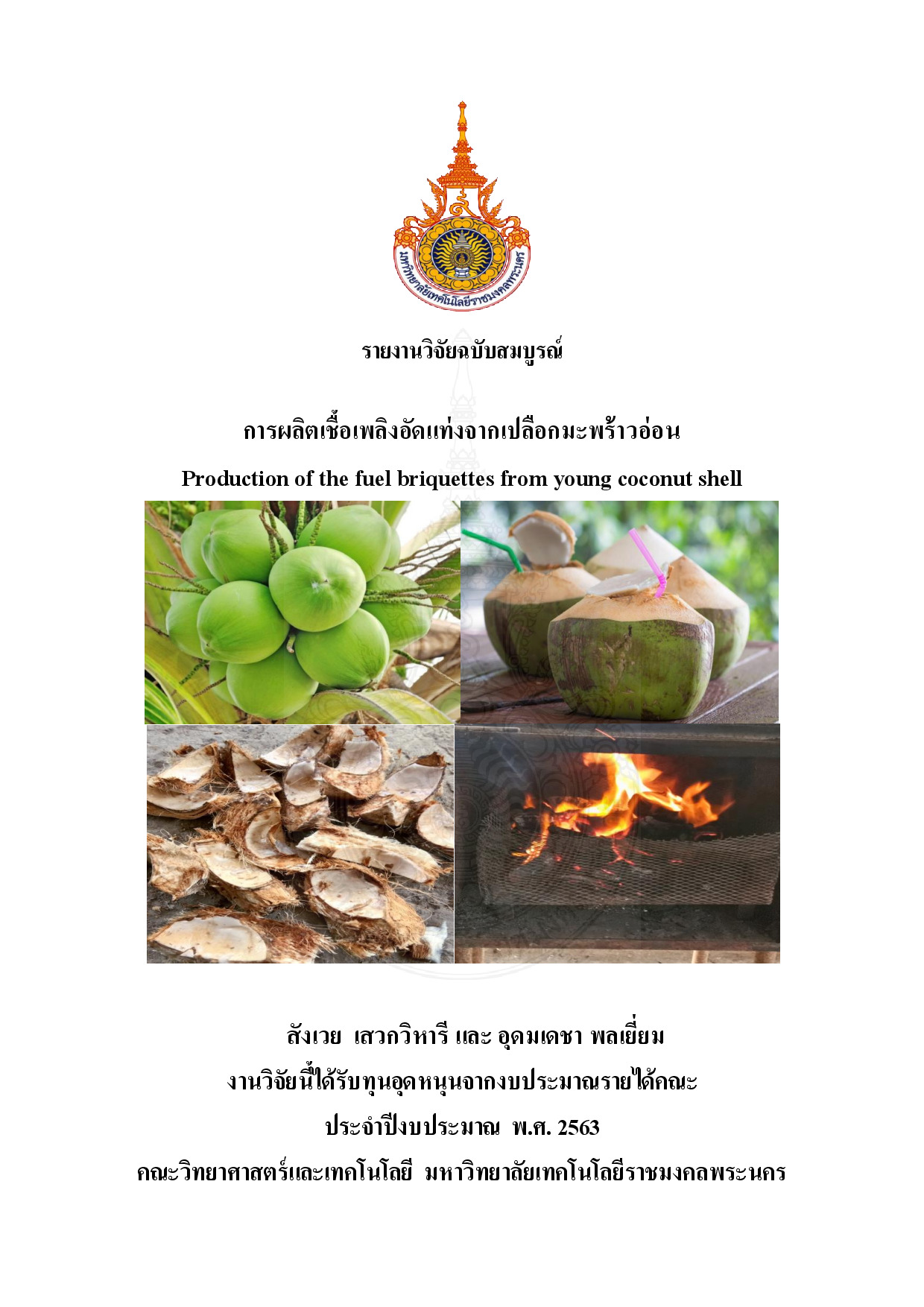
การผลิตเชื้อเพลิงอัดแท่งจากเปลือกมะพร้าวอ่อน
Young coconut shells are a byproduct after processing coconut juice which can be used to produce a solid-fuel. This fuel from the coconut shell is an alternative source instead of using firewood or charcoal made of timber in the natural forest. The solid-fuel from young coconut shells was prepared by using a wet glue powder as a binder then was compressed by using a briquette machine. The black coconut briquette was stable after exposure to the sun. The average of the briquette combustion rate was at 11.24 g /min. There is no eruption smut smoke and odor by using the young coconut shell briquette yo start a fire. To sum up a young coconut shell has a high potential as an alternative biomass material for producing a briquette especially for commercial. This solution can increase the reduction of haze weather in the sight of solid waste incineration and also global warming.