จำนวน Repository ( 8 )

การสร้างสรรค์เครื่องแต่งกายและเครื่องประกอบการแต่งกายนวัตกรรมสิ่งทอสีเขียวสู่ประชาคมอาเซียน
In the research on “The Costume Creative Design and Accessory Creative Design Green Eco Innovation for Asian Community” the purpose of the study was to create the product design on the costumes and accessories for working ladies and gentlemen. Its main sources were on Thai culture representative of the ASEAN cultures that were inspired by the culture and lifestyle of Thai people. This study has selected Thai population Thai culture Thai lifestyle Thai wisdom Thai basketry and fertility of the central region in Thailand. The samples were additionally selected from the weaving culture and fertility of the rice field in the middle of Thailand. The tools used were based on the descriptive analysis from the structure of basketry obtained from the central region of Thailand. The color analysis was based on the integrity of the rice paddy in the central plains as well as the pattern analysis was from Thai basketry and pattern of rice paddy in the central plains. The fabric used in the design was made of the natural fibers water hyacinth mixed with cotton at the ratio of 30: 70. On the product development the principles of 4P Marketing Strategy and the application of natural colors were carried to obtain the ladies’ costumes and accessory creative design and unique new handbag. From the results the analysis of basketry structure in the central region indicated after making a section for the shape as the balancing curve and circular shapes the lady costumes and accessory creative designs could be successfully fashioned.When analyzing for proper colors on the costumes and accessories the designs based on the fertility of the rice paddy in the central plains together with the cultural prosperity urbanized society and the nature were applied. The appropriate colors chosen to be yellow red and blue were from natural colors of Garcinia Rave and Indigo respectively. Therefore the products of costumes and accessory creative designs could be one innovative green textile that meets the needs of the consumers in the ASEAN communities who are concerning on the sustainable and environmental conservation.
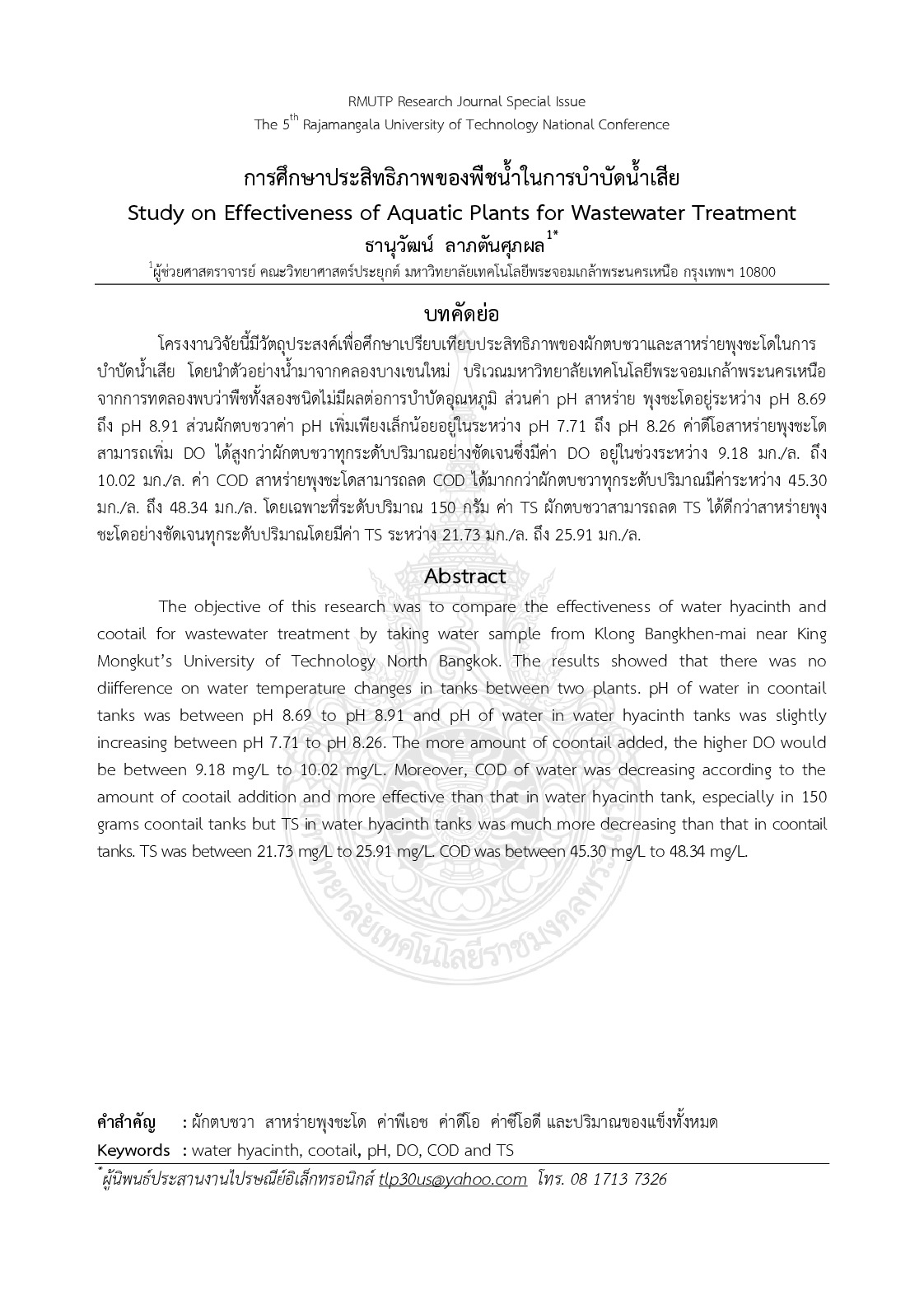
Study on effectiveness of aquatic plants for wastewater treatment
The objective of this research was to compare the effectiveness of water hyacinth and cootail for wastewater treatment by taking water sample from Klong Bangkhen-mai near King Mongkut’s University of Technology North Bangkok. The results showed that there was no diifference on water temperature changes in tanks between two plants. pH of water in coontail tanks was between pH 8.69 to pH 8.91 and pH of water in water hyacinth tanks was slightly increasing between pH 7.71 to pH 8.26. The more amount of coontail added the higher DO would be between 9.18 mg/L to 10.02 mg/L. Moreover COD of water was decreasing according to the amount of cootail addition and more effective than that in water hyacinth tank especially in 150 grams coontail tanks but TS in water hyacinth tanks was much more decreasing than that in coontail tanks. TS was between 21.73 mg/L to 25.91 mg/L. COD was between 45.30 mg/L to 48.34 mg/L.
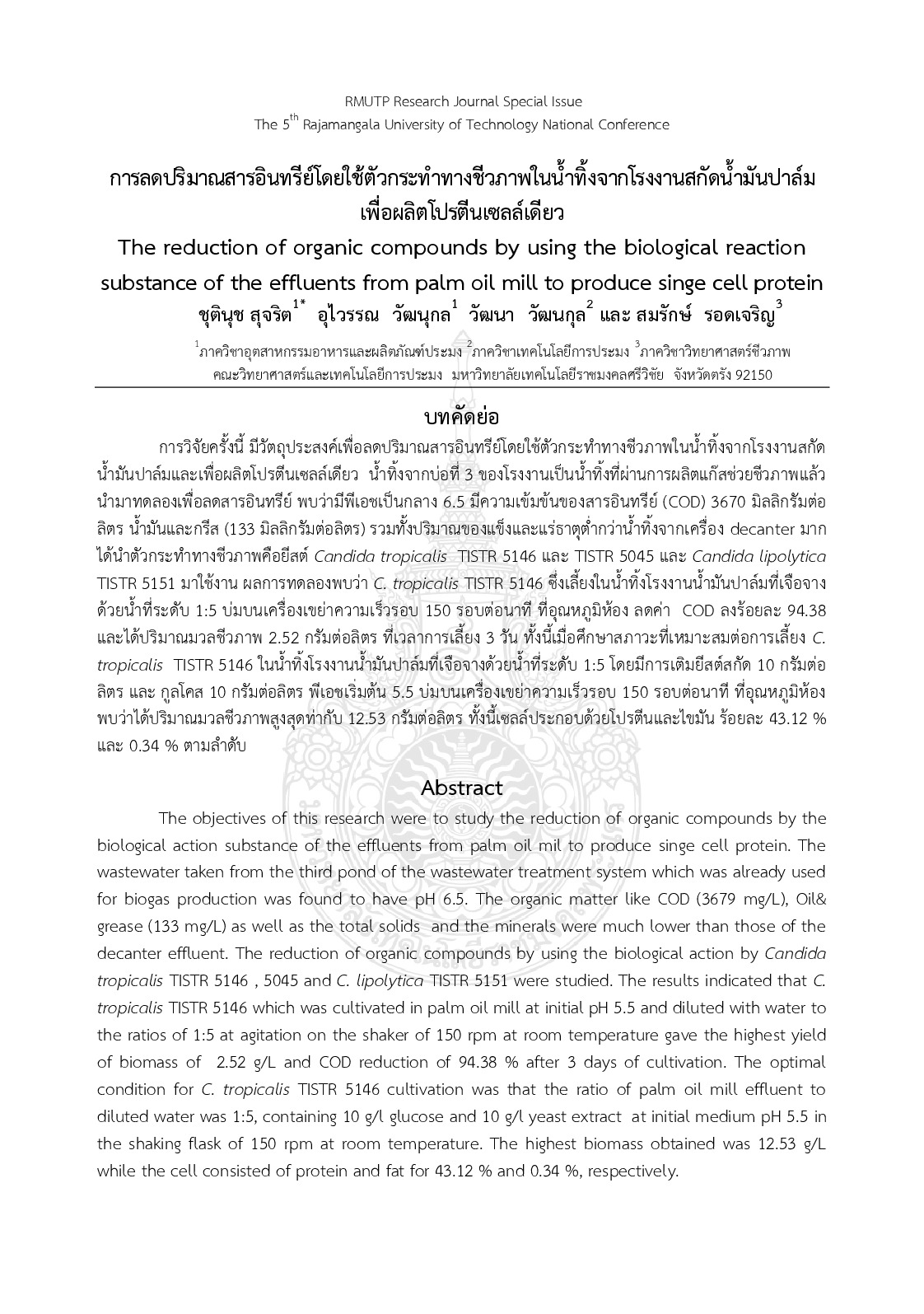
The reduction of organic compounds by using the biological reaction substance of the effluents from palm oil mill to produce singe cell protein
The objectives of this research were to study the reduction of organic compounds by the biological action substance of the effluents from palm oil mil to produce singe cell protein. The wastewater taken from the third pond of the wastewater treatment system which was already used for biogas production was found to have pH 6.5. The organic matter like COD (3679 mg/L) Oil& grease (133 mg/L) as well as the total solids and the minerals were much lower than those of the decanter effluent. The reduction of organic compounds by using the biological action by Candida tropicalis TISTR 5146 5045 and C. lipolytica TISTR 5151 were studied. The results indicated that C. tropicalis TISTR 5146 which was cultivated in palm oil mill at initial pH 5.5 and diluted with water to the ratios of 1:5 at agitation on the shaker of 150 rpm at room temperature gave the highest yield of biomass of 2.52 g/L and COD reduction of 94.38 % after 3 days of cultivation. The optimal condition for C. tropicalis TISTR 5146 cultivation was that the ratio of palm oil mill effluent to diluted water was 1:5 containing 10 g/l glucose and 10 g/l yeast extract at initial medium pH 5.5 in the shaking flask of 150 rpm at room temperature. The highest biomass obtained was 12.53 g/L while the cell consisted of protein and fat for 43.12 % and 0.34 % respectively.