จำนวน Repository ( 15 )

การพัฒนาเครื่องมือวัดอัตราการเกิดสนิมของเหล็กเสริมในคอนกรีตโดยใช้หลักการความต้านทานโพลาไลน์เซชั่นเชิงเส้น
งานวิจัยนี้มีวัตถุประสงค์เพื่อใช้ในงานวัดอัตราการเป็นสนิมของโครงสร้างคอนกรีตเสริมเหล็กโดยทั่วไป มักจะได้รับผลกระทบจากการเกิดสนิมของเหล็กเป็นส่วนมากเป็นผลให้กำลังของโครงสร้างคอนกรีตลดน้อยมีการพบการเสื่อมสภาพของโครงสร้างจากเหล็กเสริมเป็นสนิมอย่างแพร่หลายโดยเฉพาะโครงสร้างที่อยู่บริเวณชายฝั่งทะเล โดยสาเหตุสำคัญส่วนใหญ่ที่ทำให้เกิดสนิมมักเกิดจากคลอไรด์ซึมผ่านคอนกรีตเข้าไปถึงเหล็กเสริมและเมื่อคลอไรด์ซึมผ่านเข้าไปในคอนกรีตจนถึงระดับของเหล็กเสริม มีปริมาณมากเพียงพอก็จะทำลายฟิล์มที่ป้องกันที่ผิวเหล็กเสริม และทำให้โครงสร้างคอนกรีตเสริมเหล็กนั้นเกิดสนิมสะสมเพิ่มขึ้นเพียงพอที่จะทำให้เกิดหน่วยแรงและดันให้คอนกรีตเกิดความเสียหายเป็นผลทำให้กำลังของโครงสร้างลดน้อยลงจนไม่สามารถรับกำลังได้อีกและโครงสร้างจะเกิดการวิบัติในภายหลัง
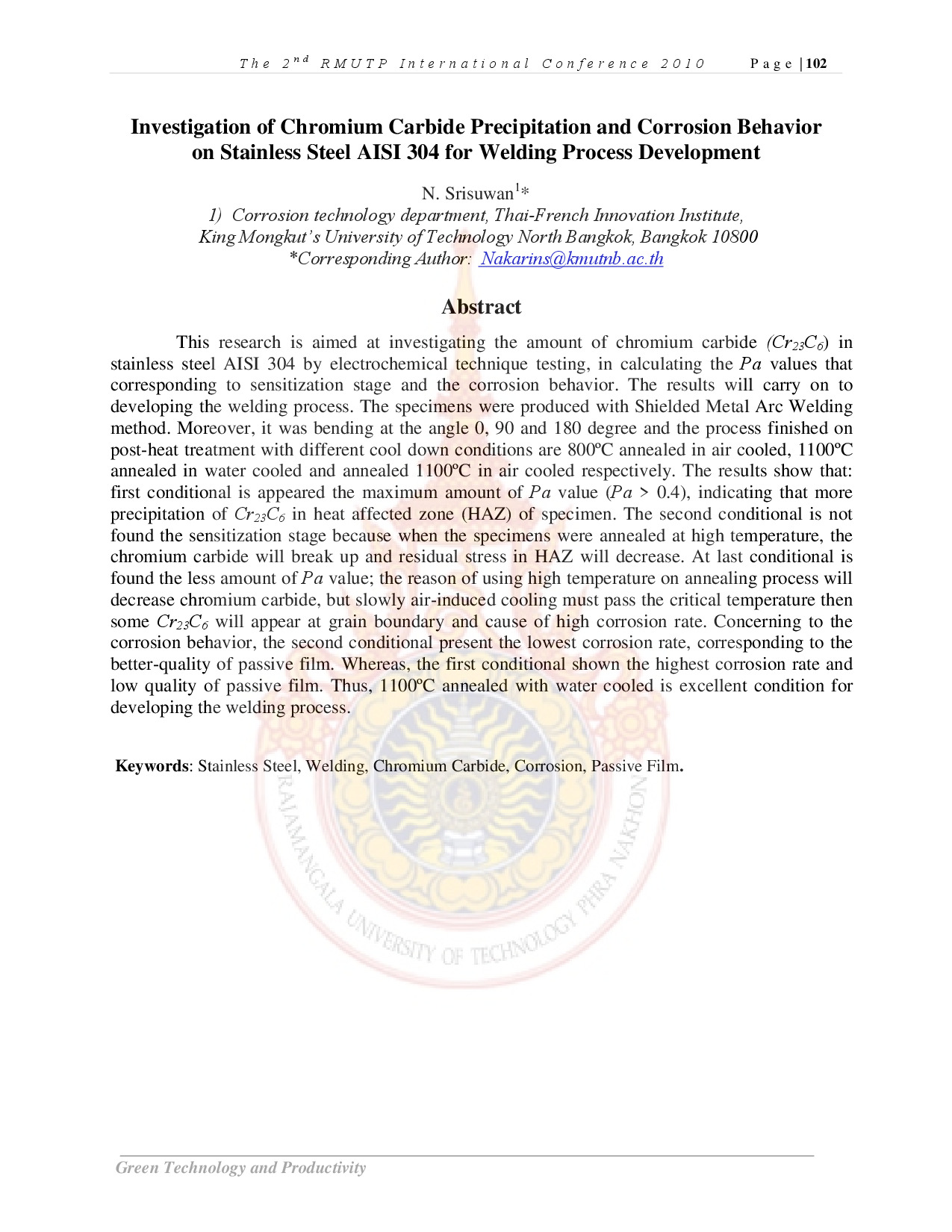
Investigation of Chromium Carbide Precipitation and Corrosion Behavior on Stainless Steel AISI 304 for Welding Process Development
This research is aimed at investigating the amount of chromium carbide (Cr23C6) in stainless steel AISI 304 by electrochemical technique testing in calculating the Pa values that corresponding to sensitization stage and the corrosion behavior. The results will carry on to developing the welding process. The specimens were produced with Shielded Metal Arc Welding method. Moreover it was bending at the angle 0 90 and 180 degree and the process finished on post-heat treatment with different cool down conditions are 800ºC annealed in air cooled 1100ºC annealed in water cooled and annealed 1100ºC in air cooled respectively. The results show that: first conditional is appeared the maximum amount of Pa value (Pa > 0.4) indicating that more precipitation of Cr23C6 in heat affected zone (HAZ) of specimen. The second conditional is not found the sensitization stage because when the specimens were annealed at high temperature the chromium carbide will break up and residual stress in HAZ will decrease. At last conditional is found the less amount of Pa value; the reason of using high temperature on annealing process will decrease chromium carbide but slowly air-induced cooling must pass the critical temperature then some Cr23C6 will appear at grain boundary and cause of high corrosion rate. Concerning to the corrosion behavior the second conditional present the lowest corrosion rate corresponding to the better-quality of passive film. Whereas the first conditional shown the highest corrosion rate and low quality of passive film. Thus 1100ºC annealed with water cooled is excellent condition for developing the welding process.
Strength, porosity and corrosion resistance of ternary blend Portland cement, rice husk ash and fly ash mortar
This paper presents a study of the strength porosity and corrosion resistance of mortars made with ternary blends of ordinary Portland cement (OPC) ground rice husk ash (RHA) and classified fly ash (fine fly ash FA). Compressive strength porosity and accelerated corrosion with impressed voltage (ACTIV) were tested. The results show that the use of ternary blend of OPC RHA and FA produces mortars with improved strengths at the low replacement level with RHA and FA and at the later age in comparison to that of OPC mortar. The porosity of mortar containing pozzolan reduces with the low replacement level of up to 20% of pozzolan but increases with the 40% replacement level. The chloride induced corrosion resistance of mortar as measured by ACTIV is however significantly improved with the use of both single pozzolan and the ternary blend OPC RHA and FA. The corrosion resistance of ternary blend mortar is higher than that of mortar containing single pozzolan. The use of ternary blend OPC RHA and FA is very effective in enhancing chloride induced corrosion of mortar.