จำนวน Repository ( 28 )

การออกแบบเครื่องย้อมเส้นด้ายไหมและด้ายฝ้ายแบบกึ่งอัตโนมัติเพื่อพัฒนาผลิตภัณฑ์ชุมชน ศูนย์หัตถกรรมพื้นบ้านนาโพธิ์ บุรีรัมย์
The purposes of this research were to design and create dyed silk yarn and cotton yarn machine for community enterprises of Ban Na Pho woven group Na Pho district Buriram province. All materials were made of stainless steel and the principle of rotation of the yarn skein which was hung with spindle yarn inside the dye tank. Dyeing process began by mixing color tanks in the exterior size for diameter ๓๐๐ mm. Adjust the temperature inside the dye bag by the boiler was attached below. Using pump in dye tank for rotating the heat with stainless steel pipe in ๑๑/๒ inches and ๓ inches x ๑/๒ inches and the rectangular tank was ๖๐ cm. wide ๙๐ cm long and ๑๖๐ cm. high. It had ๕ mm. of plastic lid cover in front of and a channel that looked at the attachment of color yarn. The lid had ๒ levels adjustable lift spring lock and ๒-axis spindle yarn. It was triangular shaped drilled holes spray to ๑ mm. on the spindle with a diameter of ๑๕ cm. and ๖๐ cm. long rotating at ๑๐ rpm strength by using electric motor size ๐.๕ HP used ๒๒๐ volts. It could be rotated left and right with the gear ratios around ๒๐:๑ ๒ adjustable that were automatic with programming on the control box and simple pattern. the spray dyed paint had ๑ liter water pump to control pressure valve for opening and closing to dyed water flow regularly by the heat from the LPG gas with a head size of ๓๐ cm. and adjust the temperature up to ๑๒๐ Celsius degree. It was showed the temperature measurement of water dye with pressure gauge and temperature gauge. The efficiency of this dye can be dyed silk yarn and cotton yarn per ๕ kg. to ๑๐ kg. which was a medium-sized textile production to the local community enterprise and applied in the preparation of yarns before dying such as peeling glue and bleaching.
การพัฒนารูปแบบของการสร้างหลักสูตรฝึกอบรมวิชาชีพระยะสั้น ด้านคหกรรมศาสตร์ กลุ่มอาชีพสหกรณ์ศิลปะประดิษฐ์ ตำบลเกาะเกร็ด จังหวัดนนทบุรี
This research aimed to study 1) the demand for short-term vocational training courses in home economics 2) create a training curriculum of home economics profession short of demand. Handicrafts Cooperative Occupational Groups Ko Kret Nonthaburi and her 3) the effects of short-term vocational training courses in home economics created The population in this study were selected purposively is a group of professional arts cooperative. Koh Kret Nonthaburi number 30 was used in the questionnaire and short-term training courses in home economics. Data analysis and statistics used were percentage average and standard deviation. The results were as follows: The population with an interest in the course of the invention include most academic inventor gift followed by molding the dough flowers Thailand. And the flowers The average score of 4.57 4.30 and 4.20 respectively Thus the curriculum invention gift. Style stuffed owl The concept of Taba comprises seven stages: 1) analysis of problems and needs for 2) define the aims of the course 3) selection of content 4) held a substantive 5) selection of a learning experience 6) experience. Learning and 7) evaluation of the course created consisting of five plans include 1) a basic knowledge about the inventor of the gift 2) materials and fabrication techniques stuffed owl onion 3) Knowledge of design creation. 4) the invention onions stuffed owl 5) costing and pricing onion stuffed owl. The six-hour period The results of the program found that participants with a performance favorably (83.33 percent) and a rating of the portfolio is in good shape (90.00 percent) from the satisfaction of the participants are. the most satisfied are averaging 4.58
Design and development of handy crafts furniture and decorative product, case study : rattan fake
The purposes of this research were to describe fundamental information about design of handy crafts furniture and decorative products from fake rattan to generalize design guideline for handy crafts furniture and decorative products from fake rattan by comparing target needs with the standard formed by Thai Community Product Standard for rattan furniture (TCPS 64/2546) and to determine the most satisfactory design pattern for handy crafts products. The study of demographic data revealed that the male and female respondents are equal and almost of participants are the elder the proprietor and the high level of income and education. The pattern of the handy crafts furniture and decorative products from fake rattan as the following: the most purchasing pattern should be the Aluminum living room sets because of their lightweight stainless weather proof inexpensive anti-termites aesthetic exotic multi-purpose indoor and outdoor usage appropriate price washable and anti-fungal. From this research it can be generalized the design guideline for handy crafts furniture and decorative products from fake rattan.
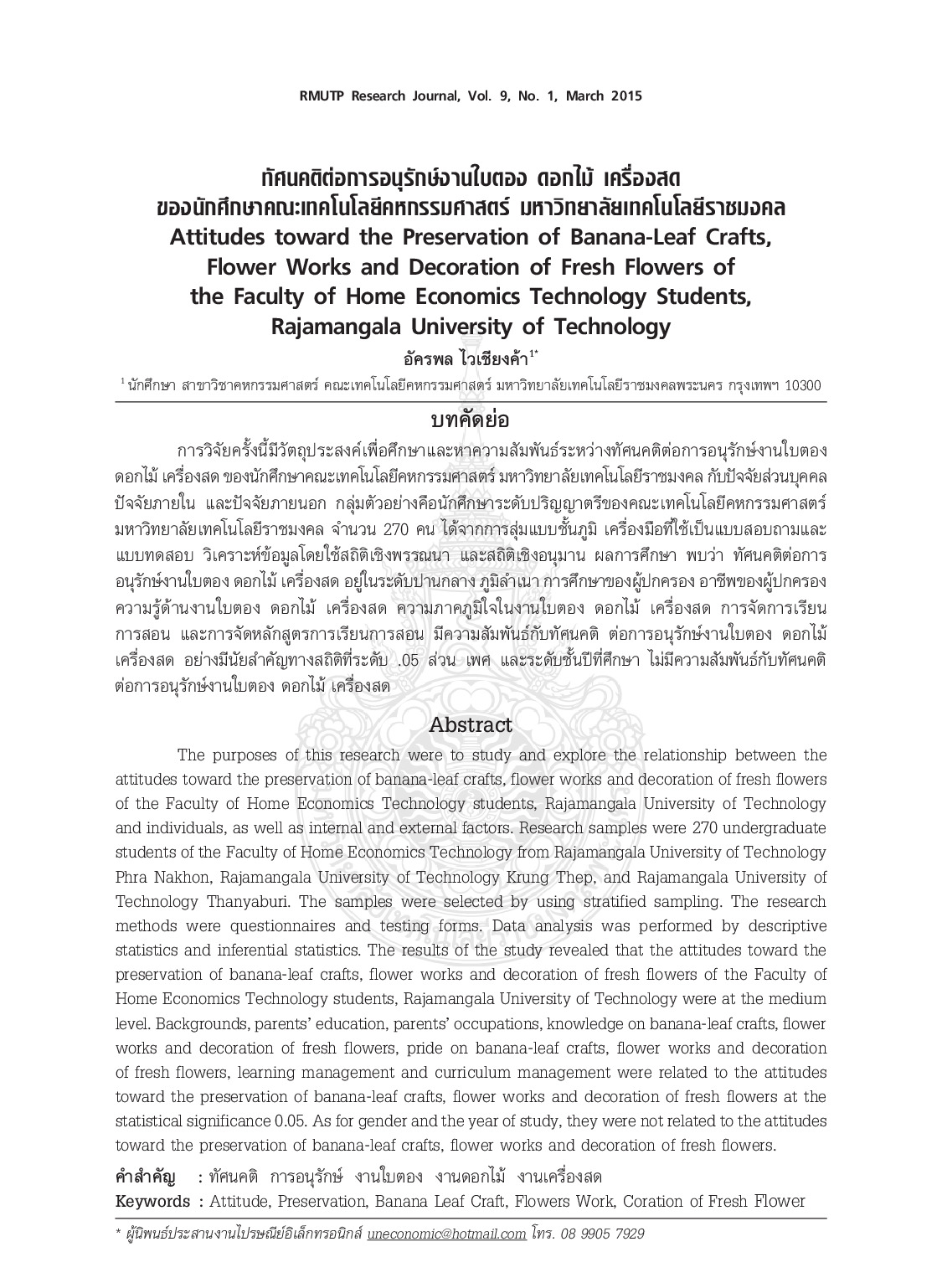
Attitudes toward the preservation of banana-leaf crafts, flower works and decoration of fresh flowers of the faculty of home economics technology students, Rajamangala University of Technology
The purposes of this research were to study and explore the relationship between the attitudes toward the preservation of banana-leaf crafts flower works and decoration of fresh flowers of the Faculty of Home Economics Technology students Rajamangala University of Technology and individuals as well as internal and external factors. Research samples were 270 undergraduate students of the Faculty of Home Economics Technology from Rajamangala University of Technology Phra Nakhon Rajamangala University of Technology Krung Thep and Rajamangala University of Technology Thanyaburi. The samples were selected by using stratified sampling. The research methods were questionnaires and testing forms. Data analysis was performed by descriptive statistics and inferential statistics. The results of the study revealed that the attitudes toward the preservation of banana-leaf crafts flower works and decoration of fresh flowers of the Faculty of Home Economics Technology students Rajamangala Univers
การพัฒนาสบู่สำหรับใช้งานแกะสลักแทนผักและผลไม้เพื่อสร้างมูลค่าเพิ่มให้งานหัตถกรรมไทย
The objective of this research was to determine the formulation of soap for carving operations and study the satisfaction of developed carved-soap by carving person. There were 3 basic formulas of the soap e.g. olive oil formula (formula 1; 500 ml olive oil 60 g sodium hydroxide and 140 ml water) coconut oil formula (formula 2; 200 ml coconut oil 34 g sodium hydroxide and 80 ml water) and glycerin formula (formula 3; 200 g glycerin and 5 g sodium hydroxide). The basic formula 3 showed the highest satisfaction scores from carving person when compared with other formulas. The next experiment was to find the optimal temperature for heating the mixtures in the range of 40-60oC. The results showed that the temperature of 45oC was the best treatment for heating three types of soap mixtures. Moreover the formula 3 soap received the highest satisfaction scores ( X = 4.21-4.53) from carving person which had the good appearance exquisite styles shape and proportion right. There was no crack no visible of mold growth and soap powder on the product after caving operations. The satisfaction of 52 carving persons between the general soap and developed carved-soap for carving operations was studied using 5-point rating scales. The satisfaction scores of softness stickiness and aroma were significant different (p<0.05) between two types of soap. However the dryness/hardness silkiness color painting property and overall quality scores were not different. The suitable shape of soap for carving operations was a round shape followed by square shape oval shape and heart shape respectively.