จำนวน Repository ( 70 )

Design and implementation of economical cost 30V 1 kW DC-electronic load controlled by microcontroller
Electronic load is an importance part of power supplies testing system. For non-electronic load type it is required to replace a resister with a new one leading to complicated working procedure. The modern power electronic technology is employ to solve this problem. The electronic load can vary the value following user command. Imported electronic load is costly leading Thailand to have a balance of trade deficit. This article proposes design and implement of an economical cost 30V 1 k DC-Electronic Load controlled by Microcontroller. The tested results can confirm the validity of this proposed electronic load
The development of computer multimedia through the internet teaching tool for lighting for broadcasting course (undergraduate level) Rajamangala University of Technology Phra Nakhon
The purposes of this research are 1) to create computer multimedia through the Internet teaching tool for lighting for broadcasting course (undergraduate level) 2) to develop and to find out quality the create computer multimedia through the Internet teaching tool for lighting for broadcasting course (undergraduate level) and to achieve efficiency according to a set of 90/90 criterion. The samples for this study were 48 second year students of Bachelor of Technology Program in Radio and Television Broadcasting Technology studying this course in the first semester of 2011 academic year at Rajamangala University of Technology Phra Nakhon. The samples were selected by simple random sampling. The research tools used are the computer multimedia through the Internet an achievement test evaluation forms for quality assessment. Statistics used for analyzing the data were percentage and mean. The results of the study revealed that the computer multimedia instruction through the Internet was ranked as a very good level by content experts and as a very good level by educational technology experts and had its efficiency of 94.80/96.60 it was higher than criteria set 90/90
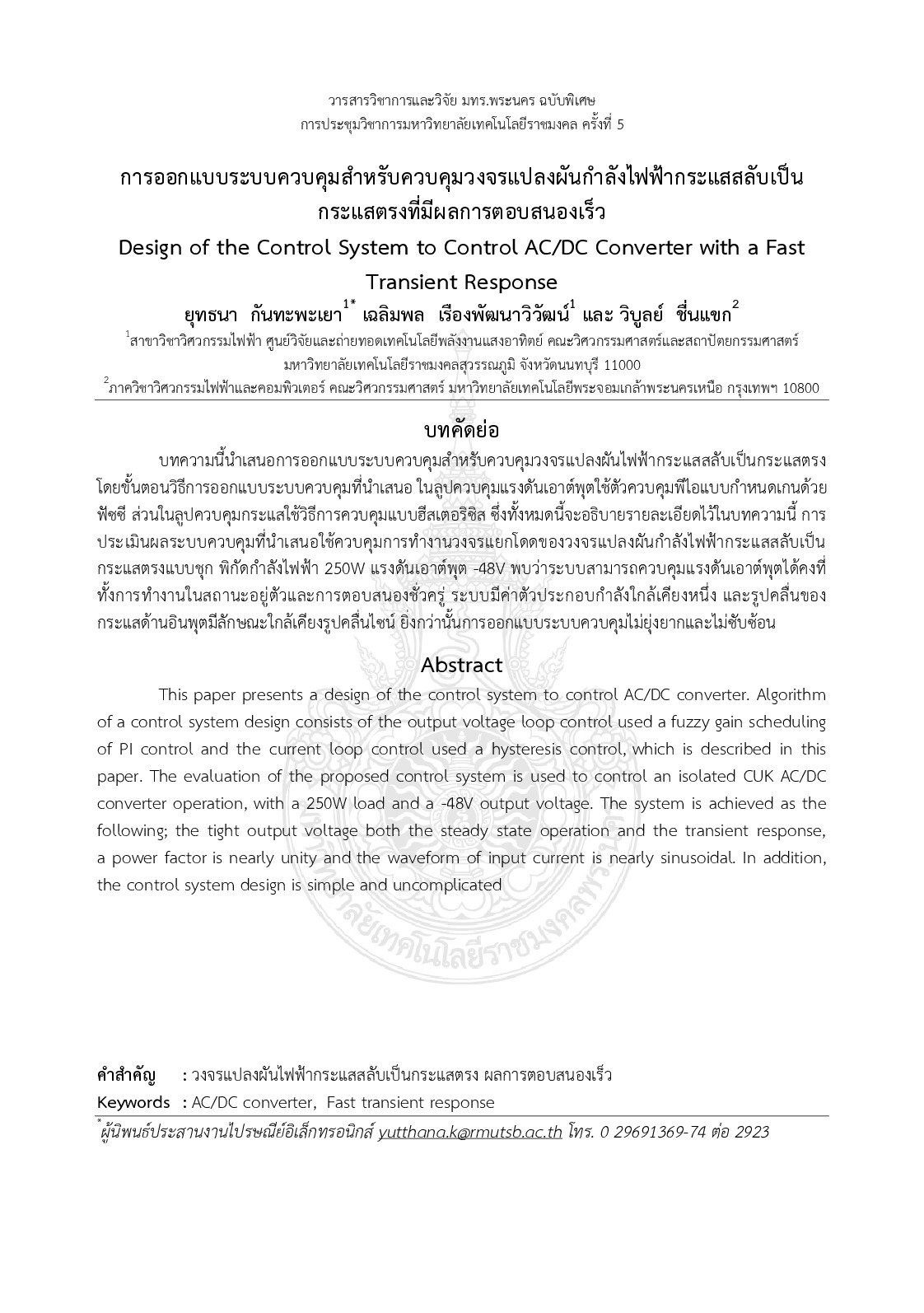
Design of the control system to control AC/DC converter with a fast transient response
This paper presents a design of the control system to control AC/DC converter. Algorithm of a control system design consists of the output voltage loop control used a fuzzy gain scheduling of PI control and the current loop control used a hysteresis control which is described in this paper. The evaluation of the proposed control system is used to control an isolated CUK AC/DC converter operation with a 250W load and a -48V output voltage. The system is achieved as the following; the tight output voltage both the steady state operation and the transient response a power factor is nearly unity and the waveform of input current is nearly sinusoidal. In addition the control system design is simple and uncomplicated
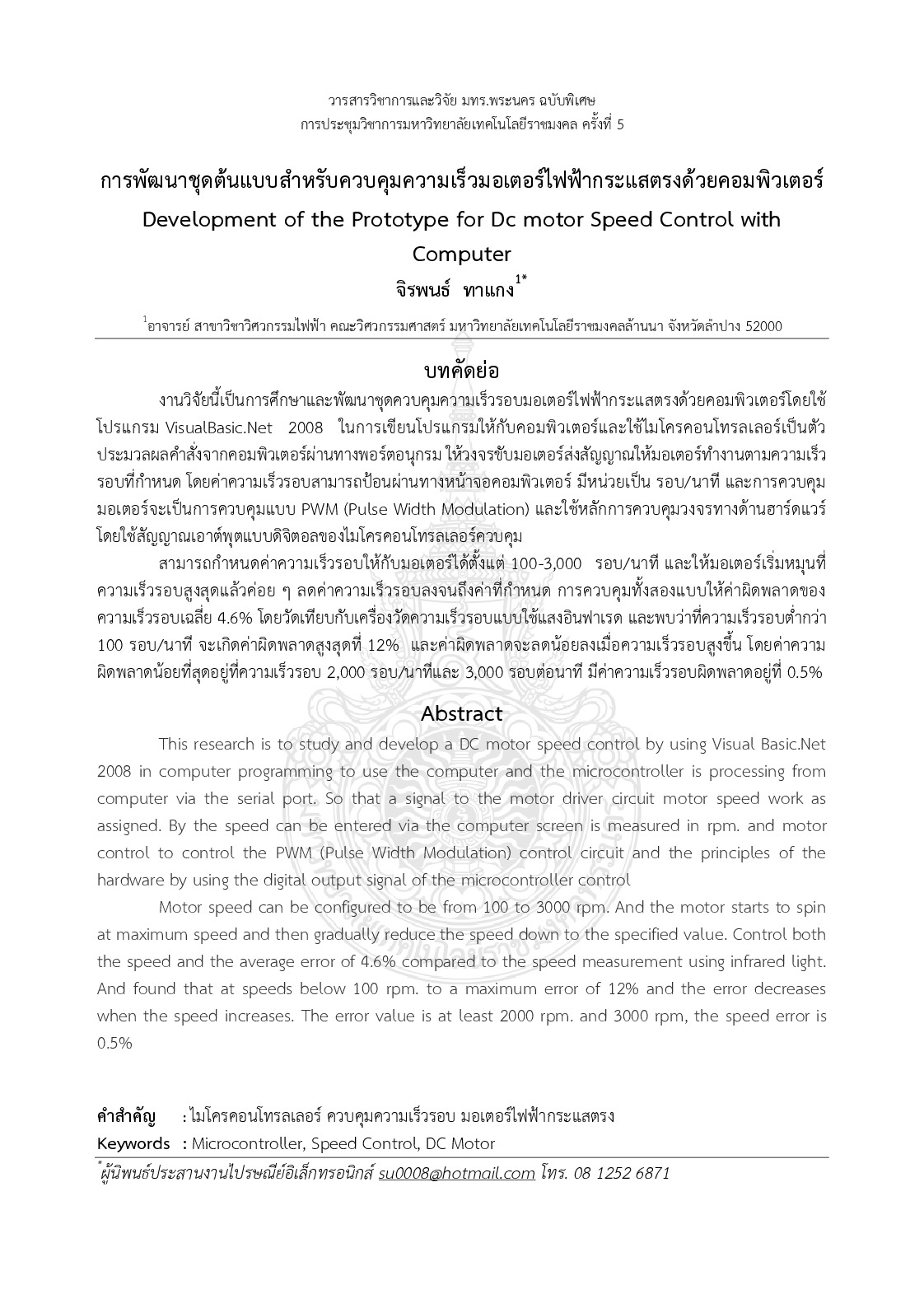
Development of the prototype for dc motor speed control with computer
This research is to study and develop a DC motor speed control by using Visual Basic.Net 2008 in computer programming to use the computer and the microcontroller is processing from computer via the serial port. So that a signal to the motor driver circuit motor speed work as assigned. By the speed can be entered via the computer screen is measured in rpm. and motor control to control the PWM (Pulse Width Modulation) control circuit and the principles of the hardware by using the digital output signal of the microcontroller control Motor speed can be configured to be from 100 to 3000 rpm. And the motor starts to spin at maximum speed and then gradually reduce the speed down to the specified value. Control both the speed and the average error of 4.6% compared to the speed measurement using infrared light. And found that at speeds below 100 rpm. to a maximum error of 12% and the error decreases when the speed increases. The error value is at least 2000 rpm. and 3000 rpm the speed error is 0.5%
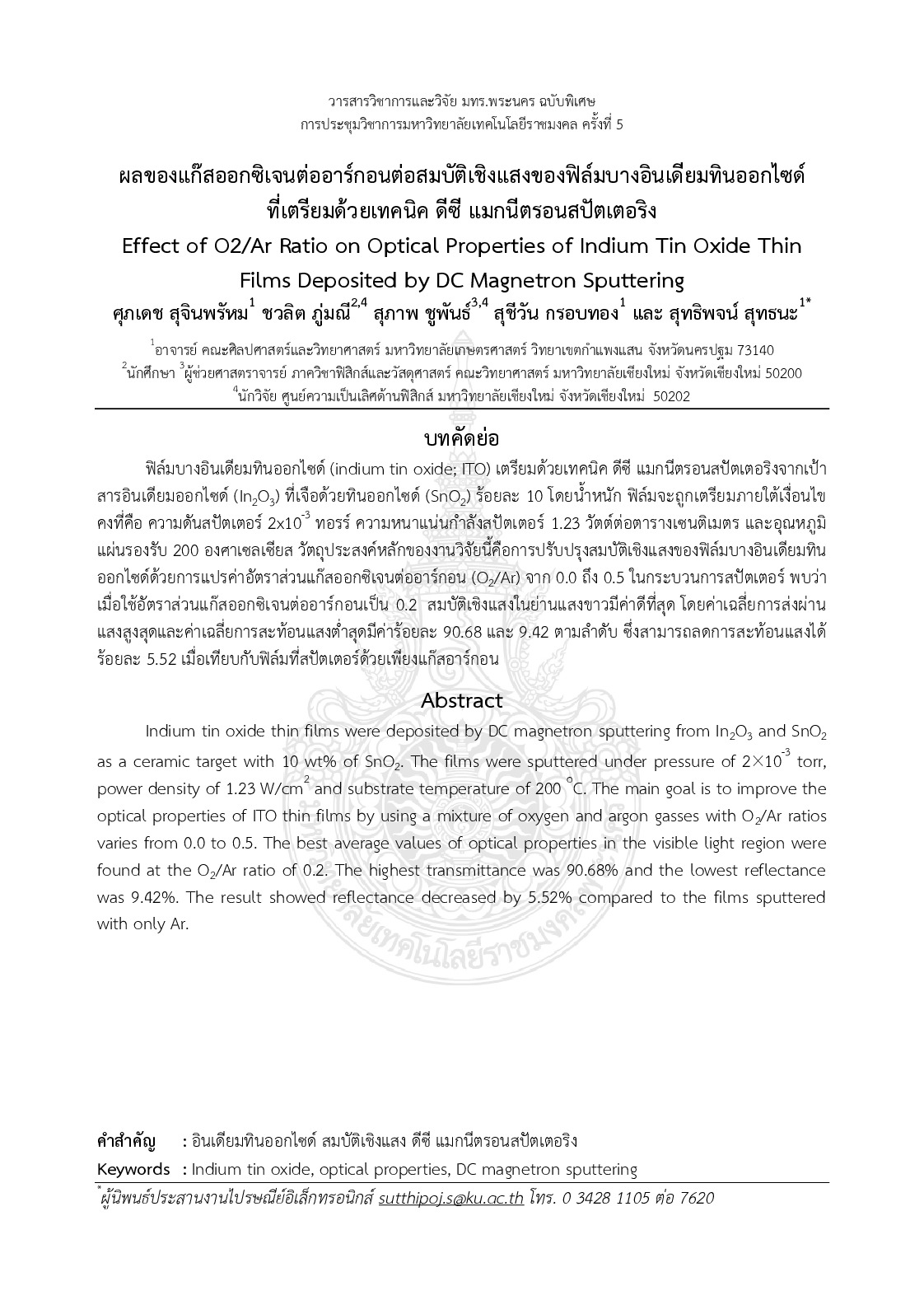
Effect of O2/ar ratio on optical properties of indium tin oxide thin films deposited by dc magnetron sputtering
Indium tin oxide thin films were deposited by DC magnetron sputtering from In2O3 and SnO2 as a ceramic target with 10 wt% of SnO2. The films were sputtered under pressure of 2?10-3 torr power density of 1.23 W/cm2 and substrate temperature of 200 oC. The main goal is to improve the optical properties of ITO thin films by using a mixture of oxygen and argon gasses with O2/Ar ratios varies from 0.0 to 0.5. The best average values of optical properties in the visible light region were found at the O2/Ar ratio of 0.2. The highest transmittance was 90.68% and the lowest reflectance was 9.42%. The result showed reflectance decreased by 5.52% compared to the films sputtered with only Ar.