จำนวน Repository ( 16 )

Bananas drying performance with a developed hot Air dryer using waste heat from charcoal production process
The purpose of this research is to develop a hot air dryer using waste heat from a200 liter kiln for drying bananas and to investigate its drying performance. The main parts of the dryer consist of the drying chamber that has dimensions 0.71x0.83x.091 m3 the air circulation system and a heat exchanger which receives waste heat from the exhaust tube and kiln surface. The dryer was developed by designing a drying chamber on the top of a 200 liter kiln to reduce heat lost in the structure and an exhaust gas heat exchanger was developed using groups of copper tubes for increasing then heat transferred to the air. The drying performances were analyzed by measuring specific drying rates and specific energy consumption. Experiments were performed under different temperatures of 60 70 and 80℃ And at a constant velocity of 1.8 ms-1. Eucalyptus was selected as the heat source. Thirty kg of peeled bananas were prepared at an initial moisture content of 241.19±31.50% dry basis and were dried until to final moisture content of 48.47±10.46% dry basis. All experiments were carried out in duplicate. For temperatures of 60 70 and 80 ℃ the ave age specific drying rates were 0.085±0.0004 0.114±0.0009 and 0.1277±0.010 kg water h-1kesolid-1 and the average specific energy consumptions were 1.42±0.055 1.21±0.355 and 1.04±0.074 MJ/kg water respectively. Some dried bananas had burned at a temperature of 80℃ so at temperature of 70 ℃ was the optimal condition in this experiment. This produced good color a high specific drying rate and low specific energy consumption.
การพัฒนาเครื่องอบแห้งข้าวเปลือกแบบไหลต่อเนื่องด้วยเทคนิคการแผ่รังสีความร้อนในแนวรัศมี
The objective of this research was to design and development of a continuous flow paddy dryer with infrared radial radiation technique. The prototype of dryer consists of two concentric circular cylinders cylinders which the paddy drying chamber is height of 1 m. The inner cylinder has diameter of 26.5 cm made from glasses and outer cylinder has diameter of 29.5 cm made from perforated (1.75 mm) steel sheet. At the center of cylinders installed 1200 w of electric infrared heater. A hopper was installed on the top of the chamber while 120 w of blower and paddy flow control were installed at bottom of chamber. The performance of the dryer in terms of specific energy consumption (SED) drying rate (DR) and quality of paddy i.e. head rice yield (HRY) and whiteness index (WI) were evaluated by drying 15 kg of paddy with initial moisture content of 23-26% (w.b.) by using the drying conditions of 80oC of drying chamber temperature 1.075 m3/min of air flow rate and 0.837 1.228 1.875 and 2.308 kg/min of paddy flow rate. The results found that paddy flow rate at 1.875 kg/min is the optimum condition because gave the highest DR lowest SEC and rice qualities (HRY and WI) closely to control.
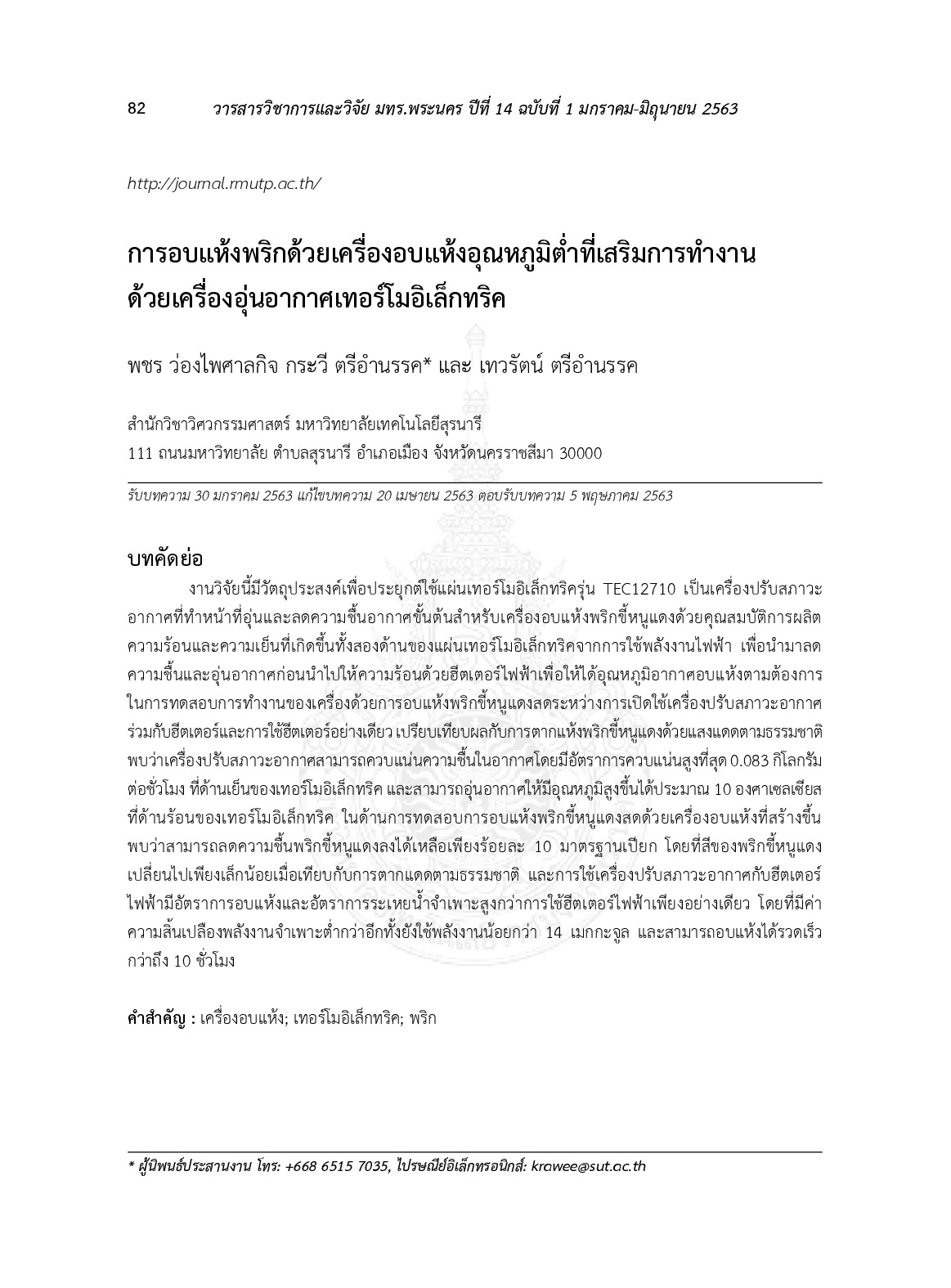
การอบแห้งพริกด้วยเครื่องอบแห้งอุณหภูมิต่ำที่เสริมการทำงานด้วยเครื่องอุ่นอากาศเทอร์โมอิเล็กทริค
This research objective was to apply thermoelectric module model TEC12710 as a preheater and dehumidifier for red chilies dryer. The heat side and cool side of Thermoelectric module affected by supplied electricity were used to produces the low humidity and warm air in preheater before charging to the main electric heater of dryer. Fresh red chilies were selected as a sample in the prototype testing during the use of preheater assisted main heater and using only main heater. The test results are compared with the sample dried under the natural sun drying. The experimental results show that the preheater can condense the moisture in air with the highest MER of 0.083 kgwaterh-1 at cold side of thermoelectric module and can heat the air up in 10°C of temperature with hot side of thermoelectric module. The final moisture content of sample is only 10%wb with the slightly changed in color when compared with the sample from sun drying. The using of preheater with main heater gives a higher specific moisture extraction rate lower specific energy consumption 14 MJ energy used and can dry faster than 10 h when compared with the using of only main heater.
กระบวนการผลิตกระเจี๊ยบเขียวแผ่นอบกรอบโดยการใช้เครื่องอบแห้งแบบลมร้อน
The study on baked crispy okra sheets (Hit 9701 species) by using a hot air dryer. The objective of this study was to investigate the okra sheets formula and manufacturing procees by hot air dryers with 3 methods; pouring finely blended okra onto the inside tray pouring finely blended okra onto the outside tray and pouring finely blended okra into an aluminum block. It was found that pouring finely blended okra into an aluminum block resulted in the least crack in the dried sheet with the rectangular shape remaining intact. After the forming method is decided on a study was conducted on the temperature to bake okra at 3 levels namely 70 80 and 90 C.It was found that baking okra at 80 C for 4.5 hours was suitable the baking and crispy okra sheets ended up with the lightness(L*) of 49.75 the green (a*) was-2.53 and yellowness (b*) of 23.71. The moisture content was at 5.07 % water activity content was 0.27 The hardness was 5.01 N and the crispness was 4.67. The results of chemical analysis showed that the carbohydrate content was 76.34% crude fibers was 10.72% ash content was 8.24% moisture content was 4.24% and fat content was 0.46%. From the study on the bacteriological quality it was found that the crispy okra sheet products can be stored at room temperature for 28 days.
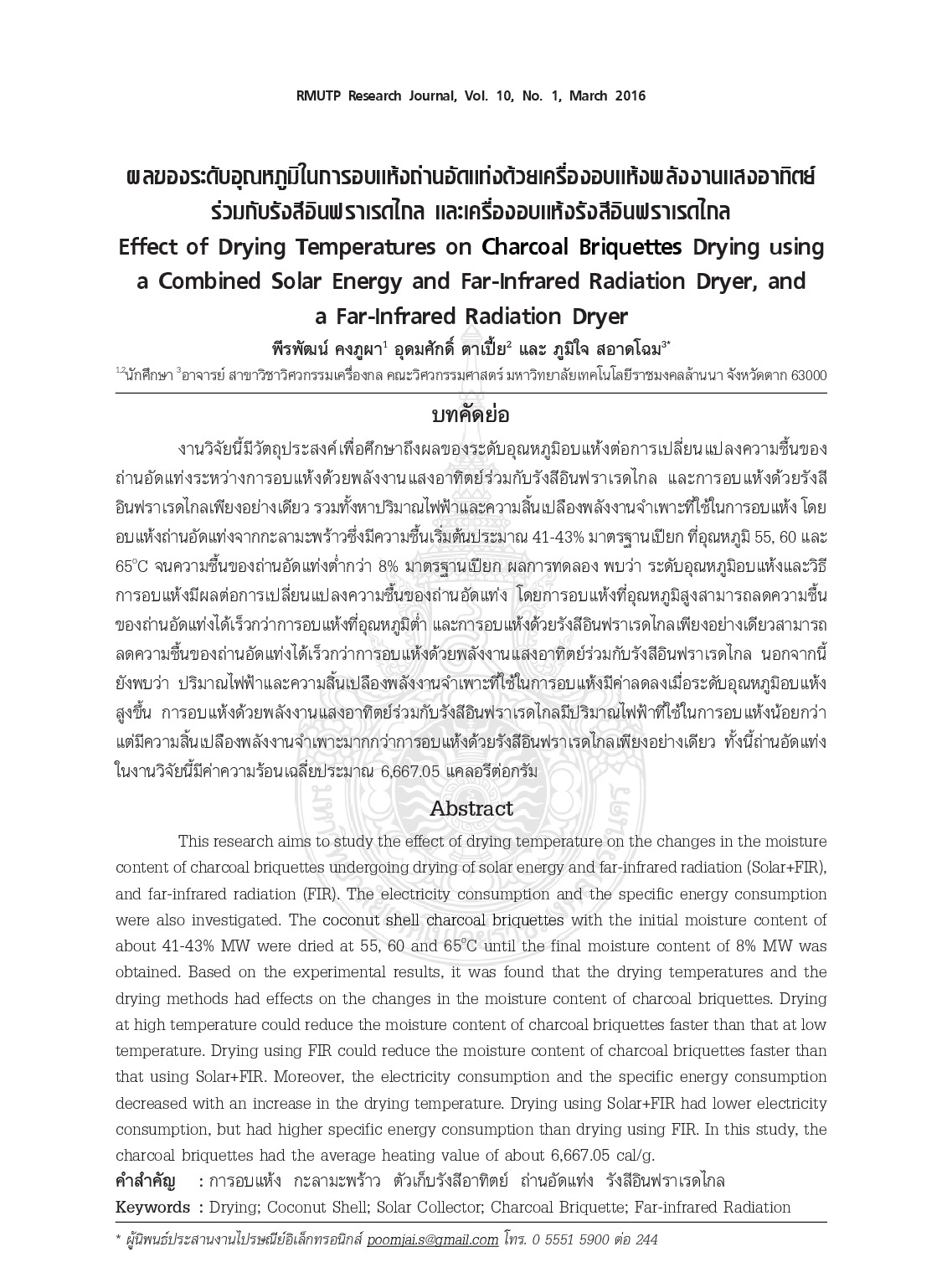
ผลของระดับอุณหภูมิในการอบแห้งถ่านอัดแท่งด้วยเครื่องอบแห้งพลังงานแสงอาทิตย์ร่วมกับรังสีอินฟราเรดไกล และเครื่องอบแห้งรังสีอินฟราเรดไกล
This research aims to study the effect of drying temperature on the changes in the moisture content of charcoal briquettes undergoing drying of solar energy and far-infrared radiation (Solar+FIR) and far-infrared radiation (FIR). The electricity consumption and the specific energy consumption were also investigated. The coconut shell charcoal briquettes with the initial moisture content of about 41-43% MW were dried at 55 60 and 65oC until the final moisture content of 8% MW was obtained. Based on the experimental results it was found that the drying temperatures and the drying methods had effects on the changes in the moisture content of charcoal briquettes. Drying at high temperature could reduce the moisture content of charcoal briquettes faster than that at low temperature. Drying using FIR could reduce the moisture content of charcoal briquettes faster than that using Solar+FIR. Moreover the electricity consumption and the specific energy consumption decreased with an increase in the drying temperature. Drying using Solar+FIR had lower electricity consumption but had higher specific energy consumption than drying using FIR. In this study the charcoal briquettes had the average heating value of about 6667.05 cal/g.