จำนวน Repository ( 24 )

การพัฒนาศักยภาพผลิตภัณฑ์ขนมไทยด้วยแป้งเปลือกทุเรียน
The objective of this research was to develop the potential of Thai desserts (Kanom Thong-Pub Kanom Thong-Ake and Kanom Sum-Pun-Nee) by using durian crust flour. In addition there were determined the effect of durian crust flour on quality properties and consumer test of Thai desserts. The sensory properties were evaluated by 40 panelists (professors of Department of Food and Nutrition and Food Service Industry Faculty of Home Economics Rajamangala University of Technology Phra Nakhon). The samples were evaluated using 9-point hedonic scale. Wheat flour was substituted with durian crust flour in Kanom Thong-Pub at the level of 0 10 20 and 30% (by weight). The results showed that 20% durian crust flour was high scores in appearance color odor taste texture and overall liking. The average values were 8.10 8.83 7.95 8.03 7.95 and 8.00 respectively (moderate to high score). Wheat flour was substituted with durian crust flour in Kanom Thong-Ake at the level of 0 20 40 and 60% (by weight). The results showed that 40% durian crust flour was high scores in appearance color odor taste texture and overall liking. The average values were 8.45 8.48 7.98 8.20 8.23 and 8.38 respectively (moderate to high score). Wheat flour was substituted with durian crust flour in Kanom Sum-Pun-Nee at the level of 0 10 20 and 30% (by weight). The results showed that 20% durian crust flour was high scores in appearance color odor taste texture and overall liking. The average values were 8.05 7.95 8.18 7.98 7.95 and 7.95 respectively (moderate to high score). Thai desserts with durian crust flour were evaluated chemical quality. The results showed that moisture fat crude fiber ash protein contents and aw value of Kanom Thong-Pub with 20% durian crust flour were 4.19 8.72 4.74 1.44 16.14 and 0.31% respectively. Physical properties The L* value of Kanom Thong-Pub without durian crust flour was higher than other samples. While the a* and b* values of Kanom Thong-Pub with 30% durian crust flour was higher than other samples. The chemical quality of Kanom Thong-Ake showed that Kanom Thong-Ake without durian crust flour showed the highest protein content (16.03%). The L* and b* values of Kanom Thong-Ake were 55.53 and 29.85 respectively. Kanom Thong-Ake with 20% durian crust flour was high fat content (31.88%). The a* value of Kanom Thong-Ake with 40% durian crust flour was 7.21. While Kanom Thong-Ake with 60% durian crust flour showed the highest moisture (16.15%) crude fiber (3.51%) ash (1.11%) contents and aw value (0.84%). The chemical properties showed that Kanom Sum-Pun-Nee with 30% durian crust flour was high moisture (22.25%) fat (5.48%) crude fiber (12.08%) ash (2.11%) and protein contents (6.26%). Kanom Sum-Pun-Nee without durian crust flour was high aw value (0.82%). While the L* value showed the highest lightness value. The a* and b* values of Kanom Sum-Pun-Nee with 20% and 30% durian crust flour were higher than other samples. The moisture fat crude fiber ash protein contents and aw value of durian crust flour were 4.78 0.53 36.66 5.04 10.01 and 0.33 respectively. For physical properties the L* a* and b* values were 68.64 4.90 and 17.72 respectively. The consumer acceptance test of Kanom Thong-Pub Kanom Thong-Ake and Kanom Sum-Pun-Nee the results found that consumer were accepted in finished product (moderate score). จ For training evaluations (follow-up) the result showed that 50 participants (100%) were satisfied with this program. The average values were 4.60 or 95.20% (high to highest score). However Thai desserts supplemented with durian crust flour should be considered the chemical composition. The effect of physical properties on Thai desserts may be attributed to the chemical composition of durian crust flour.
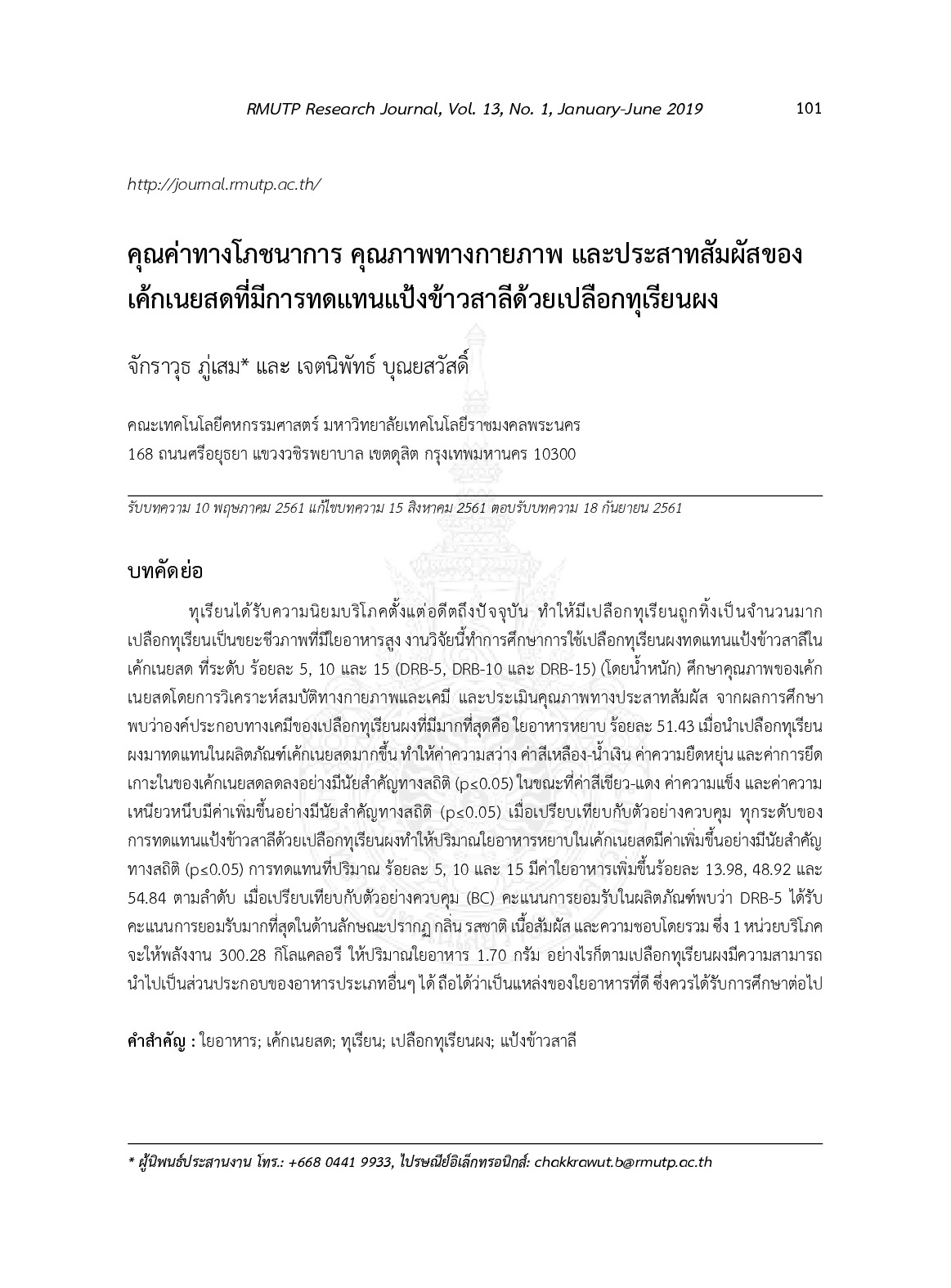
คุณค่าทางโภชนาการ คุณภาพทางกายภาย และประสาทสัมผัสของเค้กเนยสดที่มีการทดแทนแป้งข้าวสาลีด้วยเปลือกทุเรียนผง
Durian has been very popular not only local people but also tourists. As a result there are many durian peels wasted so this research is explored the utilization of durian peels. Durian rind is a biological waste but contains high amount of crude fiber. This research aims to study using durian rind powder to replace wheat flour in butter cakes at 5 10 and 15 % (w/w) (DRB-5 DRB-10 and DRB-15). Physical properties chemical composition and sensory evaluation of the butter cakes were analyzed. The results showed that durian rind powder contained 51.43 % of crude fiber. Increasing of durian rind powder in butter cakes showed significant decreasing of lightness (L*) blue–yellow component (b*) springiness and cohesiveness values while green–red component (a*) hardness and gumminess values were significantly higher than the control sample (BC) (p≤0.05). Dietary fiber content of the products shown significantly increased by 13.98% for DRB-5 48.92 % for DRB-10 and 54.84% for DRB-15 as compared with BC (p≤0.05). The acceptance scores of DRB-5 including appearance odor taste texture and overall liking scores were highest. There are 300.28 kcal for 1 serving of butter cake which contain 1.70 gram of dietary fiber. However durian rind powder can be used as a food ingredient and source of dietary fiber in other food recipes for further studies.
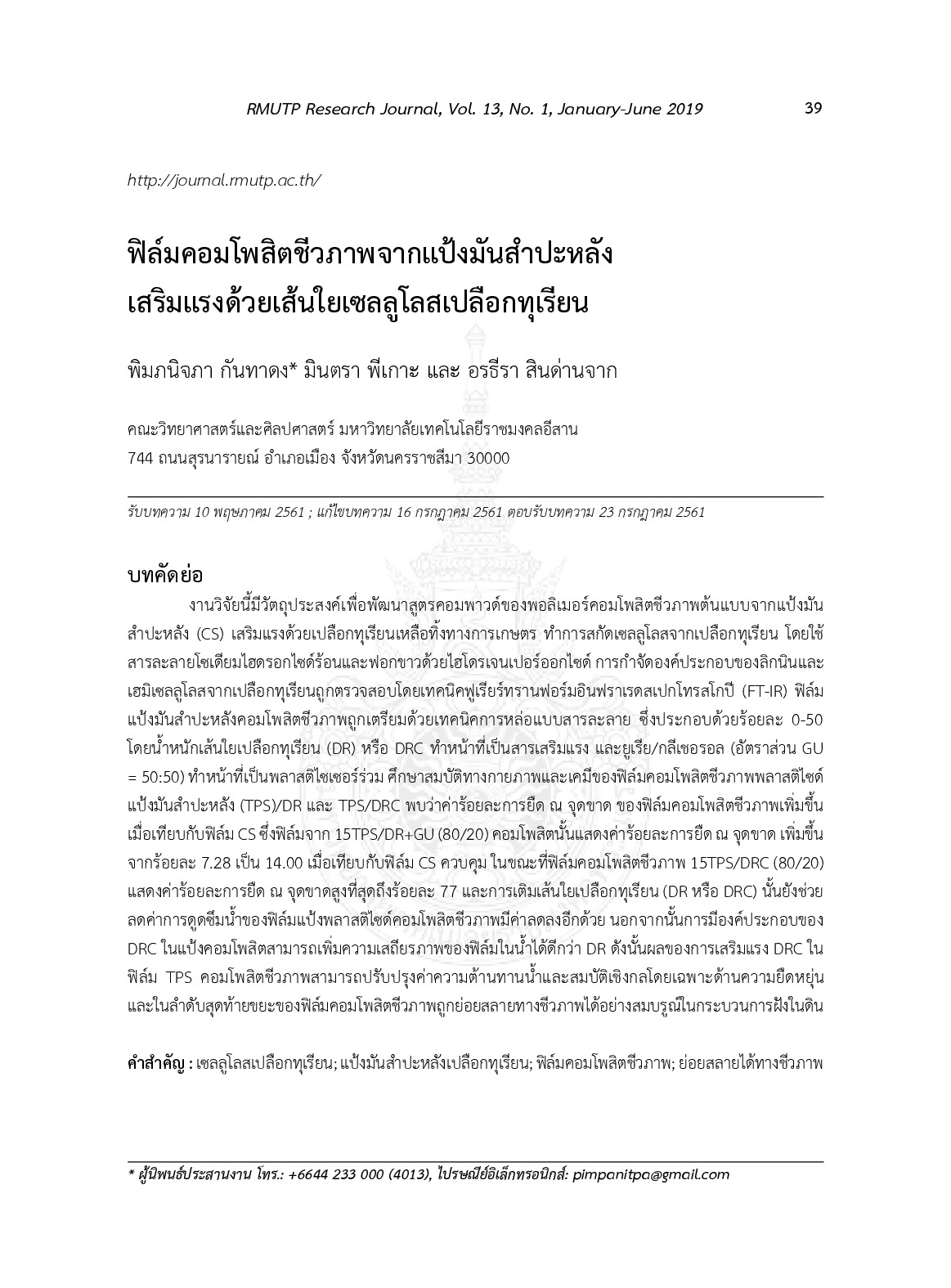
ฟิล์มคอมโพสิตชีวภาพจากแป้งมันสำปะหลังเสริมแรงด้วยเส้นใยเซลลูโลสเปลือกทุเรียน
This research aimed to develop compound of prototypes polymer bio-composites from cassava starch (CS) reinforced with agriculture residue the rind of durian fruit. Cellulose extracted from durian rind using hot sodium hydroxide and bleaching treatment with hydrogen peroxide. The removal of lignin and hemicellulose components from durian rind were investigated by fourier transform infrared spectroscopy (FT-IR). Cassava starch bio-composite films were prepared by solution-casting technique which includes 0-50 wt% of durian rind (DR) or durian rind cellulose (DRC) as reinforcement agent and urea/glycerol (GU ratio = 50:50) as plasticizer. The physical and chemical properties of thermoplastic starch (TPS)/DR and TPS/DRC bio-composite films were investigated. The percent elongation at break of bio-composite films were increased when compared to control CS film. From 15TPS/DR (80/20) films showed increase the elongation at break from 7.28 to 14.00% when compared to CS control films. While 15TPS/DRC (80/20) bio-composite films exhibited that the highest elongation at break to 77%. Durian fiber (DR or DRC) loading decreased the water absorption of plasticized bio-composite films. Furthermore incorporation of DRC in composite can be enhanced film stability in water better than DR. Therefore the effect of DRC reinforcement agent on TPS bio-composite films can improve water resistance and mechanical properties especially in terms of flexibility. Finally the waste of bio-composite films was degraded completely in soil burial test.
พฤติกรรมการบริโภคและการออมไว้ในยามฉุกเฉินของครัวเรือน ภายใต้ความไม่แน่นอนของรายได้ กรณีศึกษา : เกษตรกรชาวสวนทุเรียน จังหวัดนนทบุรี
This paper investigates household behavior with regard to consumption and precautionary saving under income uncertainty for durian farmers in Nonthaburi Province using both quantitative and qualitative research methods. A sample of 300 famers provides data collected by questionnaire and examined using the descriptive statistics of percentages mean and standard deviation as well as the inferential statistics of Pearson correlation and multiple regression analysis. The results show that durian farmers have an average income of 1039939.66 Baht per year and average debt of 574871.10 Baht per year. Focusing on precautionary saving behavior durian farmers save approximately 1000 to 5000 Baht per month by way of bank accounts premium saving bonds and human financial assets. In addition they exhibit a medium level of knowledge about philosophy of Sufficiency Economy including saving. However no relationship is found between level of saving and education. Hence the government should increase durian farmers’ knowledge concerning Sufficiency Economy including saving thus embracing improved human well-being as a developmental goal
ผลของการใช้เปลือกทุเรียนผงทดแทนแป้งข้าวสาลีต่อคุณภาพของแป้งทาร์ต
The objective of this research was to determine effect of substitution wheat flour with durian rind powder at 0 5 10 and 15% on tarts quality. Assessment by physical and chemical properties sensory evaluation. Results showed that increasing of durian rind the texture of the tart dough before baking hardness toughness and cohesiveness increased. After tart dough baked hardness and toughness increased. Both the tart dough before and after baking decreased lightness (L*) and yellowness (b*) increased of redness (a*) and water activity (aw) of baked tart dough has decreased. The durian rind tart contained increased of moisture protein ash and crude fiber. As of fat and carbohydrate are decreased. For sensory evaluation in acceptance color odor taste flavor texture and overall the tester accepted like very much at 15% of substitution durian rind powder with wheat flour.