จำนวน Repository ( 12 )
Energy Conservation by the Application of Engineering Principles in a Large Industrial Plant
This article presents the energy conservation of the wood furniture factory in Samutprakarn province by using engineering management technique. The electrical energy of 7408000 kWh per year or 25988055 Bath per year is mainly used in the processes including a heating energy system that is derived from wood scrap. After detailed audit it was found that 8 measures have a potential to improve energy efficiency. 7 measures for electrical energy can reduce the energy of 479837.60 kWh per year and the rest decreases heating energy of 120297.15 MJ/Year or saving the scrap of 9.4 tons per year. In order to assess economic possibility all measure also were considered. The result showed that it was worth to investment. In addition specific energy consumption (SEC) can be improved from 0.57 kWh/ft3 to 0.54 kWh/ft3 or diminishing of 5.26 %
Design and Product Dvevlopment Ceramics using for making wall of Energy conservation building
Ceramics Porduct Develompnet Ceramics
Design and Product Development Ceramics Using for Making Wall of Energy Conservation Building
This research aims to study and develop ceramics material using in the wall construction which can be used to proof the heat and water reduce absorbed humidity in the building. The product can save the energy especially the building which is set the air conditioning. The experiment found that the proportion of clay body can be developed and the result of thermal conductivity (K- value) was 0.111 W/ m. /K the permeability was 7 percent the glaze can be used to proof water. The product was compared to three kinds of construction materials which are brick concrete masonry unit and autoclaved aerated concrete found that K- value and permeability were lower. Moreover it can proof water and save more energy for the air conditioning building.
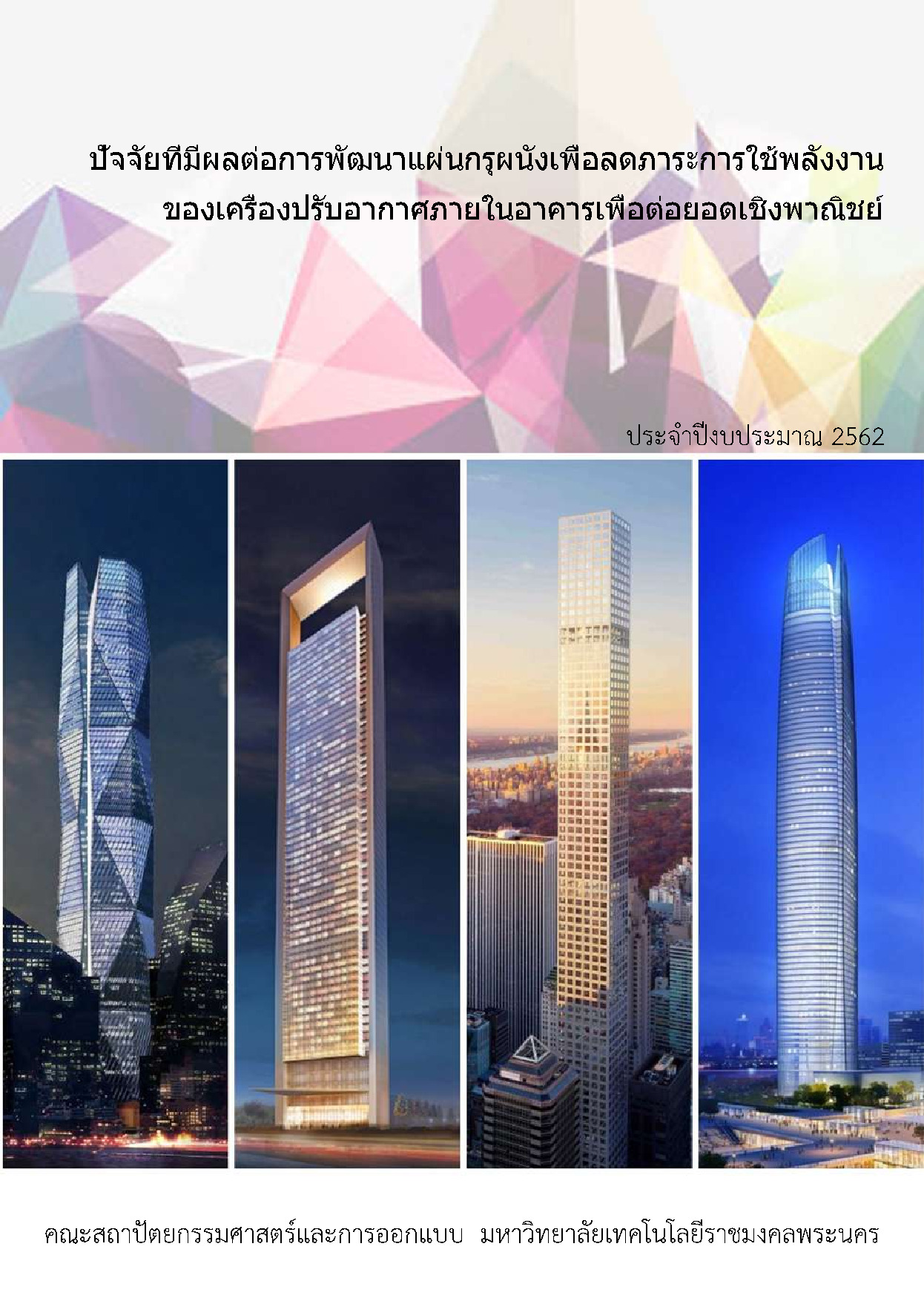
ปัจจัยที่มีผลต่อการพัฒนาแผ่นกรุผนังเพื่อลดภาระการใช้พลังงานของเครื่องปรับอากาศภายในอาคารเพื่อต่อยอดเชิงพาณิชย์
This research approach to study the development of interior wall for reduce energy consumption by air conditioning in the building. In order to be a prototype in the development of an industrial system for the export of green architecture in order to generate income for the community or entrepreneurs to bring money into the country to upgrade the industrial economy to be sustainable It is an architectural material that is compatible with the weather in Thailand. It can be used as a guideline for people interested in applying it to their own home building or disseminating through various media to reduce energy costs for a comfortable living. The objective is to study the factors that affect the development of wall paneling in order to reduce the energy burden of the air conditioner in the building in order to further the commercial production. The researcher collected data for the past 6 months not including other thermal energy. Used to calculate the energy consumption index for 2 building groups it was found that the electricity consumption of green buildings were 531100 kilowatt hours. And an average of 5.31 kilowatt hours per square meter While the non-green building has an average of 653360 kilowatt hours. And an average of 6.53 kilowatt hours per square meter As for the results of the data analysis the damage level is mostly at level 1 which is the wall surface and no obvious damage. Especially the 4th and 5th height is 1.55 meters and 1.85 meters from the floor level in the building. Damage level 3 is found at the height level 3 at a height of 1.00 meters from the floor level in the building. Assessment of damage caused to the interior wall of the building that occurred in 3 levels. The results of the data analysis showed that most damage levels were at level 1 namely the wall surface without obvious damage. Especially the 4th and 5th height is 1.55 meters and 1.85 meters from the floor level in the building. Damage level 3 is found at the height level 3 at a height of 1.00 meters and from the results of collecting moisture content in the exterior wall materials And analyzed to find the average for each of the 5 levels of height which are 0.55 meters 0.75 meters 0.95 meters 1.55 meters and 1.85 meters found that the buildings have different moisture content in each wall level (p <0.05). In conclusion this green building index equation can be applied to other buildings to reduce energy consumption and meet the standards of the green building. From the equation the electricity consumption can be predicted using the electricity usage index and systematically designed energy management in buildings. The area with the most damage will find the humidity in the range of 47% -98% the highest damage level 3 at an elevation of 0.80 meters from the floor level in the building
การพัฒนาแผ่นซีเมนต์บอร์ดจากเถ้ากะลามะพร้าว สำหรับการอนุรักษ์พลังงานและสิ่งแวดล้อม
This research aims to develop the cement board from coconut shell ash. The Portland cement type1: fine sand: tap water ratio is equal to 1: 0.4: 0.33 by weight. The 5 ratios of Portland cement type1: coconut shell ash include 1: 0.12 1: 0.13 1: 0.14 1: 0.15 and 1: 0.16 by weight. The cement board production uses the pressure casting in normal temperature (30 – 35 degree of Celsius) and controls the 0.75 g/cm3 of density then test the properties of cement-bonded fiberboard follow TIS 878-2537 standard (cement bonded particle board: high density). From the results 1: 0.12 is the most suitable ratio of cement board from coconut shell ash. This developed cement boards can reduce the quantity of coconut shell ash waste and have the good thermal insulation.