จำนวน Repository ( 10 )

การพัฒนาแผ่นใยไม้อัดซีเมนต์จากาการประยุกต์ใช้เส้นใยธรรมชาติจากกากมะพร้าวและต้นข้าวโพด
This research aims to study the application of coconut meal and corncob fiber as high density cement-bonded fiberboard. The cement: fine sand: coconut meal and corncob fiber: water: cement setting accelerator (aluminium sulphate (Al2(SO4)3) calcium chloride (CaCl2) sodium silicate (Na2SiO3)) ratio is equal to 1: 0.2: 0.05: 0.3: 0.03 by weight. The fibers are taken from coconut meal: corncob that 5 ratios are used following: 0.0500: 0 (CN0) 0.0375: 0.0125 (CN25) 0.0250: 0.0250 (CN50) 0.0125: 0.0375 (CN75) and 0: 0.0500 (CN100) by weight. 12% of Sodium Hydroxide (NaOH) was used to modify the fibers by using 1: 10 of fiber: solution and boiling 100 degree of Celsius (1-3 hours). The fiberboard production use pressure casting in normal temperature (30 – 35 degree of Celsius) and 0.75 g/cm3 of density. Resulting the CN75 ratio is suitable ratio which pass TIS 878-2537 standard (cement bonded particle board: high density) and has good physical properties mechanical properties and thermal insulation. The most suitable cement setting accelerator is calcium chloride (CaCl2).
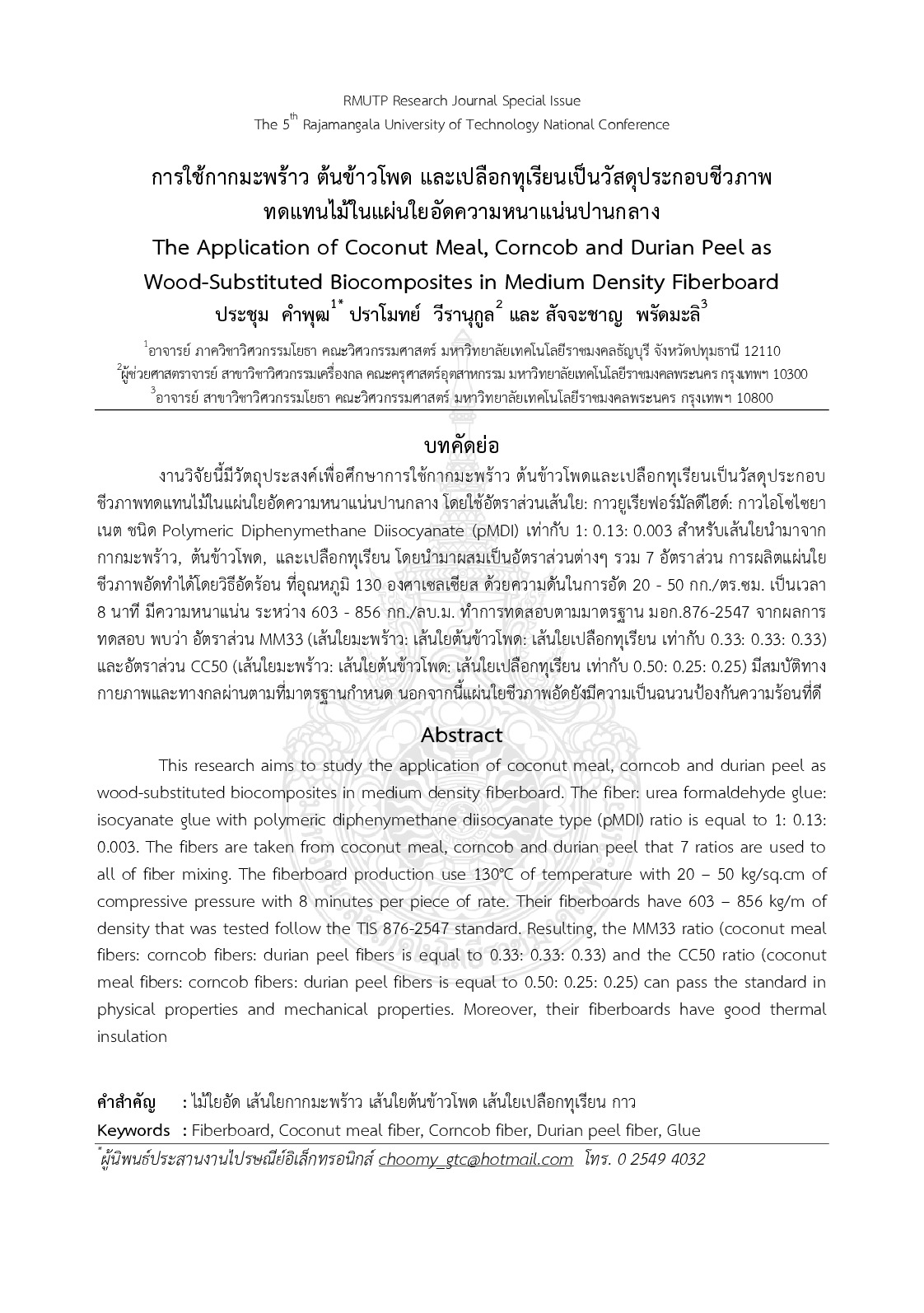
The application of coconut meal, corncob and durian peel as wood-substituted biocomposites in medium density fiberboard
This research aims to study the application of coconut meal corncob and durian peel as wood-substituted biocomposites in medium density fiberboard. The fiber: urea formaldehyde glue: isocyanate glue with polymeric diphenymethane diisocyanate type (pMDI) ratio is equal to 1: 0.13: 0.003. The fibers are taken from coconut meal corncob and durian peel that 7 ratios are used to all of fiber mixing. The fiberboard production use 130?C of temperature with 20 – 50 kg/sq.cm of compressive pressure with 8 minutes per piece of rate. Their fiberboards have 603 – 856 kg/m of density that was tested follow the TIS 876-2547 standard. Resulting the MM33 ratio (coconut meal fibers: corncob fibers: durian peel fibers is equal to 0.33: 0.33: 0.33) and the CC50 ratio (coconut meal fibers: corncob fibers: durian peel fibers is equal to 0.50: 0.25: 0.25) can pass the standard in physical properties and mechanical properties. Moreover their fiberboards have good thermal insulation
การพัฒนาแผ่นใยไม้อัดซีเมนต์จากการประยุกต์ใช้เส้นใยธรรมชาติจากกากมะพร้าวและต้นข้าวโพด
This research aims to study the application of coconut meal and corncob fiber as high density cement-bonded fiberboard. The cement: fine sand: coconut meal and corncob fiber: water ratio is equal to 1: 0.2: 0.05: 0.3. The fibers are taken from coconut meal and corncob that 5 ratios are used to all of fiber mixing. The fiberboard production use casting in normal temperature. Resulting the CN75 ratio (coconut meal and corncob fiber is equal to 0.0125: 0.0375) is suitable ratio which pass TIS 878- 2537 standard (cement bonded particle board) and has good physicalproperties mechanical properties and thermal insulation.
แผ่นใยอัดจากเส้นใยต้นมันสำปะหลัง
This research aims to study the application of cassava fiber. The fibers are taken from cassava and pineapple Head that 3 ratios are used to all of fiber mixing. The fiberboard production use 130°C of temperature with 20 – 50 kg/sq.cm of compressive pressure with 10 minutes per piece of rate. Their fiberboards have 681 – 724 kg/cu.m of density and 7.1 – 7.6 % of moisture. Resulting the CF 05 ratio (cassava: urea is equal to 0.95:0.13) is suitable ratio which has good physical and mechanical properties.
การใช้กากมะพร้าว ตันข้าวโพดและเปลือกทุเรียนเป็นวัสดุประกอบชีวภาพทดแทนไม้ในแผ่นใยอัดความหนาแน่นปานกลาง
This research aims to study the application of coconut meal corn cob and durian peel as wood-substituted biocomposites in medium density fiberboard. The fiber: urea formaldehyde glue: isocyanate glue with polymeric diphenymethane diisocyanate type (pMDI) ratio is equal to 1: 0.13: 0.003. The fibers are taken from coconut meal corn cob and durian peel that 7 ratios are used to all of fiber mixing. The fiberboard production use 130°C of temperature with 20 – 50 kg/sq.cm of compressive pressure with 8 minutes per piece of rate. Their fiberboards have 603 – 856 kg/m of density that was tested follow the TIS 876-2547 standard. Resulting the MM33 ratio (coconut meal fibers: corn cob fibers: durian peel fibers is equal to 0.33: 0.33: 0.33) and the CC50 ratio (coconut meal fibers: corn cob fibers: durian peel fibers is equal to 0.50: 0.25: 0.25) can pass the standard in physical properties and mechanical properties. Moreover their fiberboards have good thermal insulation.