จำนวน Repository ( 11 )
การพัฒนาผลิตภัณฑ์กระดาษและบรรจุภัณฑ์จากแกลบ และส่วนเหลือทิ้งในการแปรรูปข้าว เพื่ออนุรักษ์ศิลปไทย
This research is a study on the Development of Paper and Packaging from Rice Husk and Rice Processing Wastes for producing for Thai Art Conservation. This research purpose to develop products and packaging from the rice husk in rice processing to study the processes of paper production and forming products to design and develop products and packaging and to transfer technology products and packaging from the leftovers in rice processing to conserve Thai arts to the community and to study the satisfaction of the product and packaging development program from the leftovers in rice processing in order to conserve Thai arts to the community. The research findings can be summarized as follows: 1. In this research the research team produced paper and molded products experimenting with the ratio of RICE HUSK and paper SA fibers and find the best ratio of rice husk 50: paper SA fibers 50 so that rice husk can better adhere to paper and creates a beautiful texture for making products. Moreover this research uses the waste from the rice processing process it able to develop products according to objectives. At the same time can be produced at the household level. As well as finding marketing methods for new products to be able to sell which generates income for the community. 2. The results of the physical characteristics of paper produced from rice husk paper with the ratio of rice husk 50 to 50 has a moderate weight. The paper can be folded. The tensile strength of the paper is moderate. The surface is good. The characteristics of the paper after coated with waterproofing it was coated with natural extracts and environmentally friendly. When testing the water color paint on paper the water color slowly absorbed but does not spread along the paper fibers and also slightly absorbed in the backside paper. 3. In this research the development of products and packaging from the leftovers in rice processing for preserving Thai art into 2 categories 1. Develop paper from rice husk for processing into products and developing molded products from rice husk consisting of 3 sets of ornaments consisting of necklaces bracelets earrings 4 sets of home decor consisting of pans wall paintings and 3 sets of household items consisting of 4 multipurpose boxes fruit trays altar table 4. The knowledge transfer by organizing a workshop for theoretical and practical work the duration of knowledge transfer was 2 days 50 participants between 11 - 12 august 2019 at Bang Tachong Community Enterprise Village No.8 Tha Ngam Subdistrict and District in Buri Sing Buri province. Most participants are satisfied with the highest levels in all questions.
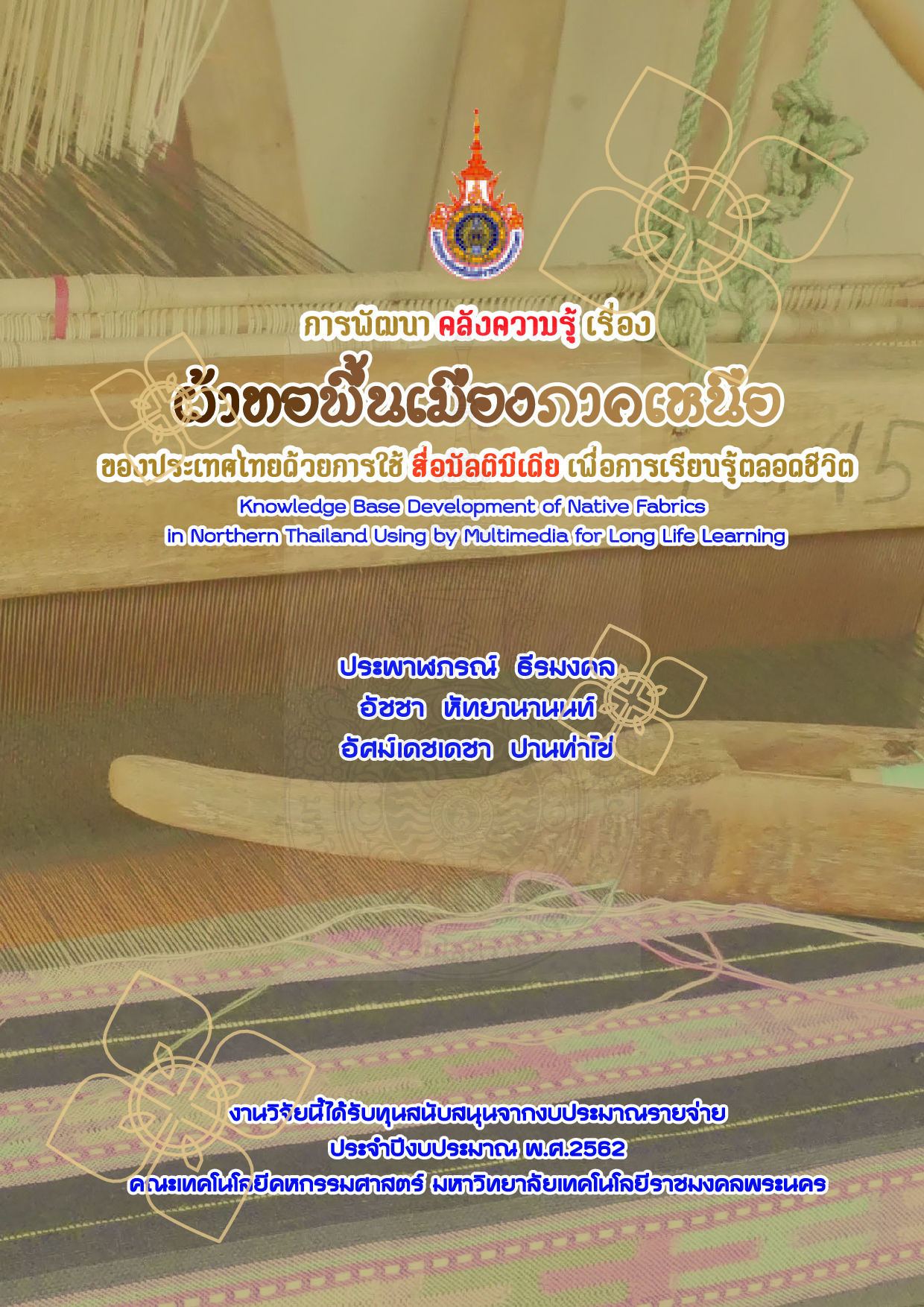
การพัฒนาคลังความรู้เรื่องผ้าทอพื้นเมืองภาคเหนือของ ประเทศไทยด้วย การใช้สื่อมัลติมีเดียเพื่อการเรียนรู้ตลอดชีวิต
This research is the development of the knowledge base on local textiles of northern Thailand by using multimedia for lifelong learning. The aim is to study compile and gather information of local cloths in northern Thailand. Develop a knowledge base by using multimedia on the local textiles of northern Thailand for lifelong learning and transferring knowledge and disseminating the knowledge base on northern Thai fabric by using multimedia for lifelong learning to the community. The research team proceeded to gather primary knowledge from the roots of the researchers who are interested in the local woven fabric. Therefore proceeding further knowledge in the upper reaches from literature reviews Including from field trips for data collection through in-depth interviews with important people Interviewing people who have knowledge about social context community local weaving characteristics weaving characteristics name of pattern type of fabric weaving technique of local textiles in northern Thailand in 9 provinces as well as studying primary data from textbooks textbooks and technical documents and in the internet. Thus the research shown that into 3 parts which are 1. Ethnic groups of Northern Thailand 2. Local woven fabric in northern Thailand and 3. Woven process and pattern. After that the knowledge library was developed by using multimedia on the local textiles of Northern Thailand for lifelong learning. This research can summarize the results in the form of a written description showing that the northern region of Thailand in the past was the Lanna Kingdom area. In the area of Xishuangbanna Before moving to the north of Thailand including the Tai Lue Tai Kheen Thai people Tai Yai people Meng (Mon) Lua people villages scattered throughout the highlands of the Lanna region such as Karen (Pak Kahen M) Mien (Yao) Hmong (Meo) Akha (Akha) Lahu (Mso) Lisu. In addition there are some groups in the Lanna fringe such as Khmu Labri (Tong Lueang). Each ethnic group has its own unique style especially Common skirt Has the same basis with the resin head the resin body and the resin tip but each part is not woven differently Have different colors Some ethnicities have a section called Lep which is the part that the weaver often weaves to keep the thread as for knowledge transfer. The research created a book Local woven cloth consists of videos from local knowledge sources and digital documents and to make the transfer of knowledge more complete Therefore held a forum and exhibition on the topic primary fabric of Lanna Kingdom as a medium for those interested in Local woven fabrics in the Lanna Kingdom of Thailand attended. Exchange ideas from various sources of knowledge from the research. While also receiving multimedia for lifelong learning from the inquiry regarding the satisfaction of the participants. The Keynote speakers are interesting and event condition caused the interest in the knowledge content that used to organize the exhibition. Overall the work is most satisfied.
การออกแบบและพัฒนาผลิตภัณฑ์จากผ้าใยกล้วยด้วยการพิมพ์แบบกราฟิกและตกแต่งนวัตกรรมนาโนสู่การพัฒนาเศรษฐกิจชุมชนเชิงพาณิชย์
This research is Design and development of banana fiber textiles with graphic printing and decoration Nano innovation to the Economic Communities Commercial The purpose of this research were 1) study the fundamental properties of banana fiber textiles with graphic printing and decoration Nano innovation on products 2) to design and develop products of banana fiber textiles with graphic printing and decoration Nano innovation 3) to produce the women handbags prototypes products of banana fabric with graphic printing and decoration Nano innovation to the Economic Communities Commercial. 4) to assess the opinion of the women handbags products of banana fabric by Questionnaire of user’s 5) to transfers knowledge of product design from banana fabric by printing graphics and decoration nanotechnology innovations. Economic development to commercialization. To be useful in the design and development of the product forward. Research tools are 1) the three graphic design drafts and create five women handbags prototypes product 2) Questionnaire of user’s opinion : an assessment of the design and the satisfaction of users of 25 people to inquiries random coincidence. Using the percentage and averages 3) implementation of knowledge transfer to the community of interest 17 – 18 September 2016 at the Chedi district office in Suphanburi province total 25 people including community enterprise Various womens groups And others interested in the surrounding area 4) Questionnaire of consumers satisfaction : the assessment of satisfaction of participants to design and develop products from banana fibers by printing graphics and decoration nanotechnology innovations. Data were analyzed using the statistical average of the results as table and descriptive. The results were as follows: 1) Innovative nano-fiber cloth decorated banana fabric can be antibacterial at 99.95% and staphylococcus bacteria klebsiella pneumonia at 99.93% and water reflection / water level of 80 percent water which can be absorbed into the cloth and wet it a bit. 2) The mostly respondents were female aged 21-25 years students earn less than 15000 baht in the inquiry satisfaction of consumers on the use of products from cotton banana fiber with printing. graphic and decorative nanotechnology innovation. All have beensatisfied at maximum average and highest level of satisfaction that with an average 4.91 percent to 98.24 satisfaction is at the highest level. 3) Execution Technology The workshop schedule for the two-day workshop on 17 - 18 September 2559 at the Chedi district office in Suphanburi province 25 people including community enterprise. Various womens groups and interested parties within the surrounding area. Most of the participants were satisfied with the level in most every question.
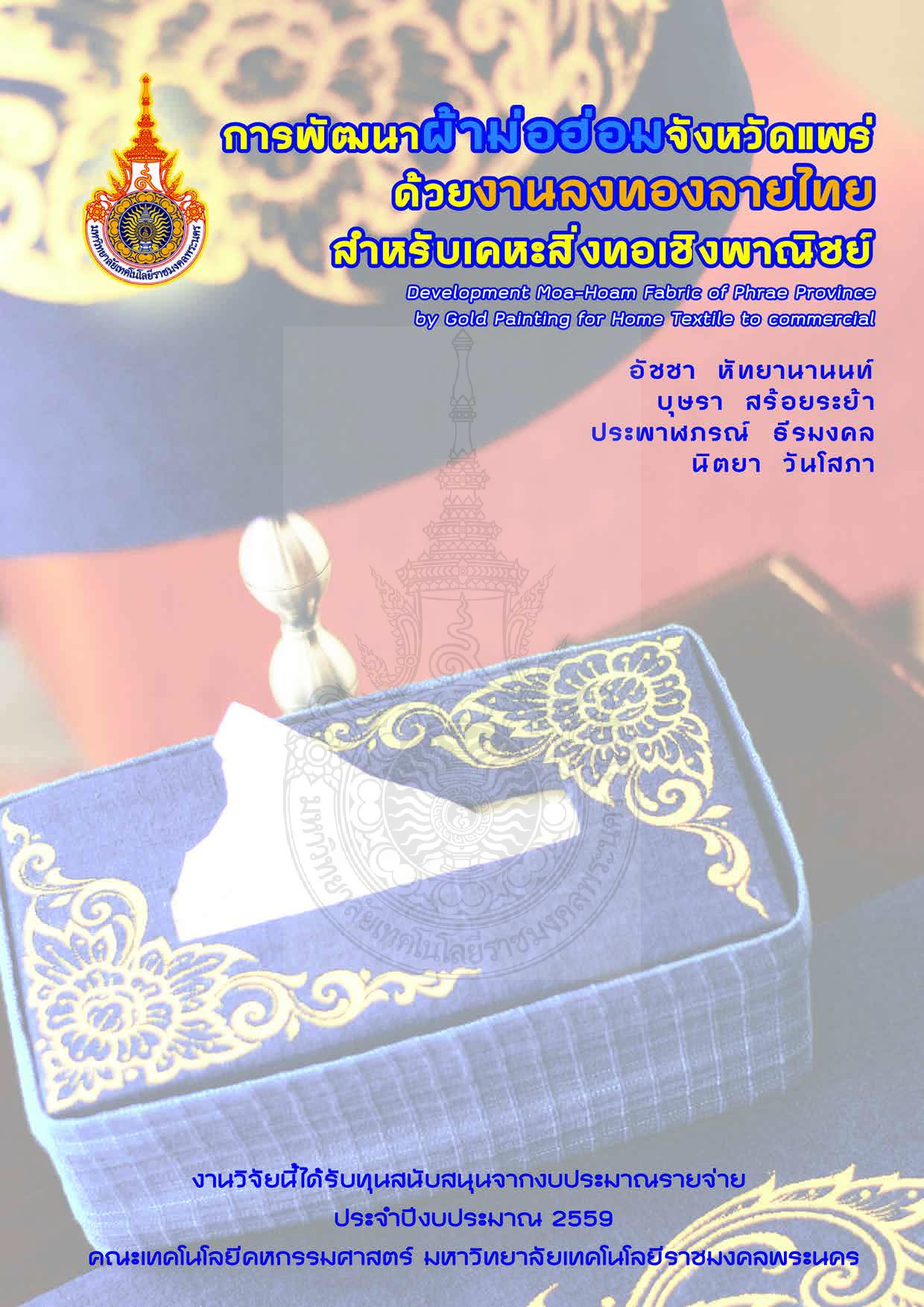
การพัฒนาผ้าม่อฮ่อมจังหวัดแพร่ ด้วยงานลงทองลายไทยสำหรับเคหะสิ่งทอเชิงพาณิชย์
This research is Development Moa-Hoam Fabric of Phrae Province by Gold Painting for Home Textile to commercial. The purpose of this research were 1) to design Thai pattern by Gold Painting for Home Textile to commercial for Moa-Hoam Fabric of Phrae Province. 2) to produce Moa-Hoam Fabric of Phrae Province products for Home Textile to commercial and 3) to assessment the consumers satisfaction towards development Moa-Hoam Fabric of Phrae Province by Gold Painting for Home Textile to commercial. The research instruments used to collect data: 1) a draft design of Thai pattern (Decorative moldings a specific pattern on the North of Thailand) 2) a draft product design 10 prototypes 3) to produce 10 prototypes as table cloth a sofa cover Wall picture cushion curtain tissue box lamp versatile fabric and trash 4) Questionnaire of consumers satisfaction towards Development Moa-Hoam Fabric of Phrae Province by Gold Painting for Home Textile to commercial of 50 people: Moa-Hoam Fabric sellers and manufacturers Hotel Entrepreneur Tourists and those interested in Moa-Hoam Fabric of Phrae Province by Gold Painting for Home Textile to commercial. The evaluation data was analyzed by using SPSS program in frequency mean and percentage. All in conclusion as table and descriptive The research showed that the design pattern that is unique to Thailand. According landmarks Phrae is wire moldings a striped pattern that is unique and original. The cutbacks on product design and textiles. The researchers made the interior of the room. Using fabric Moa Hoam write down gold striped Thailand. Living area Using fabric Moa-Hoam Fabric painted down gold striped Thailand and sewing products. Then Asking the satisfaction of Moa-Hoam Fabric sellers and manufacturers Hotel Entrepreneur Tourists and those interested were found that mostly respondents were male aged 46 years up and over by many as Hotel entrepreneurs a Bachelors degree with a monthly income of up to 30001. The respondents were satisfied with development Moa-Hoam Fabric of Phrae Province by Gold Painting for Home Textile to commercial terms at the most an average of 4.74. In the part of the ability to attract is well in average maximum 4.88. It is about of possible market average satisfaction was 4.84 at the most. Moreover The design enhances for the Moa Hoam fabric promotional image was 4.76 at the most. Exquisite designs are appropriate for the utility to add value to their products (Moa Hoam fabric) was 4.72 at the most and also the commercial customer satisfaction is at the highest level. Application of unique art in Phrae to use in textiles was 4.68 the average customer satisfaction is at the highest level. And to help promote tourism in the province to the other one the average satisfaction was 4.62 in the highest level.
การถ่ายทอดเทคโนโลยีการสร้างตราสินค้าและบรรจุภัณฑ์เพื่อเพิ่มมูลค่าผลิตภัณฑ์จากเศษวัสดุสิ่งทอเหลือทิ้ง
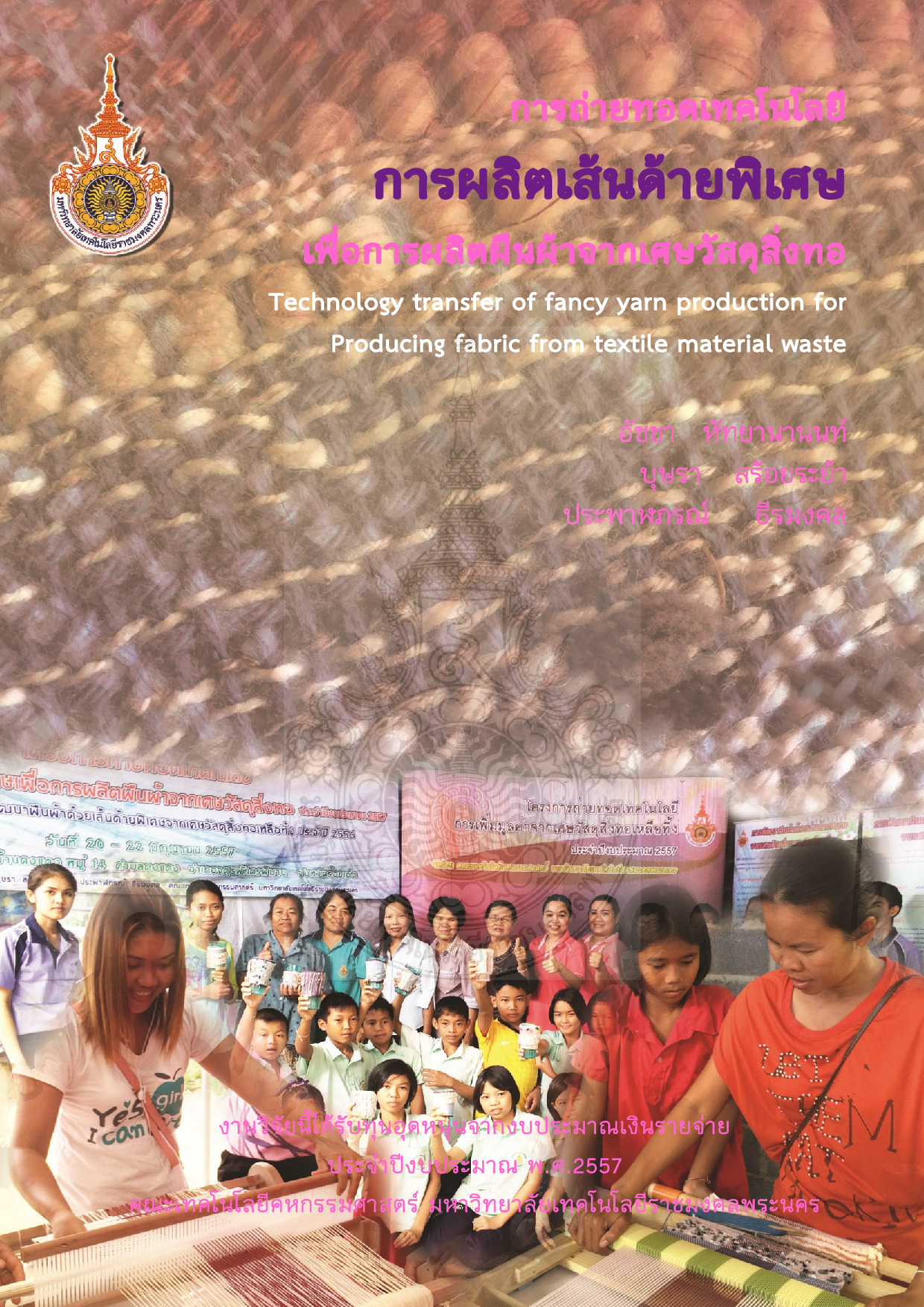
The research aimed to Technology transfer of fancy yarn production for producing fabric from textile material waste. The purpose is to technology transfer of fancy yarn production for producing fabric to people and community and to evaluate of technology transfer of fancy yarn production for producing fabric. The procedures were as follows target population for the transfer of knowledge and technology as Small and Micro community Enterprise--SMCE and individuals interested in Dang Dong sub-district Bang Bon district at Roi-Ed province. A total of 34 peoples and two days on 20 - 21 June 2557 and a satisfaction survey with a questionnaire after training. The data were analyzed using frequency percentage and mean. The results that general Information are female and younger than 21 years of education in elementary education as a student. A question that asking about their satisfaction with the course and to divide into three aspects: the purpose of the project The course structure and the contents of the course. The majority were satisfied with the very best. The purpose and the content are high level of satisfaction. In relation to technology transfer of fancy yarn production for producing fabric from textile material waste divided into three aspects: the process provides trainers and facilities was found that were satisfied at all of the 3 parts. The participants are mainly used to provide benefits to themselves for one month to apply the knowledge gained after the training. The participants modified using a new material and used local materials applied accordingly. Moreover a focus will be capped by the school to take courses and workshops and to teach another one for working out or as part of the courses taught at the school. Satisfaction with the benefits of technology transfer and utilization. Satisfaction at the highest level. The comments and suggestions of the participants found that they need for re-training again. They would like to have a longer period of training in order to gain more knowledge. All lecturer can transfer knowledge during the training as well.