จำนวน Repository ( 9 )

แนวโน้มรูปแบบการจัดการโลจิสติกส์และที่เป็นมิตรกับสิ่งแวดล้อมของสินค้าวิสาหกิจชุมชนทางการเกษตรและอาหาร
This research is intended ; 1.To analyze the experts perspective affecting green logistics model on inventory management of corporate community in agricultural and food product for inventory sustainable management. 2.To determine and examine the future trend possibility model of green logistic on inventory management of corporate community in agricultural and food products for inventory sustainable management. The key informants of the expert consisted of the expert in corporate community management 2) entrepreneurs 3) relevance persons who related to green logistics and 4) intellectual persons 21 persons in total with the selection through purposive method. The research was conducted the future research method using the Delphi technique involving Three-round questionaires including interviews are research instrument. The descriptive statistics including median interquartile rang (IR) for desired agreement and consensus answer of the key informants from the expert. The research result found that 1)In the first objective consisted of 1.1 Green logistics performance 1.2 Green organization performance 1.3 Competitive advantage building Green logistics performance were 1. Green inventory management efficiency 2. Personal efficiency 3. Follow and evaluation Green organization performance were 1. Expected based on green logistics 2. Image building for green supply chain organization Competitive advantage building were 1. Competitive strategy 2. Green logistics strategy 2) In the second objective from the above research finding and led to determine and examine acceptance model approach in the future possibility of green logistics model on inventory management of corporate community in agricultural and food products for inventory sustainable managements follows : 3 performance of 1) green logistics performance on inventory management of corporate community in agricultural and food products for inventory sustainable management. 2) organization or corporate community performance and 3) competitive advantage building performance.
ปัจจัยที่มีอิทธิพลต่อการสร้างความสามารถในการแข่งขันในการส่งออกอาหารฮาลาล สู่เส้นทางโลจิสติกส์ไทย-อาเซียน
The research on the factors influencing the creation of competitiveness for exporting Halal food using Thailand - ASEAN logistics route was aimed (1) to study the factors that influenced the ability to compete for exporting Halal food using Thailand - ASEAN logistics route including economic environment resources and operational capabilities financial administration legal administration and logistics and (2) to examine the consistency of the causal model with the empirical data. The variables used in this study were the independent variables including the economic organization organization resources financial administration legal administration and logistics. The independent variable was the ability to compete for exporting Halal food using Thailand - ASEAN logistics route. The researchers used a mixed method of qualitative and quantitative study. Questionnaires were used to collect empirical data from 445 exporter samples. The statistical methods used to analyze data were the frequency percentage mean standard deviation and the analysis on the structural equation model. The results revealed that the model was well consistent with the empirical data. The Chi – Square (2) value was 417.295 at the degrees of freedom (df) of 569 with the probability (p-value) equal to 1.000. The chi - square relative (2/df) was 1.368 with the index of harmony (GFI) equal to the probability p-value equal to 0.960. The modified harmony index measuring (AGFI) was equal to 0.930 and the index error in estimation parameters (RMSEA) was equal to 0.015. Moreover it was found that the variables were economic organization organization resources financial administration legal administration logistics and Halal food quality had positive effect on the ability to compete for exporting Halal food using Thailand - ASEAN logistics route. The research results suggested the entrepreneurs focus on environmental variables economic organization organization resources financial administration legal administration logistics and Halal food quality which could lead to advantageous for the competition exporting Halal food using Thailand - ASEAN logistics route.
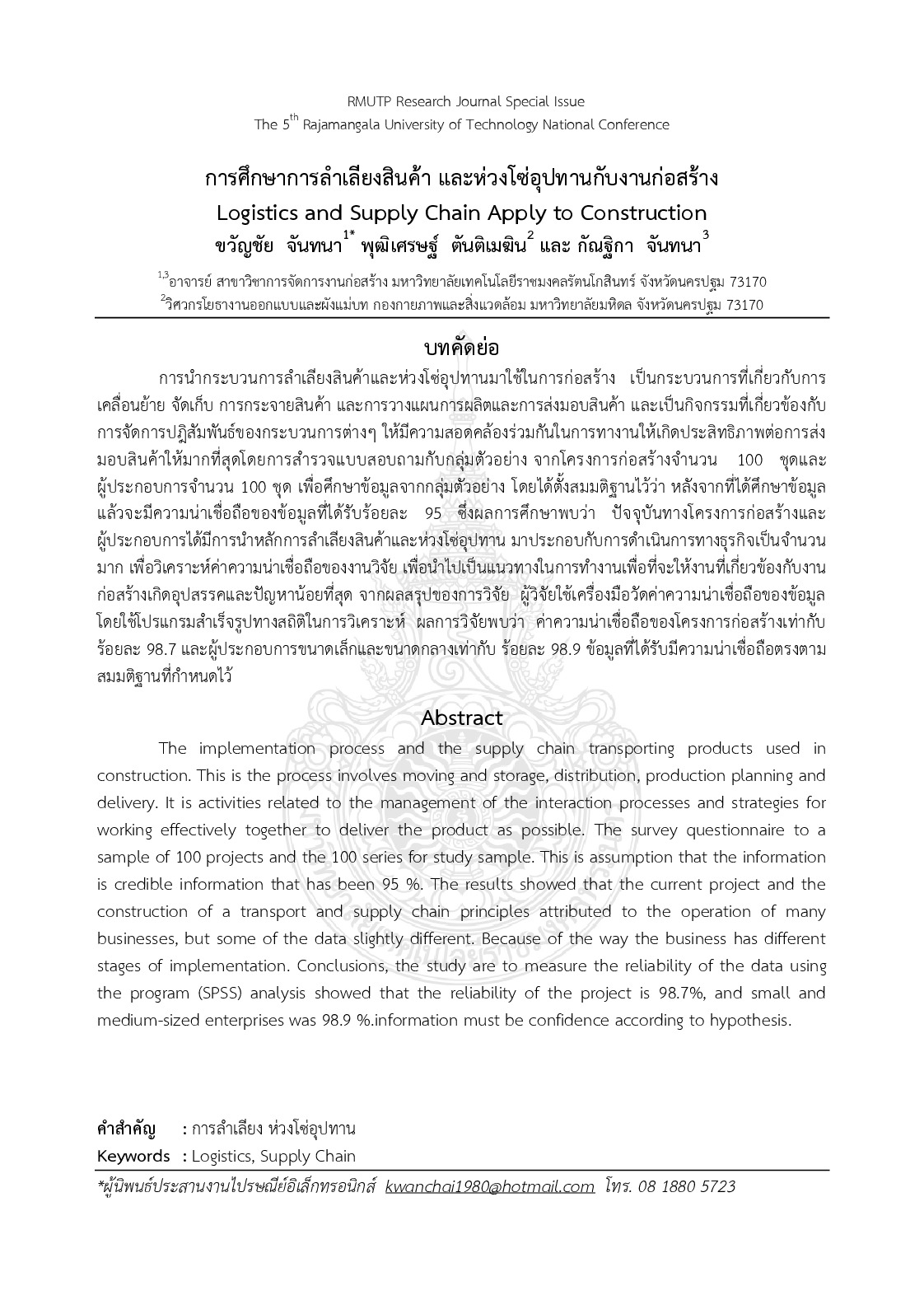
Logistics and supply chain apply to construction
The implementation process and the supply chain transporting products used in construction. This is the process involves moving and storage distribution production planning and delivery. It is activities related to the management of the interaction processes and strategies for working effectively together to deliver the product as possible. The survey questionnaire to a sample of 100 projects and the 100 series for study sample. This is assumption that the information is credible information that has been 95 %. The results showed that the current project and the construction of a transport and supply chain principles attributed to the operation of many businesses but some of the data slightly different. Because of the way the business has different stages of implementation. Conclusions the study are to measure the reliability of the data using the program (SPSS) analysis showed that the reliability of the project is 98.7% and small and medium-sized enterprises was 98.9 %.information must be confidence according to hypothesis.
การวิเคราะห์สาเหตุของการผลิตสินค้าบกพร่องและเสียด้วยตัวแบบการถดถอยโลจิสติกส์แบบเบย์: กรณีศึกษาโรงงานผลิตชิ้นส่วนรถยนต์
This research proposes a Bayesian logistic regression model which is applied to the data from autoparts manufacturing machines. Factors related to defective and bad products are investigated. The proposed model is compared with the logistic regression using maximum likelihood method for parameter estimation. The data were collected from 132 machines in an autoparts manufacturing factory. The research found that useful life machine type 6 worker group 3 and 4 working step 1 and 2 influence to the risk of producing defective and bad products. When the useful life is increased by 1 month the risk of producing defective and bad products will be increased by 2.2%. The risk that the machine type 6 will produce defective and bad products is 4.078 times greater than the risk that the machine type will do. The risk that the worker group 3 will produce defective and bad products is 61.7% less than the risk that the worker group 12 will do. The risk that the worker group 4 will produce defective and bad products is 61.5% less than the risk that the worker group 12 will do. The risk that the working step 1 will produce defective and bad products is 2.831 times greater than the risk that the working step 4 will do. The risk that the working step 2 will produce defective and bad products is 13.8 % greater than the risk that the working step 4 will do. The parameter estimates from the Bayesian logistic regression are very close to the ones from the logistic regression using maximum likelihood method for parameter estimation