จำนวน Repository ( 9 )
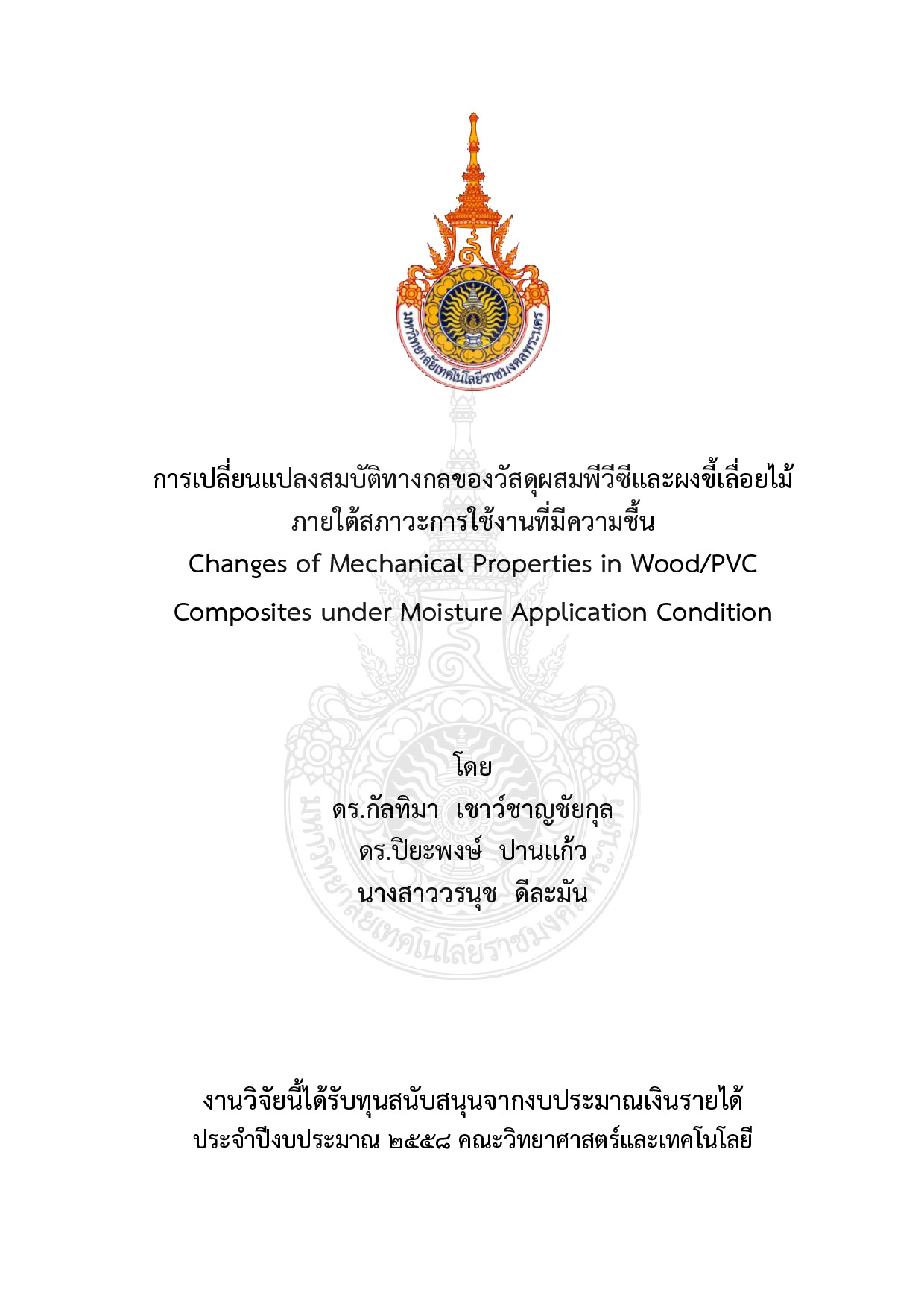
การเปลี่ยนแปลงสมบัติทางกลของวัสดุผสมพีวีซีและผงขี้เลื่อยไม้ ภายใต้สภาวะการใช้งานที่มีความชื้น
This research work was to study the effect of moisture on mechanical properties of wood/polyvinylchloride composites (WPVC). WPVC specimens in ratio of PVC and wood (100:100 by weight) were prepared by using twin screw extruder. The water conditions for WPVC specimen immersion testing were varied for temperatures of 30-70 oC and specimen immersion time of 0-120 h. The moisture effect was investigated by measuring flexural properties and hardness of WPVC as comparing with case of PVC specimen. The result suggested that flexural modulus of WPVC tended to decrease with increasing time of water immersion and then remained unchanged at immersion time of more than 72 and 48 h for water temperature of 30 and 70 oC respectively. The decrease rate in flexural modulus enhanced when water temperature increased. Flexural modulus of PVC slightly changed with increasing both immersion time and water temperature. Flexural strength for both PVC and WPVC specimens were found the change at water temperature of 70 oC only. Flexural strength of PVC tended to slightly increase with increasing immersion time whereas flexural strength of WPVC slightly decreased with increasing immersion time. Hardness of PVC specimen in cases of both water temperature of 30 and 70 oC slightly increased with increasing immersion time. For WPVC hardness tended to decrease with increasing immersion time and water temperature.
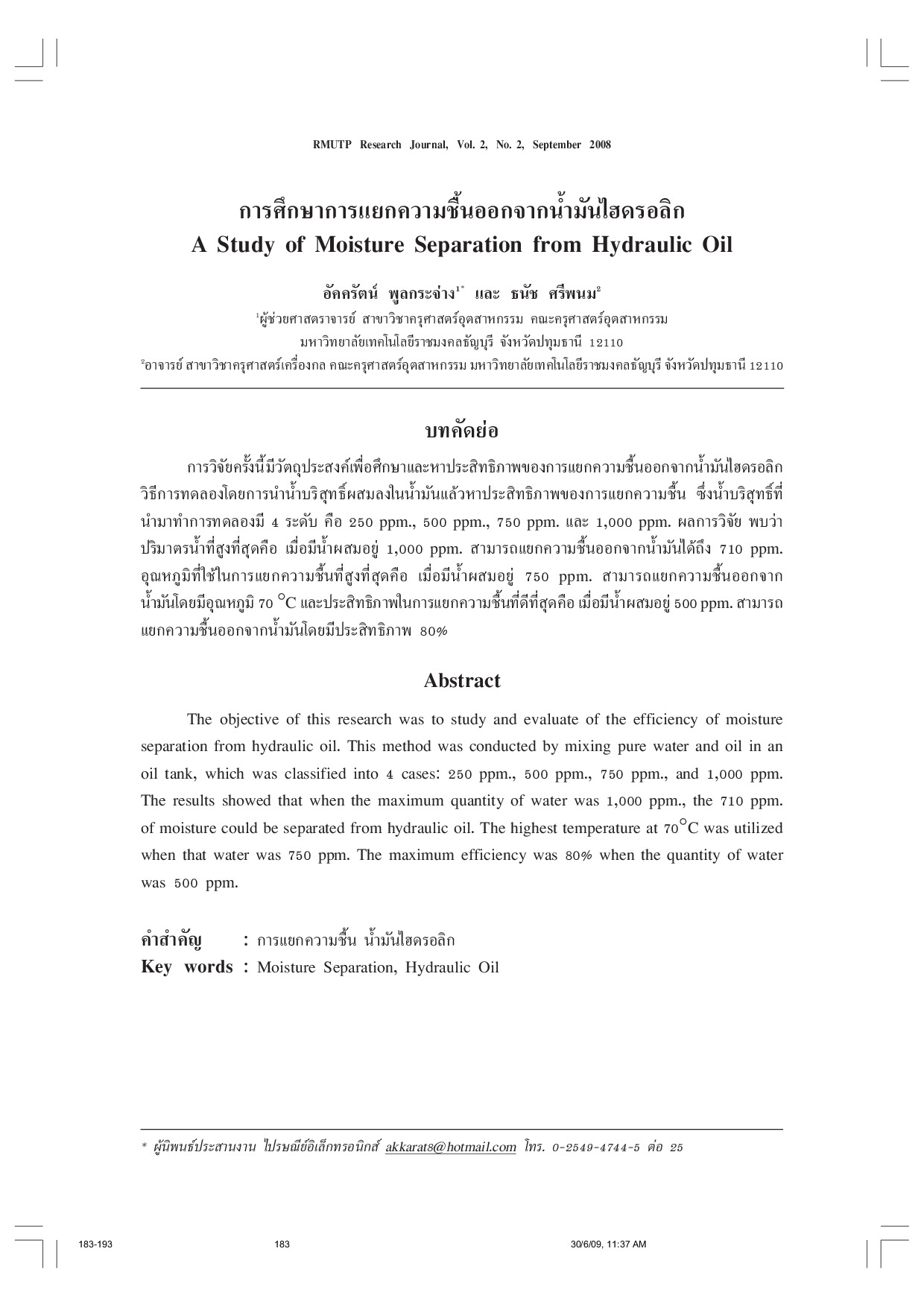
A Study of Moisture Separation from Hydraulic Oil
The objective of this research was to study and evaluate of the efficiency of moisture separation from hydraulic oil. This method was conducted by mixing pure water and oil in an oil tank which was classified into 4 cases: 250 ppm. 500 ppm. 750 ppm. and 1000 ppm. The results showed that when the maximum quantity of water was 1000 ppm. the 710 ppm. of moisture could be separated from hydraulic oil. The highest temperature at 70ฐC was utilized when that water was 750 ppm. The maximum efficiency was 80% when the quantity of water was 500 ppm.
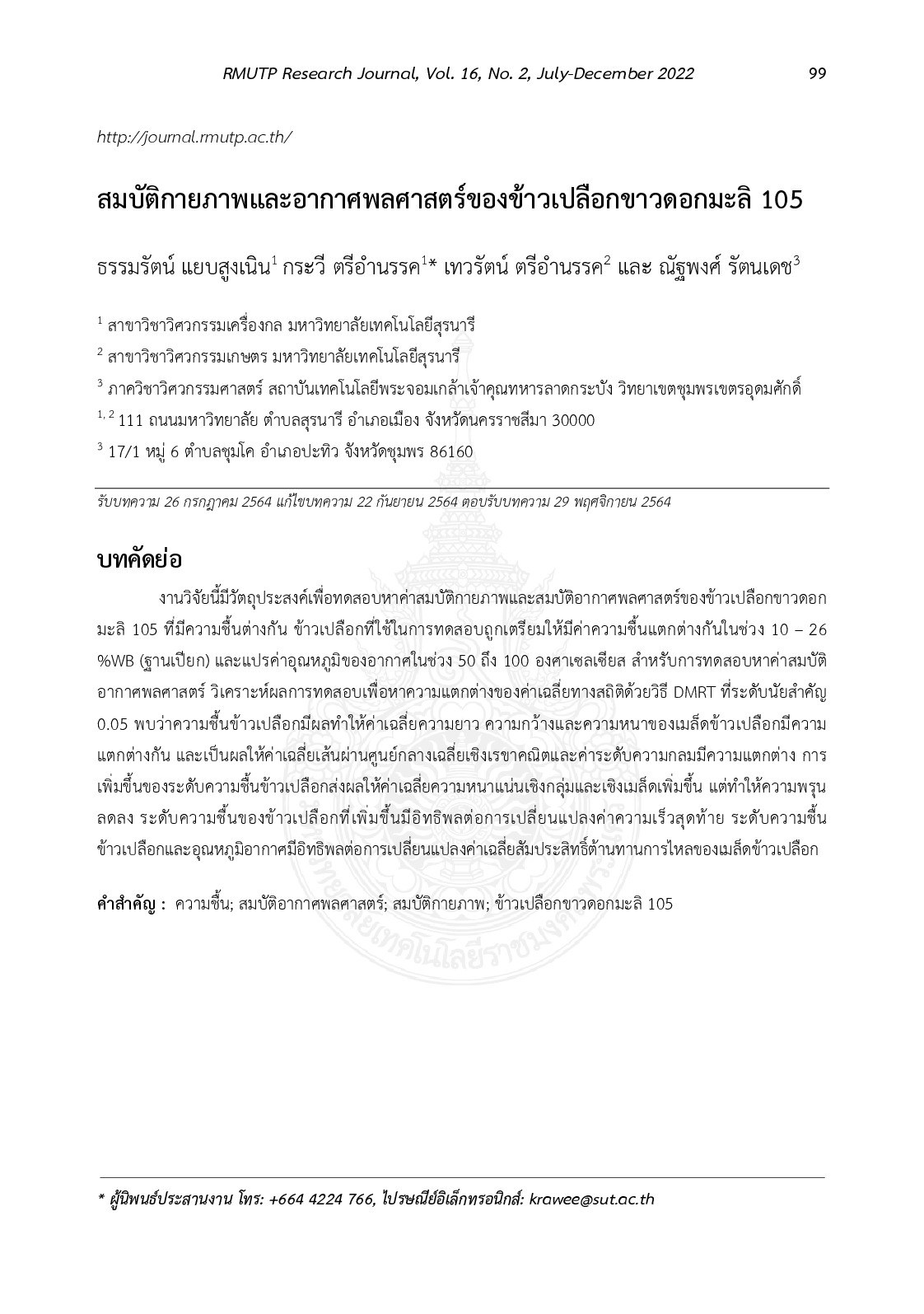
สมบัติกายภาพและอากาศพลศาสตร์ของข้าวเปลือกพันธุ์ขาวดอกมะลิ 105
This research objective was to determine physical and aerodynamics properties of Khao Dawk Mali 105 paddy (Thai Jasmine paddy rice). The paddy sample in this test was prepared with different moisture contents in the range of 10-26%WB and air temperature in aerodynamics properties test was varied in the range of 50–100 OC. Test results were analyzed to determine the statistical mean difference by DMRT method (at P<0.05). It found that moisture content in paddy affects the difference of average length width and thickness of grain and results the difference of geometric mean diameter and degree of sphericity of paddy. An increase in paddy moisture results the increase of average bulk density and kernel density but it reduces the porosity of paddy. Moisture content in paddy affects the difference of terminal velocity. Moisture content in paddy and air temperature influenced the difference of average drag coefficient of paddy.
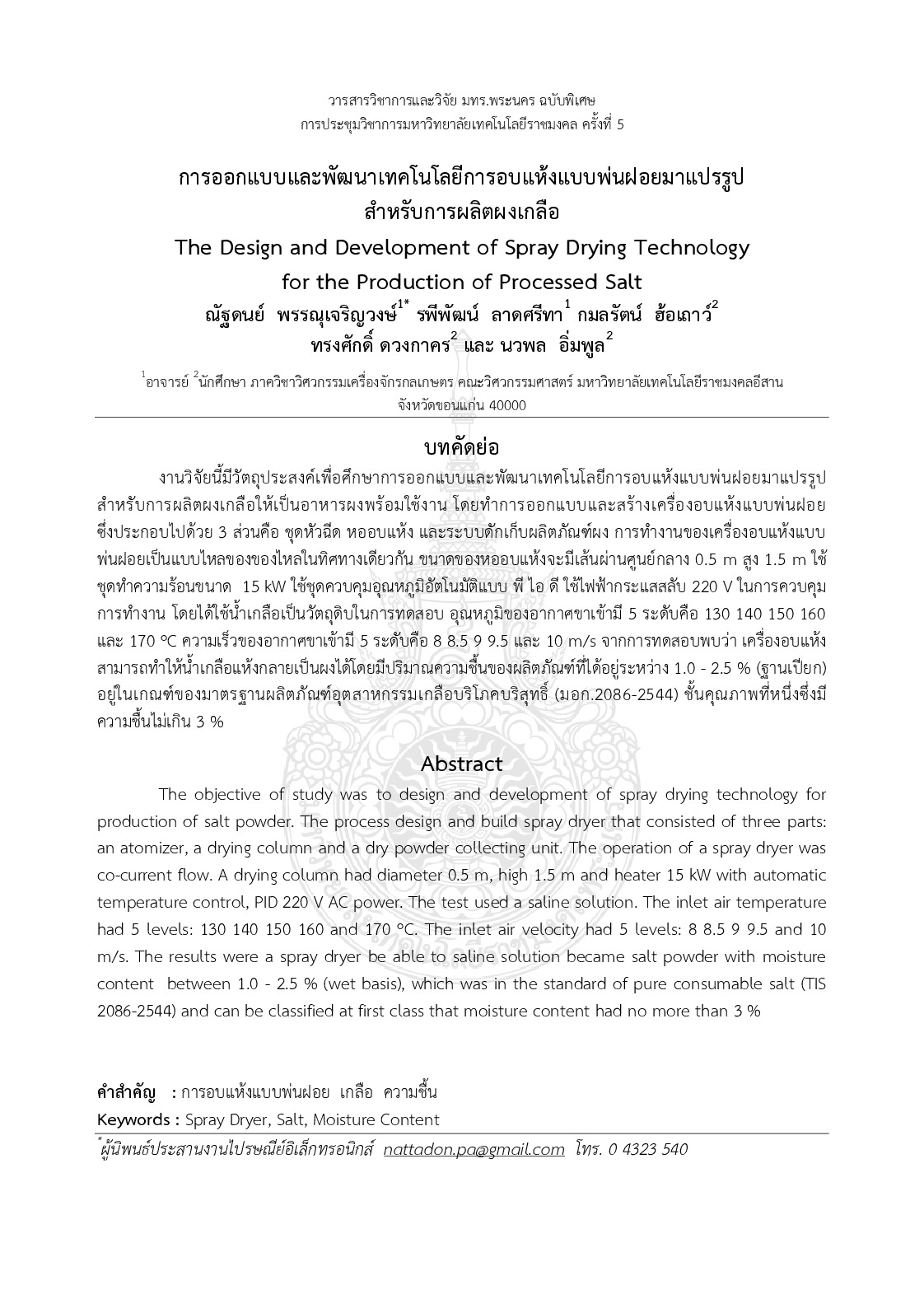
The design and development of spray drying technology for the production of processed salt
The objective of study was to design and development of spray drying technology for production of salt powder. The process design and build spray dryer that consisted of three parts: an atomizer a drying column and a dry powder collecting unit. The operation of a spray dryer was co-current flow. A drying column had diameter 0.5 m high 1.5 m and heater 15 kW with automatic temperature control PID 220 V AC power. The test used a saline solution. The inlet air temperature had 5 levels: 130 140 150 160 and 170 ?C. The inlet air velocity had 5 levels: 8 8.5 9 9.5 and 10 m/s. The results were a spray dryer be able to saline solution became salt powder with moisture content between 1.0 - 2.5 % (wet basis) which was in the standard of pure consumable salt (TIS 2086-2544) and can be classified at first class that moisture content had no more than 3 %