จำนวน Repository ( 16 )

การออกแบบและพัฒนาผลิตภัณฑสิ่งทอด้วยเทคนิคการพิมพ์เส้นด้ายแบบซิลค์สกรีนจากสีธรรมชาติ
The project of design and development of textile product using wrap yarn printing with natural dyes by silk screen technique. The purpose of this study was to find out the silk screen printing technique for patterning on Ikat or Mud Mee textile. Due to the complicated Mud Mee process for patterning the design on Mud Mee textile silk screen printing was chosen because of its convenience and rapidity. Silk screen printed on warp yarn with dyed weft yarn created the plain weave pattern. Pattern design was inspired by the natural form of vortex. Such form was applied with silk screen printing technique with extract of natural dye from jackfruit heartwood. The research showed that the product interested the sample was home textile product by using for bedroom which designed using home textile design principle. Three tone of color were chosen for warp yarn by screen printing technique such as red colour from lac blue colour from natural indigo and yellow colour from jackfruit heartwood . Weft yarn were dyed with lac and natural indigo using cationic agent. The cationic agent using before mordanting along with dying by 5 g/l aluminum potassium sulfate (alum) which is the best result because the outcome colors were intense and bright like vermilion and natural indigo. The color extracted from jackfruit heartwood was used for silk screen printing process. Color extracted from jackfruit heartwoodwas in the form of powder color integrated with 4% sodium alginate. The viscosity was optimize for printing. Printed warp yarn was dried at 120 °C. Weaving in plain weave pattern which created the strength structure of textile. Mordants with alum showed bright and intense color. The fastness tests were at good to excellent level for producing home textile product for bedroom application. From the questionnaire it was found that the satisfaction of the sample were as follows 54% printing fabric by printing of warp yarn is similar to Mud Mee weaving 58% textile made by printed warp yarn showed the identity of Thai color tone using for printing 80% weaving pattern design inspired by the form of vortex was suitable 84 % plain textile was suitable for weaving in the form of vortex 64 % the composition of the whole pattern of the products was suitable 86% the color of the pattern was suitable 70% the color of the weft yarn was suitable with the color of the pattern 76 % the size of the products was fitting and 92 % the products were suitable for the purpose of using.
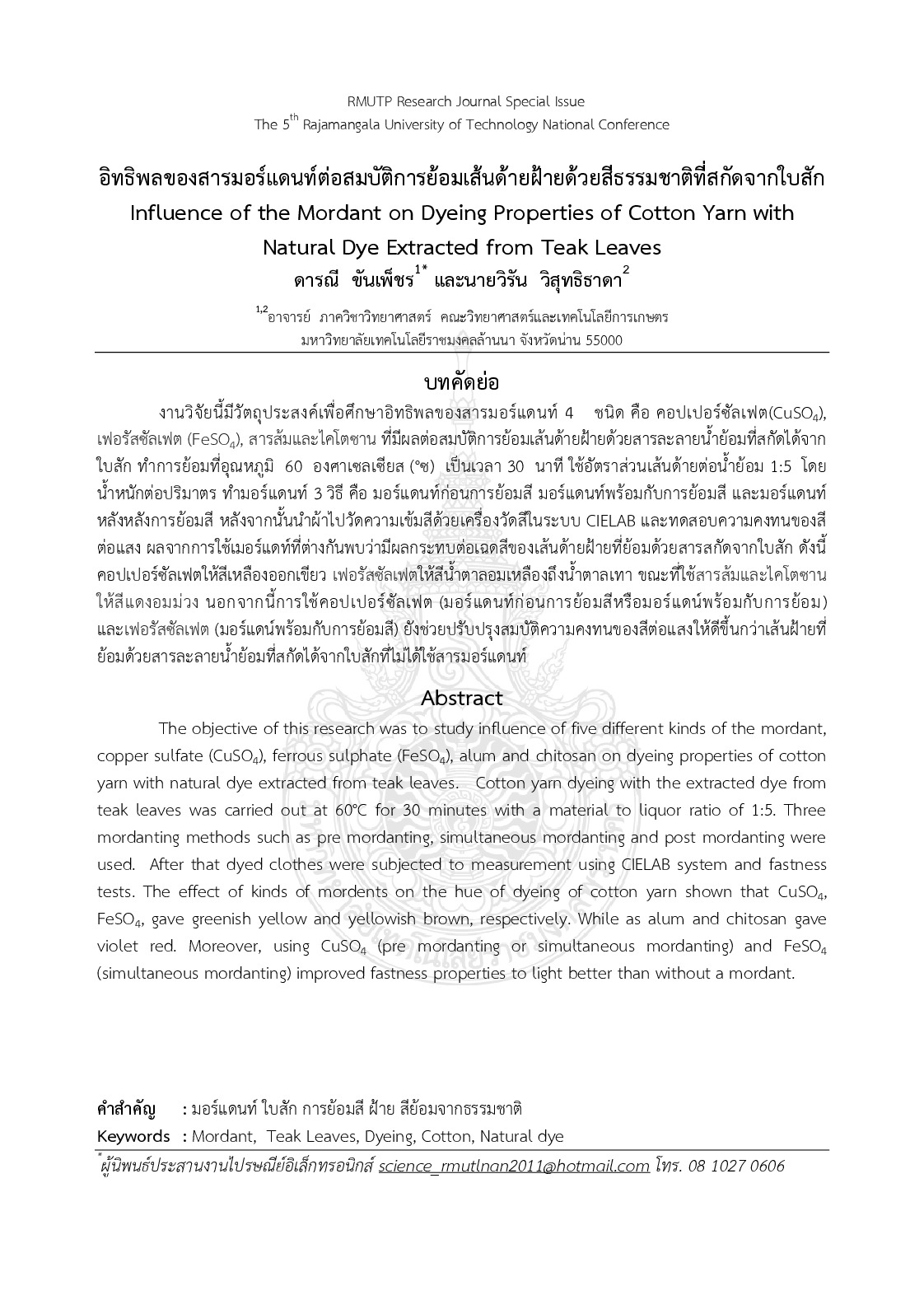
Influence of the mordant on dyeing properties of cotton yarn with natural dye extracted from teak leaves
The objective of this research was to study influence of five different kinds of the mordant copper sulfate (CuSO4) ferrous sulphate (FeSO4) alum and chitosan on dyeing properties of cotton yarn with natural dye extracted from teak leaves. Cotton yarn dyeing with the extracted dye from teak leaves was carried out at 60?C for 30 minutes with a material to liquor ratio of 1:5. Three mordanting methods such as pre mordanting simultaneous mordanting and post mordanting were used. After that dyed clothes were subjected to measurement using CIELAB system and fastness tests. The effect of kinds of mordents on the hue of dyeing of cotton yarn shown that CuSO4 FeSO4 gave greenish yellow and yellowish brown respectively. While as alum and chitosan gave violet red. Moreover using CuSO4 (pre mordanting or simultaneous mordanting) and FeSO4 (simultaneous mordanting) improved fastness properties to light better than without a mordant.
การควบคุมการย้อมสีธรรมชาติและพัฒนาประยุกต์กับลายทอกะเหรี่ยงภายใต้แผนงานวิจัยการจัดการองค์ความรู้ทางสิ่งทอในการพัฒนาและอนุรักษ์ภูมิปัญญาชุมชน กรณีศึกษาผ้าทอกะเหรี่ยง
A research study as Natural Dye Controlled and Applied to Karen Pattern Styles was divided to 2 main studies. The first was natural dye control by varying the condition amount of auxiliaries and mordanting process. The second study was developed and applied the natural shade color to the Karen patterns and using questionnaires as the tool for measure the customer satisfactions level. The results distributed to the target. All the results transferred to the target group at Bann Yang Nam Klad Tai Phetchaburi province. Natural dyed controlling was found the condition was reflect to shade of dye especially the primary condition of natural dye. Almost studied dyes were good using the primary condition as acid condition for Arceanut plam and Butterfly Pea the neutral condition for Sappan tree core of jack fruit tree and Ebony tree. However Curcumin was good dyeing in acid condition whereas the primary condition as neutral. The amount of auxiliary as salt was effect to deep of dye shade. The optimize stage was ranging about 10-20 g/l. Addition the pre mordanting was a good results for this research cause of forming the Chelate ring to bonding between dye and substrate. The natural dye applied into the Karen pattern was shown the modern style pattern and vast application for using and design products. The customer acceptances were good to excellent. The content distributed to the group thus it made a new knowledge occupational and immediately usage.
การพิมพ์สีธรรมชาติจากเปลือกลูกจากแห้ง
The aim of this research is to study white and colour resist printing of dye extracted from dry nipa palm shell. The printing recipes and fixation condition were studied in this work. The result of white resist printing showed that 30 % owp of sodium carbonate (Na2CO3) was used to be a resisting agent. The steam fixation for 15 minutes was suitable to show a good white resist printing in whiteness and sharpness of printing pattern. The whiteness value was 35.05. The washing and rubbing fastness were good to very good and light fastness was fair. The tensile strengths of warp and weft directions were decreased to 10.29 % and 4.25 % respectively. The colour resist printing was using Curcuma longa Linn. powder as illuminant dye. The dye was miscible in 30 % owp of sodium carbonate. The colour resist printing results were corresponding as white resist printing results. The 15 minute of steam fixation showed a good colour resist printing. The Curcuma longa Linn dye could be fixed on silk fabric and showed a good colour strength and sharpness of pattern. The washing and rubbing fastness were good to very good. And light fastness was fair. The tensile strengths of warp and weft directions were decreased to 18.37 % and 4.18 % respectively.
การออกแบบกระเป๋าเก็บความร้อน/เย็น ด้วยผ้าฝ้ายทอมือย้อมสี ธรรมชาติของกลุ่มน้ำมอญแจ้ซ้อน
The purpose of this research was to study the basic needs of hand-woven cotton fabric with natural dyes the Nan Mon Chae Son group in Lampang. The research instruments were interviewing and evaluation form. The sample were 100 people. The statistic of this research was percentage. The findings revealed that there were different kinds of hand-woven cotton fabric with natural dyes such as scarves bedspreads towels tissue boxes hats bags clothes and pieces of cloth. The design of a luggage storage of heat and hand-woven cotton fabric with natural dyes the Nan Mon Chae Son group divided to 5 groups 25 patterns. The design of mother bag was appropriate at 82% the design of children bag was appropriate at 80% The design of lady bag was the most appropriate at 90% the design of health bag was appropriate at 82% the design of travel bag was appropriate at 81%. The recommendation from evaluation group are as follows. It should make a new products (13 evaluator). It should use the leather for bag handles and decoration (3 evaluator) It should develop the light fastness of fabrics which made from hand weave and natural dye. (4 evaluator).