จำนวน Repository ( 15 )
การพัฒนาผลิตภัณฑ์กระเบื้องยางธรรมชาติต้นทุนต่่าที่มีสมบัติต้านทานการลามไฟ และใช้เศษขยะพลาสติกเอทธิลีนไวนิลอะซิเตทความละเอียดสูงเป็นสารเติมแต่ง
This research aims to develop the natural rubber and ethylene vinyl acetate (EVA) plastic floor tile with flame resistance property. The 6 ratios of natural-rubber STR 20: zinc oxide: stearic acid: sulfur: mercaptobenzothiazole: diphenyl guanidine: EVA plastic: antimony trioxide were equal to 100: 5: 2: 3: 0.5: 0.2: 20: 0 100: 5: 2: 3: 0.5: 0.2: 20: 20 100: 5: 2: 3: 0.5: 0.2: 20: 40 100: 5: 2: 3: 0.5: 0.2: 20: 60 100: 5: 2: 3: 0.5: 0.2: 20: 80 and 100: 5: 2: 3: 0.5: 0.2: 20: 100 by weight or phr. The samples are ground by two-roll mill and formed by compression molding at 150 degree Celsius with 30x30x0.2 cm of dimension for 4: 29 to 5: 19 minutes. The properties of the natural-rubber floor tiles were tested under ASTM standard. From the results it was found that the natural rubber and ethylene vinyl acetate plastic floor tile with flame resistance property was the suitable ratio for using as the rubber floor tiles in building and extinguished a fire by themselves. The antimony trioxide effected to increase the density hardness and thermal conductivity and decrease the tensile strength tear strength and wear resistance properties of the natural rubber and EVA plastic floor tiles
การปรับปรุงสมบัติทางกลและความสามารถในการขึ้นรูปของพลาสติกชีวภาพที่ทำมาจากโปรตีนกลูเตนโดยการใช้ยางธรรมชาติ
The aims of this research work were to enhance the impact resistance and processibilty of wheat gluten (WG) by the addition of epoxidized natural rubber (ENR) compared to glycerol. This work was divided into two parts: to study the optimum ENR content for improvement of WG and the effect of together functions between ENR and glycerol on the properties of WG. Tested specimens were mixed and prepared by internal mixer and compression molding machine respectively. ENR and glycerol were varied from 10 to 40 phr. The effects of modifier types and contents on WG were evaluated by tensile impact and water absorption testing and thermal analysis. Fracture behavior and rubber dispersion were investigate with scanning electron microscope (SEM). The result revealed that the increase of ENR or Glycerol contents led to the decreases in tensile modulus and strength except for modifier content of 10 phr whereas elongation at break and impact strength increased. Glass transition temperature (Tg) of modified WG tended to decreased with the increase of ENR or glycerol contents especially for glycerol. The presence of glycerol affected on the decomposition temperature (Td) values but those were unchanged for case of ENR. Water resistant of WG specimen was improved by the presence of ENR whereas the increase of glycerol led to weight loss at immersion time of 2880 min. For the effect of ENR : glycerol ratios it indicated that glycerol enhanced tensile resistances but suppressed impact and water resistances of modified WG by ENR. Sizes and dispersion of ENR particles were improved by the addition of glycerol. Tg and Td values of modified WG by ENR and glycerol increased when ENR fractions were increased.
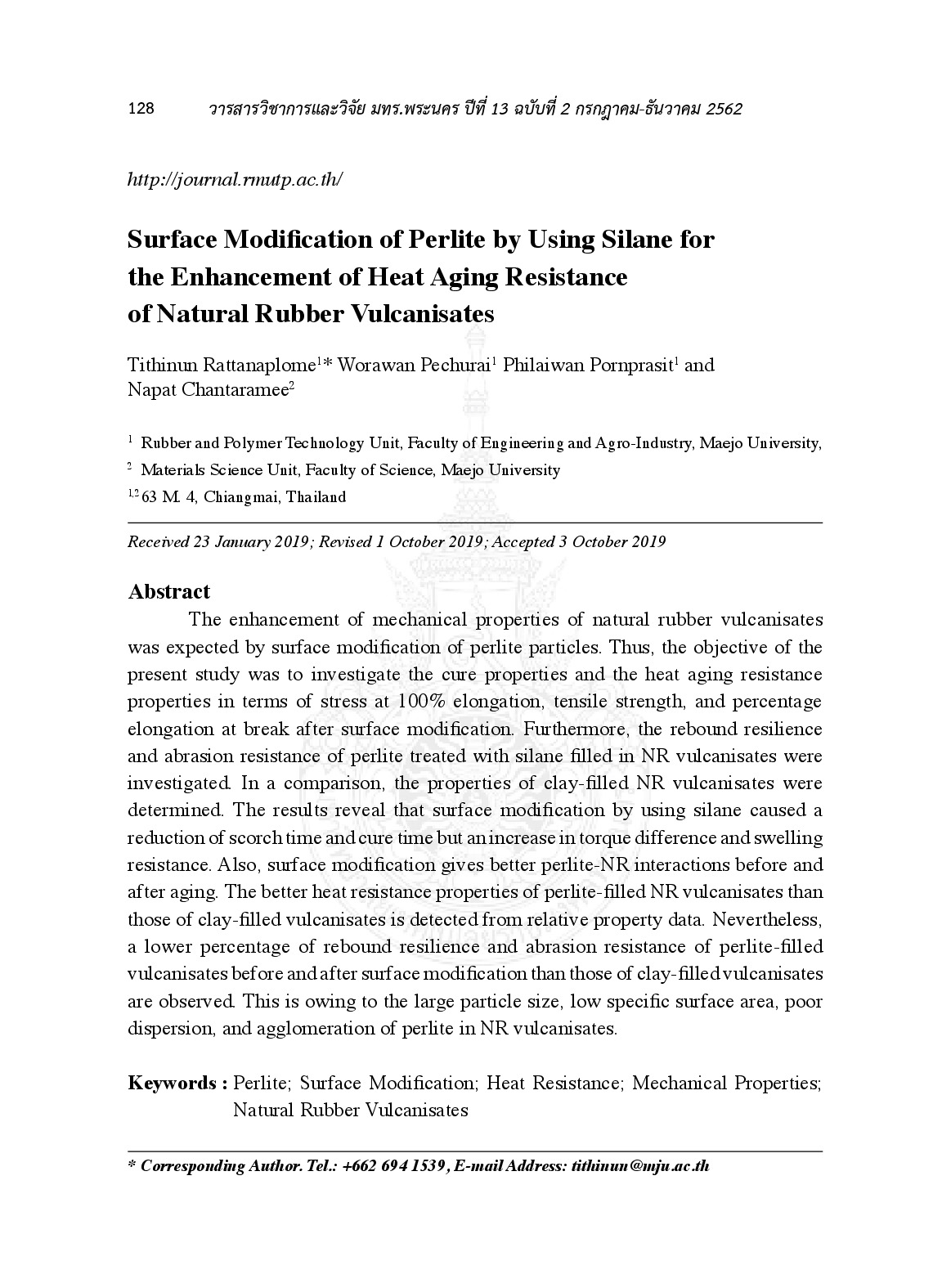
Surface modification of perlite by using silane for the enhancement of heat aging resistance of natural rubber vulcanisates
The enhancement of mechanical properties of natural rubber vulcanisates was expected by surface modification of perlite particles. Thus the objective of the present study was to investigate the cure properties and the heat aging resistance properties in terms of stress at 100% elongation tensile strength and percentage elongation at break after surface modification. Furthermore the rebound resilience and abrasion resistance of perlite treated with silane filled in NR vulcanisates were investigated. In a comparison the properties of clay-filled NR vulcanisates were determined. The results reveal that surface modification by using silane caused a reduction of scorch time and cure time but an increase in torque difference and swelling resistance. Also surface modification gives better perlite-NR interactions before and after aging. The better heat resistance properties of perlite-filled NR vulcanisates than those of clay-filled vulcanisates is detected from relative property data. Nevertheless a lower percentage of rebound resilience and abrasion resistance of perlite-filled vulcanisates before and after surface modification than those of clay-filled vulcanisates are observed. This is owing to the large particle size low specific surface area poor dispersion and agglomeration of perlite in NR vulcanisates.
การศึกษาและพัฒนาวัสดุปูผิวทางแบบแอสฟัลติกคอนกรีตผสมด้วยยางพาราธรรมชาติ
This paper present the engineering properties of asphalt (AC 60/70) modified with different ratios of natural rubber. Then select the best properties of the binder to mix asphaltic concrete. From laboratory testing results with adding 6% natural rubber into mixtures for the best results. The properties of asphaltic concrete can be improved by adding 6% natural rubber. For asphaltic concrete Marshall Stability increased and flow decreased with adding natural rubber into asphalt. Comparing to ordinary asphaltic concrete (AC 60/70) the rutting resistance was increased 22% for natural rubber modified asphalt respectively. Moreover the fatigue resistance of natural rubber modified asphalt improved to be 2.06 times compared to AC 60/70.

การพัฒนาผลิตภัณฑ์กระเบื้องยางธรรมชาติต้นทุนต่ำที่มีสมบัติต้านทานการลามไฟ และใช้เศษขยะพลาสติกเอทธิลีนไวนิลอะซิเตทความละเอียดสูงเป็นสารเติมแต่ง
This research aims to develop the natural-rubber floor tiles mixed with high fineness ethylene vinyl acetate plastic wastes (EVA plastics) from the factories. The study use natural-rubber STR 20 at 100 phr with various contents of EVA plastics (e.g. 0 5 10 20 40 and 80 phr) and then mixed with chemical substance at constant ratio include zinc oxide at 5 phr stearic acid at 2 phr mercaptobenzothiazole at 0.5 phr diphenyl guanidine at 0.2 phr and sulfur at 3 phr. The samples are ground by two-roll mill and formed by compression molding at 150 degree Celsius with 30x30x0.2 cm of dimension. The properties of the natural-rubber floor tiles are tested under ASTM standard. From the results it is found that the natural-rubber floor tiles mixed with 10 phr of EVA plastics is the suitable ratio for using as the rubber floor tiles in building. This ratio can increase the hardness tensile strength and wear resistant properties and decrease the density and thermal insulation properties when compare to the natural-rubber floor tiles without EVA plastic.