จำนวน Repository ( 816 )
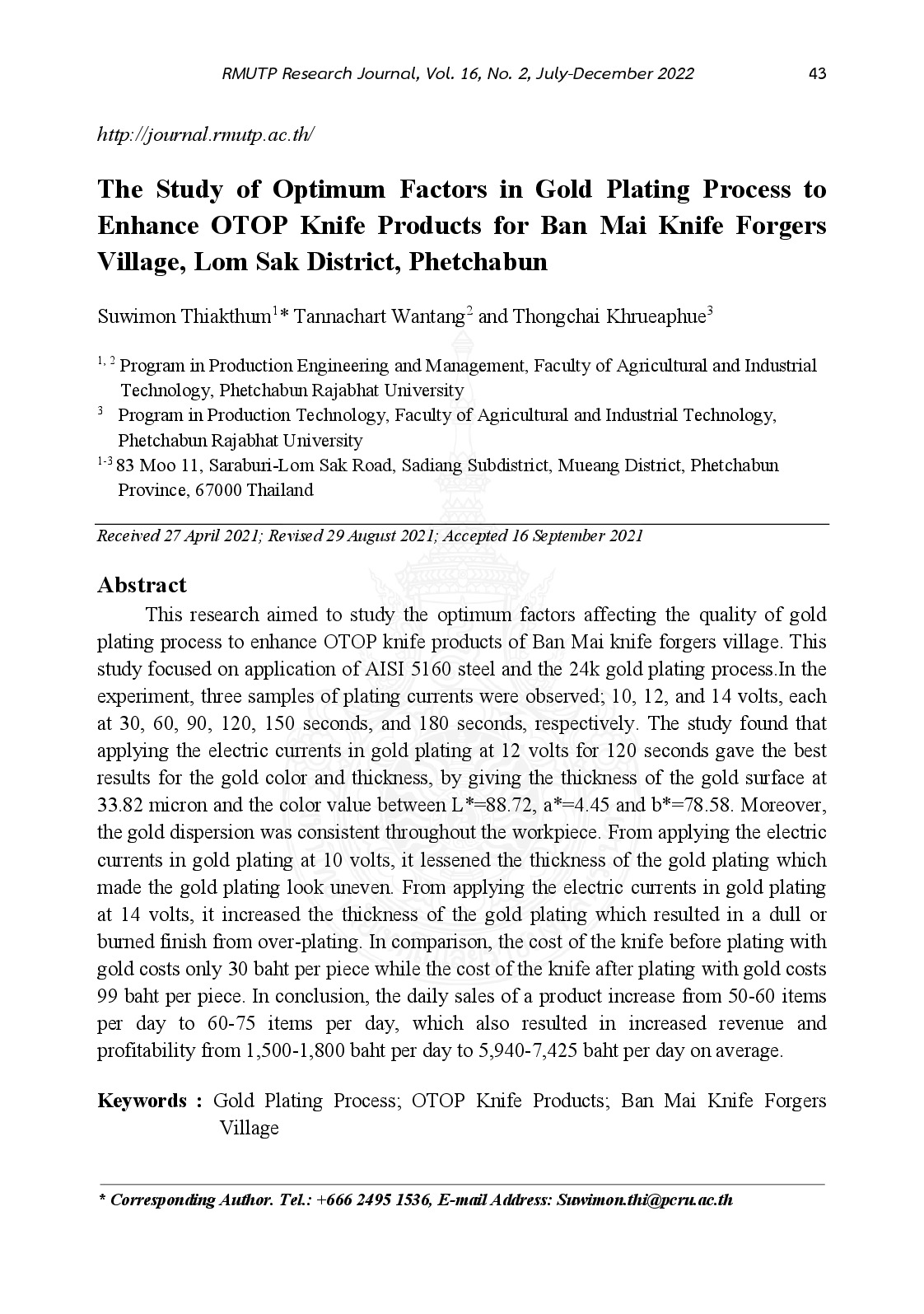
The study of optimum factors in gold plating process to enhance OTOP knife products for ban mai knife forgers village, Lom Sak district, Phetchabun
This research aimed to study the optimum factors affecting the quality of gold plating process to enhance OTOP knife products of Ban Mai knife forgers village. This study focused on application of AISI 5160 steel and the 24k gold plating process.In the experiment three samples of plating currents were observed; 10 12 and 14 volts each at 30 60 90 120 150 seconds and 180 seconds respectively. The study found that applying the electric currents in gold plating at 12 volts for 120 seconds gave the best results for the gold color and thickness by giving the thickness of the gold surface at 33.82 micron and the color value between L*=88.72 a*=4.45 and b*=78.58. Moreover the gold dispersion was consistent throughout the workpiece. From applying the electric currents in gold plating at 10 volts it lessened the thickness of the gold plating which made the gold plating look uneven. From applying the electric currents in gold plating at 14 volts it increased the thickness of the gold plating which resulted in a dull or burned finish from over-plating. In comparison the cost of the knife before plating with gold costs only 30 baht per piece while the cost of the knife after plating with gold costs 99 baht per piece. In conclusion the daily sales of a product increase from 50-60 items per day to 60-75 items per day which also resulted in increased revenue and profitability from 1500-1800 baht per day to 5940-7425 baht per day on average.
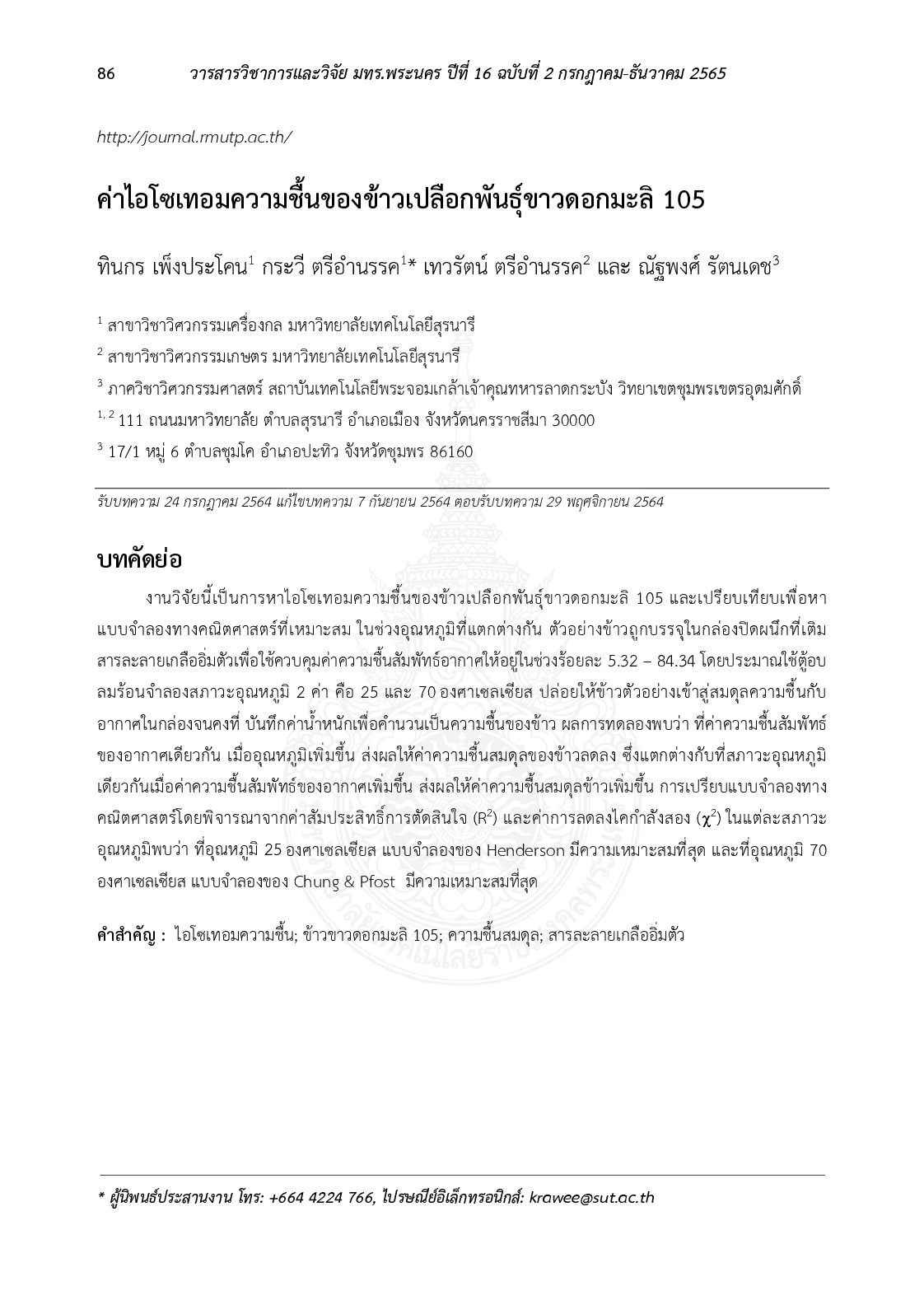
ค่าไอโซเทอมความชื้นของข้าวเปลือกพันธุ์ขาวดอกมะลิ 105
The objectives of this research were the determination of sorption isotherms and the comparison of mathematical models to determine a suitable model in different temperature ranges for Khao Dawk Mali 105. This experiment was made by placing samples in containers which were contained saturated salt solutions to control the humidity in the ranges of 5.32 – 84.34 %RH and the hot air oven was used to provide temperature conditions at 25 and 70 oC. The samples were in containers until the mass of samples was constant so the equilibrium between the samples and the surrounding was reached and then the equilibrium moisture content was determined. The experiment found that for the same relative humidity in the air when the temperature increased the equilibrium moisture content would decrease and for the same temperature in the air when the relative humidity increased the equilibrium moisture content would increase. Furthermore the comparison of models by analysis from R-Squared (R2) and Chi-Square (χ2) in each temperature found that Henderson model was a suitable model at 25 oC and Chung & Pfost was a suitable model at 70 oC.
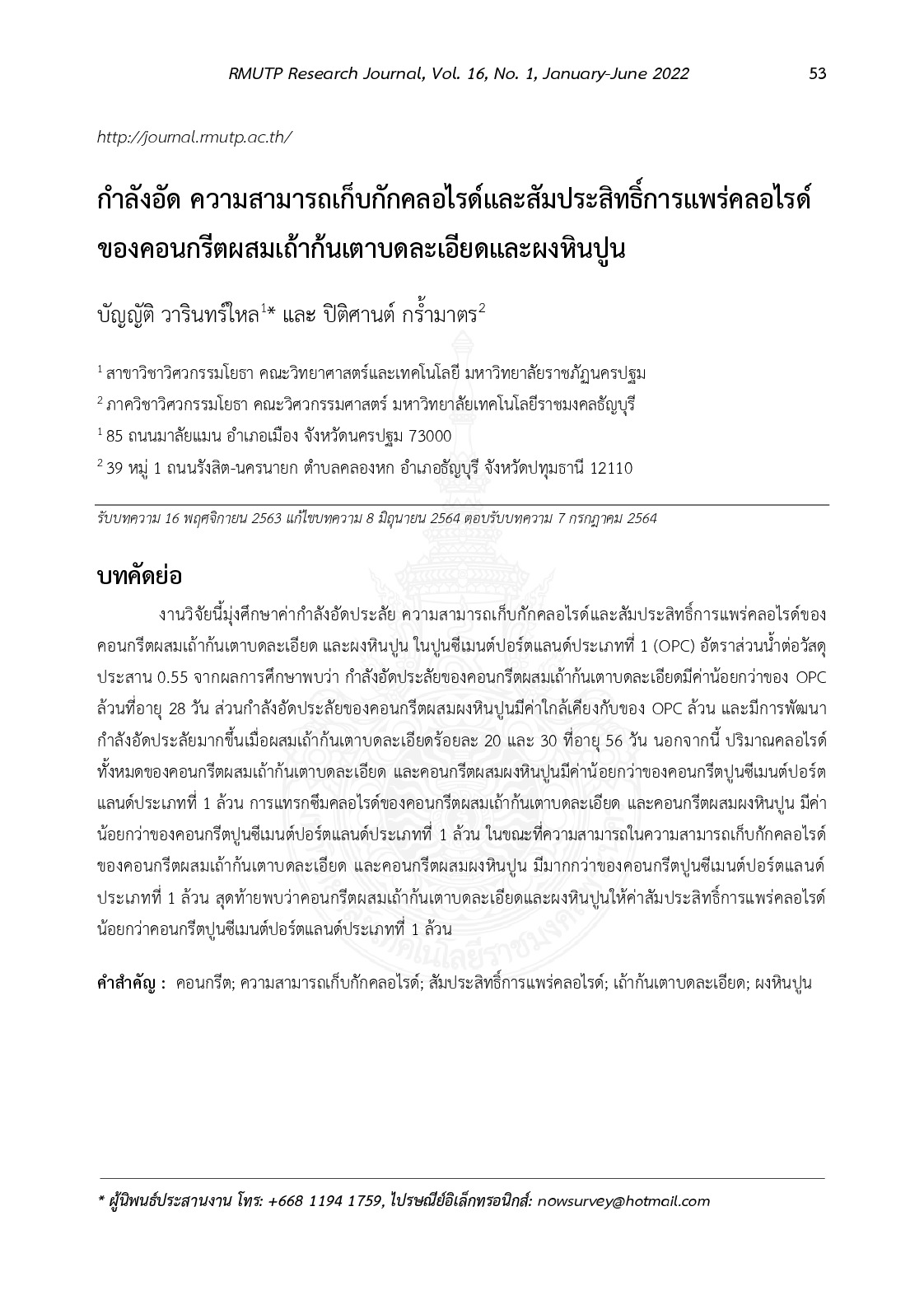
กำลังอัดความสามารถเก็บกักคลอไรด์และสัมประสิทธ์การแพร่คลอไรด์ของคอนกรีตผสมเถ้าก้นเตาบดละเอียดและผงหินปูน
This research was aimed to study the compressive strength chloride binding capacity and chloride diffusion coefficient of concrete replaced by ground bottom ash (GBA) and limestone powder in ordinary Portland cement (OPC). The water to binder ratios were 0.55. The results showed that the compressive strength of concrete with GBA was lesser than that of OPC concrete at 28 days. Also the compressive strength of concrete with limestone powder was close to that of OPC concrete and compressive strength could develop of concrete with GBA 20% and 30% higher than that of OPC concrete at 56 days. Moreover the total chloride of the concrete containing GBA and limestone powder was less than that of OPC concrete. The chloride penetration of the concrete containing GBA and limestone powder was less than that of OPC concrete. The chloride binding capacity of the concrete made with ground bottom ash and limestone powder were higher than that of OPC concrete. Finally the chloride diffusion coefficient of the concrete containing GBA and limestone powder was less than that of OPC concrete.
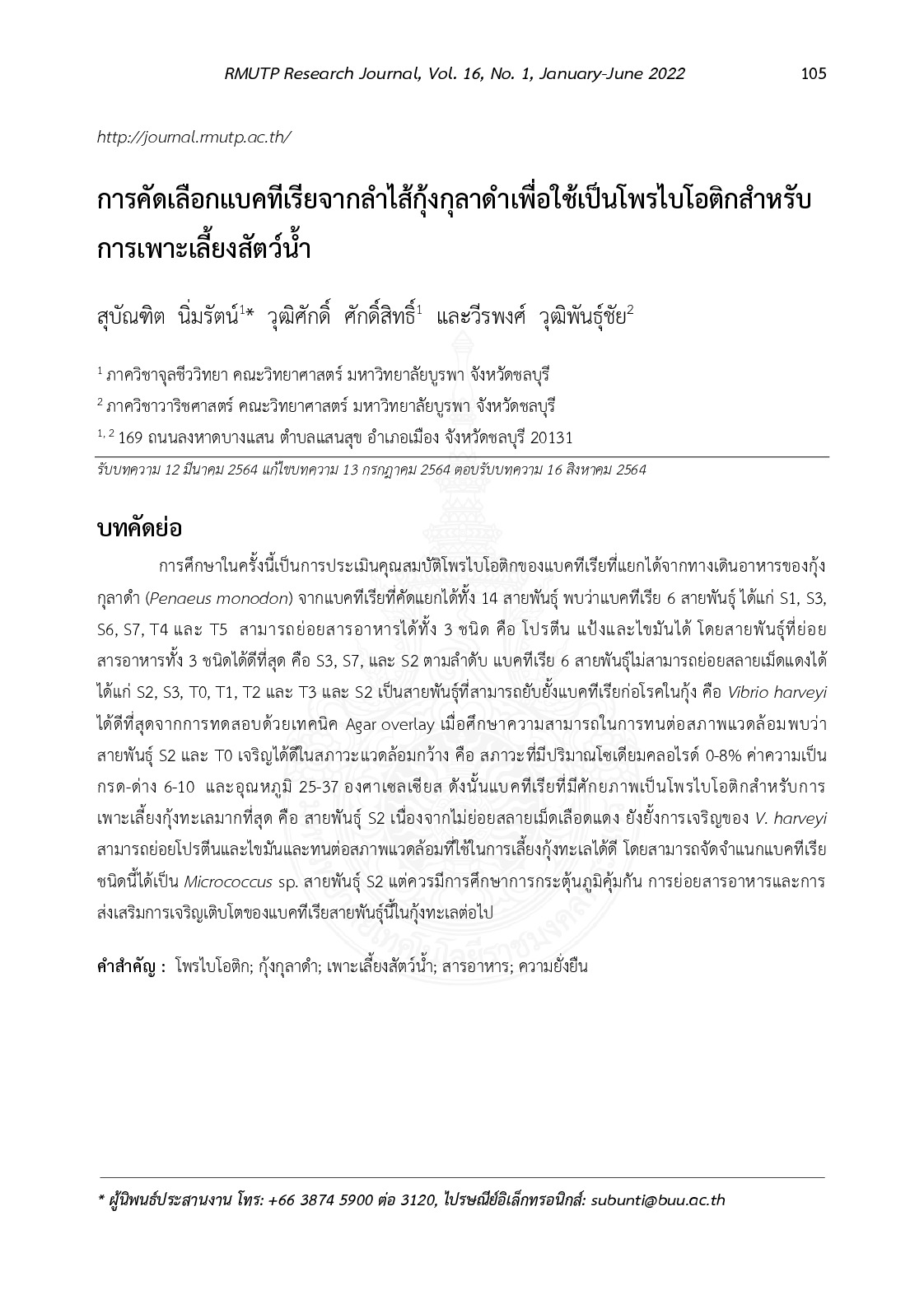
การคัดเลือกแบคทีเรียจากลำไส้กุ้งกุลาดำเพื่อใช้เป็นโพรไบโอติกสำหรับการเพาะเลี้ยงสัตว์น้ำ
In this study 14 bacterial strains isolated from gastrointestinal tract of black tiger shrimp (Penaeus monodon) was investigated for their probiotic potential. The results showed that 6 strains namely S1 S3 S6 S7 T4 and T5 were able to degrade 3 nutrient substances including protein starch and lipid among which S3 S7 and S2 were the best tested nutrient-degrading bacteria respectively. Six bacterial strains were unable to lyse red blood cells including S2 S3 T0 T1 T2 and T3. S2 strain showed the strongest antibacterial activity against shrimp pathogenic Vibrio harveyi following an agar overlay technique. Based on environmental tolerance tests S2 and T0 strains grew well under wide ranges of environmental conditions e.g. sodium chloride concentration (0-8%) pH (6-10) and temperature (25-37C). As a consequence S2 strain had the most probiotic potential for shrimp culture owing to no hemolysis of red blood cells inhibition of V. harveyi growth protein and lipid degrading ability and high environmental tolerance for shrimp cultivation. The strain was identified as Micrococcus sp. S2. However additional study focused on immune response nutrient digestibility and growth promotion of the strain should be further performed in marine shrimp.
การเปรียบเทียบภาระขาดของรอยเชื่อมผ้าทอทางสถาปัตยกรรมจากการเชื่อมลมร้อนและเหนี่ยวนำ
Architectural fabrics were continuously developed on their unique performance. Architects and Engineers designed them for the application of important buildings around the world despite the symptom that Architectural fabric sizes from manufactures are smaller than the application sizes. Recently although the well-known method used to weld Architectural fabrics to enlarge their size is the high frequency welding there were some application issues. To mitigate those issues the researcher created the hot air welding to replace the high frequency welding in consideration on the failing loads of welded seams which are variable factors of the failing loads to indicate the weld strength and it is crucial for the Architectural fabric application. This research presents the comparison of failing load of weld seams between the hot air welding and high frequency welding by the test of Taguchis Orthogonal arrays L25 method. The test results demonstrated that Architectural fabrics welded by the hot air welding has the highest failing loads of wrap equal to 95.38 kN/m and the highest failing loads of weft at 86.17 kN/m. Conversely Architectural fabrics welded by the high frequency welding has the highest failing loads of wrap equal to 101.37 kN/m and the highest failing loads of weft at 97.78 kN/m. Based on a forementioned results there is no significant difference from both welding methods and thus concluded that the hot air welding could be used to replace the high frequency welding method.