จำนวน Repository ( 15 )

การศึกษาปริมาณเส้นใยมิวซิเลจจากเมล็ดแมงลักทดแทนไข่ไก่ในผลิตภัณฑ์คัสตาร์ดครีม
The study of Mucilage Fiber amount from Ocimum Basilicum or Hairy Basil Seed which is used instead of egg in custard cream product in order to study basic formula and production process for custard cream product which made from Mucilage Fiber of Hairy Basil Seed instead of egg. In addition to study end life cycle of Mucilage Fiber in the custard cream. Beginning with appropriate basic formula study and production process of custard cream product found that formula test no.3 got the number 1 ranking which got vote from most of tester. Meanwhile the suitable amount of Mucilage Fiber from Hairy Basil Seed in the custard cream product which there’re 3 level included 10 15 and 20 (gram) so the resulting that almost tester vote 20 gram is best composition of Mucilage Fiber amont. Furthermore we can get smooth and soft custard cream which found when pressing cream on the top bread. After that comparing the basic custard cream from egg found the cream from Mucilage Fiber of Hairy Basil Seed have a total amount of protein and Ash lower than 1.58 and 1.12 respectively basic custard cream from egg and also humidity value more than 1.02 the custard cream which made from egg. The analysis of microbe found that total of microbe which not over standard can maintain 4 days in polypropylene plastic bottle (closed conditon) so 99% of customer feedback and accept “Custard Cream from Mucilage Fiber of Hairy Basil Seed”
The optimization of formulation and cost on homemade dairy yogurt
The objective of this study was investigate the optimal formulation of Homemade dairy yogurt that 100 percent of dairy milk ratio of dairy milk to skim milk powder and milk powder was 90:10 85:15 and 80:20 respectively as compared to the control (commercial-yogurt Dutch mill). The Yogurt mixeds were heated to 85 C and held for 5 min incubated at 43 C until the pH reached 4.3. The mixes were then stored at 4 C. Yogurt were prepared from higher ratio of dairy milk : skim milk powder and milk powder led to the more time of incubation. The 31 participated sensory evaluation of the sample. From the result choosed first three formulas to analysed in chemical characteristic and bacterial chariacteristic. Total solid of yogurt were prepare from 90:10 and 85:15 of dairy milk : milk powder ratio were not different with control (p>0.05). Total cell count was found to range between 8.08 – 8.50 LogCFU/g and Lactic acid bacteria was found to range between 6.71 – 8.88 LogCFU/g. The optimum formula of homemade dairy yogurt that ratio of dairy milk to milk powder was 90 : 10 and cost per unit (140 g.) was 10.51 Baht compare with control was 14 Baht.
Optimization for sewing machine setup using experimental design technique
The objective of the research was to identify the optimized thread tensile values for the setup of Model D – We 1218-55 computerized 18-needles sewing machine in order to minimize a number of times the machine halts. The cause of the sewing machine halting which reduced the efficiencies of the machine was found to be torn threads. In order to maximize the efficiencies the experimental design technique was utilized to find the optimal values for five types of cloth: polo tc-cool cotton jacket and shirt. The method involved three nested designs which are the type of thread number of sewing layers and thread-hole size. The three thread tensile levels experimented were low (2 oz.) medium (5 oz.) and high (8 oz.) and the response was the number of times the machine halted in the span of 30 minutes. The ANOVA (Analysis of Variance) used for the experimental design showed that the three factors significantly affected the machine’s halt. The number of times the machine halted was used to create Surface Plot with polynomial trend-lines and the quadratic equation was applied to determine the optimal value for each type of thread number of sewing layers and thread-hole size. The values obtained were then set for another experiment the results of which were that the sewing machine halted less frequently and the efficiencies thus increased about by 77.01%.
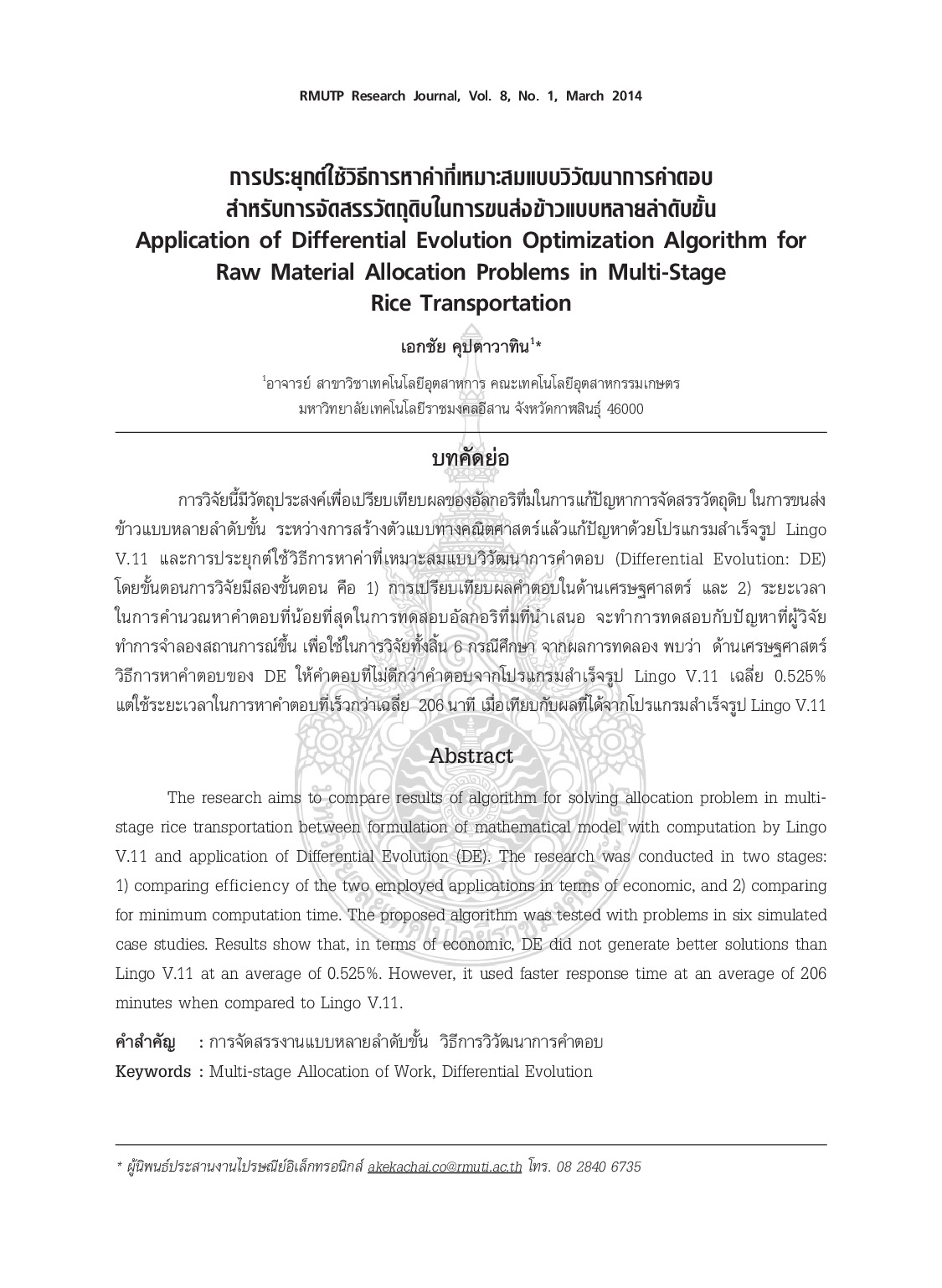
Application of differential evolution optimization algorithm for raw material allocation problems in multi-stage rice transportation
The research aims to compare results of algorithm for solving allocation problem in multi-stage rice transportation between formulation of mathematical model with computation by Lingo V.11 and application of Differential Evolution (DE). The research was conducted in two stages: 1) comparing efficiency of the two employed applications in terms of economic and 2) comparing for minimum computation time. The proposed algorithm was tested with problems in six simulated case studies. Results show that in terms of economic DE did not generate better solutions than Lingo V.11 at an average of 0.525%. However it used faster response time at an average of 206 minutes when compared to Lingo V.11.
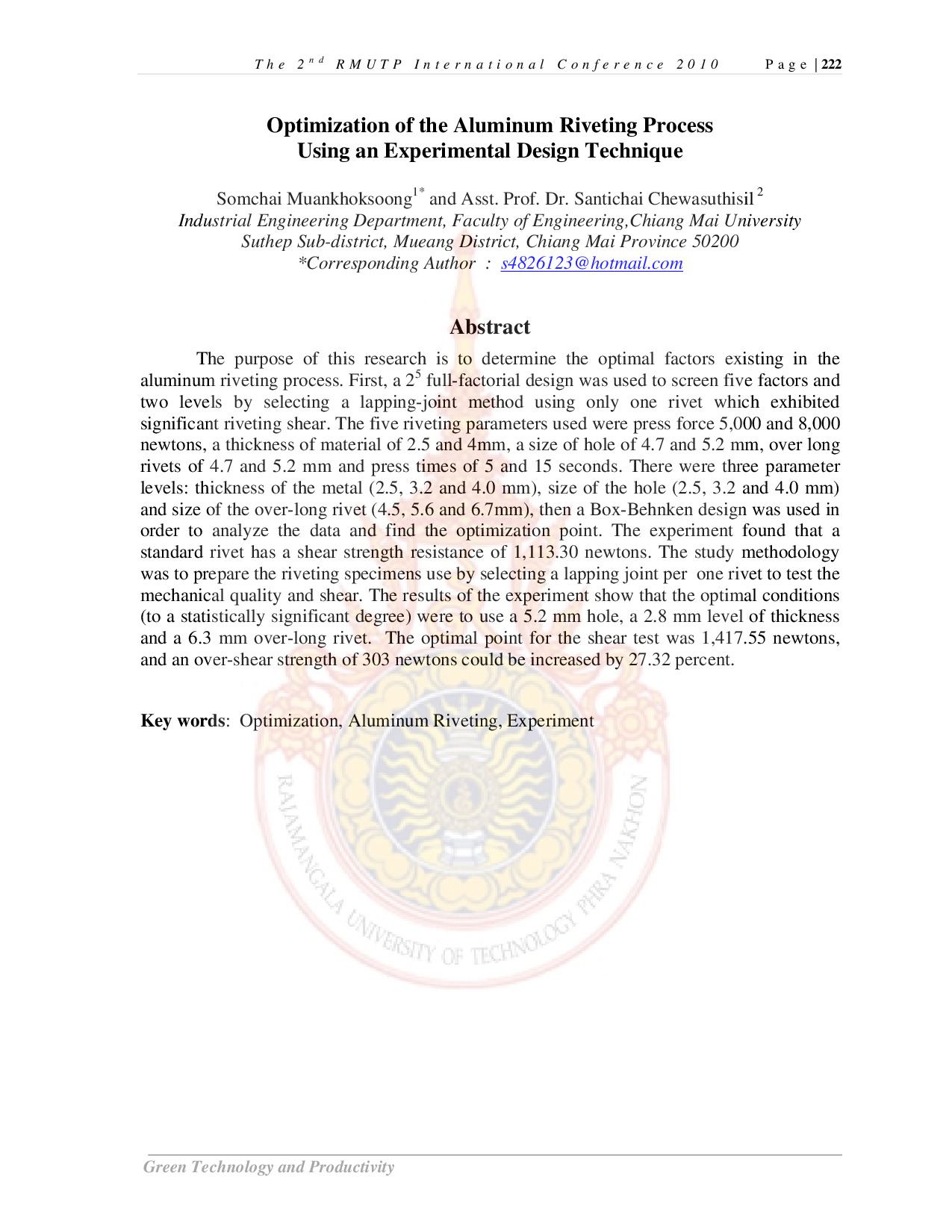
Optimization of the Aluminum Riveting Process Using an Experimental Design Technique
The purpose of this research is to determine the optimal factors existing in the aluminum riveting process. First a 25 full-factorial design was used to screen five factors and two levels by selecting a lapping-joint method using only one rivet which exhibited significant riveting shear. The five riveting parameters used were press force 5000 and 8000 newtons a thickness of material of 2.5 and 4mm a size of hole of 4.7 and 5.2 mm over long rivets of 4.7 and 5.2 mm and press times of 5 and 15 seconds. There were three parameter levels: thickness of the metal (2.5 3.2 and 4.0 mm) size of the hole (2.5 3.2 and 4.0 mm) and size of the over-long rivet (4.5 5.6 and 6.7mm) then a Box-Behnken design was used in order to analyze the data and find the optimization point. The experiment found that a standard rivet has a shear strength resistance of 1113.30 newtons. The study methodology was to prepare the riveting specimens use by selecting a lapping joint per one rivet to test the mechanical quality and shear. The results of the experiment show that the optimal conditions (to a statistically significant degree) were to use a 5.2 mm hole a 2.8 mm level of thickness and a 6.3 mm over-long rivet. The optimal point for the shear test was 1417.55 newtons and an over-shear strength of 303 newtons could be increased by 27.32 percent.