จำนวน Repository ( 9 )
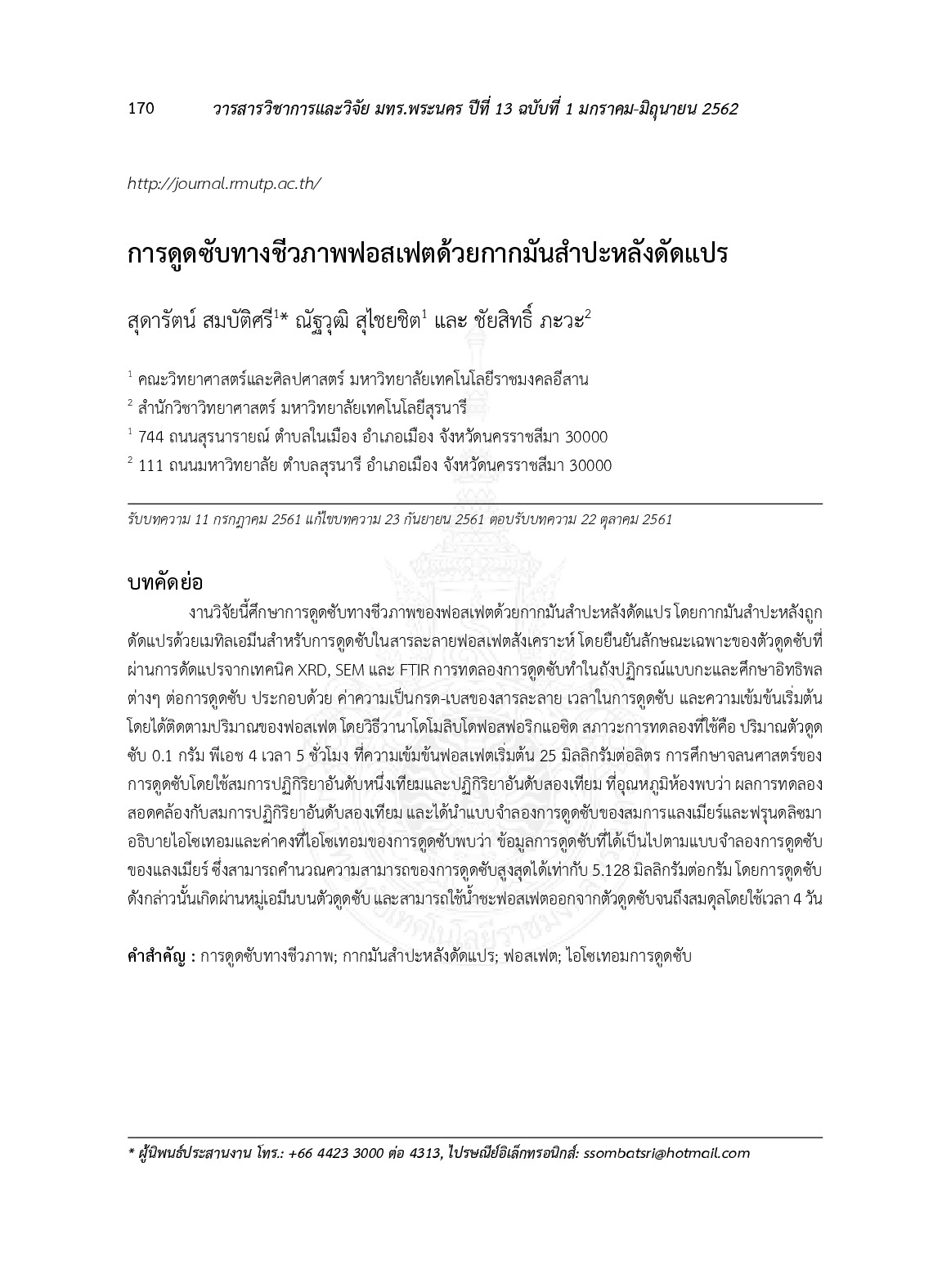
การดูดซับทางชีวภาพฟอสเฟตด้วยกากมันสำปะหลังดัดแปร
The biosorption of phosphate using modified cassava waste were studied. Cassava pulp was modified in methylamine for the adsorption of phosphate ion in aqueous solution. XRD SEM and FTIR result confirmed the surface modification of modified cassava waste. The adsorption experiments were conducted in a batch reactor. The studied parameters included pH contact time and initial concentrations. The amount of phosphate in the solution was measured by Vanadomolybdophosphoric acid method. Optimum conditions of adsorption were 0.10 g of modified cassava waste pH 4 and 5 hour of contact time at 25 mg/L of initial phosphate concentration. Kinetic of adsorption were studied by using the pseudo-first and pseudo-secondorder models at room temperature. The results indicated that the pseudo-second-order model best described adsorption kinetic data. The Langmuir and Freundlich adsorption models were applied to describe the isotherms and isotherm constants. The adsorption of modified cassava fitted well with the Langmuir model and the maximum adsorption capacity of 5.128 mg/g; and the active site of adsorption was amine functional group. Phosphate released in water reach equilibrium within 4 days.

การบำบัดฟอสเฟตจากน้ำเสียด้วยวัสดุกรองร่วมกับเปลือกหอย
The objective of this research was to study the treatment of Phosphate from wastewater by filter material with shells. Various parameters include pH temperature turbidity DO nitride ammonium and phosphate were investigated and compared before and after filler wastewater. The results show that the quality of wastewater after treatment enhancing with adding filter material with shells. The optimum ratio treatment of phosphate is resulting in maximum values was around 0.05 mg/liter (50% compare with wastewater before treatment) with formula no. 3 that not have time to filler. Moreover the results demonstrated the treatment of Phosphate from wastewater by filter material with shells can be improvement the value of turbidity nitride ammonia and DO for wastewater.
การเตรียมและการวิเคราะห์แก้วและแก้วเซรามิกชีวภาพจากระบบแคลเซียมโซเดียมฟอสเฟต
The aim of this work was to study the magnetic properties of magnetic glassceramics with composition system CaO-Na2O-P2O5-BaO-Fe2O3. The magnetic glass– ceramics were prepared by conventional melting at 1300oC for 2 h of the coprecipitation derived starting products and heat treated at different temperatures. The structure and microstructure of the samples were characterized by X-ray diffraction energy dispersive X-ray analysis (EDXA) and scanning electron microscopy. The magnetic measurement showed that the samples which contained barium ferrite exhibited magnetic behavior which is similar to soft magnetic materials. Finally the samples were soaked in simulated body fluid (SBF) for 14 days. The apatite was found to form on the surface layer of glass-ceramics and it increases with the barium ferrite content was increased.
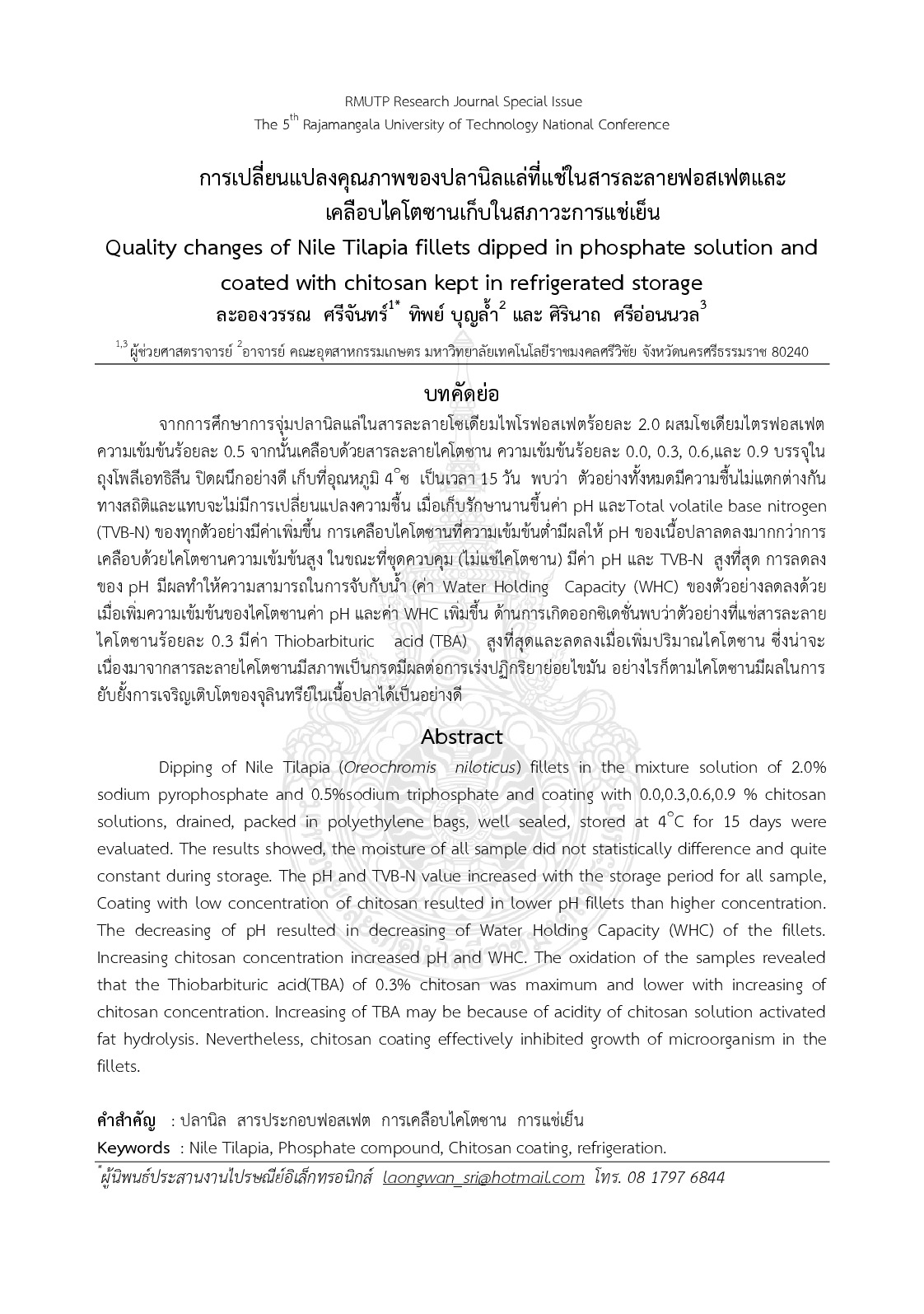
Quality changes of nile tilapia fillets dipped in phosphate solution and coated with chitosan kept in refrigerated storage
Dipping of Nile Tilapia (Oreochromis niloticus) fillets in the mixture solution of 2.0% sodium pyrophosphate and 0.5%sodium triphosphate and coating with 0.00.30.60.9 % chitosan solutions drained packed in polyethylene bags well sealed stored at 4๐C for 15 days were evaluated. The results showed the moisture of all sample did not statistically difference and quite constant during storage. The pH and TVB-N value increased with the storage period for all sample Coating with low concentration of chitosan resulted in lower pH fillets than higher concentration. The decreasing of pH resulted in decreasing of Water Holding Capacity (WHC) of the fillets. Increasing chitosan concentration increased pH and WHC. The oxidation of the samples revealed that the Thiobarbituric acid(TBA) of 0.3% chitosan was maximum and lower with increasing of chitosan concentration. Increasing of TBA may be because of acidity of chitosan solution activated fat hydrolysis. Nevertheless chitosan coating effectively inhibited growth of microorganism in the fillets.