จำนวน Repository ( 10 )

การศึกษาประสิทธิภาพการใช้งานระบบบริหารงานบุคคล มหาวิทยาลัยเทคโนโลยีราชมงคลพระนคร
The first purpose of this research is to study the using of personnel management system of Rajamagala University of Technology Phranakhon. Secondly the satisfaction in system using is suggested. The investigation and gathering information from university workers are done by questionnaire of satisfaction. The information is evaluated by using frequency percentage mean and standard deviation term. The reliability of two samples is tested by t-test using Alpha Coefficient of Cronbach and the reliability of more than two samples is tested by One Way Analysis of Variance. The results showed that the efficiency of using the personnel management system is the same as the system which is used in division of personnel management administration and division of general administration. The setting manual and log out of system which used in sub-system of each role are consistent with research hypothesis. The analysis of satisfaction of all workers between sexes (male and female) and between duties (support and academic staff) showed that the satisfaction in personnel management system is at high level. The university plan to develop the system continuously to face the changing and the present.
การพิมพ์สีธรรมชาติจากเปลือกลูกจากแห้ง
The aim of this research is to study white and colour resist printing of dye extracted from dry nipa palm shell. The printing recipes and fixation condition were studied in this work. The result of white resist printing showed that 30 % owp of sodium carbonate (Na2CO3) was used to be a resisting agent. The steam fixation for 15 minutes was suitable to show a good white resist printing in whiteness and sharpness of printing pattern. The whiteness value was 35.05. The washing and rubbing fastness were good to very good and light fastness was fair. The tensile strengths of warp and weft directions were decreased to 10.29 % and 4.25 % respectively. The colour resist printing was using Curcuma longa Linn. powder as illuminant dye. The dye was miscible in 30 % owp of sodium carbonate. The colour resist printing results were corresponding as white resist printing results. The 15 minute of steam fixation showed a good colour resist printing. The Curcuma longa Linn dye could be fixed on silk fabric and showed a good colour strength and sharpness of pattern. The washing and rubbing fastness were good to very good. And light fastness was fair. The tensile strengths of warp and weft directions were decreased to 18.37 % and 4.18 % respectively.
การลอกกาวไหมด้วยยางมะละกอ
Degumming process is a fundamental process for silk yam and silk fabric finishing. The main objective is scouring the substrate such as silk gum (sericin) wax and fatty acid from silk fiber. The principle of degumming process is destroying the peptide linkage of amino acid in sericin structure into a small molecule which is soluble in water. The hydrolysis reaction performed by acid alkaline enzyme surfactant as soap and high pressure steam process. The conventional methods favor degumming with soap and sodium carbonate. This process has a problem on the surface area of silk. Proteolytic enzymes can answer this problem but it seldom use because of a specific condition and high cost. For this reason the insteading of papain enzyme from dry latex of Carica payapa Linn. was decided to use for silk degumming at any condition study. This research was concerned with the silk degumming using papain enzyme form dry latex of Carica payapa Linn. The degumming process was performed at the temperature vary from 55 -85 degree Celsius time fromlO to 40 minutes and the amount of dry latex ranging from 0 to 4% owf in order to study the suitable condition for degumming and surface morphology. The efficiency of degumming process was evaluated by determination of tensile strength and stainiqgJest with dire~~ dyes (C.1. Direct Red 80~StaIDing result.will be opposed to degumming efficiency. The result was revealed; the appropriate conditions for silk degumming with dry Carica payapa Linn. s latex were recommended as follows : the amount of dry latex solution of 4 % owf at 75 degree Celsius for 30 minutes. The degummed fibers leaves lustrous soft and surface smooth. This condition does not have effect to tensile strength and fiber surface.
Causticization and Anticrease finish in Continuous Process
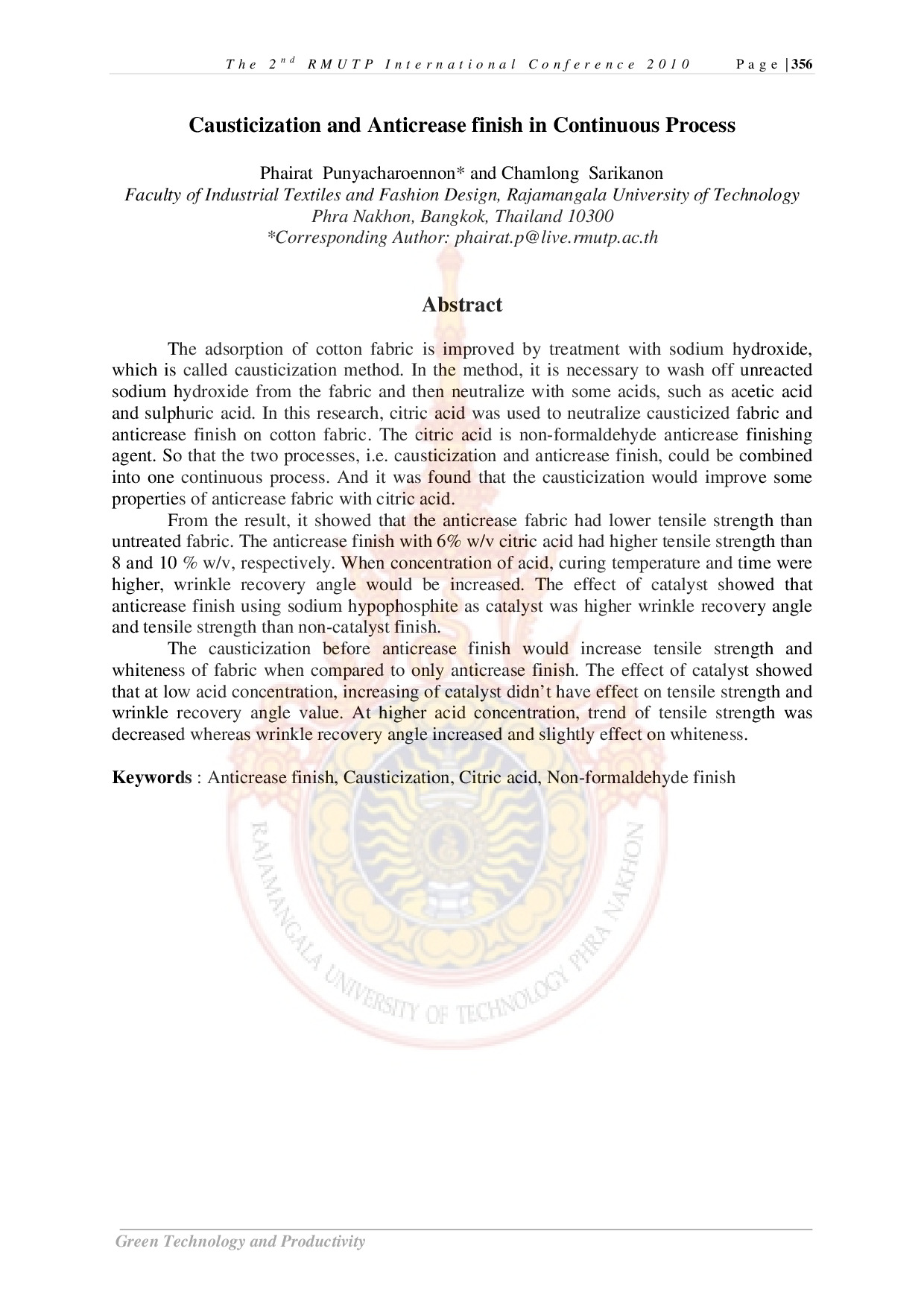
The adsorption of cotton fabric is improved by treatment with sodium hydroxide which is called causticization method. In the method it is necessary to wash off unreacted sodium hydroxide from the fabric and then neutralize with some acids such as acetic acid and sulphuric acid. In this research citric acid was used to neutralize causticized fabric and anticrease finish on cotton fabric. The citric acid is non-formaldehyde anticrease finishing agent. So that the two processes i.e. causticization and anticrease finish could be combined into one continuous process. And it was found that the causticization would improve some properties of anticrease fabric with citric acid. From the result it showed that the anticrease fabric had lower tensile strength than untreated fabric. The anticrease finish with 6% w/v citric acid had higher tensile strength than 8 and 10 % w/v respectively. When concentration of acid curing temperature and time were higher wrinkle recovery angle would be increased. The effect of catalyst showed that anticrease finish using sodium hypophosphite as catalyst was higher wrinkle recovery angle and tensile strength than non-catalyst finish. The causticization before anticrease finish would increase tensile strength and whiteness of fabric when compared to only anticrease finish. The effect of catalyst showed that at low acid concentration increasing of catalyst didn’t have effect on tensile strength and wrinkle recovery angle value. At higher acid concentration trend of tensile strength was decreased whereas wrinkle recovery angle increased and slightly effect on whiteness.
Phosphonic Acid Functionalization of Hyperbranched Polyamidoamine Grafted Ultrafine Silica to Prepare the Flame Retardant for Cotton Fabric
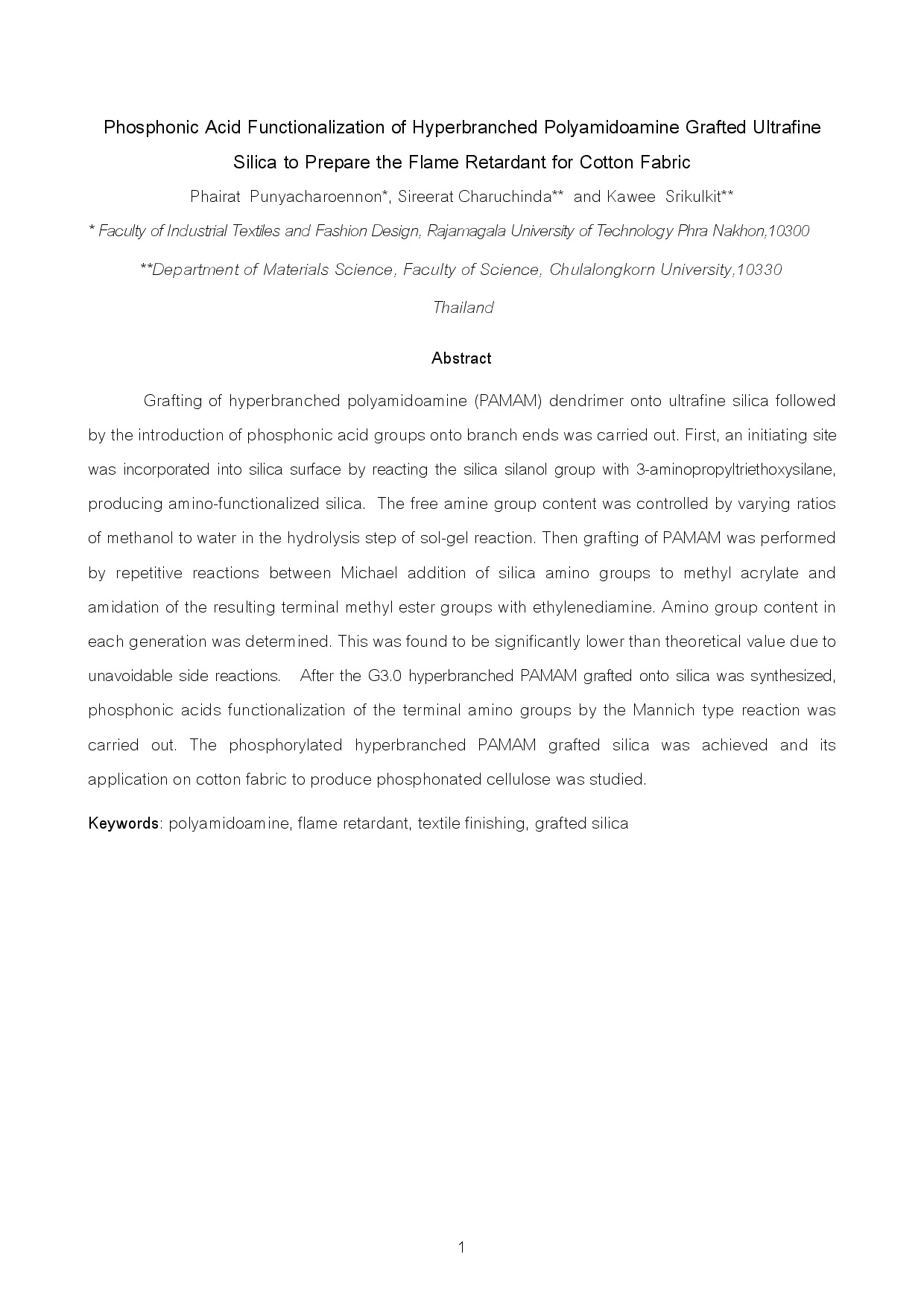
Grafting of hyperbranched polyamidoamine (PAMAM) dendrimer onto ultrafine silica followed by the introduction of phosphonic acid groups onto branch ends was carried out. First an initiating site was incorporated into silica surface by reacting the silica silanol group with 3-aminopropyltriethoxysilane producing amino-functionalized silica. The free amine group content was controlled by varying ratios of methanol to water in the hydrolysis step of sol-gel reaction. Then grafting of PAMAM was performed by repetitive reactions between Michael addition of silica amino groups to methyl acrylate and amidation of the resulting terminal methyl ester groups with ethylenediamine. Amino group content in each generation was determined. This was found to be significantly lower than theoretical value due to unavoidable side reactions. After the G3.0 hyperbranched PAMAM grafted onto silica was synthesized phosphonic acids functionalization of the terminal amino groups by the Mannich type reaction was carried out. The phosphorylated hyperbranched PAMAM grafted silica was achieved and its application on cotton fabric to produce phosphonated cellulose was studied.