จำนวน Repository ( 10 )

การเตรียมผ้าไม่ทอจากใบอ้อย
This research was concerned with the fiber separation and non-woven preparation form sugar canes leaves. The separation process was carried out by chemical pulping method at 100 degree Celsius. In order to study the suitable condition for separation process the concentration of sodium hydroxide ranging from 0 -20 grams per liter and boiling time 15 30 45 60 75 90 105 and 120 minutes were performed. Web formation process was performed by wet laid method and polyvinyl alcohol was selected as binder in web bonding process. in order to study the suitable amount of binder in bonding process concentration of polyvinyl alcohol ranging from 1 2 4 6 8 and 10 % w/v coated on web surface and cured at 120 degree Celsius. Bursting strength as well as physical properties evaluation of non-woven fabrics was performed. For antimicrobial finishing process was performed by spray method and pad method. The finishing result was evaluated by MTCC test method 147-1998 (Qualitative) and 100 -1999 (Quantitative) The result was found that appropriate condition for fiber separation was recommended as follows: the amount of sodium hydroxide of 10 grams per liter and boiling time 60 minutes. The suitable amount of polyvinyl alcohol for web bonding process was 2 % w/v. Bursting strength of non-woven fabric was 53 kN/m 3 and padding method was a suitable method for antimicrobial finishing (antimicrobial area 0.3 millimeters )
การพัฒนาอุปกรณ์พิมพ์สกรีนต้นแบบเพื่องานอุตสาหกรรมสิ่งทอ
Devlopment of Screen Printign Devices Prototypes for Textile lndustry was a research project which it was established to solve the practical learning of the faculty of industrial textile and fashhion desing students at Rajamangala University of Technology Phra Nakhon. This set had 3 important machines such as a self assembly aluminum block screen an automatic aluminum screen could saved the saved the screen fabric1.76 m2 reduced the chemical usageand waste minimization in the process.The practical time reduced from 16 minutes to 1 minute using the automatic aluminum screen coating. The efficiency time was 97.81. The 400 gram emulsion consumed obtained the thin film layer on the screen fabricand evenness.The sharpen pattern displayed when the exposed time was 3minutes.Moreoverthe drying and fixation machine was completely for natural fiber and synthetic fibers at 80-180 C. Therefore the Screen Printing Devices Prototypes was effectively used in textile industrialdispose of the practical learning problemraw material savingand waste minimization adjacent to clean technology process.The prototype set was produced by house equipmentsand extended for textile industrial.
การนำน้ำหล่อเย็นจากเครื่องทำน้ำกลั่นกลับมาใช้ใหม่
Cooling water recovery from water distillation equipment was a research that has the objective to restore the cooling water from distillation equipment which installed at textile chemistry technology department laboratory at Textile industrial and fashion design in Rajamangala University of Phra Nakorn. The research plan was designing and developing the water distillation equipment type cyclon ultrapure water stills model WSC008 of Fistreem company. The outcomes found the designed system could save the tap water consumption 3462.72 square meters per year. That was implied 7617.64 Bath per year of tap water consumption could be save what the tap water consumption rate was 2.22 Bath per square meters. This system was paid back in 3.33 years and the benefit-cost ratio for single project (B/C ratio) was 1.26 (>1). Finally this project was successfully to save the tap water consumption and great benefit investment.
การลอกกาวไหมด้วยยางมะละกอ
Degumming process is a fundamental process for silk yam and silk fabric finishing. The main objective is scouring the substrate such as silk gum (sericin) wax and fatty acid from silk fiber. The principle of degumming process is destroying the peptide linkage of amino acid in sericin structure into a small molecule which is soluble in water. The hydrolysis reaction performed by acid alkaline enzyme surfactant as soap and high pressure steam process. The conventional methods favor degumming with soap and sodium carbonate. This process has a problem on the surface area of silk. Proteolytic enzymes can answer this problem but it seldom use because of a specific condition and high cost. For this reason the insteading of papain enzyme from dry latex of Carica payapa Linn. was decided to use for silk degumming at any condition study. This research was concerned with the silk degumming using papain enzyme form dry latex of Carica payapa Linn. The degumming process was performed at the temperature vary from 55 -85 degree Celsius time fromlO to 40 minutes and the amount of dry latex ranging from 0 to 4% owf in order to study the suitable condition for degumming and surface morphology. The efficiency of degumming process was evaluated by determination of tensile strength and stainiqgJest with dire~~ dyes (C.1. Direct Red 80~StaIDing result.will be opposed to degumming efficiency. The result was revealed; the appropriate conditions for silk degumming with dry Carica payapa Linn. s latex were recommended as follows : the amount of dry latex solution of 4 % owf at 75 degree Celsius for 30 minutes. The degummed fibers leaves lustrous soft and surface smooth. This condition does not have effect to tensile strength and fiber surface.
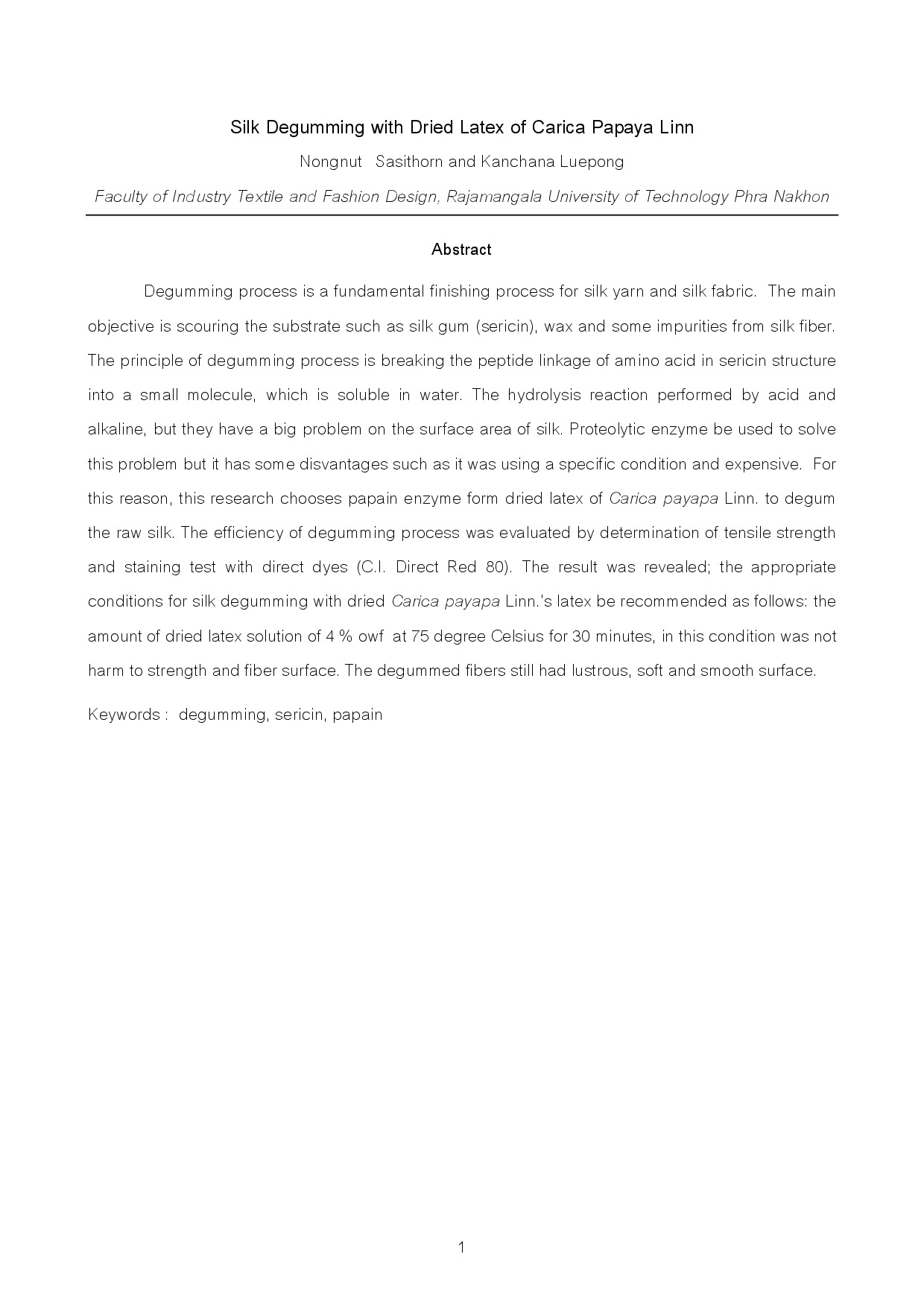
Silk Degumming with Dried Latex of Carica Papaya Linn
Degumming process is a fundamental finishing process for silk yarn and silk fabric. The main objective is scouring the substrate such as silk gum (sericin) wax and some impurities from silk fiber. The principle of degumming process is breaking the peptide linkage of amino acid in sericin structure into a small molecule which is soluble in water. The hydrolysis reaction performed by acid and alkaline but they have a big problem on the surface area of silk. Proteolytic enzyme be used to solve this problem but it has some disvantages such as it was using a specific condition and expensive. For this reason this research chooses papain enzyme form dried latex of Carica payapa Linn. to degum the raw silk. The efficiency of degumming process was evaluated by determination of tensile strength and staining test with direct dyes (C.I. Direct Red 80). The result was revealed; the appropriate conditions for silk degumming with dried Carica payapa Linn.’s latex be recommended as follows: the amount of dried latex solution of 4 % owf at 75 degree Celsius for 30 minutes in this condition was not harm to strength and fiber surface. The degummed fibers still had lustrous soft and smooth surface.