จำนวน Repository ( 13 )
การพัฒนาปูนดิบจากเปลือกหอยครางเพื่อส่งเสริมวิสาหกิจชุมชน
This research aimed to study the optimum conditions for making raw lime from shells which consisted of 9 conditions: calcined at three levels of 700 800 and 900 degrees Celsius for 1 2 and 3 hours. Calcium element content in raw lime using X-ray fluorescence (XRF) measurement and structural analysis of calcium compounds by X-Ray Diffraction (XRD). The research results were found. 1. Optimal conditions for making lime mortar are temperature 800 degrees Celsius duration 2 hours. The physical characteristics of raw lime are white and porous. 2. The calcium content from the shells calcination at 800 degrees Celsius for 1 2 and 3 hours was 98.22% 96.70% 97.89%. 3. Changes in the calcium compounds of raw lime obtained by calcining the shell at 800 degrees Celsius for 1 hour were mainly found in the form of calcium carbonate (CaCO3). At 2 3 hours calcium carbonate (CaCO3) is mostly converted to form calcium hydroxide (Ca(OH)2)compound calcium oxide (CaO) compound is formed.
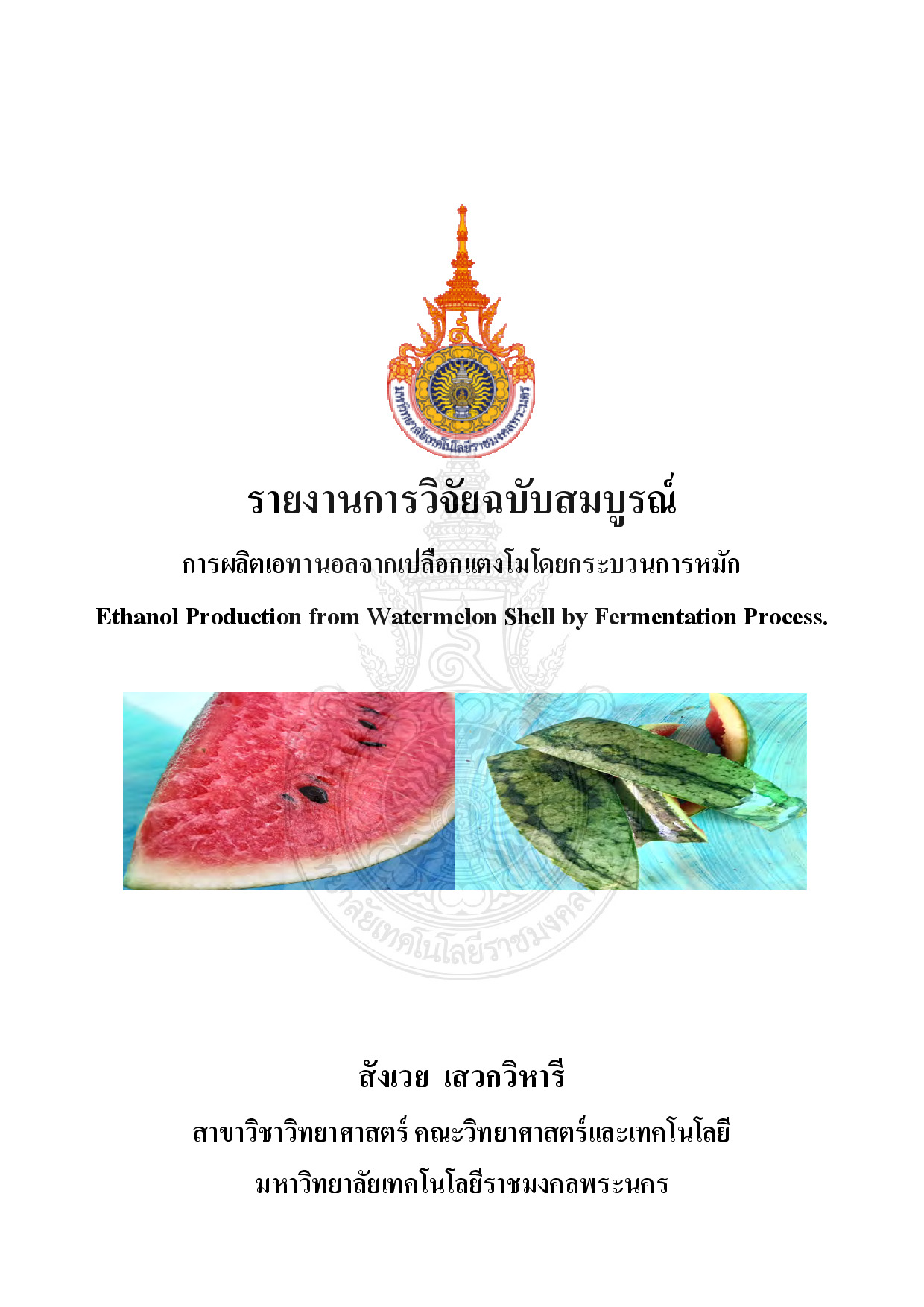
การผลิตเอทานอลจากเปลือกแตงโมโดยกระบวนการหมัก
Ethanol is a form of renewable energy. That can be used as fuel. Can replace gasoline or diesel. Fuel is an important factor driving the countrys economy. Ethanol can be produced from agricultural products garbage and various waste. his research uses watermelon rind. Which is waste from the community as a raw material for the production of ethanol by the fermentation process the microorganisms used in the fermentation process are ball flour. After fermentation for 6 hours it was found that the watermelon rind weighing 10 grams measured the concentration of alcohol. The concentration was 9.3 % VOL 18 Brix %. 20 grams of watermelon rind measuring the concentration of alcohol The concentration of 8.1 % VOL 16 Brix % of watermelon rind at 30 grams measured the concentration of alcohol. Get the concentration 8 % VOL 16 Brix % watermelon rind at 40 grams measure the concentration of alcohol get the concentration of 7.9 % VOL 15.1 Brix % and watermelon rind at 50 grams measure the concentration of alcohol the concentration of 7 % VOL 15 Brix %. Therefore it can be said that the watermelon rind which is waste from the community. Is a raw material with high potential for ethanol production to be used as a renewable energy source Instead of using raw materials from food plants and other energy crops.
พลังงานทางเลือกจากวัชพืชน้ำจืดสาหร่ายหางกระรอก
Energy is an important factor in the necessity of human life. Many countries around the world are seeking alternative energy sources. To use as alternative energy. Our alternative sources of energy are ethanol which can be produced from agricultural products. Including plants with cellulose components. The ethanol can be mixed with gasoline. It is a new product called gasohol. This research use of fresh water weed Hydrilla is a raw material in the production of ethanol. Hydrolysis sweetening and fermentation. The microorganisms used in fermentation processes the yeast is found Hydrilla through hydrolysis the acid is H2SO4 at 0.5 % . Measuring the concentration of the alcohol concentration of 4.0 % VOL 9 Brix %. The Hydrilla through hydrolysis at alkaline NaOH is at a concentration of 1 % concentration of alcohol concentration was 3.5% VOL 8 Brix %. Hydrilla and the Hydro Delight with distilled water (H2O) to measure the concentration of the alcohol concentration of 5.5 % VOL 12 Brix %. Thus it can be said that Hydrilla is a material that has the potential to produce ethanol for energy alternatives. And used as a source of renewable energy. Instead of using raw materials from food plants. And other energy crops.
การพัฒนาหลักสูตรระยะสั้นด้านการผลิตเคมีภัณฑ์ในครัวเรือน
The purpose of this research was to develop a short vocational training course on household chemical products and to develop a training course for shortterm vocational training in the production of household chemicals. Population groups Is a general public in Bangkok and metropolitan area by using the voluntary selection as follows. Trial of a short course on the production of household chemicals 10 participants. Evaluation of short courses in household chemical production 10 participants. Technology transfer the short-term training course on household chemical production 20 participants and five speakers. The tools used in the research are as follows: 1. Demand questionnaire 2. Short-term vocational training course 3. Satisfaction assessment. Data analysis using statistical software packages. The statistics used were mean ( X ) standard deviation (SD) and t-test. The research found that 1. Study and development of short courses in the production of household chemicals 1.1 selection of household chemicals that will lead to the creation of training courses based on components Where to buy Price per set Properties of components Safety and hazard Materials and equipment used for production storage use and distribution opportunities 1.2 Creating training courses training course components and training documents to have a sequence of steps that are easy and convenient for the learning of the general public 2. Trial of a short course on the production of household chemicals 2.1 Most trainees are satisfied with the short-term training program model as follows: Training procedures Training hours 1.30 hours per 1 course Short-term courses can be implemented and the curriculum can be used as a guideline for occupation at the highest level. As for the number of trainees four people per group per 1 course is at a high level. 2.2 Most of the trainees were satisfied with the speakers and short-term training. In explaining the various components of Household chemicals Explanation of the mixing process Household chemicals Integration of household chemical mixing techniques Explanation of caution In the mixing of household chemicals And explaining how to pack household chemicals at the highest level 3.Short-term evaluation of household chemical production 3.1 Most trainees are satisfied with the short-term training program model. The training process Training hours 1.30 hours per 1 course Short-term courses can be implemented and courses can be used as guidelines for their career at the highest level. As for the number of trainees four people per group per 1 course is at a high level. 3.2 Most of the trainees were satisfied with the speakers and short-term training. Explain the various components of household chemicals Explanation of the mixing process Household chemicals Integration of household chemical mixing techniques. Explanation of caution In the mixing of household chemicals And explaining how to pack household chemicals at the highest level 4.Technology transfer the short-term training course on household chemicalproduction 4.1 Most of the trainees were satisfied with the trainers for short-term training. Explain the various components of household chemicals Explanation of the mixing process Household chemicals Integration of household chemical mixing techniques Explanation of caution in the mixing of household chemicals and explaining how to pack household chemicals at the highest level 4.2 Most trainees were satisfied with the short-term training program model. Regarding the number of trainees four people per group Training procedures The number of training hours is 1.30 hours per course the highest level. Furthermore short courses can be implemented. As for the curriculum it can be used as a guideline for a career at a high level.

Potential energy of the fuel briquettes from mangosteen shell
The objective of this research is to use mangosteen shell that from household wastes for produce the fuel briquette. This fuel is used in terms of renewable energy which instead of firewood and charcoal from natural forest. We used the adhesive paste as a binder and briquette with hand pack filler. The results showed that the mangosteen shell can be burned to charcoal black and lightweight. By grinding mangosteen charcoal into small size these charcoals were mixing with the paste. We have to compress the mixing charcoal molded into fuel briquettes. These briquettes are performed the stable and non-broken products. After sun drying the results of potential energy testing showed that the calorific value 5920 cal/g combustion rate 11.8 g/min fixed carbon content 61.7% and ash content 7%. For the combustion efficiency testing our fuel briquette could be performed cooking as well non-explosion high combustible non-soot non-smoke and non-odors during used. These fuel briquettes are suitable for fuel products in household community or commercial production and industrial. Due to these advantages our briquettes are possibly to instead of firewood and charcoal from natural forest which can be reduced the global warming by another way.