จำนวน Repository ( 16 )

การพัฒนาผลิตภัณฑ์ข้าวเกรียบปรุงรสเสริมน้ำสกัดจากใบขลู่
The aims of this study were to select (1) a basic recipe of tapioca crackers (2) the appropriate concentration of Khlu leaf extract for fortification in the tapioca cracker product (3) the suitable seasoning powder for tapioca cracker fortified with Khlu leaf extract and finally (4) to study of physical chemical nutritional qualities as well as (5) consumers acceptance in the seasoned tapioca cracker fortified with Khlu leaf extract. The results showed that a basic recipe for tapioca cracker making was 57% tapioca flour 4% sugar 2% finely chopped garlic 2% salt 1% pepper and 34% boiling water as considered from sensory evaluation. The appropriate concentration of Khlu leaf extract was the mixture of water and fresh sliced Khlu leaves at a ratio of 1: 0.5. This ratio was given a preference score greater than 1:1 and 1:1.5 (p?0.05). After that three seasoning powders were added to the crackers fortified with Khlu leaf extract. It was found that the Tom yum seasoning powder tended to be obtain the highest sensory scores than those of the samples seasoned with paprika and algae seasoning powder (p?0.05). The final formulation of the seasoned tapioca crackers fortified with Khlu leaf extract contained fat protein dietary fiber and carbohydrate contents approximately 40.50% 1.49% 2.01% and 51.10% respectively. According to the consumer test (100 consumers) the seasoned tapioca cracker fortified with Khlu leaf extract was accepted as the novel and delicious product. Moreover 92% of consumers decided to buy the product containing 60 g in the plastic bag with the price of 30 Baht.
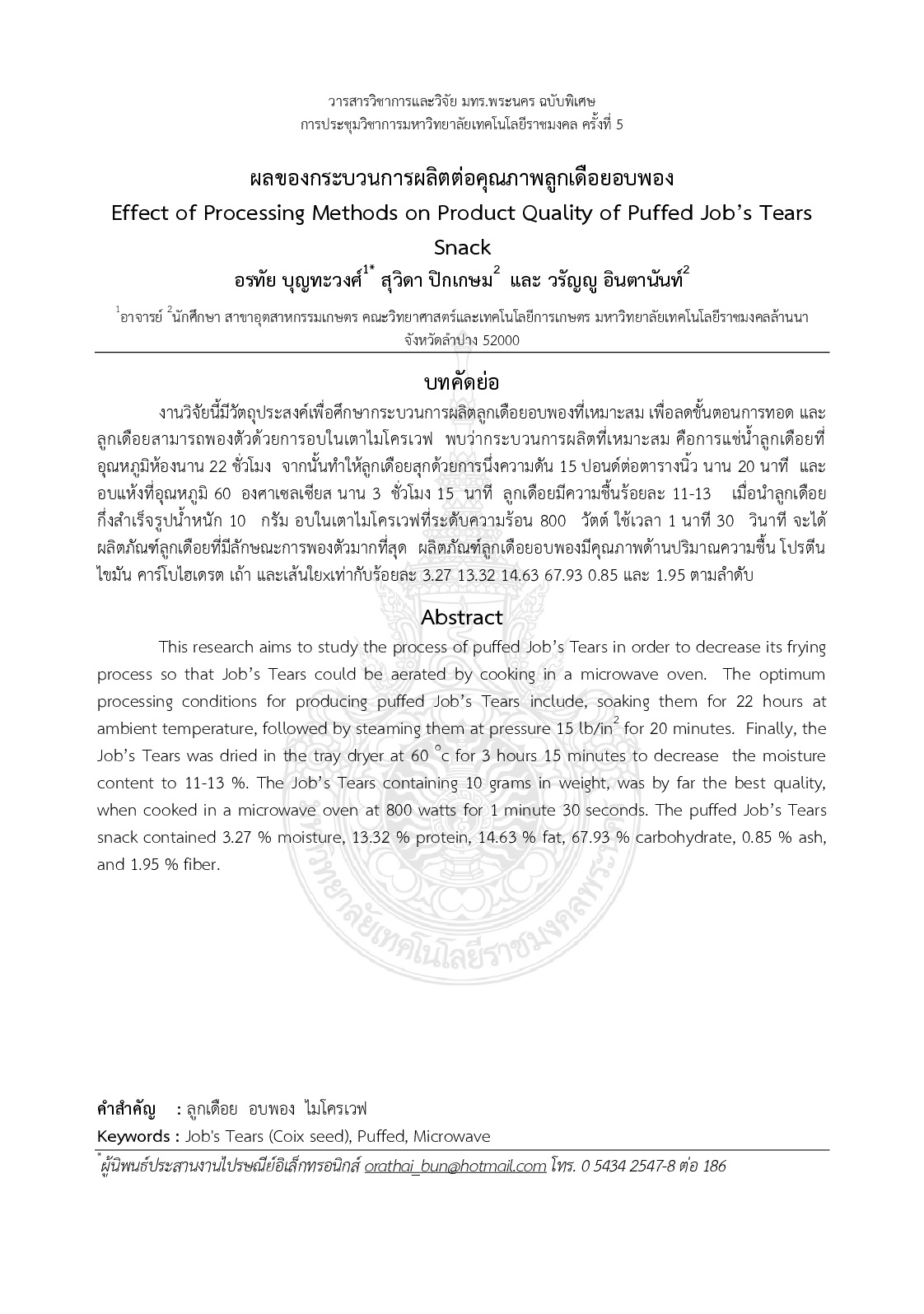
Effect of processing methods on product quality of puffed job’s tears snack
This research aims to study the process of puffed Job’s Tears in order to decrease its frying process so that Job’s Tears could be aerated by cooking in a microwave oven. The optimum processing conditions for producing puffed Job’s Tears include soaking them for 22 hours at ambient temperature followed by steaming them at pressure 15 lb/in2 for 20 minutes. Finally the Job’s Tears was dried in the tray dryer at 60 oc for 3 hours 15 minutes to decrease the moisture content to 11-13 %. The Job’s Tears containing 10 grams in weight was by far the best quality when cooked in a microwave oven at 800 watts for 1 minute 30 seconds. The puffed Job’s Tears snack contained 3.27 % moisture 13.32 % protein 14.63 % fat 67.93 % carbohydrate 0.85 % ash and 1.95 % fiber.
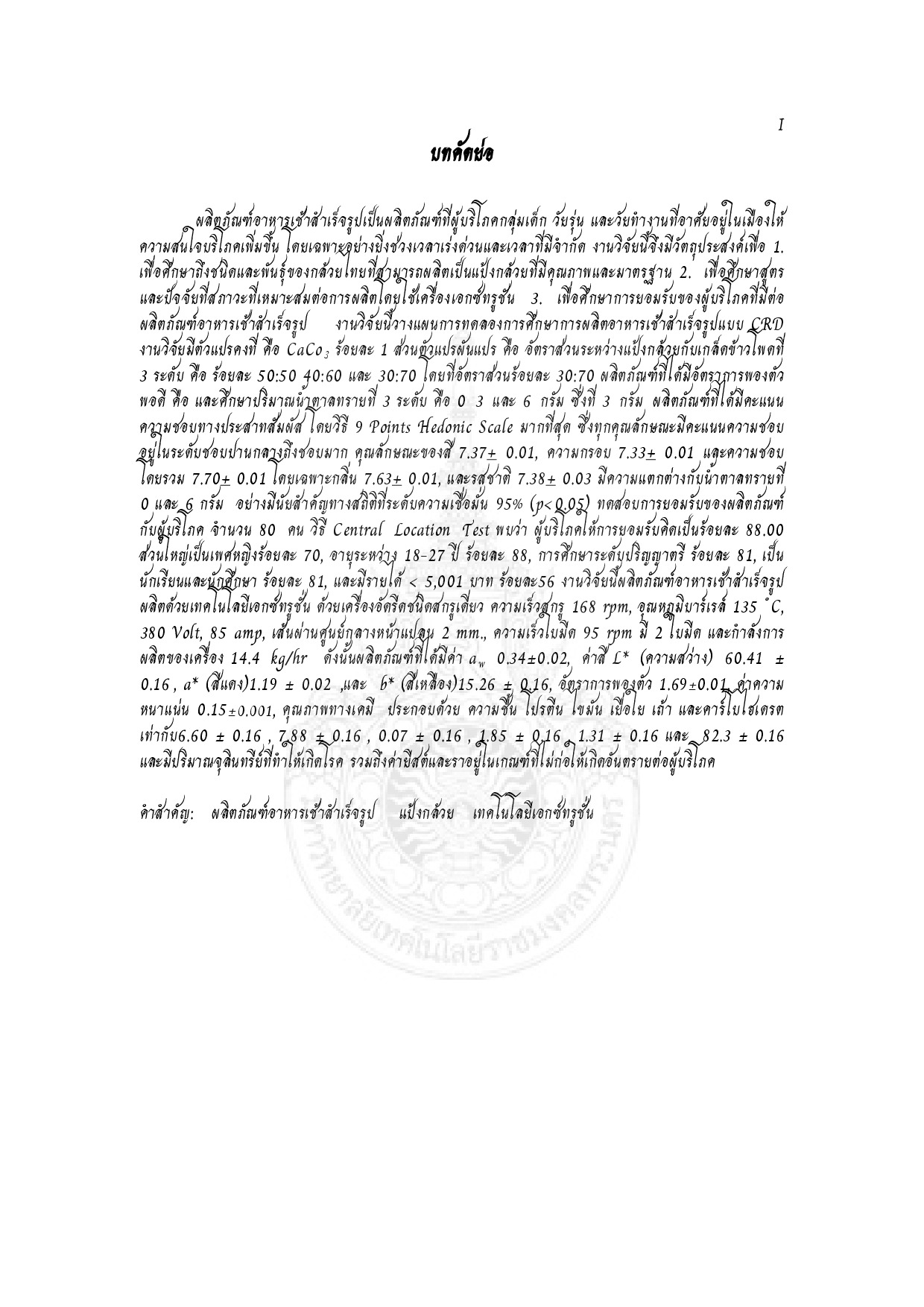
ผลิตขนมขบเคี้ยวจากพืชสมุนไพรไทยพื้นบ้านด้วยเทคโนโลยีเอ็กซ์ทรูชั่น
Thai Local Herbs Snack Product (TLHSP) is very popular and has increase tendency the target group in worldwide such as children teenager and adult which live in metropolis. The aim was 1.) to study the formular and condition to produce TLHSP by extruder machine 2.) to study the type and quantity of Thai Local Herbs which was added 3.) to study the shelf-life and type of package to keep TLHSP. The study used CRD to design the method and has a stable variable is 1% CaCo3and varies 2 variables are the ratio between a speed of single screw at 3 levels such as 250 300 and 350 rpm and moisture content of raw material at 3 levels such as 15 17.5 and 20. And this research study about the level of grinded sugar (GS) at 3 levels such as 0 3 and 6 g. which at 3 g. the TLHSP had well scores of 7 to 8 (like moderately to like very much; used 9 Points Hedonic Scale method for the sensory test) the characteristic for color was 7.37+ 0.01 texture in crisp was 7.33+ 0.01 and overall acceptance was 7.70+ 0.01. Especially odor was 7.63+ 0.01 and taste was 7.38+ 0.03 there were significant differences (p<0.05) with 0 and 6% grinded sugar. TLHSP was well accepted by consumers with 88.00% (By the Central Location Test for questionnaire paper survey). Almost 70% were female 88% had 18-27 years-old 81% were student and 56% hadincome cash < 5001 baht/ months. This study used the extrusion technology to produceTLHSP which the fixed specification fallow as; a speed of single screw was 300 rpm Barrel temperature was 134-165 ˚C 380 Volt 85 amp a diameter in front of machine was 2 mm. a speed of blade 95 rpm and had 2 pieces. And the capacity was 14.4 kg/hr. Therefore aw0.34±0.02 Lightness 60.41 ± 0.16 %extended ratio1.69±0.01 %bulk density 0.15± 0.001. Chemical Properties for %moisture6.60±0.16 %protein 7.88±0.16
การผลิตอาหารขบเคี้ยวจากฟักทองผสมแป้งข้าวกล้องเริ่มงอก
This research aimed to study the basic recipe of Pumpkin Snack. The Randomized Completely Block Design (RCBD) was used to evaluate the sensory property appearance color flavor taste texture and overall liking. 40-testers and 7-Point Hedonic Scale were used. The study found that the first basic recipe had the highest scores in overall satisfaction. The 3 ratios of Cassava Starch and Pre-Germinated Brown Rice flour were 40:60 50:50 and 60:40. It was found that the 60:40 had the highest average scores. 3 Levels of Frying time at 180 degrees Celsius were 5 10 and 15 seconds. It was found that frying 10 seconds had the highest average scores. Quality color texture (Crispness) and chemical composition were found that 9.11 N Brightness (L*) 36.70 Red (a*) 8.71 Yellow (b*) 33.71 aw 0.53 Moisture 0.72% Fat 7.30% Protein 9.51% Ash 7.05% Crude fiber 1.96% and Carbohydrates 73.42%. The production cost of Pumpkin and Pre-Germinated Brown Rice Snack is 100 Bahts per kilograms or 4 Bahts per serving.
พฤติกรรมการบริโภคอาหารว่างของนักเรียน ระดับชั้นประกาศนียบัตรวิชาชีพ (ปวช.)คณะคหกรรมศาสตร์ ในวิทยาลัยอาชีวศึกษาสังกัดสถาบันการอาชีวศึกษา กลุ่มภาคตะวันตก
The objectives of this research were to study the snack consumption behavior of vocational education students certificates level as relate to sex age education level income knowledge of snacks and to study relationship of different levels of knowledge of snacks to sex age and education level of vocational education students certificate level. Sample of 267 home economics students ages 16-18 years home in Kanchanaburi Suphanburi and Nakhonphathom were randomly selected by stratified random sampling. All data were colleted by questioners and analyzed through percentage mean standard education chi – square T – test and F – test. The results of this study indicated that the snack consumption behavior of vocational education certificate level studied in the western Region Vocational Education Institutes had medium level of knowledge about snack. Sex age education level and different income were not significantly related to snack consumption behavior. Different sex and age did not contribute to knowledge levels about snacks.