จำนวน Repository ( 8 )
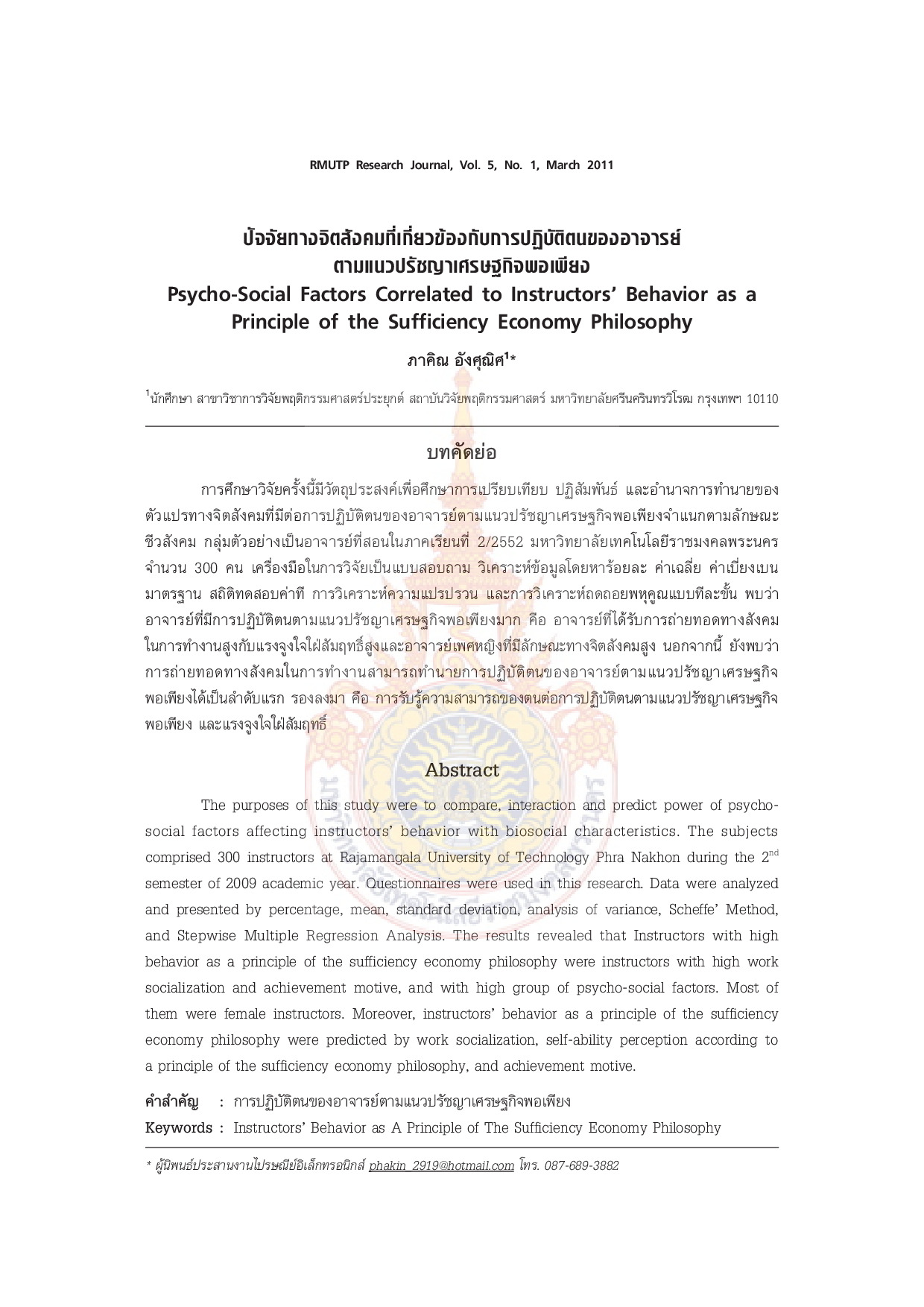
Psycho-Social Factors Correlated to Instructors’ Behavior as a Principle of the Sufficiency Economy Philosophy
The purposes of this study were to compare interaction and predict power of psychosocial factors affecting instructors’ behavior with biosocial characteristics. The subjects comprised 300 instructors at Rajamangala University of Technology Phra Nakhon during the 2nd semester of 2009 academic year. Questionnaires were used in this research. Data were analyzed and presented by percentage mean standard deviation analysis of variance Scheffe’ Method and Stepwise Multiple Regression Analysis. The results revealed that Instructors with high behavior as a principle of the sufficiency economy philosophy were instructors with high work socialization and achievement motive and with high group of psycho-social factors. Most of them were female instructors. Moreover instructors’ behavior as a principle of the sufficiency economy philosophy were predicted by work socialization self-ability perception according to a principle of the sufficiency economy philosophy and achievement motive

บทบาทครอบครัว ท้องถิ่นและชุมชนในการพัฒนาคุณภาพชีวิตผู้สูงอายุในเขตภาคกลางโดยใช้หลักเศรษฐกิจพอเพียง
This study of the role of family locals and community in enhancing the quality of elderly people’s lives in central area by means of Sufficiency Economy theory collected the data from people. It aims 1) to study the role of family locals and the community to enhance the quality of elderly people’s life in Thailand’s central region; 2) to analyze factors related to the quality of elderly people’s lives; and 3) to identify ways of encouraging the development of elderly people to prepare them to be part of the society of elderly people in the ASEAN region. The participants in this research were elderly people in the central region. The research used quantitative methods to measure quality of life. Multi-stage sampling was employed. The data were analyzed with descriptive statistics such as average (x̅) and standard deviation to investigate the elements of each factor in the study. The results from the focus group regarding the quality of elderly people’s life can be summarized as follows: 1) The development of the quality of life of elderly people is based on the concept of “Strong community and people through the development and adaptation of the theory of the Sufficency Economy”. 2) The development of the quality of elderly people’s lives by means of religion: emphasizing the Buddhist way of life and local wisdom and culture to teach family members to be a grateful and loyal and to be a good person for the family and local community. 3) The quality of life of elderly people can be improved by implementing laws informed by morality to encourage generosity between family locals and community to solve the problems of elderly people. 4) The quality of life of elderly people locals and the community is based on mutual respect living together naturally according to the concept of the Sufficiency Economy in order to support large numbers of elderly people in the future. Suggestions arising from this research and from other ideas from participants include increases in government funds budgeted to support elderly people and the creation by local government of projects and activities for elderly people. In addition the participants also perceive the need for a chance for the elderly to study and learn in the local elderly school without age limit as a form of life-long learning. The participants also suggested the idea of evaluating the systems of schools for elderly people according to the “cheerfulness and happiness” of learners rather than by any other method. Connections between the schools for elderly learners in the central area should be co-ordinated so as to create more projects and activities.
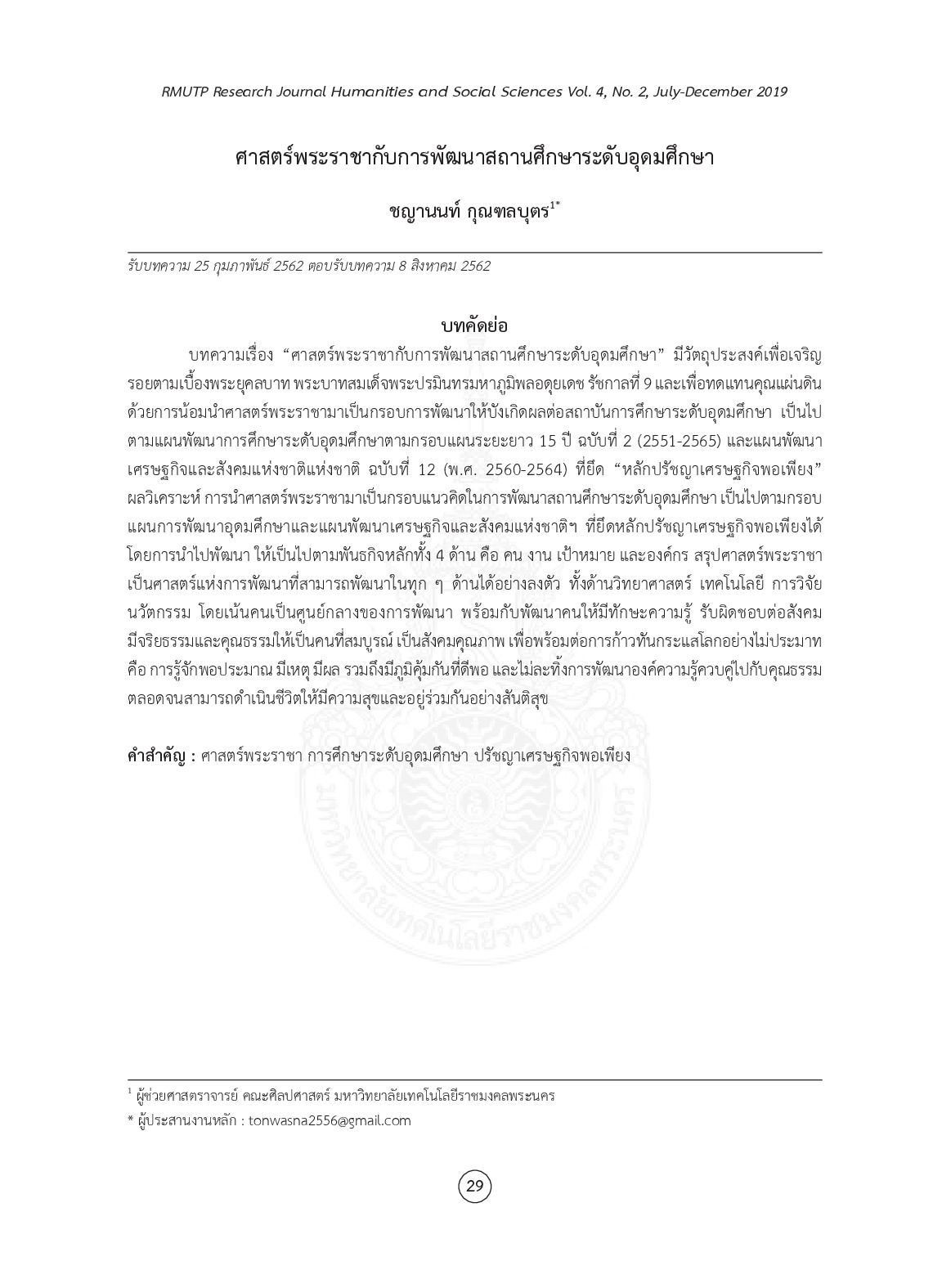
ศาสตร์พระราชากับการพัฒนาสถานศึกษาระดับอุดมศึกษา
The article “King’s wisdom for the development in higher education Institution” aims to follow in the footsteps of the King Bhumipol Aduyadej Rama 9 and to be grateful for the mother land the application the King’s wisdom to be framework for the development in higher education plan in accordance with the 15 years long-term plan N๐. 2 (BE 2551-2565) and the National Economic and Social Development Plan N๐. 12 (BE 2560-2564) which adheres to the guideline “philosophy of sufficiency economy.” The results of the analysis of the King’s wisdom in accordance with the framework of the Higher Education Development Plan and the National Economic and Social development Plan for the development of four main missions: men working goals and organization. Summary King’s wisdom is a science of development that can be develop in every area perfectly in science technology research and innovation by focusing on people as the center with developing people to have knowledge skill social responsibility with ethics and morality to be a perfect person in order to be ready to live in a modern world and world trend which being aware of moderation reasoning and having good self-immunity and not abandoning the cultivation of morality as well as being able to live happily and living together in peace.