จำนวน Repository ( 10 )
การคำนวณต้นทุนการจัดการขยะมูลฝอย กรณีศึกษาเทศบาลนครอ้อมน้อย
The purposes of this study were to costs and fees of solid waste management and to provide resolutions towards solid waste management of Omnoi City Municipality. The data were collected by using financial data during 5 years from 2008 to 2012. Then the data were calculated to figure out the costs of solid waste management divided by solid waste management-related cost and non-solid waste management-related cost. The results found that annual solid waste generation rate of Omnoi City Municipality was 0.53 ton/person or 0.65 ton/household. The annual average quantity of solid waste was 27327.26 ton/year and the annual cost of solid waste management was 2084.62 Baht/ton. The costs were separated into the solid waste management-related cost including the cost of main department responsible for solid waste collection service as follows; 1) direct labor 493.79 Baht/ton 2) direct materials 170.83 Baht/ton 3) production cost 231.07 Baht/ton and 4) cost of solid waste management 477.95 Baht/ton. Moreover the non-solid waste management-related cost or the cost allocation supported by other departments consisted of Administration Department and Council 95.78 Baht/ton Office of the Municipal Clerk 308.43 Baht/ton Division of Technical Services and Planning 93.49 Baht/ton Division of Finance 137.25 Baht/ton and Division of Sanitation and Environment 76.03 Baht/ton. Omnoi City Municipality could gather the fees of solid waste management about 152.32 Baht/person/year or 186.61 Baht/household or 290.31 Baht/ton or 13.93 percent of the cost of solid waste management. According to the cost calculation of solid waste management the supporting departments associated with the solid waste management should allocate sufficient budget and provide the cost data which would be useful for administrators at all levels to measure and improve performance. Furthermore additional policies related to the solid waste management should be defined to reduce the management cost and quantity of solid waste. The responsible departments should also promote people’s understanding and realization of duty to pay for fees of solid waste management.

Awareness and behavior on mobile phone hazardous waste management : A case study of youth in Bangkok Metropolitan
The purposes of this research are to examine the students’ Awareness and Behavior on Mobile Phone Hazardous Waste Management (ABMPWM) comparative studies of dependent variables among the levels of independent variables and their Corresponding correlation’s between their exposure to information and ABMPWM and to yield the appropriate means for managing mobile phone waste. The survey research using self-administered questionnaires was conducted on 450 random samples from 264027 students with study standing at junior and senior high school in Bangkok. The analytical statistical methods used were percentage mode mean S.D.(Standard Deviation) T-Test F-Test One-way ANOVA Analysis Correlation Analysis and Regression Analysis & Prediction Model. The level of the Awareness on Mobile Phone Hazardous Waste Management index (AMPHWM index) was high. The AMPHWM index of men was higher than women and significance difference (p<.05). The group of 13-14 years of age had AMPHWM index at the highest level. The samples of junior high school students had higher AMPHWM index than the group of senior high school students. The group of students who bought the mobile phone themselves had higher AMPHWM index than the others. The group of students belonging the mobile phone with 15000 baht had higher AMPHWM index than the low price. The group of students paying service charge monthly about 301-500 had higher AMPHWM index than the group paying more or less. The group of exposure to information had higher AMPHWM than no exposure to information group. Most of students received information from T.V.. The Awareness on Management of Mobile Phone Waste of the group of exposure to information and the group did not expose to information had correlation to the Behavior on Management of Mobile Phone Waste. The level of the Behavior on Mobile Phone Hazardous Waste Management index (BMPHWM index ) was average. The BMPHWM index of men was higher than women. The group of 13-14 years of age had higher than the others. The samples of junior high school students had higher BMPHWM index than the group of senior high school students. The group of students who bought the mobile phone themselves had higher BMPHWM index than the others. The group of students belonging the mobile phone with more 8001-15000 baht had higher BMPHWM index than the lower and higher price. The group of students paying service charge monthly about 301-500 had higher BMPHWM than the group paying more or less. The group of exposure to information had higher BMPHWM index than no exposure to information group. The group of students received information from internet or electric media had higher BMPHWM index than the group students who received the information from the others.
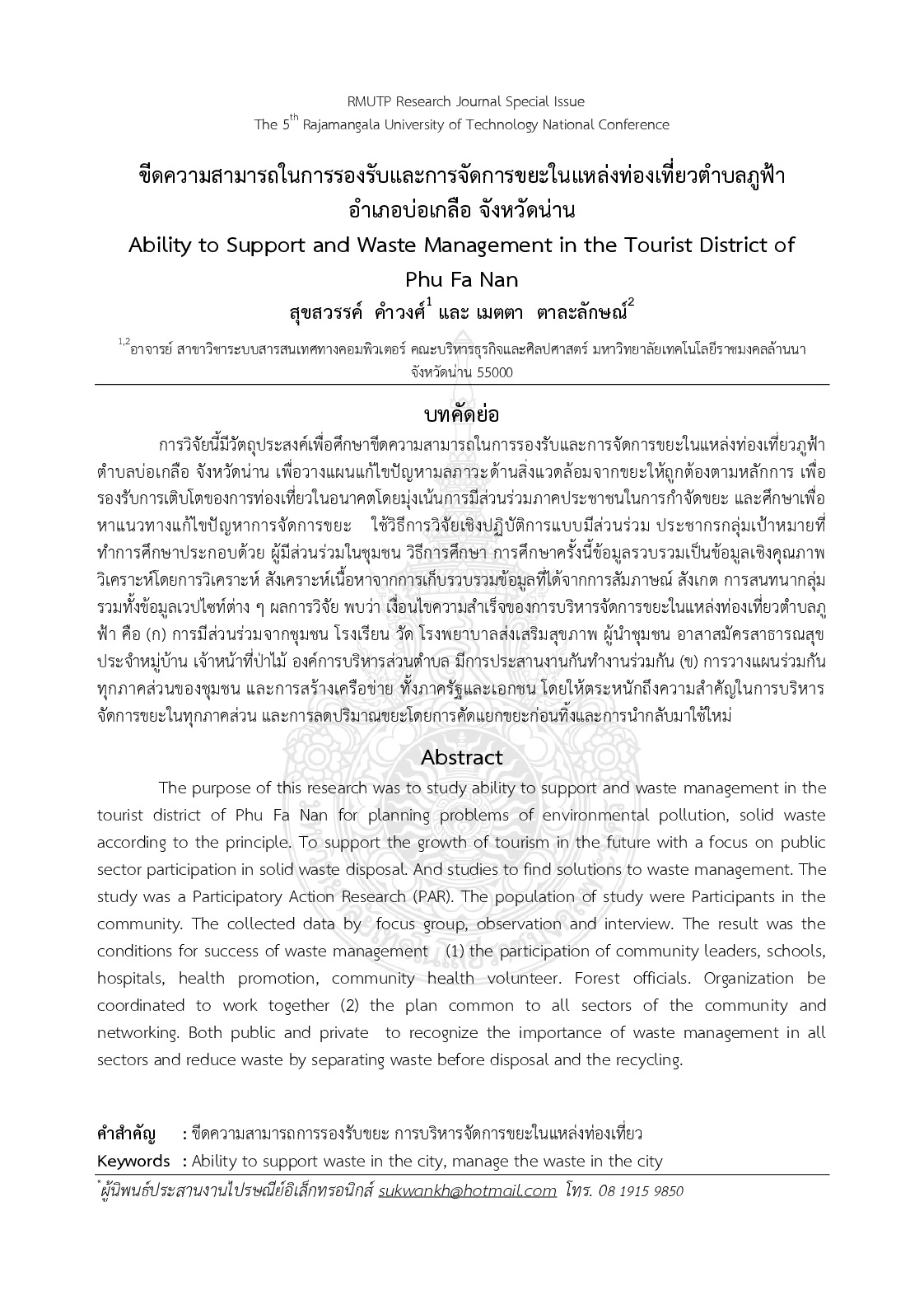
Ability to support and waste management in the tourist district of phu fa nan
The purpose of this research was to study ability to support and waste management in the tourist district of Phu Fa Nan for planning problems of environmental pollution solid waste according to the principle. To support the growth of tourism in the future with a focus on public sector participation in solid waste disposal. And studies to find solutions to waste management. The study was a Participatory Action Research (PAR). The population of study were Participants in the community. The collected data by focus group observation and interview. The result was the conditions for success of waste management (1) the participation of community leaders schools hospitals health promotion community health volunteer. Forest officials. Organization be coordinated to work together (2) the plan common to all sectors of the community and networking. Both public and private to recognize the importance of waste management in all sectors and reduce waste by separating waste before disposal and the recycling.
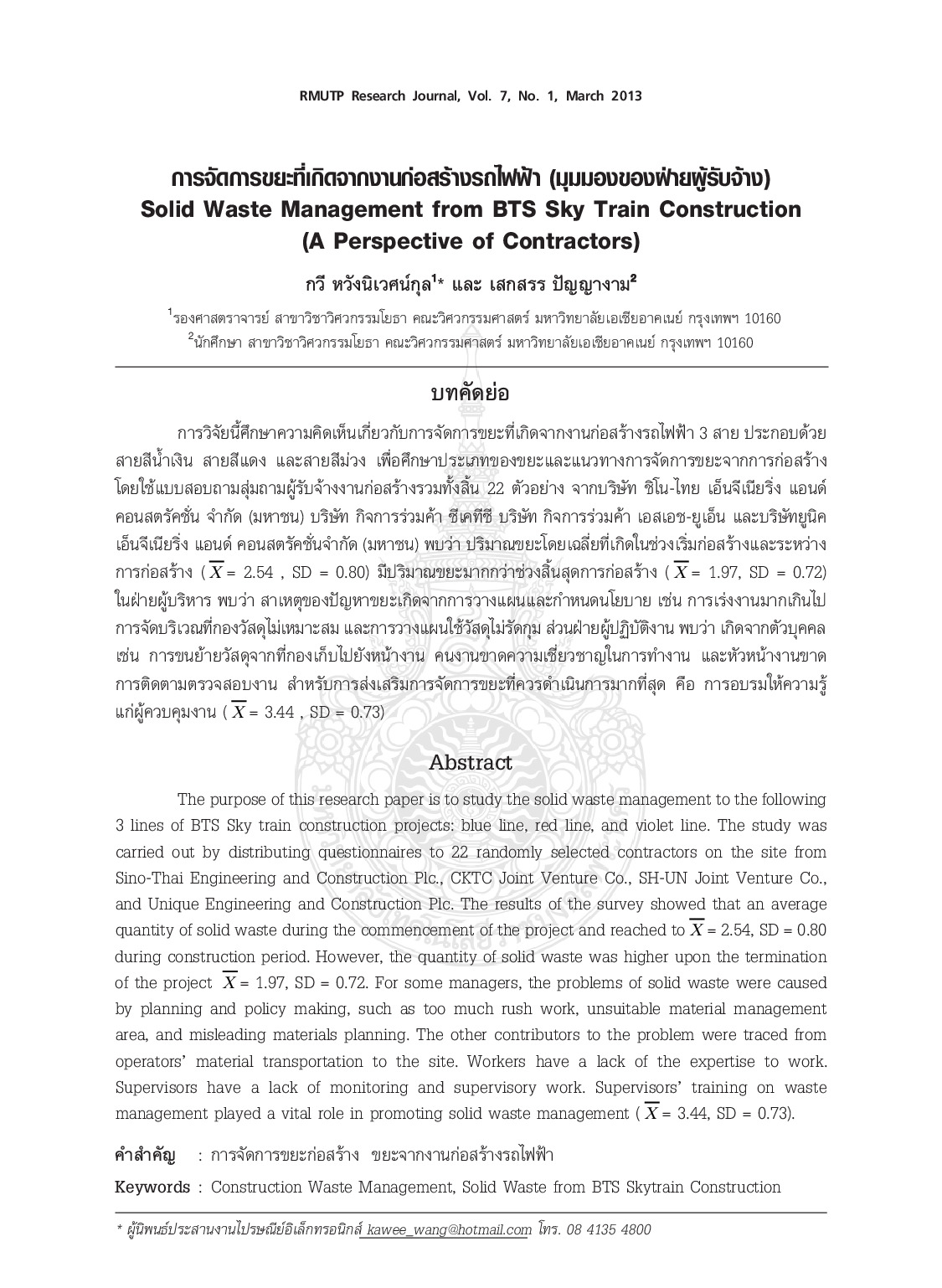
Solid waste management from BTS Sky train construction (a perspective of contractors)
The purpose of this research paper is to study the solid waste management to the following 3 lines of BTS Sky train construction projects: blue linered line and violet line.The study was carried out by distributing questionnaires to 22 randomly selected contractors on the site from Sino-Thai Engineering and Construction Plc. CKTC Joint Venture Co. SH-UN Joint Venture Co. and Unique Engineering and Construction Plc. The results of the survey showed that an average quantity of solid waste during the commencement ot the project and reached to x=2.54SD=0.80 during construction period. However the quantity lf solid waste was higher upon the termination of the project X=1.97 SD=0.72. For some managers the problems of solid waste were caused by planning and policy maling such as too much rush work unsuitable material management area and misleading materials planning. The other contributors to the problem were traced from operators material transportation to the site. Workers have a lack ot the expertise to work. Supervisors have a lack of monitoring and supervisory work. Supervisors training on waste management played a vital role in promoting solid waste management(X = 3.44 SD = 0.73).
การประเมินปริมาณการเกิดมูลฝอยที่เกิดขึ้นจากคณะวิทยาศาสตร์และเทคโนโลยี มหาวิทยาลัยเทคโนโลยีราชมงคลพระนคร
The aim of this research was to study the solid waste management in Faculty of Science and Technology Rajamangala University of Technology Phra Nakhon study problems and obstacles of the solid waste management. The study will benefit related organizations as fundamental information for setting plans on the solid waste management to ensure the maximum efficiency and expand to other faculties. In this study a researcher collected quantitative data and also characteristics of solid waste occurred. Total amounts of solid waste were approximately 20.86 kilograms per day. Types of solid waste mostly found were reuse /recycle wastes (10.21 kilograms per day) and organic wastes (10.43 kilograms per day). The results showed an information for developing solid waste management under 3R processes (Reduce Reuse and Recycle) lead to sustainable solid waste management and efficiency.