จำนวน Repository ( 33 )
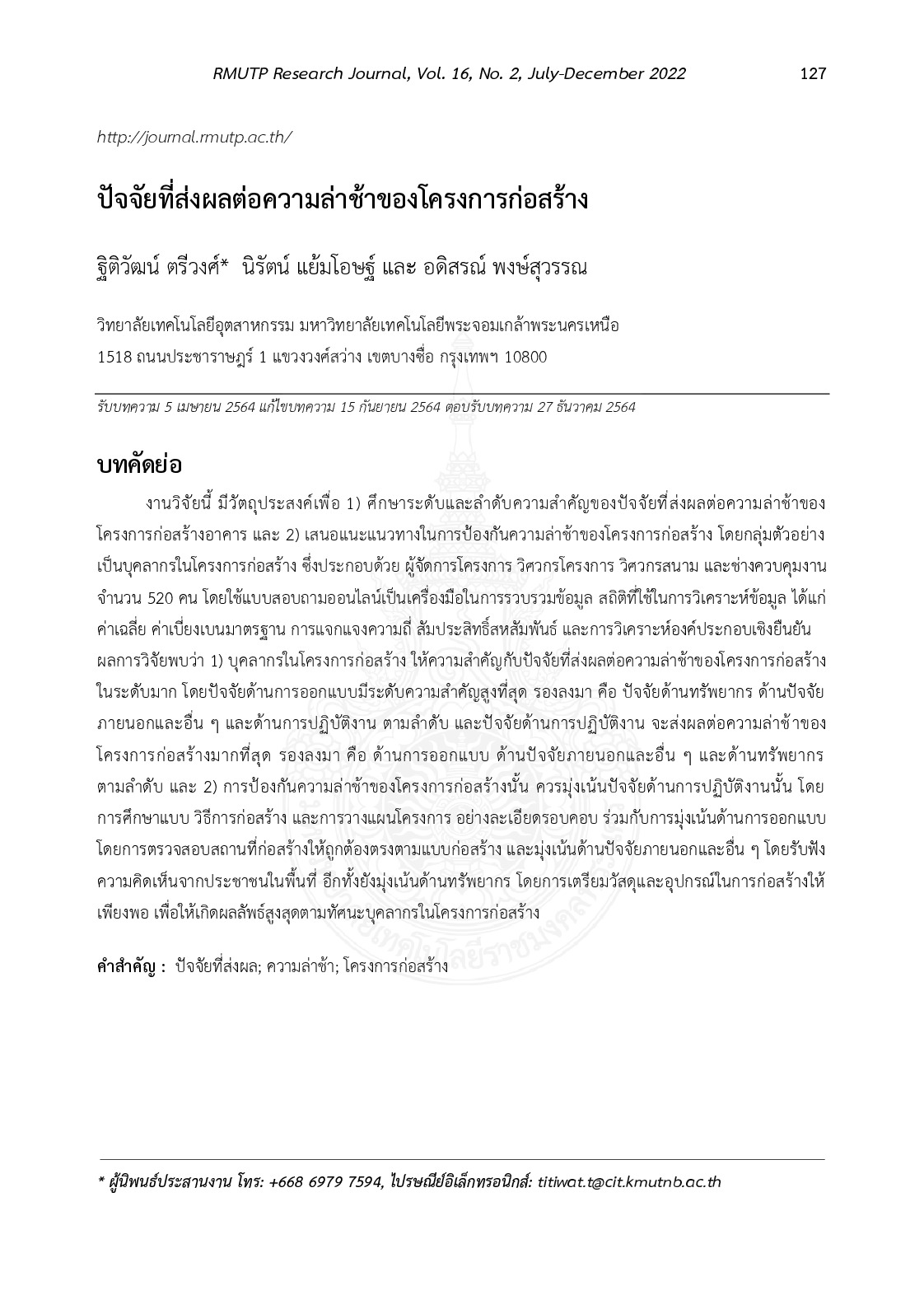
ปัจจัยที่ส่งผลต่อความล่าช้าของโครงการก่อสร้าง
The research is aimed to 1) study the level and priority of the factors affecting the delay of construction projects and 2) provide suggestions in relation to the prevention of such delay. The sample is 520 people who were working for different construction projects. They were project managers project engineers field engineers and foremen. The data were collected by using online questionnaires and analyzed to find out mean standard deviation (SD) frequency correlation coefficient and confirmatory factor analysis. The findings reveal two significant aspects. First those who were working in the construction projects concerned about the factors affecting the delay of the projects at high level. Respectively the factors related to design resource external factors and others were taken into consideration. The factor regarding to work performance is regarded affecting the project delay at the highest level. Other factors i.e. the design external factors and others and resource have the affects at the lower level. Second the work-related factors can help prevent the project delay. In other words the construction plan and methods as well as the project management should be well-implemented in accordance with the design. The construction site should be on inspection considering its drawing. Regarding the external factors and others the public voices of those living around the construction site should be taken into consideration. Furthermore the effective use of the resources can be carried out by sufficiently preparing all materials tools and equipment for constructing any project effectively as a consequence.
การใช้แป้งข้าวกล้องทับทิมชุมแพทดแทนแป้งข้าวเจ้าในขนมเรไร
The objectives of this study were 1) to study the basic recipe of Khanom Raerai and 2) to study the substitute amount of rice flour by using Tubtim Chumphae Brown rice flour in Khanom Raerai at four different levels of 0% 40% 50% and 60% by total rice flour weight. Randomized Complete Block Design (RCBD) to apply the sensory quality in terms of appearance color odor texture and overall preference using a 9-Point Hedonic Scale tasting method tasted by 40 untrained students from Foods and Nutrition Program Faculty of Home Economics Technology Rajamangala University of Technology Phra Nakhon. The data was verified by mean Analysis of Variance (ANOVA) and then compared the mean difference at a 0.05 confidence level by using Duncans New Multiple Range Test (DMRT) method. The results were analyzed by a computer software program. The results found that 1) the basic Khanom Raerai recipe made from rice flour tapioca flour arrowroot flour soybean oil and water was 27.25% 1.63% 1.63% 4.09% and 65.40% by total ingredients weight. The tasters verified the sensory quality in appearance color odor texture and overall preference. The mean values were 7.80 7.40 7.27 7.67 and 7.93 respectively at a moderate level of liking. The results found that almost all sensory aspects were significantly different at the 0.05 level except for color and odor. 2) the amount of Tubtim Chumphae brown rice flour substitutes for rice flour in Khanom Raerai it was found that the tasters accepted 40% by weight of rice flour in terms of appearance color odor texture and overall preferences. The mean values were 8.60 8.20 8.40 8.33 and 8.67 respectively at the level of liking the most. The sensory results found that all sensory characteristics were not different at the 0.05 level. Therefore the Khanom Raerai recipe uses Tubtim Chumphae brown rice flour substitutes for rice flour at the 40% level as the formula accepted in this study.
น้ำพริกผงโรยข้าวเจเสริมเม็ดแปะก๊วย
Vegetarian rice seasoning supplement with ginkgo seeds is an alternative product for health-conscious consumers as well as adds value to ginkgo seeds. In this research the basic formula of rice seasoning was selected and developed into a Vegetarian rice seasoning supplement with ginkgo seeds at 0 25 50 75 and 100 percent of the total amount of ingredients. The 3 basic formulas were prepared and were conducted the sensory evaluation in terms of appearance colour smell taste texture and overall liking. It was found that the panelists gave the highest acceptance score on basic formula No. 1 for all aspects significantly (p<0.05). Therefore this formulation was supplemented with ginkgo seeds at different levels (0-100%). From sensory testing by 50 panelists rice seasoning supplement with ginkgo seeds 50% showed the highest satisfaction score in all aspects (p<0.05). The appearance was included smaller pieces of golden yellow ginkgo seeds with crispy texture. This product still preserved the smell of chili paste mixed with the smell of ginkgo. The taste is mellow and lighter than that of the basic recipe. The nutritional value in terms of total energy carbohydrates fats of rice seasoning supplement with ginkgo were slightly close to that of the basic vegetarian rice seasoning. In addition the color values (L* a* b*) moisture content and water activity (aw) of rice seasoning supplement with ginkgo seeds at 50% were higher than those of the basic formula (p<0.05). From this resulted it may be used as a guideline for the development of other rice seasoning or other foods to enhance nutritional value with ginkgo seeds as well.
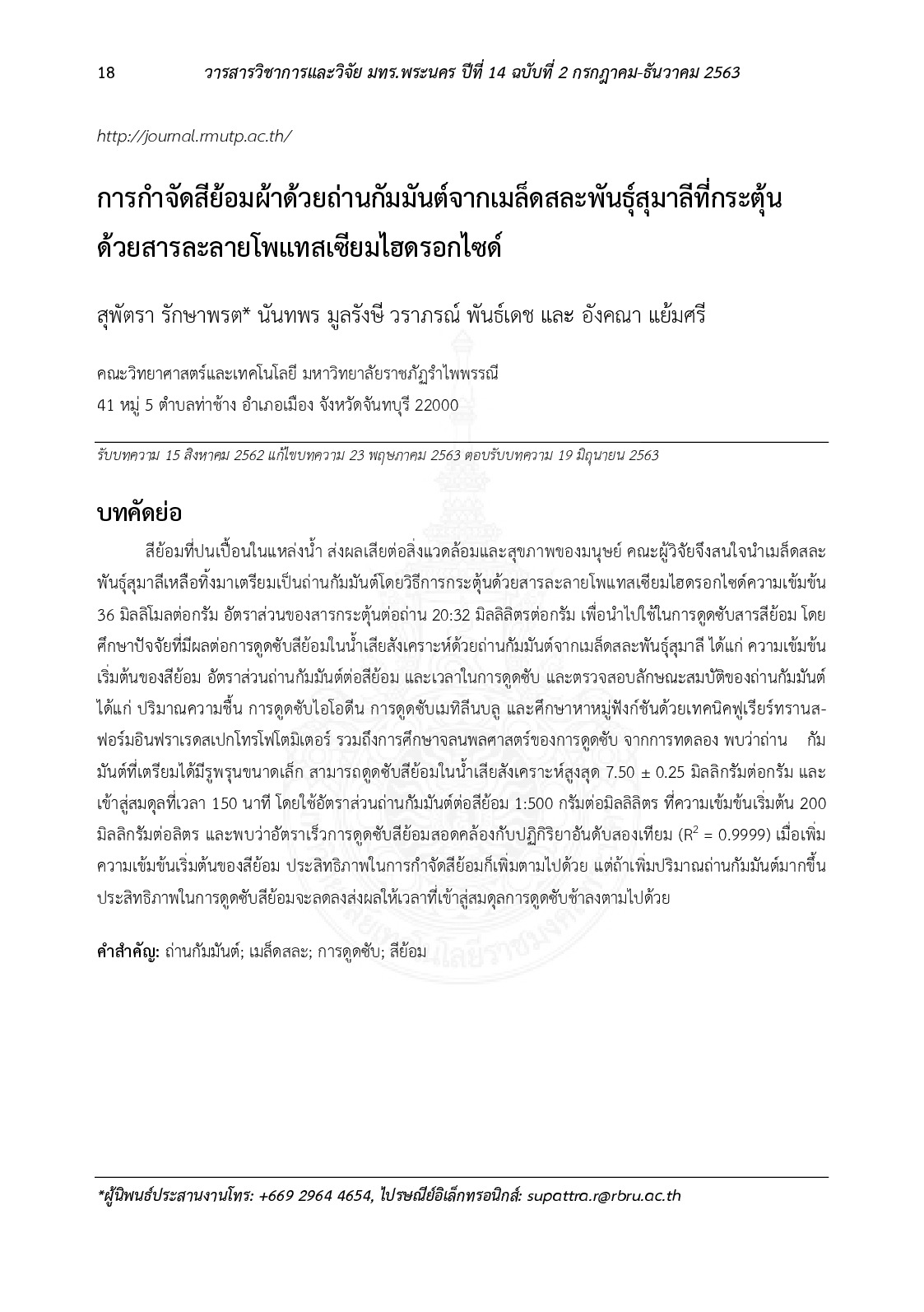
การกำจัดสีย้อมผ้าด้วยถ่านกัมมันต์จากเมล็ดสละพันธุ์สุมาลีที่กระตุ้น ด้วยสารละลายโพแทสเซียมไฮดรอกไซด์
Dyes contaminated in wastewater that negatively affecting the environment and human health. The objectives of this study to prepare activated carbon from Salacca zalacca (Sumalee) seeds activated by 36 mmol/g KOH dye solution and activated carbon ratio 20:32 ml/g for dye removal. The influents of dye removal from wastewater by Salacca zalacca (Sumalee) seeds activated carbon were investigated as initial dye concentration activated carbon and dye solution ratio and contraction time. The moisture content the iodine number the methylene blue index and the functional groups by FTIR technique of the Salacca zalacca (Sumalee) activated carbon were characterized and the kinetics adsorption were also analyzed. The results showed that the activated carbon was the microporous material the highest dye removal from wastewater was 7.50 ± 0.25 mg/g the equilibrium time was 150 min with the activated carbon to dye solution ratio of 1:500 g/ml for 200 mg/l initial concentration. The kinetics of the adsorption process can be described by a pseudo-second order model (R2 = 0.9999). When increasing the initial concentration of dyes the adsorption efficiency was increased. The amount of activated carbon increased resulting in lower adsorption efficiency and the equilibrium time was longer
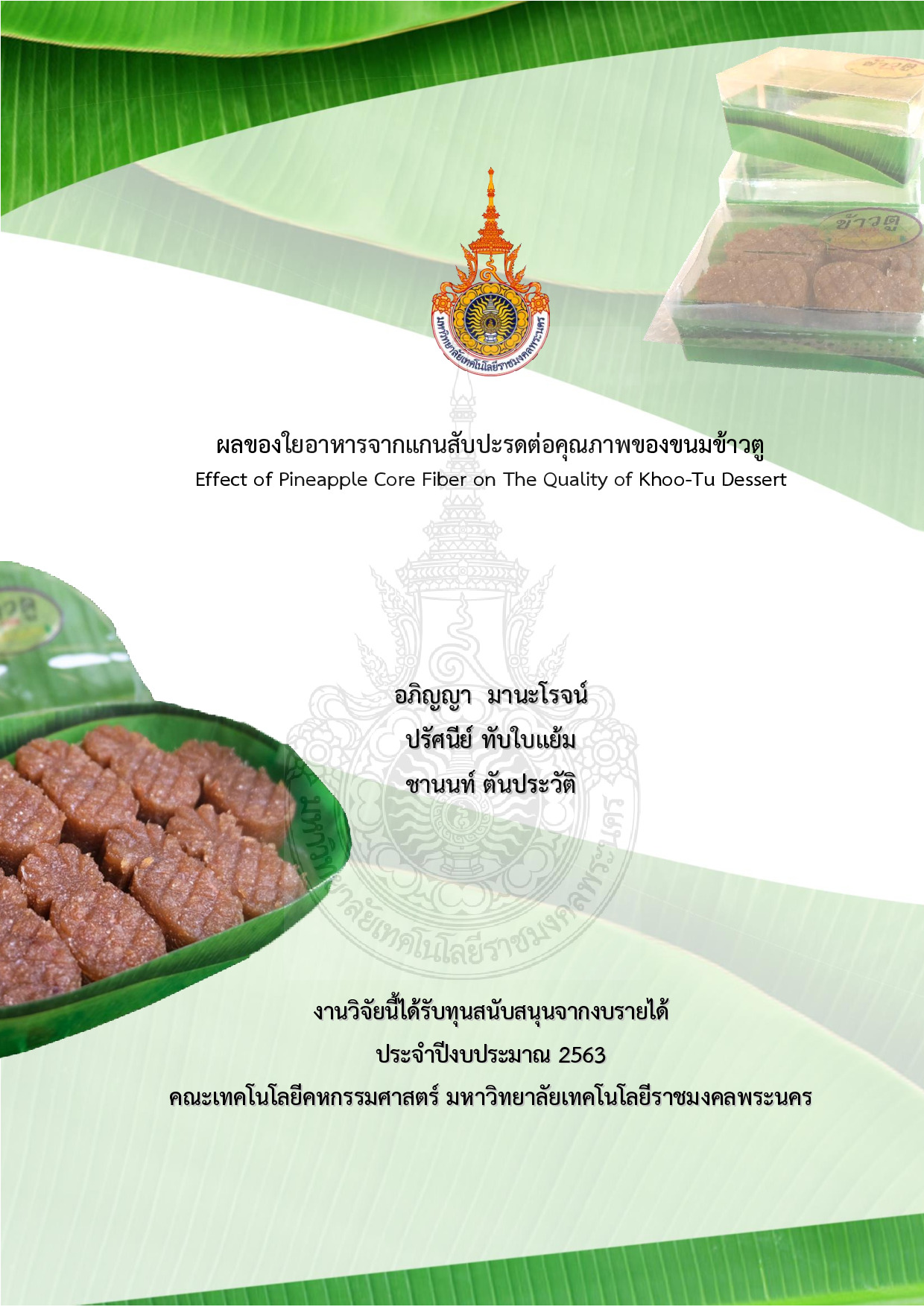
ผลของใยอาหารจากแกนสับปะรดต่อคุณภาพของขนมข้าวตู
These research objectives are to study the basic formulas of Khoo-Tu dessert (dried rice balls made from rice and coconut) and to study the volume of pineapple cores instead of coconut in Khoo-Tu. The test of Khoo-Tu dessert basic formulas by 9 - point hedonic scale method of 50 examiner laboratory the results show acceptance rated on a moderate scale (7). After that substituting coconut with pineapple core the amount of 0 25 50 75 and 100 of the weight coconuts.It was found that at 75% of the substitution level the tasters evaluated the greatest acceptance (p> 0.05). The basic formulas had a pH of 6.24 the Pineapple core formulas 5.94 (p> 0.05). Water Activity (aw)of Khoo-Tu the basic formula was 0.85 and the pineapple core formula was 0.90 (p> 0.05). The color value of the pineapple core Khoo-Tu was L * (brightness value) (37.31) b * (yellowness value) (9.45) rather than the basic formula Khoo-Tu (p> 0.05). The nutritional value of the pineapple core Khoo-Tu was 316 Kcals protein 2.71 % fat 8.86 % ash 0.52 % carbohydrates 56.3 % dietary fiber 3.99 % insoluble fiber 3.60 % and 0.39% of water-soluble dietary fiber that was found in the pineapple core Khoo-Tu to provide lower nutritional value than basic formula Khoo-Tu. The microbiological quality of basic formula and pineapple core formula was found that the total variable count fungi and bacillus serous were less than 10 colonies / 1 g sample and staphylococcus aurias were not found in both samples. The shelf life of rice (Room temperature) found that the basic recipe was 12 days and the pineapple core recipe It has a shelf life of 6 days. At chilled temperature (4 degrees Celsius) it was found that the basic formula and pineapple core formula had a shelf life of 25 days with all microorganisms less than 1 x 10⁴ colonies/sample 1 gram fungus less than 100 colonies /1 gram sample and All microorganisms and fungi exceeded the standard on the 28th day.