จำนวน Repository ( 16 )

การออกแบบเครื่องย้อมเส้นด้ายไหมและด้ายฝ้ายแบบกึ่งอัตโนมัติเพื่อพัฒนาผลิตภัณฑ์ชุมชน ศูนย์หัตถกรรมพื้นบ้านนาโพธิ์ บุรีรัมย์
The purposes of this research were to design and create dyed silk yarn and cotton yarn machine for community enterprises of Ban Na Pho woven group Na Pho district Buriram province. All materials were made of stainless steel and the principle of rotation of the yarn skein which was hung with spindle yarn inside the dye tank. Dyeing process began by mixing color tanks in the exterior size for diameter ๓๐๐ mm. Adjust the temperature inside the dye bag by the boiler was attached below. Using pump in dye tank for rotating the heat with stainless steel pipe in ๑๑/๒ inches and ๓ inches x ๑/๒ inches and the rectangular tank was ๖๐ cm. wide ๙๐ cm long and ๑๖๐ cm. high. It had ๕ mm. of plastic lid cover in front of and a channel that looked at the attachment of color yarn. The lid had ๒ levels adjustable lift spring lock and ๒-axis spindle yarn. It was triangular shaped drilled holes spray to ๑ mm. on the spindle with a diameter of ๑๕ cm. and ๖๐ cm. long rotating at ๑๐ rpm strength by using electric motor size ๐.๕ HP used ๒๒๐ volts. It could be rotated left and right with the gear ratios around ๒๐:๑ ๒ adjustable that were automatic with programming on the control box and simple pattern. the spray dyed paint had ๑ liter water pump to control pressure valve for opening and closing to dyed water flow regularly by the heat from the LPG gas with a head size of ๓๐ cm. and adjust the temperature up to ๑๒๐ Celsius degree. It was showed the temperature measurement of water dye with pressure gauge and temperature gauge. The efficiency of this dye can be dyed silk yarn and cotton yarn per ๕ kg. to ๑๐ kg. which was a medium-sized textile production to the local community enterprise and applied in the preparation of yarns before dying such as peeling glue and bleaching.
การออกแบบและพัฒนาผลิตภัณฑสิ่งทอด้วยเทคนิคการพิมพ์เส้นด้ายแบบซิลค์สกรีนจากสีธรรมชาติ
The project of design and development of textile product using wrap yarn printing with natural dyes by silk screen technique. The purpose of this study was to find out the silk screen printing technique for patterning on Ikat or Mud Mee textile. Due to the complicated Mud Mee process for patterning the design on Mud Mee textile silk screen printing was chosen because of its convenience and rapidity. Silk screen printed on warp yarn with dyed weft yarn created the plain weave pattern. Pattern design was inspired by the natural form of vortex. Such form was applied with silk screen printing technique with extract of natural dye from jackfruit heartwood. The research showed that the product interested the sample was home textile product by using for bedroom which designed using home textile design principle. Three tone of color were chosen for warp yarn by screen printing technique such as red colour from lac blue colour from natural indigo and yellow colour from jackfruit heartwood . Weft yarn were dyed with lac and natural indigo using cationic agent. The cationic agent using before mordanting along with dying by 5 g/l aluminum potassium sulfate (alum) which is the best result because the outcome colors were intense and bright like vermilion and natural indigo. The color extracted from jackfruit heartwood was used for silk screen printing process. Color extracted from jackfruit heartwoodwas in the form of powder color integrated with 4% sodium alginate. The viscosity was optimize for printing. Printed warp yarn was dried at 120 °C. Weaving in plain weave pattern which created the strength structure of textile. Mordants with alum showed bright and intense color. The fastness tests were at good to excellent level for producing home textile product for bedroom application. From the questionnaire it was found that the satisfaction of the sample were as follows 54% printing fabric by printing of warp yarn is similar to Mud Mee weaving 58% textile made by printed warp yarn showed the identity of Thai color tone using for printing 80% weaving pattern design inspired by the form of vortex was suitable 84 % plain textile was suitable for weaving in the form of vortex 64 % the composition of the whole pattern of the products was suitable 86% the color of the pattern was suitable 70% the color of the weft yarn was suitable with the color of the pattern 76 % the size of the products was fitting and 92 % the products were suitable for the purpose of using.
การพัฒนาชุดราตรีโดยการตกแต่งด้วยเทคนิคการสานจากเศษเส้นด้ายไหม เหลือทิ้ง ของกิจการผ้าไหมบ้านครัว เขตราชเทวี กรุงเทพมหานคร
The creation of nightgown decorated by woven silk yarn scrap from Baan Krua Cottage Industrial Village in Ratchathewi Bangkok Thailand. Objectives are: 1) to study the weaving technique using the silk yarn scrap 2) to design a nightgown decorated with woven silk yarn scrap and 3) to study the overall satisfaction of nightgown designs which utilize silk yarn scrap. The sample population in this research is 250 women found on Silom Road central Bangkok. The research instrument is a questionnaire with 9 prototype nightgowns decorated with woven silk yarn scrap. The collection consists of 3 sets one set with 3 short nightgowns another set with 3 long nightgowns and the last set with 3 short nightgowns with long tails. The research methodology is to hand out the questionnaire to 250 non-specific women on Silom Road. Data analysis is done by statistic percentage average and standard deviation. Results of studying the survey show that most of the sample populations are women age between 31 -35 years old with bachelor degrees or the equivalent. Most are married and work as state enterprise officers. Incomes are between 20001 - 30000 baht. Most of them have bought a silk nightgown before and chosen to buy at department stores. The reason that they do not prefer silk nightgowns is because most in the current market are not innovative enough. Most of the sample populations have never seen a nightgown decorated with woven silk yarn scrap before. The results of studying the satisfaction of the sample population found that for the short nightgown set most of the sample population prefer number 2 standard deviation is 4.48. For the long nightgown set most of the sample populations prefer number 2 standard deviation is 4.44. And for the short nightgown with long tail set most of the sample populations prefer number 2 standard deviation is 4.46.
การพัฒนาชุดราตรีโดยการตกแต่งด้วยเทคนิคการสานจากเศษเส้นด้ายไหม เหลือทิ้ง ของกิจการผ้าไหมบ้านครัว เขตราชเทวี กรุงเทพมหานคร
The creation of nightgown decorated by woven silk yarn scrap from Baan Krua Cottage Industrial Village in Ratchathewi Bangkok Thailand. Objectives are: 1) to study the weaving technique using the silk yarn scrap 2) to design a nightgown decorated with woven silk yarn scrap and 3) to study the overall satisfaction of nightgown designs which utilize silk yarn scrap. The sample population in this research is 250 women found on Silom Road central Bangkok. The research instrument is a questionnaire with 9 prototype nightgowns decorated with woven silk yarn scrap. The collection consists of 3 sets one set with 3 short nightgowns another set with 3 long nightgowns and the last set with 3 short nightgowns with long tails. The research methodology is to hand out the questionnaire to 250 non-specific women on Silom Road. Data analysis is done by statistic percentage average and standard deviation Results of studying the survey show that most of the sample populations are women age between 31 -35 years old with bachelor degrees or the equivalent. Most are married and work as state enterprise officers. Incomes are between 20001 - 30000 baht. Most of them have bought a silk nightgown before and chosen to buy at department stores. The reason that they do not prefer silk nightgowns is because most in the current market are not innovative enough. Most of the sample populations have never seen a nightgown decorated with woven silk yarn scrap before. The results of studying the satisfaction of the sample population found that for the short nightgown set most of the sample population prefer number 2 standard deviation is 4.48. For the long nightgown set most of the sample populations prefer number 2 standard deviation is 4.44. And for the short nightgown with long tail set most of the sample populations prefer number 2 standard deviation is 4.46.
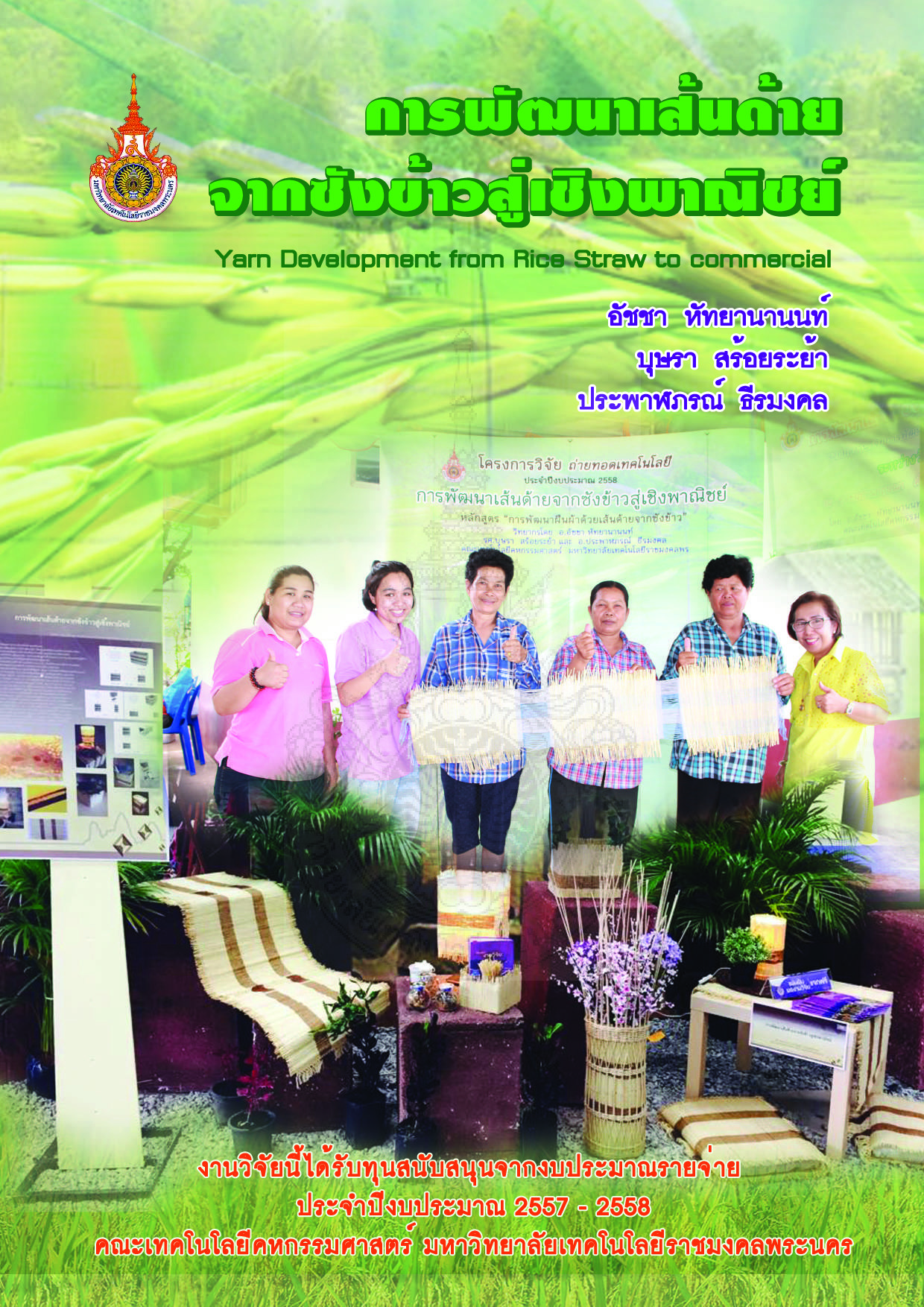
การพัฒนาเส้นด้ายจากซังข้าวสู่เชิงพาณิชย์
This research is Yarn Development from Rice straw to commercial. It aims to study the process of seperating fibers from rice straw. To study the physical properties of fibers from rice straw and to study the process of manufacturing yarn from rice straw fibers. The research material is rice straw fibers after that data was analyzed byphysical textile testing laboratory. The result of the first year’s research was the rice straw yarn has been developed as woven and develop into commercial products to promote. The process of separating fibers from rice straw which dried the sun for a few days. Selecting the rice straw fiber length at least 30 cm. to subtract the joints of the lower end of the stem by hand. peel off the rice straw fiber and place flat on a horizontal line. Then Rice straw fiber were tested in the physical laboratory was found that it is cellulose fibers tensile strength (Newton) at 28.18 elongation (percent) is at 2.01. The amounts of metals has plenty of CADMIUM at 0.1 mg/kg CHROMIUM (TOTAL) / (VI) at 0.5 mg/kg COPPER at 0.5 mg/kg and LEAD at 0.1 mg/kg which was not found to be risk for using. The fiber cross-section of rice straw fiber were found to be oval the middle is clearly. The fiber length is smooth and transparent when viewed from the side to see the clarity of the fiber. Rice straw fiber was weave in plain structure. Warp yarn uses a special brown cream and brown flat yarns. We use rice straw fiber with the same type of yarn. There are 2 warp yarn and using natural color without blench. Rice straw fabric was dyeing with dried hibiscus flowers (Kaa-Jeab herb) and mordant as ashes. The result is red light because of rice straw fiber surface is smooth and lustrous. Therefrom When woven as a fabric to develop be 4 products prototype : table lamps tablecloths in Japanese style potted plants and Accessories Box The result of the second year’s research there are focus group inquire for people it is interesting in this research and Date for transfer knowledge as: Ban-Krit-Sa- Na community Krit-Sa-Na sub-district bang-pra-ma district in Supanburi province. To plan the schedule and set the date place amount of participate and lectures 34 people The range of time to transfer as 3 days on 3 – 5 May 2015 and asking for consumer satisfaction of the curriculum and lecture for “transfer knowledge Yarn Development from Rice straw to commercial” by Questionnaire of participate satisfaction. Last the evaluation data was analyzed by using SPSS program in mean and percentage. The second year found that mostly participates were female aged under 21 years old finished the secondary school and also there are farmer. The participates are their income under 5000 baht and no income. For the participates questions relation to technology transfer of “Yarn Development from Rice straw to commercial” about course divided into 3 parts: The purpose The curriculum and The knowledge. The satisfaction of participates about project divided into 3 parts: Service process Lecturer and Facilities found that have been satisfied at maximum average and highest level of satisfaction in every parts of both satisfied participates questions. The participants are mainly used to provide benefits to themselves for one month to apply the gained after the training. Satisfaction with the benefits of technology transfer and utilization. Satisfaction at the highest level the participants used knowledge to apply with local and waste material. Moreover the participates make product as soon as finish course and they are planning to produce the table Hand Woven for weaving the Rice straw yarn fabric and push it to be OTOP products. The comments and suggestions of the participants found that they need for re-training again. They would like to have a longer period of training in order to gain more knowledge. All lecturer can transfer knowledge during the training as well.