จำนวน Repository ( 10 )
ปัจจัยการสื่อสารการตลาดที่ส่งผลต่อพฤติกรรมการซื้อนมเปรี้ยวพร้อมดื่มของผู้บริโภคในเขตกรุงเทพมหานคร
The objectives of the research were 1) to study the level of marketing mix factors marketing communication mix and mettle of mind factors towards consumer buying behaviors toward drinking yoghurt 2) to examine the level of drinking yoghurt buying behaviors of dwellers in Bangkok 3) to compare the demographic characteristics and drinking yoghurt buying behaviors of people living in Bangkok 4) to investigate the marketing mix that influenced Bangkok’s consumer behaviors in choosing drinking yoghurt 5) to study the marketing communication mix that affected consumer behaviors in purchasing drinking yoghurt of Bangkok residents and 6) to explore the mettle of mind factors which influenced consumer behaviors towards buying drinking yoghurt of people in Bangkok Metropolitan. A sample was identified by a number of 400 people who reside in Bangkok Metropolitan. The questionnaires were distributed to the selected respondents in order to collect data. The statistical methods used to analyze data were frequency percentage mean standard deviation t-test one-way analysis of variance and enter multiple regression analysis. 1. The results indicated the majority of female consumers accounting for 62.50 percent. The age range from 31 to 40 was responsible for 42.70 percent. The bachelor’s degree holders comprised 59.80 percent. The employees working in the private companies were found 61 percent. As much as 66 percent of the sample remained unmarried and 31.50 percent of the people earned an average monthly income from 15001 to 20000 baht. 2. The marketing mix factors the marketing communication mix and mettle of mind factors were prioritized in a high level. The consumer buying behaviors were in a high level. 3. The increase of marketing mix factors including product price and place resulted in a higher level of drinking yoghurt buying behavior. 4. The marketing communication mix including advertising public relations and sales promotion increased the level of drinking yoghurt buying behavior. 5. The mettle of mind factors particularly in the aspect of lifestyle and personality stimulated a higher level of drinking yoghurt buying behavior. 6. People with different age occupation average monthly income and marital status had different drinking yoghurt buying behaviors with statistical significance at level .05 while different gender and educational background showed no differences of the buying behaviors.
อิทธิพลของสารทดแทนไขมันที่มีผลต่อการเหลือรอดของเชื่อโพรไบโอติคในไอศกรีมดยเกิร์ต
Probiotic is a micro organism that is useful for human bodies and can help creating balances for human intestinal system. The objective of this research is to compare amounts of fat substitutes supplied in the industries in order to determine their ability to encapsulate Probiotic microbes in the production of yoghurt ice cream to ensure maximum survived Probiotic microbes. In this research two fat substitutes Purity SM 100 and CRYSTAL texTM 648 were used to substitute skim milk in the standard formulas in order to study numbers of survived Probiotic microbes and to test the sensory acceptance. For the sensory acceptance it was found that the Probiotic yoghurt ice cream containing 20% Purity SM100 is acceptable at the maximum significance (p ≤ 0.05) because its flavor and taste was better than other samples as well as the best overrun with statistical significant differences (p ≤ 0.05). However by addition of both fat substitutes at different concentrations pH values of Probiotic yoghurt ice cream products did not have statistical significant differences (p ≥ 0.05). When Lactobacilluss acidophilus Bifidobacterium and Streptococcus thermophilus microbial starters were added into the Probiotic yoghurt ice cream using both fat substitutes in place of skim milk at ratios of 10% 15% and 20% respectively under a storage condition of -20oC for 4 weeks it was found that types and amounts of fat substitutes affected the surviving rate of Probiotic microbes in the product with a statistical significance (p ≤ 0.05). The addition of fat substitutes Purity SM100 and CRYSTAL texTM 648 at all concentration levels made Probiotic microbes survive in the product which illustrated that both fat substitutes used in above experiments could encapsulate Probiotic microbe cells. The survived Probiotic microbes were in the range of 108 – 109 CFU/ml in comparison to the Probiotic yoghurt ice cream with the standard formula without the addition of fat substitutes that has survived Probiotic microbes of only 106 CFU/ml.
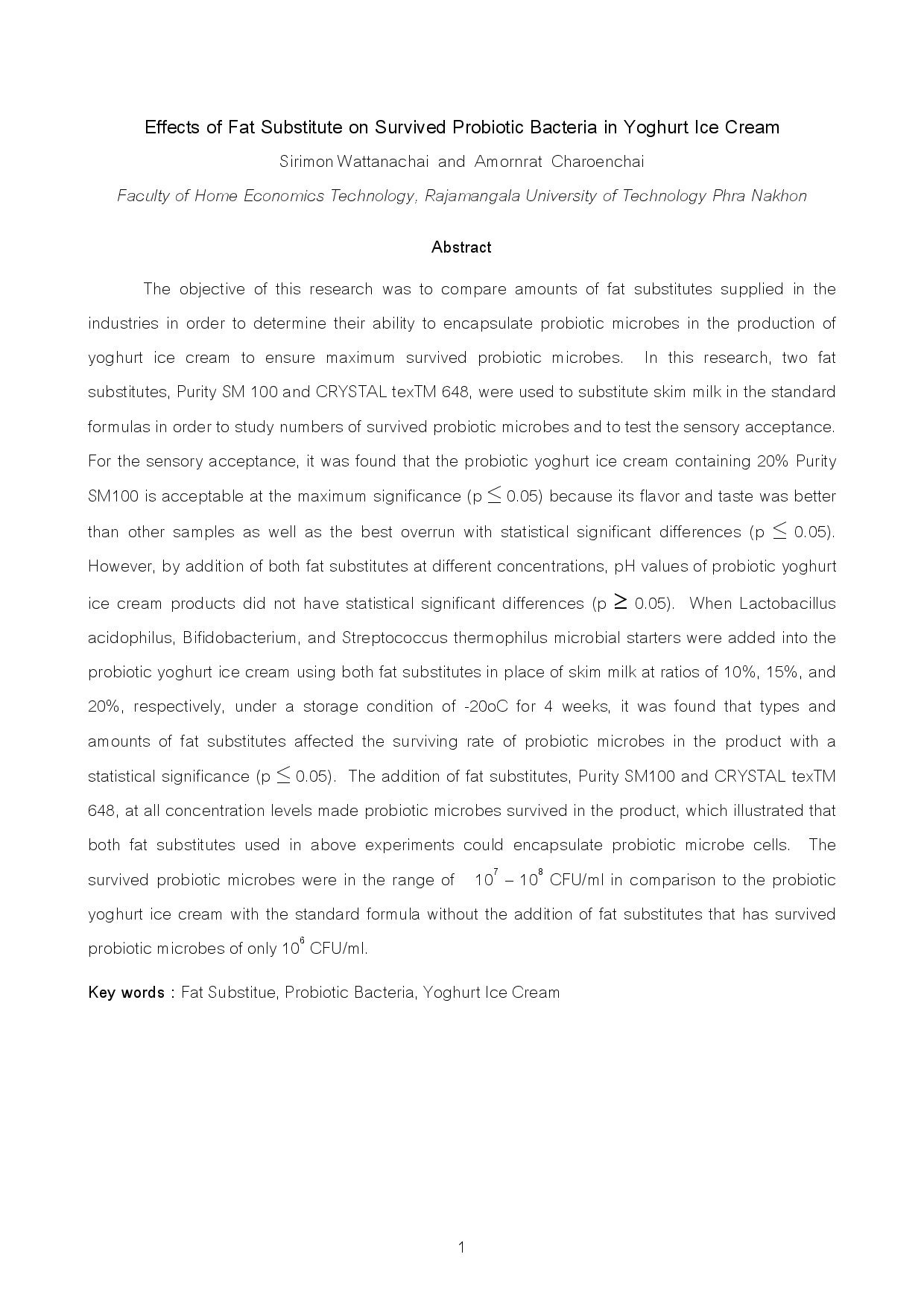
Effects of Fat Substitute on Survived Probiotic Bacteria in Yoghurt Ice Cream
The objective of this research was to compare amounts of fat substitutes supplied in the industries in order to determine their ability to encapsulate probiotic microbes in the production of yoghurt ice cream to ensure maximum survived probiotic microbes. In this research two fat substitutes Purity SM 100 and CRYSTAL texTM 648 were used to substitute skim milk in the standard formulas in order to study numbers of survived probiotic microbes and to test the sensory acceptance. For the sensory acceptance it was found that the probiotic yoghurt ice cream containing 20% Purity SM100 is acceptable at the maximum significance (p ≤ 0.05) because its flavor and taste was better than other samples as well as the best overrun with statistical significant differences (p ≤ 0.05). However by addition of both fat substitutes at different concentrations pH values of probiotic yoghurt ice cream products did not have statistical significant differences (p ≥ 0.05). When Lactobacillus acidophilus Bifidobacterium and Streptococcus thermophilus microbial starters were added into the probiotic yoghurt ice cream using both fat substitutes in place of skim milk at ratios of 10% 15% and 20% respectively under a storage condition of -20oC for 4 weeks it was found that types and amounts of fat substitutes affected the surviving rate of probiotic microbes in the product with a statistical significance (p ≤ 0.05). The addition of fat substitutes Purity SM100 and CRYSTAL texTM 648 at all concentration levels made probiotic microbes survived in the product which illustrated that both fat substitutes used in above experiments could encapsulate probiotic microbe cells. The survived probiotic microbes were in the range of 107 – 108 CFU/ml in comparison to the probiotic yoghurt ice cream with the standard formula without the addition of fat substitutes that has survived probiotic microbes of only 106 CFU/ml.
การพัฒนาผลิตภัณฑ์โยเกิร์ตลูกหนามแดง (มะม่วงหาวมะนาวโห่)
The development of Karanda Sundae-style set yogurt has the objectives to develop a formula for making Karanda yogurt and as a guide to the use of Karanda. To study the base formula of set yogurt and study amount of Karanda jam that is suitable for making Sundae-style yogurt and study the quality changing during yogurt storage at cold temperature (4ºC). From the results of the selection of basic formulas for set yogurt. It was found that the panelists liked yogurt which was prepared from 82 % pasteurized milk 9% skimmed milk powder 4.5% sugar and 4.5% plain yogurt. Next this selected yogurt recipe was developed to be a product of sundae-style set yogurt with Karanda jam. From sensory testing Karanda jam (65% Total soluble solids) at 15% of the total yogurt ingredients received a preference score of more than 10% and 20%. Karanda Sundae-style set yogurt has protein fat carbohydrate and fiber content 7.17 1.56 67.94 and 1.60% respectively. When stored at 4 ºC for 18 days Karanda Sundae-style set yogurt still maintains the good characteristics of set yogurt found a syneresis of whey and surface of the yogurt is slightly dry. The yogurt has a pH at 3.65 with a lactic acid content of 0.92% the amount of anthocyanin has changed slightly. And microbial quality still has the number of lactic acid bacteria in accordance with the standard criteria of the type of yogurt that still contains live microorganisms
การพัฒนาผลิตภัณฑ์ไอศกรีมโยเกิร์ตเสริมว่านหางจระเข้
Ice cream is a kind of sweets that is popular worldwide. For years ice cream has been continuously developed to meet various consumer satisfactions. Nowadays people are more concerning about health. Ice-cream is then added with some herb into ingredients to build more nutrition and to be healthy. Aloe Vera is a plant full of water containment. It also heals wound of fire hot water scalds persistent wound and appetite wound. Moreover Aloe Vera has its potential to instant product development in the forms of medicine food and cosmetics. The development purpose of yogurt ice cream with Aloe Vera added is to study the proper quantity of Aloe Vera in the yogurt ice cream along with the quality of Yogurt ice cream with Aloe Vera added product throughout the consumer’s satisfactions of the product as well. After the study of Aloe Vera chemical properties it indicates that each 100 grams of Aloe Vera has 3.20 kcal of energy 0.80 percent of carbohydrate less than 1.25 percent of protein 0.20 percent of ashes 99.0 percent of humidity and 0.64 percent of fiber. The study of production process indicates that the proper quantity of yogurt and Aloe Vera to add in the product of yoghurt ice cream with Aloe Vera added are yogurt at 60 percent and Aloe Vera at 50 percent. The study of physical side of quality indicates that the yogurt ice cream with Aloe Vera added has an increasing viscosity rate up to 1525 cps. color level at L* 91.98 a* -0.48 b* 14.28 infusible solid at 26.4 brix degrees. The melting rate of yoghurt ice cream with Aloe Vera added is at 67.90 and overrun rate is at 72.76. The study of chemical properties show that each 100 grams of yogurt ice cream with Aloe Vera added gives 147 kcal of energy 15.4 percent of carbohydrate 2.04 of protein 8.55 percent of fat 73.6 percent of humidity 0.42 percent of fiber and 0.46 percent of ashes. After proceeding yoghurt ice cream with Aloe Vera added to consumer test to research consumer’s satisfactions and to study marketing tendency for sale the target group is general amount of 200 persons. The study shows that the acceptance of consumer is in the level of high to highest.