จำนวน Repository ( 34 )
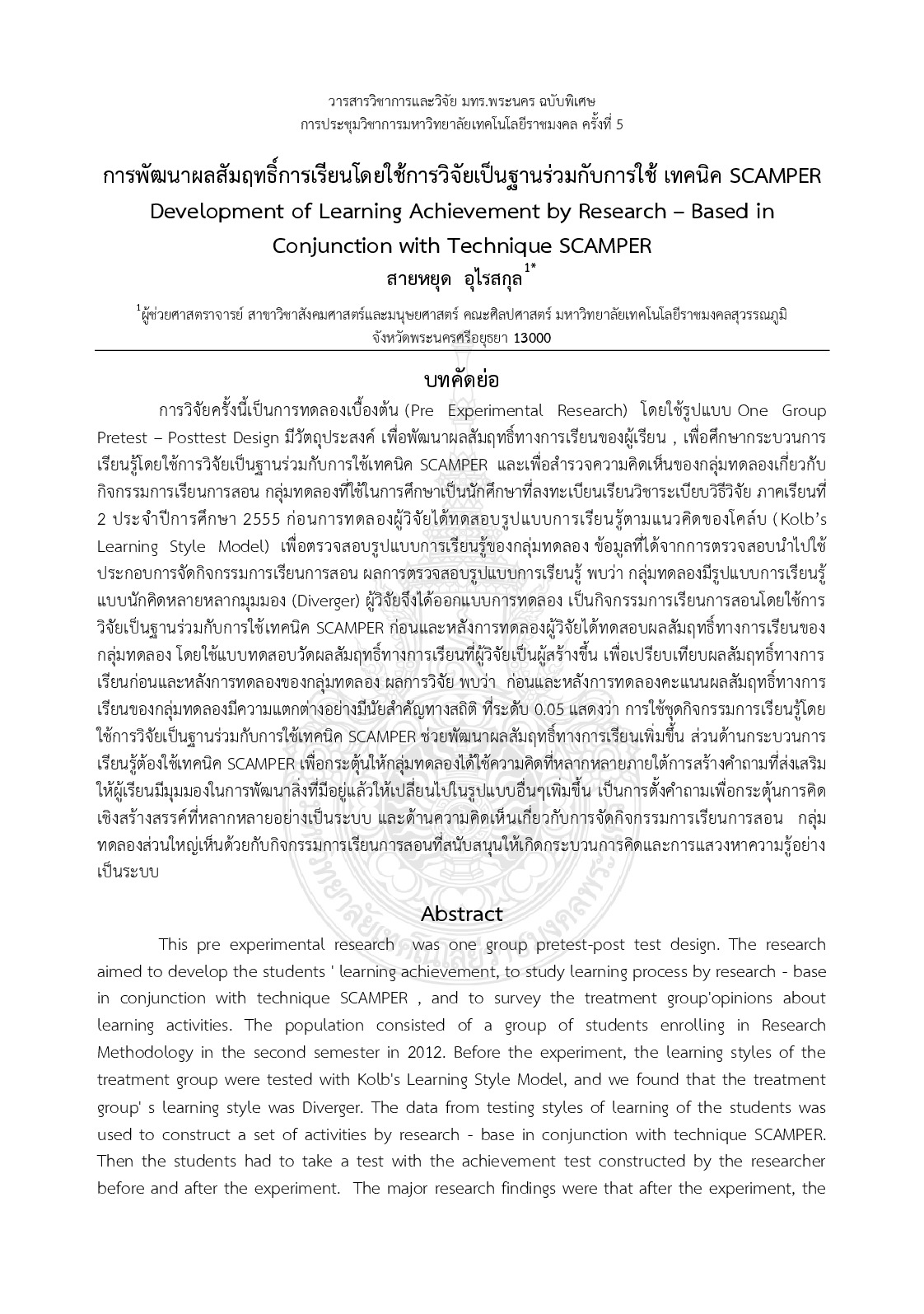
Development of learning achievement by research – based in conjunction with technique SCAMPER
This pre experimental research was one group pretest-post test design. The research aimed to develop the students learning achievement to study learning process by research - base in conjunction with technique SCAMPER and to survey the treatment groupopinions about learning activities. The population consisted of a group of students enrolling in Research Methodology in the second semester in 2012. Before the experiment the learning styles of the treatment group were tested with Kolbs Learning Style Model and we found that the treatment group s learning style was Diverger. The data from testing styles of learning of the students was used to construct a set of activities by research - base in conjunction with technique SCAMPER. Then the students had to take a test with the achievement test constructed by the researcher before and after the experiment. The major research findings were that after the experiment the scores of the treatment group were significantly different at level 0.05 therefore; we concluded that the qualified set of the learning activities by research - base in conjunction with SCAMPER was able to develop the students learning achievement. In the part of learning process the technique SCAMPER was used to promote the students different views and ideas by asking questions which encouraged students to create their thinking systematically. In the students opinions about learning activities most of them strongly agreed with this technique which contributed to the thinking process and the systematic pursuit of knowledge.
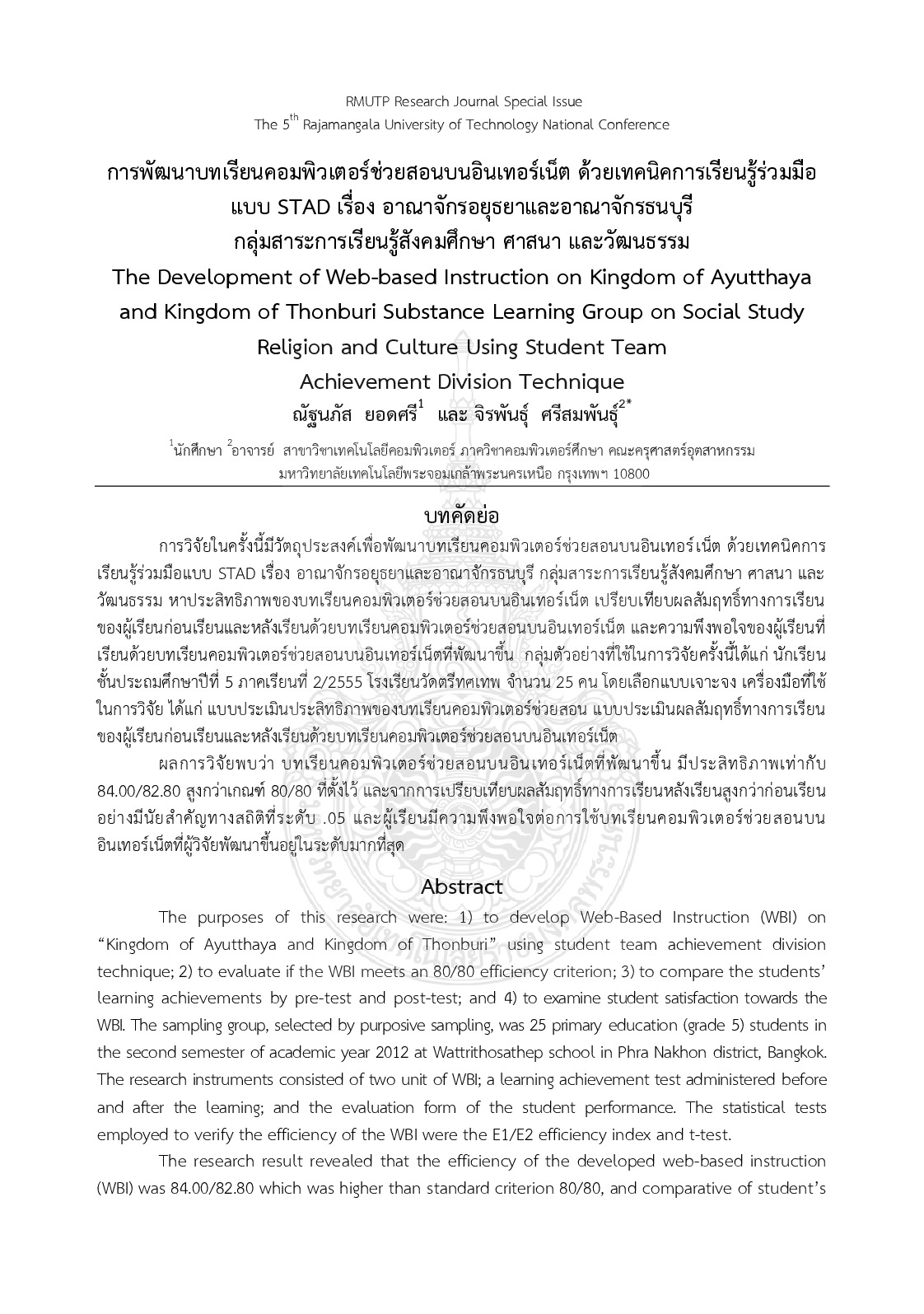
The development of web-based instruction on kingdom of ayutthaya and kingdom of thonburi substance learning group on social study religion and culture using student team achievement division technique
The purposes of this research were: 1) to develop Web-Based Instruction (WBI) on “Kingdom of Ayutthaya and Kingdom of Thonburi”กusing student team achievement division technique; 2) to evaluate if the WBI meets an 80/80 efficiency criterion; 3) to compare the students’ learning achievements by pre-test and post-test; and 4) to examine student satisfaction towards the WBI. The sampling group selected by purposive sampling was 25 primary education (grade 5) students in the second semester of academic year 2012 at Wattrithosathep school in Phra Nakhon district Bangkok. The research instruments consisted of two unit of WBI; a learning achievement test administered before and after the learning; and the evaluation form of the student performance. The statistical tests employed to verify the efficiency of the WBI were the E1/E2 efficiency index and t-test. The research result revealed that the efficiency of the developed web-based instruction (WBI) was 84.00/82.80 which was higher than standard criterion 80/80 and comparative of student’s achievement it was found that the student achieved learning progress significantly level of .05. Finally it was found that the learners opinion after using the developed web-based instruction (WBI) was very satisfactory.
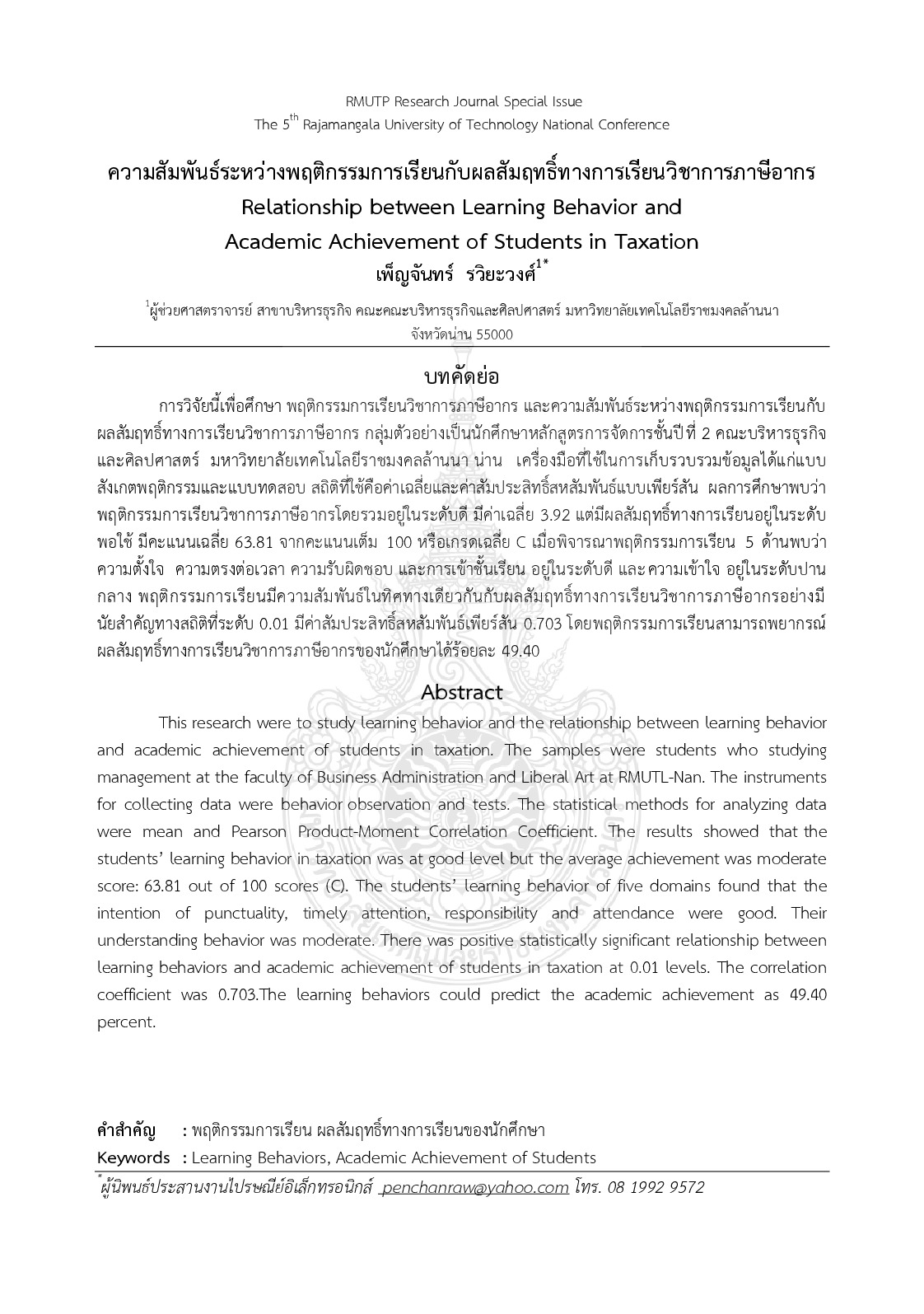
Relationship between learning behavior and academic achievement of students in taxation
This research were to study learning behavior and the relationship between learning behavior and academic achievement of students in taxation. The samples were students who studying management at the faculty of Business Administration and Liberal Art at RMUTL-Nan. The instruments for collecting data were behavior observation and tests. The statistical methods for analyzing data were mean and Pearson Product-Moment Correlation Coefficient. The results showed that the students’ learning behavior in taxation was at good level but the average achievement was moderate score: 63.81 out of 100 scores (C). The students’ learning behavior of five domains found that the intention of punctuality timely attention responsibility and attendance were good. Their understanding behavior was moderate. There was positive statistically significant relationship between learning behaviors and academic achievement of students in taxation at 0.01 levels. The correlation coefficient was 0.703.The learning behaviors could predict the academic achievement as 49.40 percent.
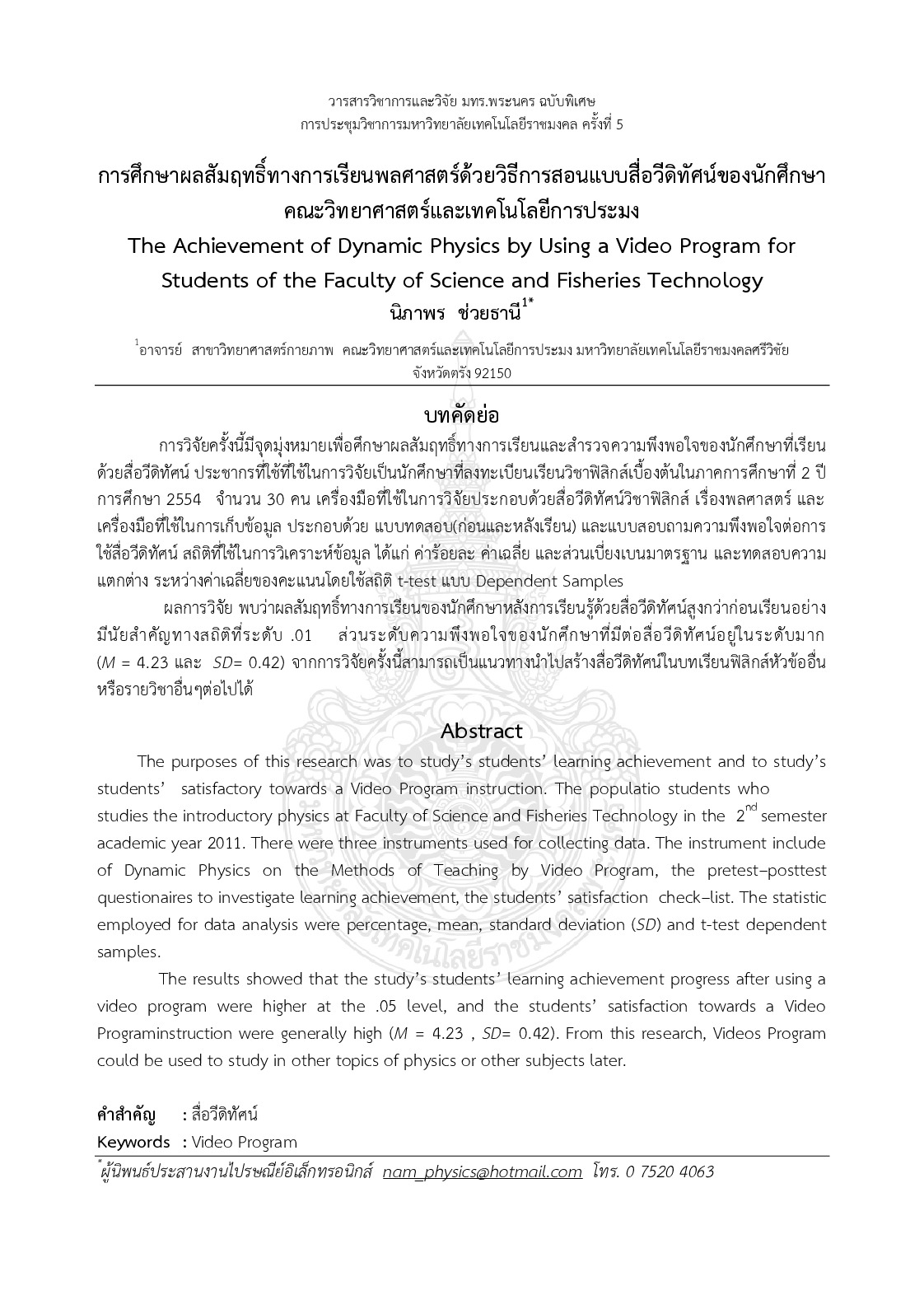
The achievement of dynamic physics by using a video program for students of the faculty of science and fisheries technology
The purposes of this research was to study’s students’ learning achievement and to study’s students’ satisfactory towards a Video Program instruction. The population of 30 students who studies the introductory physics at Faculty of Science and Fisheries Technology in the 2nd semester academic year 2011. There were three instruments used for collecting data. The instrument include of Dynamic Physics on the Methods of Teaching by Video Program the pretest–posttest questionaires to investigate learning achievement the students’ satisfaction check–list. The statistic employed for data analysis were percentage mean standard deviation (SD) and t-test dependent samples. The results showed that the study’s students’ learning achievement progress after using a video program were higher at the .05 level and the students’ satisfaction towards a Video Programinstruction were generally high (M = 4.23 SD= 0.42). From this research Videos Program could be used to study in other topics of physics or other subjects later.

การพัฒนาผลสัมฤทธิ์ทางการเรียนวิชาแคลคูลัส 1 สำหรับวิศวกรมด้วยการสอนเสริมคณิตศาสตร์พื้นฐาน
This research aims to solve the basic knowledge problems of undergraduate students who study Calculus 1 for Engineers in the Faculty of Engineering Rajamangala University of Technology Phra Nakhon. Basic Mathematics tutorials are conducted in order to improve their knowledge which leads to increase the efficiency of learning the Calculus 1 for Engineers. The basic mathematics lessons are designed and their efficiency is assessed in the tutored group using the 60/60 criteria. The pretest and posttest are assigned to both tutored and tutorless groups as well as the tutored student satisfactions with thedesigned lessons and the Calculus 1 for Engineers are conducted. The result shows that the efficiency of the designed lessons is 76.60/64.67 which is higher than the criteria; hence they are proper to be used. For the treatment group the posttest grades are higher than the pretest grades significantly (.05) with the effectiveness of 34.67. The comparison of the learning achievement for the Calculus 1 for Engineers shows that the grades of the tutored group are higher than the grades in the tutorless group significantly (.05) as well. The student satisfactions for both the designed lessons and the Calculus 1 for Engineers are at the levels of good and very good.